Authentic Travel Experiences for Groups: A Planner's Guide
September 11, 2026·MyPerfectStay
Seven friends have booked a long weekend in Marrakech. One wants a cooking class, another wants a mountain walk, two want a market and museum day, and the nightlife crowd is already sharing rooftop bars. Someone asks, “What feels authentic?” The group chat goes quiet, because everyone has a different answer.
That question doesn't need another abstract definition. It needs a decision process. The practical method is survey, vet, vote, book, verify, with each traveler stating what local connection means to them before one organizer turns personal preference into a final itinerary.
Table of Contents
- Why Groups Struggle With Authentic Travel Experiences
- What Authentic Travel Experiences Actually Mean in 2026
- Researching Authentic Travel Experiences Before You Book
- Turning Different Definitions of Authentic Into One Group Plan
- Vetting Activities for Safety, Ethics, and Local Benefit
- Sample Authentic Group Itineraries Across Europe and MENA
- Your Repeatable Authentic Travel Workflow
Why Groups Struggle With Authentic Travel Experiences
The disagreement starts with the word itself. One traveler means eating food prepared by residents. Another means learning a traditional craft. A third wants a story-rich walk through an old neighborhood, while someone else wants time away from famous landmarks and crowds. Each definition may come from Instagram, a guidebook, a family story, or a previous trip.
The first message in the group chat usually creates more noise than clarity. Cooks propose a market-to-table class, hikers suggest a countryside route, museum people share galleries, and nightlife seekers post bars. Nobody creates a shortlist, so the group keeps discussing options without moving toward a decision.
Four failure modes appear repeatedly:
- The vague group chat: Everyone shares links, but no one compares the activities using the same criteria.
- The silent organizer: One person filters the options privately, often removing activities that don't match their own idea of authenticity.
- The staged experience: A listing uses words such as “local,” “traditional,” or “hidden,” but delivers a fixed performance designed for tourists.
- The post-trip regret: A member feels their cultural, social, physical, or personal priorities were ignored.
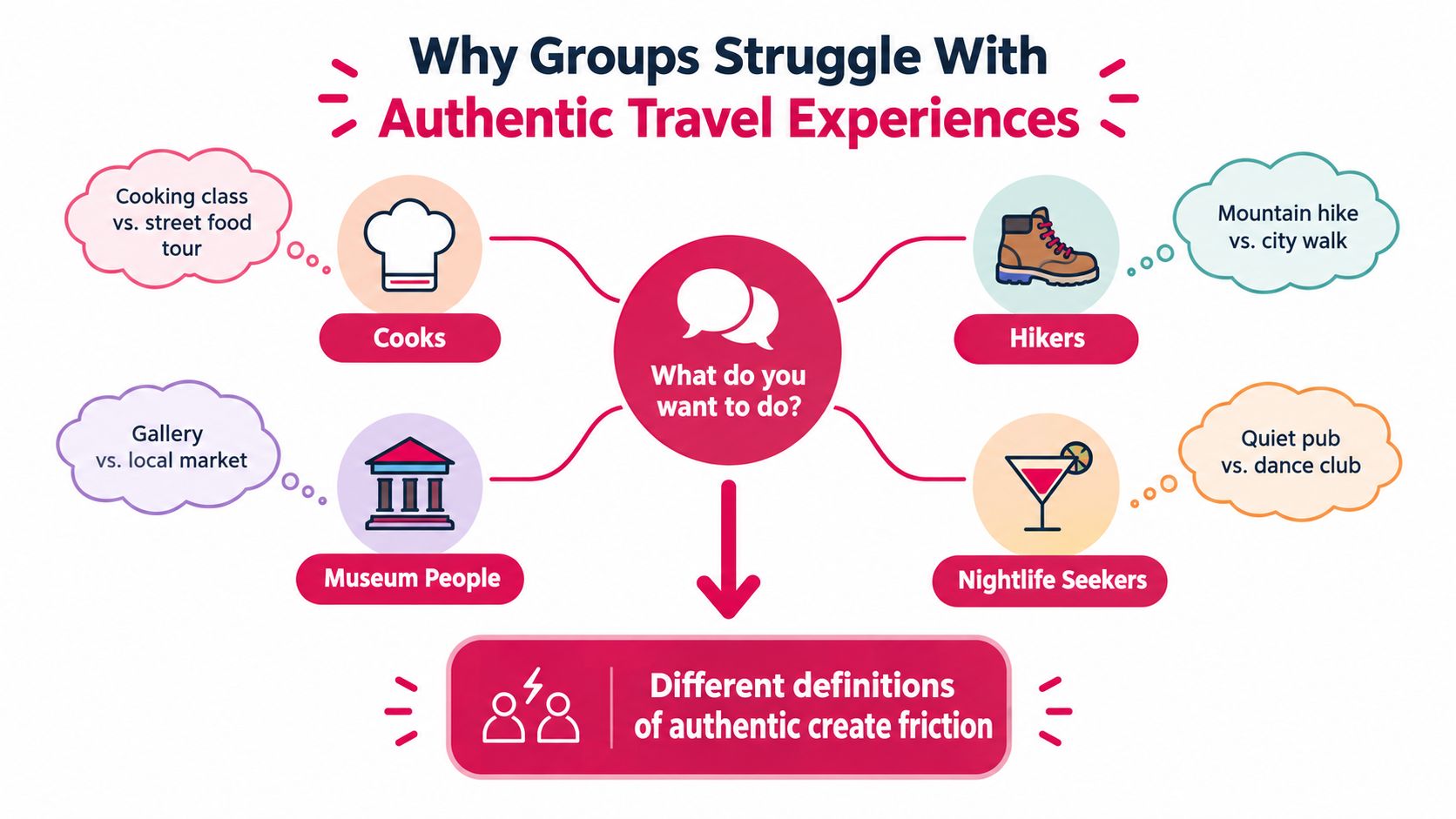
Planner's rule: Don't ask a group to agree on the meaning of “authentic.” Ask each person to score the elements they value, then compare the results.
A repeatable workflow solves the problem without pretending everyone's preferences are identical. Use a private survey to capture priorities, build a vetted shortlist, open a ranked vote, review the match outcome, book the winner, and verify the details when you arrive.
That approach protects minority preferences too. A food crawl might win overall while a hiking enthusiast still gets a meaningful local walk on another day. The point isn't to make every activity perfect for everyone. It's to make the trade-offs visible, fair, and bookable.
What Authentic Travel Experiences Actually Mean in 2026
Travelers now use “authentic” to describe experiences connected to local culture, active participation, personal meaning, and human contact. A survey of 1,000 U.S. leisure travelers, commissioned by GetYourGuide and run in late October 2022 ahead of the 2023 season, found that 90% made experiencing a destination as locals do a priority, while 95% preferred to spend at least part of their trip on new and unique experiences, ideally about 3 hours a day. The same GetYourGuide travel trends research found that 62% considered a trip wasted without local culture and 45% worried their trips weren't authentic.
A separate 2026 industry summary on authentic travel reported that 75% of travelers actively seek culturally authentic experiences and 69% want their spending to benefit local communities. That combination matters. Travelers aren't only asking whether an activity feels different. They're asking who hosts it, what they learn, and whether their money supports the place they visit.
Use four dimensions when evaluating an activity:
- Local culture: Is the experience rooted in a particular community, place, tradition, or daily practice?
- Involvement: Do travelers make, learn, walk, cook, ask, practice, or contribute instead of watching?
- Meaningfulness: Will participants leave with a skill, story, deeper understanding, or tangible reminder?
- Social interaction: Do travelers meet residents in a natural setting, rather than listen to a guide recite a script?
| Experience Type | Local Culture | Involvement | Meaningfulness | Social Interaction |
|---|---|---|---|---|
| Cooking class | High | High | High | High |
| Homestay | High | Medium | High | High |
| Hike with a local guide | Medium to high | High | High | Medium to high |
| Generic landmark bus tour | Medium | Low | Medium | Low |
| Fixed-script souk walk | Medium | Low | Low to medium | Low |
A cooking class usually scores well because travelers handle ingredients, hear food stories, and interact with the host. A homestay can connect visitors to daily life and create personal meaning, while a hike with a local guide combines movement, explanation, and conversation.
For a broader foundation, read UN Tourism's criteria for sustainable tourism development, which ask operators to respect the socio-cultural authenticity of host communities and to distribute economic benefits fairly. Those two tests matter most when an activity claims to support residents. A crowded souk walk with hourly departures, identical photo stops, and a memorized script may carry a local label, but it scores weakly across all four dimensions.
Researching Authentic Travel Experiences Before You Book
Start with sources that understand the destination from the inside. Regional destination management organizations, community tourism platforms, locally owned operators, and recommendations from small guesthouse owners often reveal stronger options than a generic search page. A hotel host in Lisbon may know a family-run tile workshop that never appears beside mass-market excursions, while a riad owner in Marrakech may know which medina walks are led by residents rather than imported guides. Posts from residents and niche local accounts on social media can surface the same names, provided you treat the images as leads to verify rather than as evidence.
Search broadly first, then read every listing as if you're checking a supplier for a group booking. Look for a named host, a precise meeting point, a clear activity description, group-size information, pricing, cancellation terms, and a direct way to contact the local provider.
Watch for these warning signs:
- Stock photography: The images show anonymous models, famous landmarks, or polished scenes that don't identify the actual host or venue.
- Hourly “traditional shows”: A cultural performance repeats on a rigid schedule with no explanation of who performs it or how workers are paid.
- No host name: The listing sells a destination but doesn't identify the person or organization delivering the experience.
- Weak cancellation terms: The reseller explains its policy but provides no clear conditions from the local operator.
- Generic reviews: Travelers praise the guide's friendliness but say little about what they did, learned, or encountered.
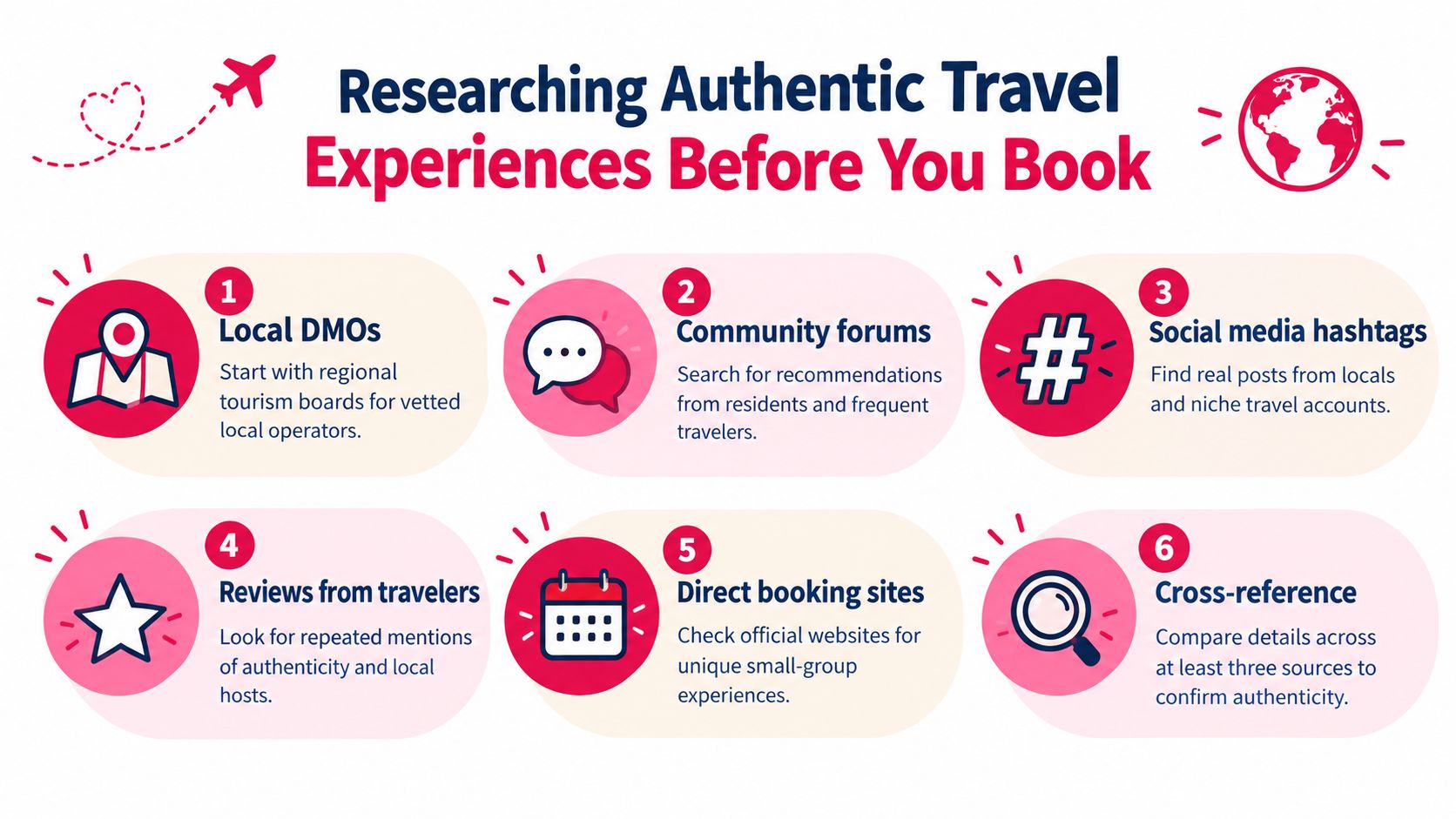
Cross-check the activity before putting it to a vote, comparing details across at least three independent sources. Search the host's name, the neighborhood, and recent local coverage. Confirm that the venue still operates, the route is current, and the business hasn't changed ownership or moved. If one source calls a workshop community-run but the operator's own page describes a commercial demonstration, record the discrepancy.
Each researcher should submit a one-page dossier. Keep the format identical so the group compares activities rather than presentation quality.
- Activity: Exact name and short description.
- Host: Person, business, cooperative, or venue responsible.
- Location: Meeting point and approximate travel time.
- Cost: Price per person and what it includes.
- Capacity: Maximum group size and any minimum booking requirement.
- Dimension score: Ratings for local culture, involvement, meaningfulness, and social interaction.
- Red flags: Missing information, staged elements, access concerns, or unclear local benefit.
Aim for five to seven candidates before the vote. Fewer options can make the decision feel forced. Too many options return the group to the original chat problem.
Untold Italy's podcast episode on new ways to research a trip is a useful prompt for deciding what your group should investigate before booking, even when your destination isn't Italy.
Turning Different Definitions of Authentic Into One Group Plan
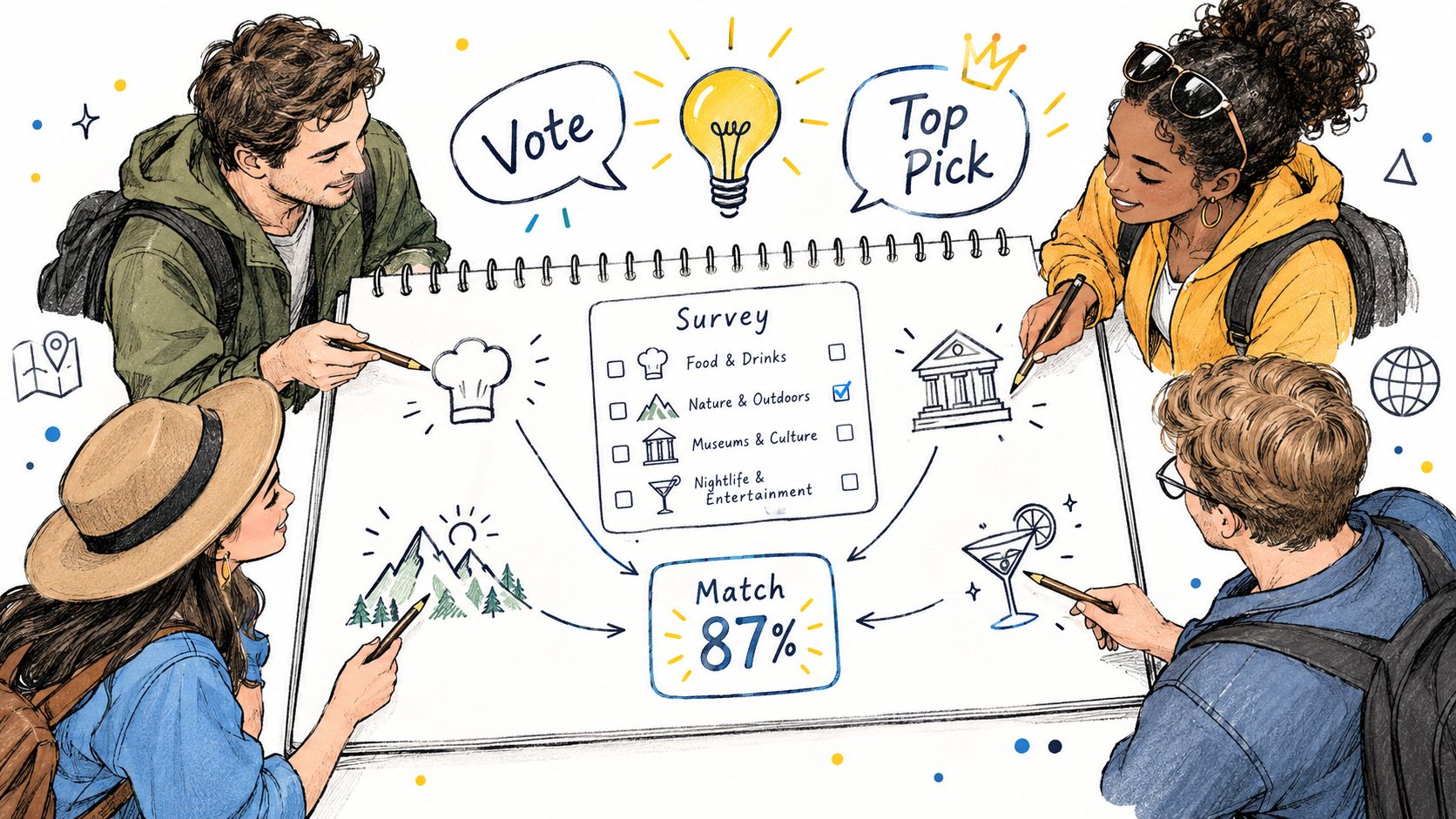
The cleanest group decision starts before anyone shares links. Build a private survey with six to eight questions, and make every answer useful for the final selection.
Ask each traveler to rank the four dimensions, local culture, involvement, meaningfulness, and social interaction. Then collect a per-person budget ceiling and hard constraints such as mobility needs, dietary requirements, photography restrictions, language preferences, and maximum walking tolerance. Add one open question: “What would make this experience feel personally worthwhile?”
MyPerfectStay can host this process through a survey builder, ranked voting, match scores, and a booking flow that carries the selected activity into the group plan. Use it as the coordination layer, not as a substitute for researching the operator.
Consider a Marrakech group choosing between three candidates:
- A hidden-medina food crawl, with market visits and tastings at small food businesses.
- A cooperative-run argan workshop, focused on production, local livelihoods, and hands-on learning.
- A Berber music evening at a family riad, centered on conversation, performance, and shared food.
The food crawl may lead on local culture and involvement. The argan workshop can rank highest for meaningfulness and community benefit. The music evening may win social interaction, especially for travelers who value conversation more than structured activity.
The survey should expose those differences rather than flatten them. A match-score output can show the overall alignment, while individual responses reveal who strongly supports each option and why. That lets the group choose a food crawl without dismissing the traveler who wanted a community-led workshop. The workshop can become a second-day option, or the group can select the riad evening if social connection is the shared priority.
Handling a tie: Ask tied options to answer one final question, “Which activity would be hardest to replace in this destination?” Use that answer as the tiebreaker, not the organizer's personal preference.
Weighting can also reflect commitment. If one traveler has organized the day, arranged transport, or agreed to participate in the full activity, the survey can record that commitment. Don't use it to silence other votes. Use it to distinguish a genuine tie from casual interest.
Once the group approves the winner, export the activity into the booking flow, attach the agreed budget and constraints, and send the confirmation to every traveler. For a useful companion on structured group decisions, see the group decision-making tool.
Vetting Activities for Safety, Ethics, and Local Benefit
A polished listing isn't proof of a good experience. Run every shortlisted activity through the five checklist layers below before it reaches the vote, marking each layer pass or fail. Pass all five and the activity is bookable; any fail and it should be replaced. Then add the group-fit check, which no checklist can make for you.
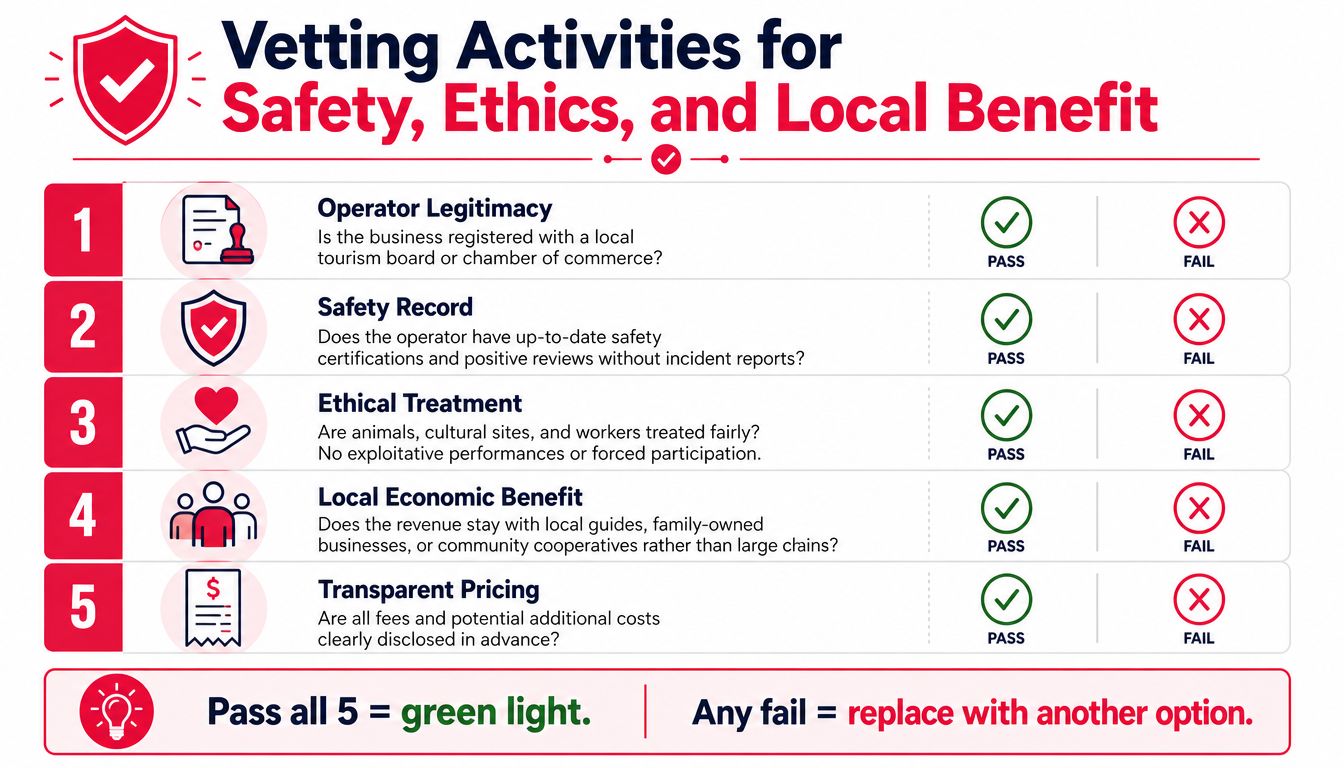
Operator legitimacy
Pass the activity when the business is identifiable, locally established, reachable, and supported by verifiable reviews that discuss the actual activity. A clear provider name matters. Fail it when the listing hides the operator, uses imported guides instead of residents, or can't explain who receives the booking revenue.
Safety record
Ask for the group-size cap, emergency contact, insurance information, meeting instructions, and route details. For hikes, check fitness demands and access to medical help. For water or adventure activities, confirm equipment, supervision, weather procedures, and cancellation rules. An operator that refuses basic safety information fails.
Ethical treatment
Check whether hosts, workers, animals, and cultural sites receive respectful treatment. A performance that pressures residents to act out a stereotype fails the ethical layer. Photography should involve consent, not automatic access. An activity that forbids photography entirely without explaining the reason also fails the consent check, because the operator hasn't provided a workable, respectful policy.
Local economic benefit and sustainability
Ask how the activity manages group size, waste, transport, and pressure on the neighborhood. A family business, cooperative, or resident-led organization may offer clearer local ownership than a chain, but don't assume. Verify the claim. If the operator can't explain where money goes or how it limits disruption, replace it.
Transparent pricing
Ask for the price per person, what it includes, what costs extra, the deposit and cancellation terms, and whether any mandatory fee is collected on the day. Fail the activity when a headline price turns into compulsory extras at the meeting point, or when the operator won't put the total in writing before the group commits.
Group fit
A culturally valuable experience can still be wrong for the group. Check accessibility, age range, fitness level, language support, dietary accommodation, religious sensitivity, and timing. A steep walk isn't a good choice for a group member who can't manage it, and an activity requiring extended standing may exclude someone who wasn't consulted.
Record each pass or fail in the booking record. Add the host's name, safety contact, agreed meeting point, consent policy, accessibility notes, and the reason the group selected the activity. If someone questions the decision later, the record should show the evidence rather than a vague memory from the chat.
Sample Authentic Group Itineraries Across Europe and MENA
A good workflow changes the result according to the group, not according to a fixed list of “must-do” attractions. Paris offers a useful example because the city attracts enormous demand. The regional tourist board's review of the 2023 season in Paris Île-de-France counted 21.6 million international visitors, up 11% on 2022, inside a total of more than 47.5 million tourists. A group that wants local contact needs to look beyond a standard landmark circuit.
Four friends rank hands-on participation and local culture highest. Their Paris shortlist includes a market-to-table cooking class in the 11th arrondissement, a small-group Seine sampan outing with a working bargeman, and an after-hours Louvre visit led by an art-history PhD. The cooking class wins because it gives the group a shared task, a neighborhood setting, and a meal they understand rather than photograph.
A multi-generational family of seven in Lisbon ranks meaningfulness and gentle pacing above novelty. Their winning sequence is a tile-painting workshop with a third-generation azulejo maker, a tram-and-pastéis walking route with regular pauses, and an evening fado house run by a vetted family venue. The survey prevents the most active travelers from turning the day into a long walking challenge.
A corporate offsite of twelve in Marrakech prioritizes social interaction and ethical depth. The group selects a cooperative-led weaving morning in the Ourika valley, a shared tagine lunch prepared by a women-run catering collective, and a guided night medina walk ending with non-commercial rooftop tea at the guide's family home. The organizer checks capacity, transport, consent, and payment arrangements before booking.
For destination-specific planning, use this practical guide to things to do in Marrakech, then apply the same survey and vetting discipline rather than copying a generic itinerary.
| Group Type | Destination | Top-Ranked Dimension | Signature Activity | Booking Outcome |
|---|---|---|---|---|
| Four friends | Paris | Involvement | Market-to-table cooking class | Booked as the shared anchor activity |
| Multi-generational family | Lisbon | Meaningfulness | Tile-painting workshop | Selected with pacing and access checks |
| Corporate offsite | Marrakech | Social interaction | Cooperative-led weaving morning | Booked after capacity and ethics review |
The same method produces three different outcomes. That is the point. Authenticity isn't a destination category that every traveler experiences identically. It is a set of priorities converted into a practical group choice.
Your Repeatable Authentic Travel Workflow
Save the process as a checklist and rerun it for every trip.
- Trigger the survey: Enter destination, dates, group size, available days, and budget ceiling.
- Collect preferences: Ask each traveler to rank local culture, involvement, meaningfulness, and social interaction. Capture mobility, dietary, language, and photography constraints.
- Build the shortlist: Require each researcher to submit one dossier, then narrow the results to five to seven vetted activities.
- Open the vote: Let travelers rank the candidates privately. Keep minority preferences visible.
- Review the match score: Use the shared ranking to identify the activity with the strongest overall fit, then resolve ties with a final replacement-value question.
- Book the top pick: Confirm the provider, cancellation policy, meeting point, inclusions, and participant requirements.
- Verify on arrival: Check that the named host, route, group size, and activity match the listing. Record any material change.
Each step has a clear input and output. The input is not “a vibe.” It's a group profile, a set of constraints, and evidence about real activities. The output should be one booked experience for each travel day that needs a shared anchor.
The wider market supports this discipline. The GetYourGuide survey and HBX Group's 2026 trend summary point the same way: travelers want cultural contact, and they want their spending to reach the people who host them. Neither finding tells a group which activity to book, which is exactly what the survey, the checklist, and the vote are for. It also means no single signal settles the question on its own — a verifiable host and something learned will do more for the group than a listing that simply calls itself traditional.
MENA is worth attention in both directions. ETC and UN Tourism's study of the Middle East outbound travel market, published in 2012, described the region as one of the world's smallest but fastest-growing tourist-generating areas, with outbound travel quadrupling over the previous 20 years — a reminder that groups forming in the region are planning their own trips, not only receiving visitors. For groups travelling the other way, heritage-led experiences in Marrakech, Cairo, Amman, Petra, Muscat, Doha, Abu Dhabi, and Tunis reward the same survey-and-vet discipline.
For the wider mechanics of organizing a city break, use this guide to plan a city break. Then run the same cycle again: survey, shortlist, vet, vote, book, verify.
MyPerfectStay helps groups collect private preferences, compare activities through shared voting and match scores, and move the selected experience into a coordinated booking and itinerary. Visit MyPerfectStay to turn your group's competing ideas for authentic travel experiences into a vetted, bookable plan.