Bachelor Party Itinerary Template: How to Build and Use It
September 16, 2026·MyPerfectStay

You're probably the person who said, “I'll sort the bachelor weekend,” and then watched the group chat become a negotiation about budget, sleep, flights, dinner, and whether everyone really wants to go out both nights. The hard part isn't finding another bar, activity, or villa. It's building a plan that different people can follow without feeling trapped by it.
A useful bachelor party itinerary template is a decision framework, not a decorative Friday-to-Sunday schedule. It shows what everyone must attend, where people can split into smaller groups, when decisions close, and how much each choice affects the total cost. The approach below is designed around practical city breaks in Europe and MENA, with editable and printable planning logic you can adapt to Prague, Lisbon, Marrakech, Dubai, Budapest, or another destination that fits the group.
Table of Contents
- Why Most Bachelor Party Plans Fall Apart Before the First Night
- What a Great Bachelor Party Itinerary Template Includes
- How to Customize Your Template and Get Group Agreement Fast
- Three Ready to Use Sample Itineraries for Different Party Styles
- Budget Timing and Backup Plans That Keep the Weekend on Track
- Finalize Share and Book Your Bachelor Weekend With MyPerfectStay
Why Most Bachelor Party Plans Fall Apart Before the First Night
The failure usually starts innocently. One person suggests Prague, another prefers Lisbon, a third wants a quiet villa, and the guest of honor says he's happy with anything. Then someone books an activity before the group has agreed on a budget, while another person assumes the second night is optional. By the time the itinerary exists, the chat contains several competing versions of the weekend.
The underlying problem is coordination. Budgets differ, energy levels differ, and people interpret “the plan” differently. A guest who wants one excellent dinner and an early night can't easily say so when the itinerary presents every activity as mandatory. Someone who wants nightlife may feel the whole weekend is being softened for the quietest member. Without labels, both sides lose.
Bachelor parties are also compressed trips. WeddingWire's 2019 Bachelor & Bachelorette Study found that over 60% last two or more days, about one in three lasts three or more days, and the average attendee spends $1,044. Most take place domestically in the United States, at 94%, which still reinforces the planning lesson for Europe and MENA trips: a weekend itinerary needs room for multiple meals, activities, transfers, and nightlife blocks rather than one isolated evening. The same source identifies April, May, and June as the most popular months for bachelor parties, at 15%, 16%, and 14%, respectively, so early decisions matter when demand concentrates in spring. See the underlying bachelor-party planning data.
The organizer's real job
Your job isn't to make every guest attend everything. It's to make the shared parts clear and the optional parts socially safe. That means separating:
- Must-attend blocks, such as the main activity, group dinner, or a planned toast.
- Optional blocks, such as a late bar, second venue, morning workout, or extra excursion.
- Branch blocks, where the group splits by energy, budget, or interest and reconvenes later.
- Open space, deliberately left unscheduled for sleep, showers, delays, and spontaneous plans.
This is the difference between a schedule that looks exciting and one that survives contact with the weekend. A practical decision-making framework for group travel helps you treat disagreements as choices to resolve, not messages to debate indefinitely.
By the end, you should have a compact template with two anchors per day, visible cost notes, clear attendance labels, recovery time, and a deadline for every unresolved decision. That gives the group freedom without making the organizer responsible for every minute.
What a Great Bachelor Party Itinerary Template Includes
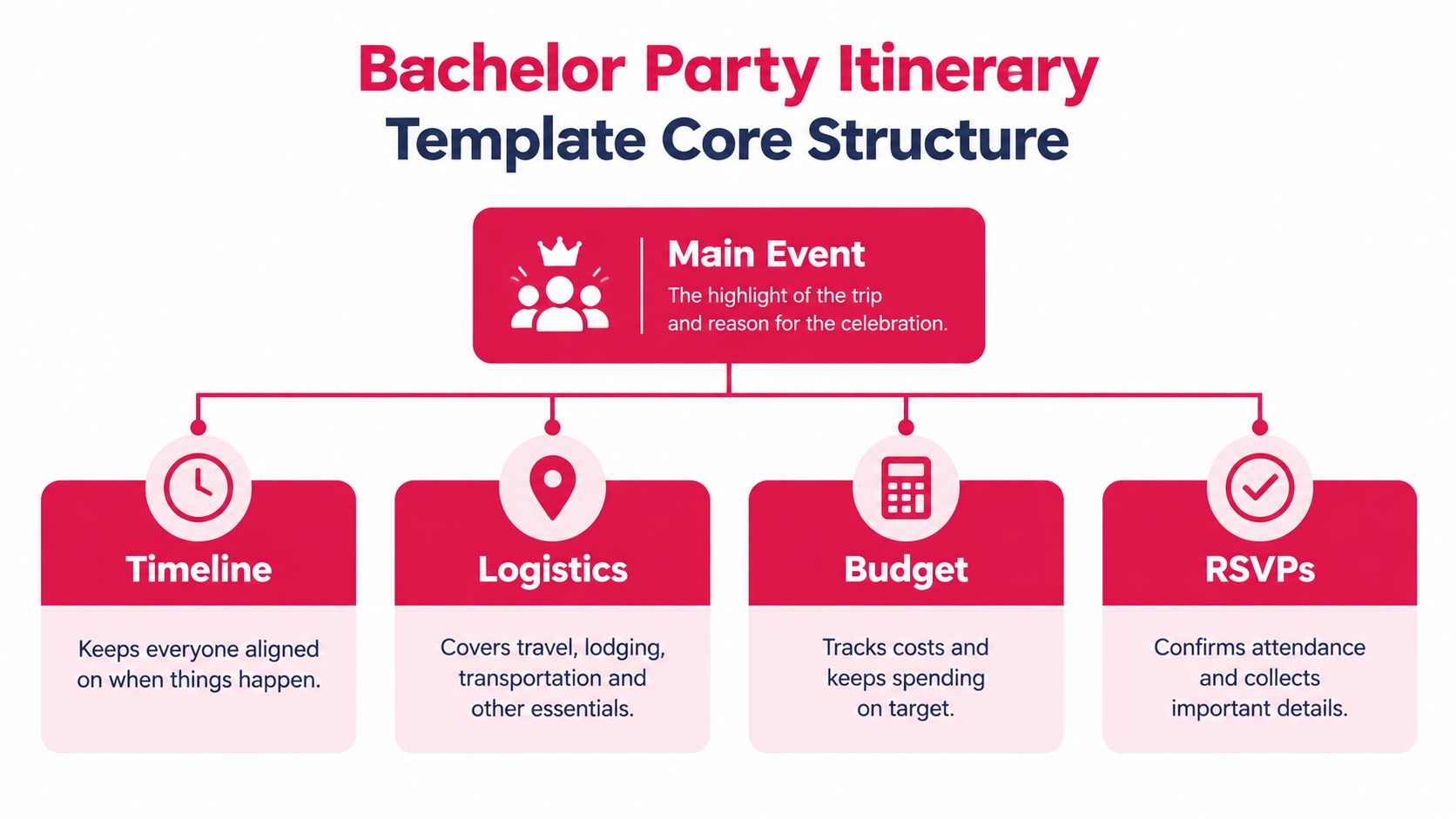
A reliable template starts with a simple daily skeleton: one anchor activity, one shared dinner, and one main nightlife venue. That structure works particularly well for European city breaks because it leaves room for travel between neighborhoods, late arrivals, queues, and the inevitable pause when half the group needs coffee.
The second day needs a recovery anchor rather than another ambitious mission. A thermal bath in Budapest, a long lunch in Lisbon, a park beer session, or a slow cultural visit can keep the weekend moving without pretending everyone has the same stamina. The point isn't to make the itinerary quiet. It's to prevent the first night from dictating the quality of the entire trip.
Build every block for scanning
Each row should answer the same questions: what is happening, where, when, who must attend, what it costs, and what happens if someone skips it. Add a meeting point that's more precise than “outside the hotel.” Include a contact person, reservation reference, expected travel time, and a buffer before the next commitment.
Use color sparingly. One color for required blocks, one for optional blocks, and a neutral shade for travel or personal time is enough. In a group chat, excessive color coding becomes decoration. Clear labels do more work.
| Block Type | When to Use It | Example |
|---|---|---|
| Must attend | Use for the shared moments that define the weekend | Main daytime activity or groom's dinner |
| Optional | Use when guests can join without affecting the core plan | Late bar, nightclub, or early-morning gym |
| Branch | Use when different preferences deserve separate routes | Quiet wine bar or higher-energy club |
| Recovery | Use after a late night or demanding activity | Thermal bath, long lunch, or free afternoon |
| Buffer | Use between fixed commitments and transfers | Hotel reset before dinner |
| Personal | Use for solo time, calls, shopping, or sleep | Unscheduled morning |
Make the document usable
Keep the first page short enough to read on a phone. Put the full details on linked or subsequent pages, including addresses, booking terms, payment status, dietary notes, and transport arrangements. An editable personalised travel itinerary can provide the visual starting point, but the content still needs to reflect the group's actual decisions.
Add a top-line summary with the destination, dates, accommodation, organizer, emergency contact, and the total number of confirmed travelers. Then create one daily panel for each day. Every panel should show the anchor, the meal, the evening plan, and the spaces between them.
Practical rule: If a guest has to scroll through a paragraph to find the meeting point, the template is too complicated.
The best format is both editable and printable. Use the editable version while collecting votes and payments, then export a clean PDF when the schedule is locked. Avoid hiding important changes in the chat. If the itinerary changes, update the central document and post one concise message identifying the change.
How to Customize Your Template and Get Group Agreement Fast
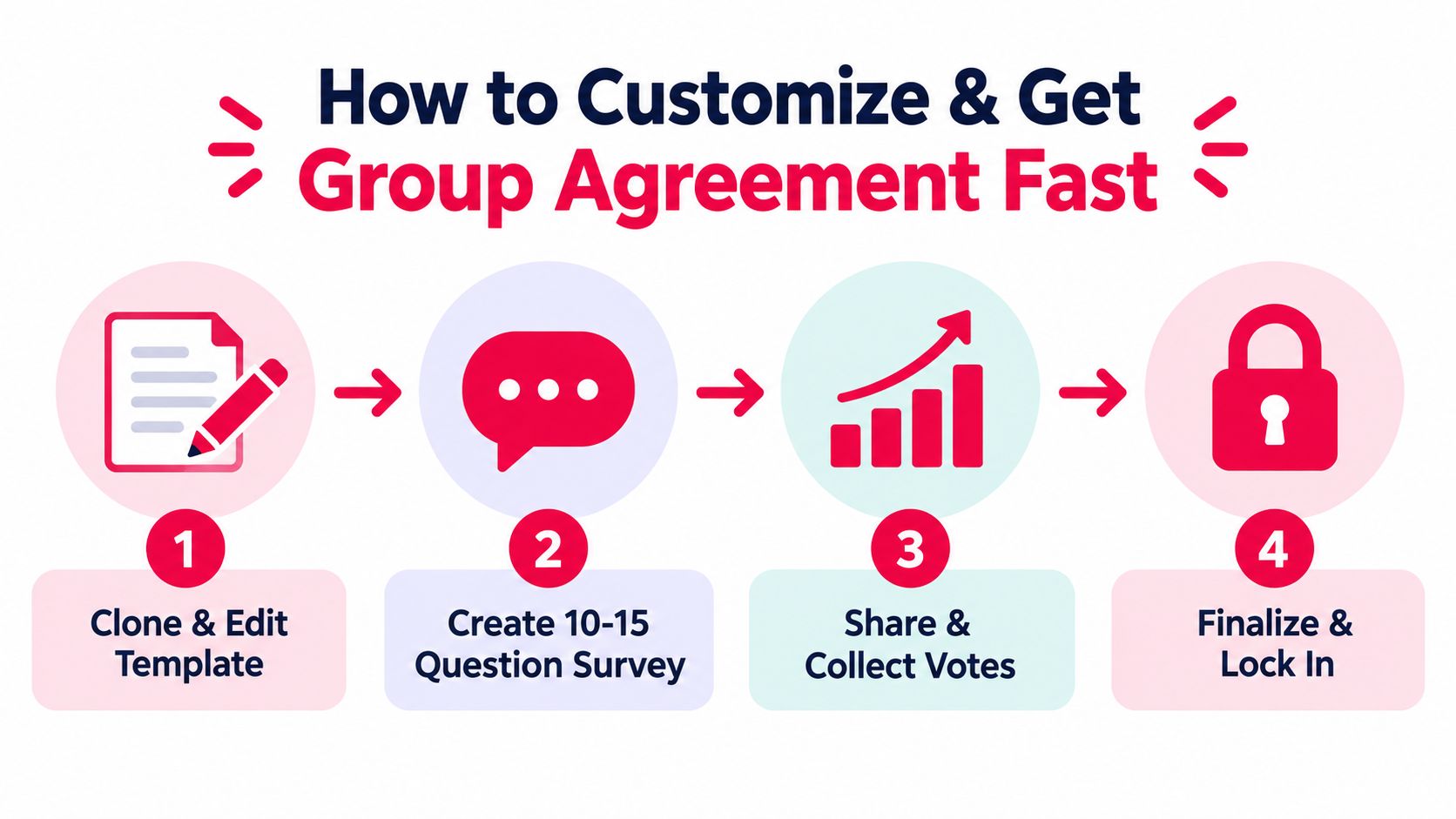
Start with the guest of honor's priorities, then collect the group's practical limits. Don't ask open-ended questions such as “What should we do?” unless you want a hundred disconnected suggestions. Ask about budget range, destination preference, energy level, food restrictions, nightlife interest, accommodation preference, and activities people won't join.
A short survey works better than a free-form discussion. Group-travel guidance recommends keeping it to 10 to 15 questions, using mostly multiple-choice or scaled answers, adding a “none of the above” option, and setting a completion deadline. This group decision guide supports the practical reason for that format: the organizer needs comparable answers, not a larger message archive.
Use questions that produce decisions
A useful questionnaire might ask:
- Which destination feels most suitable?
- What budget range is comfortable?
- Which energy level fits you best, low-key, balanced, or nightlife-heavy?
- Which daytime activity would you actively choose?
- Which activity would you rather skip?
- How important is a shared dinner?
- Are you comfortable with late-night transport?
- Do you need dietary or accessibility accommodations?
- Would you prefer a private room, shared room, or flexible arrangement?
- Which blocks must remain optional?
- Are you willing to split into sub-groups?
- What time do you ideally want the first morning to begin?
- Do you have any destination restrictions?
- Which proposed date works?
- Is there anything else the organizer should know?
That final option matters. "None of the above" prevents people from choosing an activity because the survey gives them no honest alternative.
Keep the guest of honor out of the planning channel
If the weekend is meant to contain surprises, use a private planning room or invite link and leave the guest of honor out of the operational discussion. Everyone should be able to vote without creating another account or learning a new process. A structured decision-making tool can help turn individual preferences into visible overlap, but the organizer still needs to apply judgment when the highest-scoring option conflicts with budget, timing, or the guest of honor's stated limits.
Publish the survey deadline in the first message. Send one reminder before the deadline, then make the schedule from the responses you have. Late voters shouldn't be allowed to reopen decisions that already affected deposits or reservations.
The fairest itinerary doesn't maximize attendance at every block. It protects the shared moments and makes the optional moments genuinely optional.
Use match scores or simple overlap notes to identify the common ground. If half the group wants a club and half wants a quiet evening, don't force a compromise venue that satisfies nobody. Make dinner the shared anchor, then create a nightlife branch and a low-key branch with a stated reconnection point. Add solo time where the group's sleep preferences are far apart.
The final survey output should become a one-page decision record: destination, dates, budget ceiling, must-attend blocks, optional branches, and the person responsible for each booking. That document stops the group from relitigating settled choices.
Three Ready to Use Sample Itineraries for Different Party Styles
The same skeleton can support very different weekends. The key is to preserve two meaningful anchors per day, then decide whether the remaining time belongs to nightlife, recovery, exploration, or personal space.

Prague and Lisbon for a city-break group
Prague suits a nightlife-forward weekend with a compact center and a strong evening focus. Day one can use a guided city activity or group challenge as the anchor, followed by a sit-down dinner and one main venue. Mark any second bar as optional, not as a required continuation.
For day two, schedule a recovery activity before dinner. The lower-energy branch might choose a long lunch and a relaxed neighborhood walk, while the higher-energy branch adds a daytime experience before both groups meet for the evening meal.
Lisbon offers a similar structure with a different rhythm. Use a daytime food or cultural experience, then protect time for a hotel reset before dinner. The evening can branch after the meal, with one group choosing a relaxed bar and another continuing to a main nightlife venue.
Marrakech and Dubai for an adventure-led weekend
In Marrakech, make a daytime desert or outdoor experience the first anchor, but don't schedule another demanding activity immediately afterward. Dinner becomes the second shared anchor, while the evening can remain flexible around a rooftop setting or a quieter group meal.
For Dubai, a desert experience can serve as the major daytime event. Keep the following block intentionally light, because transfers and heat can change the group's energy. A private dinner or villa meal provides a dependable shared moment, with nightlife treated as an optional branch rather than the automatic conclusion.
Budapest for a balanced mixed-energy group
Budapest works well when the group wants one lively evening but doesn't want the entire weekend organized around drinking. Use a daytime city experience on day one, followed by dinner and one selected venue.
On day two, put the recovery anchor first. A thermal bath gives the group a shared plan without demanding constant conversation or physical effort. Afterward, leave a long open window before dinner. Guests can nap, explore, or meet in smaller groups without missing the core itinerary.
| Party style | Daytime anchor | Shared meal | Evening structure | Recovery choice |
|---|---|---|---|---|
| Nightlife-heavy | Compact city activity | Reserved dinner | One main venue, extra bar optional | Late start and open afternoon |
| Adventure-led | Desert or outdoor experience | Simple group meal | Relaxed venue or villa evening | Light schedule after transfers |
| Balanced | Cultural or food experience | Central sit-down dinner | One chosen venue | Thermal bath or long lunch |
Choose the destination after the group agrees on the operating style. A famous city won't rescue a schedule that ignores sleep, cost, or the least energetic guest.
Budget Timing and Backup Plans That Keep the Weekend on Track
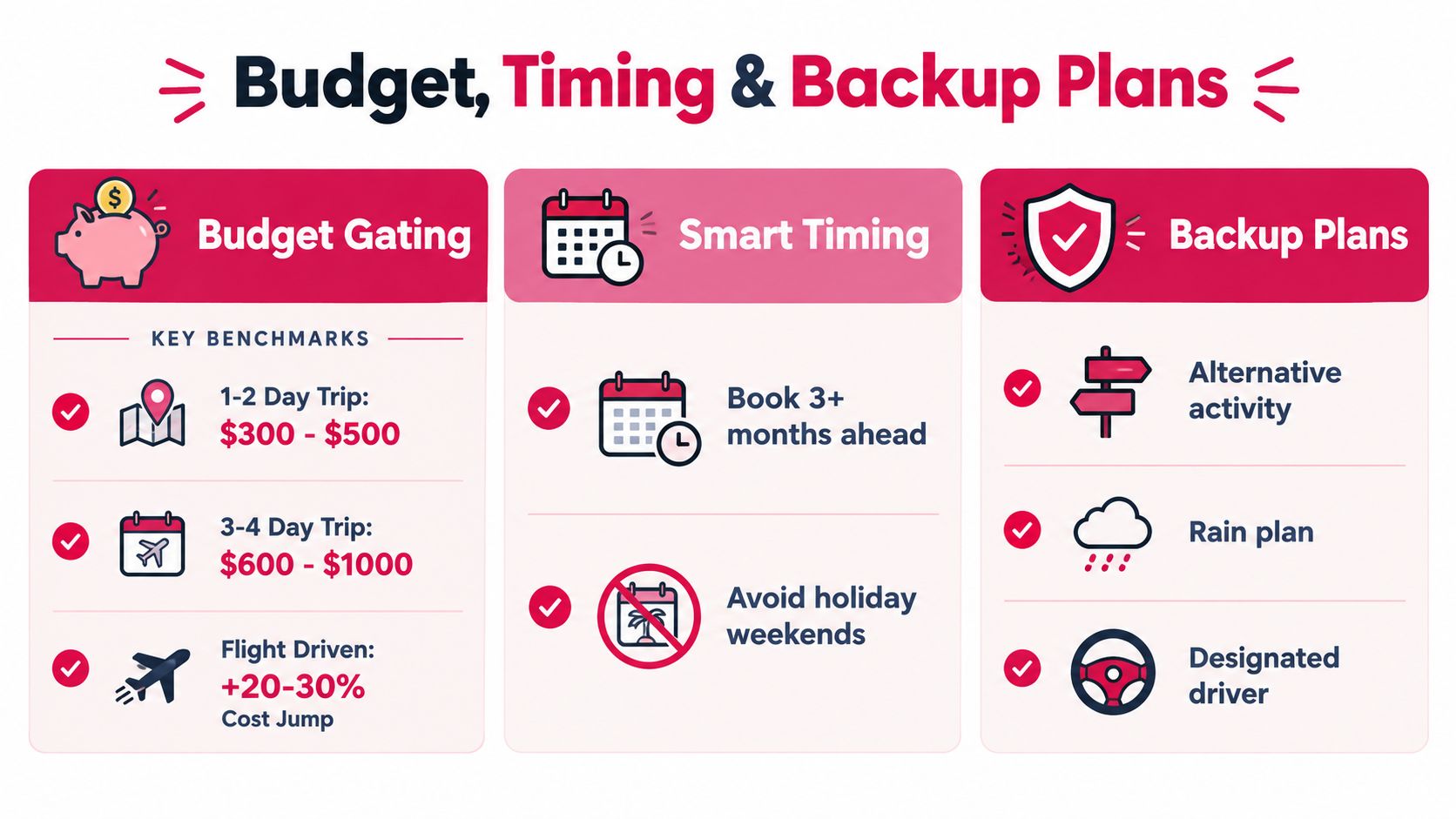
Budget gating belongs before activity selection. The Knot's 2023 Bach Study puts bachelor-party costs at about $1,300 per attendee for one-to-two-day trips, about $1,650 for three-to-four-day trips, and $2,000 per attendee when the party requires a flight against $1,000 when guests can drive. It also found 37% of attendees spend more than $1,000. Those are total per-person figures covering transport, accommodation, food, activities, and extras, not the shared activity budget alone, which is why they run well above the amount a group actually votes on. Review the cost study. For comparison, the 2019 study cited above put a three-day bachelor party at $1,144 per guest, so the flight line is where the escalation happens.
These figures aren't a quote for your group. They're a warning about escalation. Start with a ceiling, then subtract accommodation, transport, food, and the main activity before anyone chooses premium extras. If the core plan already strains the ceiling, remove an optional block rather than asking guests to stretch later.
Use a dated operating schedule
A practical planning timeline looks like this:
- Three to four months before departure: Pick the destination, set the budget, and finalize dates. Check the dates against public holidays and long weekends in the destination before you lock them, because prices and queues both move.
- About two months before departure: Confirm the group size and finalize activities.
- One week before departure: Collect remaining payments, confirm reservations, and share the final itinerary.
- During the weekend: Keep the central document current when a venue, meeting point, or timing changes.
Per-member booking can reduce payment disputes. Each traveler books their own flight and hotel room from their own city, using their own card, while the organizer handles shared activities and the central schedule. State cancellation rules before deposits are collected, and show who has paid for each shared commitment.
The UK market also shows why value awareness matters. A 2026 industry overview estimates annual stag-and-hen spending at £400–£600 million, with roughly 175,000–210,000 celebrations and 2.2–2.7 million participants each year. It reports average per-person spending rising 42.8% from 2022 to 2025, from £152 to £217, with stag weekends representing 85.5% of bookings and spending about 47% more per person than hen groups, £200 compared with £136. See the market overview and its methodology.
Plan for the version where something goes wrong
Every anchor needs a substitute. A rain plan might replace an outdoor activity with a cooking class, museum visit, or indoor challenge. A delayed arrival should affect an optional block first, not the main dinner. A late night should trigger a later recovery start, not a frantic attempt to preserve every scheduled item.
If Dubai is the accommodation base, compare the full logistics before choosing a villa. A practical guide to Dubai villa hire in 2026 can help you think through space, location, and service requirements without treating the property as a substitute for a workable itinerary.
Keep one person responsible for transport checks and one for payments. That division prevents the organizer from becoming the only person who knows where everyone needs to be.
Finalize Share and Book Your Bachelor Weekend With MyPerfectStay
Once the decisions are made, stop editing the itinerary for entertainment. Lock the agreed version, publish the attendance labels, and give every guest the information needed to act without asking the same questions again.
MyPerfectStay lets a group start with a destination, invite participants, collect private preferences about budget, interests, energy level, and must-see ideas, then surface activities with match scores. It supports 300,000+ bookable experiences across 190+ countries, including desert safaris, museum tours, food tastings, and yacht cruises. The group can vote, lock the selected activities, and book for everyone in one flow, with instant confirmations sent to participants.
The useful part for an organizer is the combination of structure and participation. Link invites let people join without creating an account to start, deadlines and nudges help chase late responses, and the shared itinerary organizes the confirmed schedule by day. Private preferences also let guests express limits they may not want to post publicly in the group chat.
Use the platform alongside your own checklist, not instead of judgment. Confirm the guest of honor's priorities, check the final costs, verify arrival times, and label every block as must-attend, optional, branch, recovery, buffer, or personal. The iOS and Android apps can support updates while the group is moving between venues.
Download or duplicate your template, write the survey questions, set the response deadline, and send the invite link today. Once the group agrees, book the shared experiences while the schedule is still clear, then share one final itinerary rather than reopening the entire conversation.
MyPerfectStay gives you a practical way to collect private group preferences, compare activity matches, organize the winning choices into a daily itinerary, and book shared experiences with confirmations for everyone. Visit MyPerfectStay, send the invite link, and turn your bachelor party itinerary template into a confirmed weekend.