Business Retreats: The Complete Planning Guide
September 4, 2026·MyPerfectStay
Three weeks before a quarterly leadership offsite, the operations manager at a 180-person SaaS company is staring at 47 Slack threads, four venue shortlists, and a CFO asking for a 25% budget cut. Nobody can agree on dates. Two executives have conflicting dietary requirements. The most recent spreadsheet has three different headcounts.
That isn't a retreat plan. It's a coordination failure with a hotel booking at the end of it.
Business retreats now work best as recurring operating moments, not occasional reward trips. The strongest format brings the right people together outside the office for a defined purpose, with enough structure to produce decisions and enough space for relationships to form. The destination matters, but ownership, objectives, budget control, and follow-through matter more.
Table of Contents
- What a Business Retreat Really Is in 2026
- The Four Retreat Types and When Each One Works
- Why Frequency Beats One Big Annual Trip
- Best Europe and MENA Destinations for Retreats
- The Six-Month Planning Checklist That Actually Works
- Measuring Retreat ROI Without Guesswork
- How MyPerfectStay Simplifies Group Decisions and Booking
- Your Pre-Planning Checklist and Common Pitfalls
What a Business Retreat Really Is in 2026
A business retreat is a deliberately structured gathering of employees outside their usual workplace. It can last from a short working session to several days, but duration alone doesn't make it useful. The retreat needs a business reason, a named owner, and an agenda designed around an outcome such as leadership alignment, annual planning, cross-functional coordination, recovery, or team connection.
Three traits separate a real retreat from a conference or holiday.
- A defined owner: One person has authority over the brief, budget, decisions, and final logistics. A committee can advise, but it shouldn't own execution collectively.
- Measurable objectives: The group must know what will be different when it returns. That might mean agreed priorities, a resolved roadmap dispute, or documented communication norms.
- A fit-for-purpose venue: Familiarity isn't a selection criterion. The property needs private rooms, workable meeting space, reliable food service, and travel access that match the group.
Practical rule: If the organizer can't write the retreat's intended decisions on one page, the team isn't ready to book it.
The old model was usually an annual, large gathering with a gala dinner and broad culture messaging. The current model is smaller, more frequent, and more outcome-led. Distributed and hybrid teams have made face-to-face time harder to coordinate, so each in-person session needs to earn its place on the calendar.
That doesn't mean every company should hold a large event every quarter. It means leaders should match the format to the work. A leadership group may need a focused planning session in Lisbon. A cross-functional product team might benefit from a shared challenge in Barcelona. A burned-out department may need a lighter reset in Marrakech or Muscat.
The four useful archetypes are strategic offsites, team-building retreats, strategy retreats, and wellness retreats. Confusing them is one of the fastest ways to spend heavily while producing little.
The Four Retreat Types and When Each One Works
Start with the decision the group needs to make. Don't start with the hotel, the activity, or the destination.
Strategic offsites
A strategic offsite suits a leadership team of 8 to 25 people that needs to set priorities for the next two quarters. Keep the room small enough for candid discussion and fast decisions. It backfires when attendance rises beyond 30 people, because senior voices dominate while everyone else becomes an observer.
The warning sign is a draft agenda full of departmental updates. Replace status reporting with decisions, trade-offs, and clear owners.
Team-building retreats
Team-building works for a newly formed or recently reorganized group of 20 to 80 people. Choose a shared challenge that requires collaboration, such as a facilitated problem-solving exercise, a food workshop, or an accessible outdoor activity in Athens or Dubrovnik.
It fails when the program relies on trust-fall clichés or forced vulnerability. The warning sign is an activity selected because it looks entertaining in a brochure rather than because it supports the team's working relationship.
Strategy retreats
A strategy retreat is not just a larger leadership offsite. It focuses on multi-year bets, market choices, operating-model questions, or roadmap debates. It needs longer working blocks, stronger preparation, and often an external facilitator who can challenge assumptions without carrying internal politics.
The warning sign is an ambition statement with no choices attached. If the group won't decide what to stop doing, it isn't conducting strategy.
Wellness retreats
A wellness retreat addresses burnout, retention risk, or recovery after an intense operating period. Keep the agenda light, usually 2 to 3 days, and protect rest rather than filling every hour with activities.
The warning sign is a wellness label placed over a standard meeting schedule. A retreat can include coaching, quiet work, movement, and shared meals, but it shouldn't pretend that a packed conference agenda is restorative.
| Retreat type | Primary purpose | Group size | Duration | Backfires when |
|---|---|---|---|---|
| Strategic offsite | Near-term priorities and alignment | 8 to 25 | Short, focused format | More than 30 attendees dilute discussion |
| Team-building retreat | Trust and cross-functional connection | 20 to 80 | Several days | Activities feel forced or exclusionary |
| Strategy retreat | Multi-year choices and roadmap debates | Senior decision-makers | Longer working blocks | The group avoids hard trade-offs |
| Wellness retreat | Reset and recovery | Department or team | 2 to 3 days | The agenda is too dense |
Use a simple filter. If the goal is to decide, choose a strategy-led format. If the goal is to bond, choose team-building. If the goal is to reset, choose wellness. Don't ask one retreat to solve all three problems equally.
Why Frequency Beats One Big Annual Trip
A single annual mega-offsite creates one peak of attention. Smaller, repeated retreats create a cadence for decisions, feedback, and course correction.
The corporate retreats market was estimated at $31.8 billion in 2024, with a projection to reach $73.7 billion by 2034 at a reported 9.1% compound annual growth rate, according to this 2026 corporate retreat market summary. The same source reports that more than 70% of mid-size to large companies host annual offsites, with typical per-person budgets between $1,000 and $3,000 and an average retreat length of 3.78 days.
Those figures describe a recurring operating expense, not a one-off perk. Historical practice supports the same direction. General Electric opened its Crotonville leadership campus in Ossining, New York, in 1956, and describes it as the world's first major corporate university (GE on Crotonville). Taking senior people out of the office on a fixed schedule is a seventy-year-old management practice, not a remote-work invention.
Frequency also gives leadership more opportunities to fix a problem before it hardens. Reporting cited by retreat frequency research puts high-performing companies at an average of 2.8 offsites per year, compared with 2.4 for underperforming firms. That gap doesn't prove that retreats cause performance, but it supports a practical operating principle: repeated alignment is more useful than one dramatic gathering.
The logistics reinforce the case for smaller, well-designed groups. 98% of groups book meeting rooms at their accommodation, 85% of retreat groups opt for single rooms, and 92% eat three or more meals on site, according to the corporate retreat market summary cited above. A property that combines sleeping rooms, meeting space, and catering reduces transfers and schedule risk.
Plan business retreats as a rhythm. Set a repeatable briefing template, define the decision window, and keep a record of commitments from one gathering to the next. The aim isn't more time away. It's better timing for the conversations your normal workday keeps postponing.
Best Europe and MENA Destinations for Retreats
Shortlist destinations by operational fit, not postcard appeal. Lisbon, Barcelona, Marrakech, Dubai, and Athens can all work, but they solve different planning problems.
Lisbon is the strongest all-rounder for European teams that want attractive surroundings, solid hospitality, and broad appeal. It suits leadership and cross-functional groups, although demand can tighten around peak periods. Barcelona offers strong venue variety and a dense activity ecosystem, making it easier to build a work-and-experience agenda without long transfers.
Marrakech works when the retreat needs a clear change of scene, distinctive food, and an atmosphere that encourages informal connection. Budget the tax line separately: Morocco charges 20% VAT as its standard rate but applies a reduced 10% to accommodation and catering (PwC Morocco tax summary), which is lower than the 15–25% VAT European countries commonly levy on accommodation, catering, and event services (Europe retreat location and VAT overview). Recovery depends on the company, service, and jurisdiction, so finance should review the structure before procurement.
Dubai wins on infrastructure, international connectivity, and high-capacity venues. It's the practical choice for teams spanning Europe and the Gulf, but premium properties and experiences can push the budget upward. Athens offers strong value and an easy blend of urban meetings, food, and coastal or cultural activities, though specialist offsite-experience supply can be thinner than in Barcelona.
| Destination | Nightly cost (pp) | Flight access | Venue supply | VAT exposure |
|---|---|---|---|---|
| Lisbon | Compare live quotes | Strong European access | Boutique hotels and meeting properties | Review applicable Portuguese VAT |
| Barcelona | Compare live quotes | Strong European access | Broad hotel and conference supply | Spanish VAT requires finance review |
| Marrakech | Compare live quotes | European access, with MENA connections | Riads, resorts, and specialist venues | Confirm Moroccan treatment and recovery |
| Dubai | Compare live quotes | Strong European and GCC access | Extensive premium and conference supply | Confirm UAE treatment and recovery |
| Athens | Compare live quotes | Strong European access | Hotels and resort-style options | Review applicable Greek VAT |
Venue-sourcing agencies recommend around 6 to 9 months of lead time for a European company retreat, while noting that shorter runways are workable (venue planning guidance for company retreats). Use that runway to move from a longlist to two finalists, then request comparable proposals covering rooms, meeting space, catering, transfers, taxes, cancellation terms, and activities. For destination discovery, review the MyPerfectStay destination collection, then validate every finalist against the actual attendee map.
The Six-Month Planning Checklist That Actually Works
A retreat planned in a group chat has no reliable owner. A retreat planned against dated gates does.
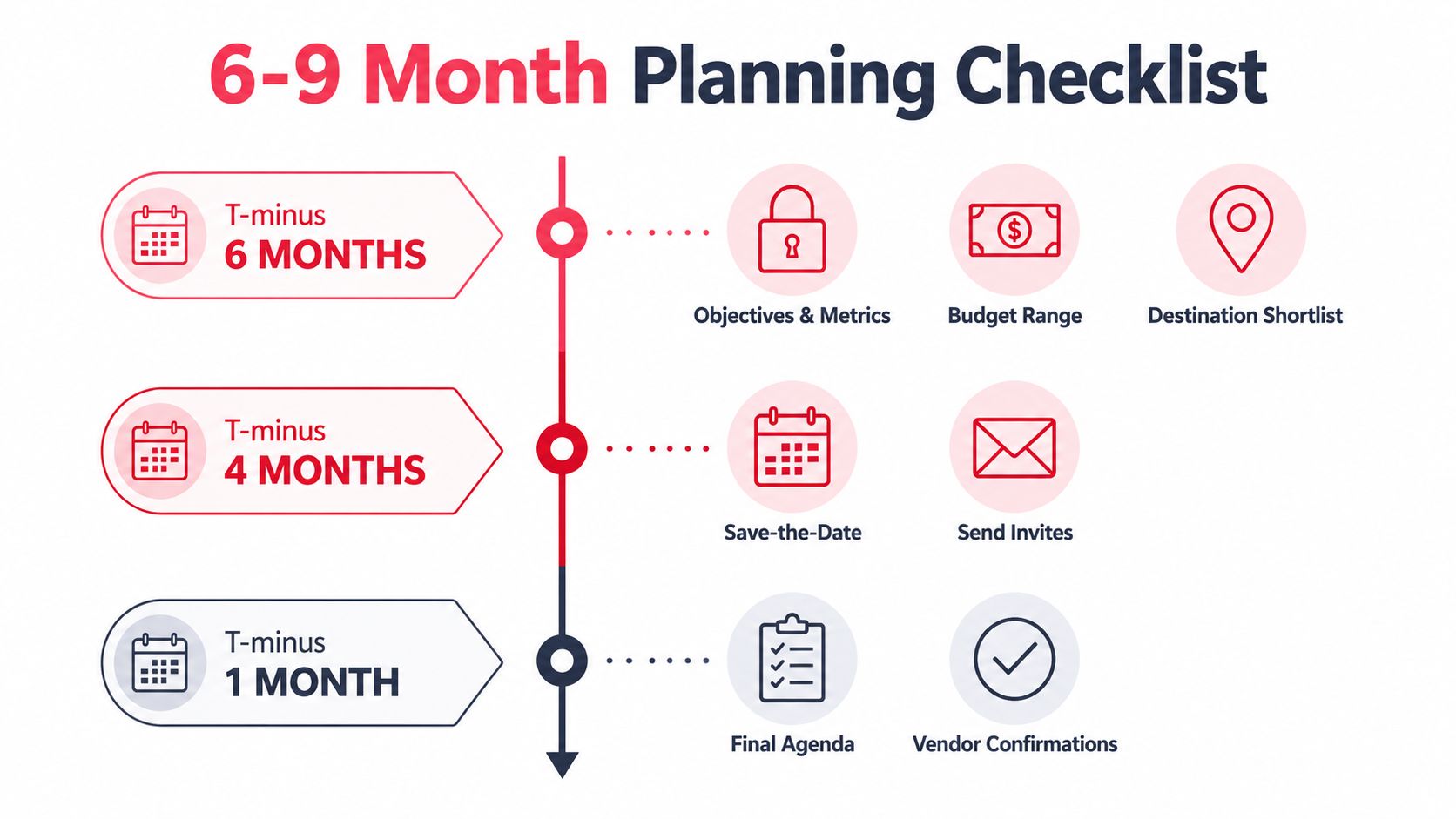
Most European company retreats run on a 6 to 9 month runway, so assign each phase to one accountable person. The owner can collect input, but they must be able to close a decision.
T-minus 6 months
The executive sponsor writes the brief. Lock the operational objective, success metrics, budget range, and attendee profile. The operations lead then shortlists 2 to 3 destinations, using travel access, venue supply, VAT treatment, and agenda fit as filters.
Don't authorize flight booking yet. First confirm that shortlisted properties can provide private rooms, dedicated meeting capacity, suitable food service, and a cancellation structure finance can accept.
T-minus 4 months
The logistics owner issues the save-the-date, sends a dates poll, and opens venue requests for proposal. Ask each property for a complete package rather than a room-only rate. You need comparable answers on accommodation, meeting rooms, meals, audiovisual support, transfers, accessibility, and experiences.
A written corporate travel policy should cover approval levels, booking rules, and traveler needs.
T-minus 3 months
Confirm the venue and contract the facilitator. The program owner drafts agenda blocks, protects informal time, and places the hardest decisions when participants are most alert. The finance owner checks VAT, deposits, currency exposure, and cancellation liabilities before signature.
T-minus 2 months
Finalize the attendee list. The logistics owner collects dietary and accessibility requirements, confirms travel windows, and resolves rooming. The facilitator turns the retreat brief into pre-work, decision questions, and session outputs.
T-minus 1 month
Ship the pre-read and circulate the draft agenda. Lock vendors, experiences, transfers, and the escalation path for changes. Brief the logistics lead in writing, including arrival instructions, emergency contacts, and the latest rooming list.
T-minus 1 week
The program owner shares the final agenda. Assign a notetaker to every decision-heavy session, name the decision owner, and state where the output will live after the retreat.
Ownership test: Every open item should have one name beside it, one deadline, and one place where the final answer is recorded.
Measuring Retreat ROI Without Guesswork
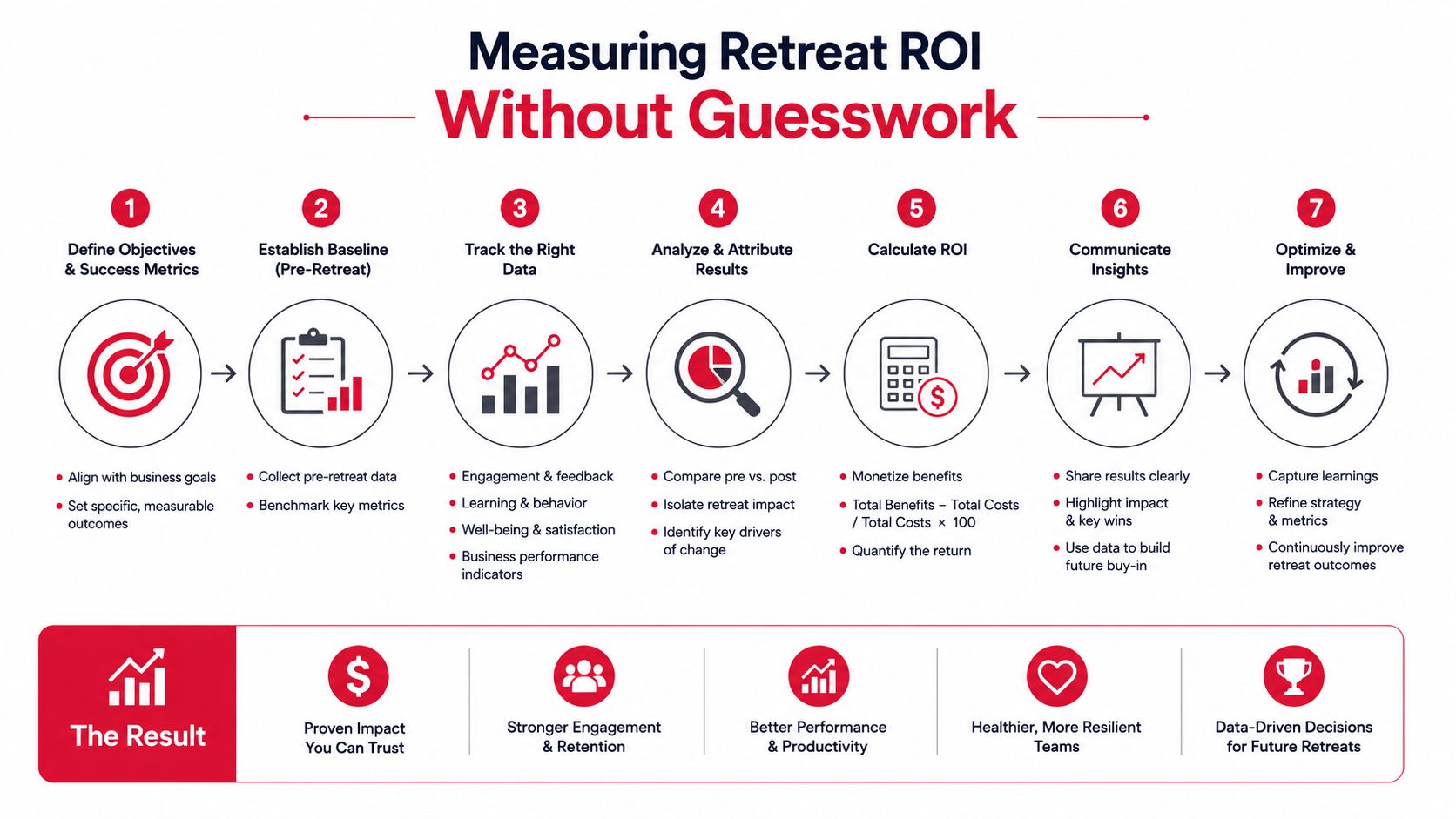
Measure the retreat before anyone arrives. Satisfaction scores alone are weak because people can enjoy a destination without resolving a business problem.
Use two measurement buckets.
Leading indicators during the retreat
Run a short anonymous baseline survey before departure. Ask participants to rate their clarity on the next-quarter priorities, confidence in cross-functional decisions, and understanding of who owns critical work. Repeat the questions during the final session.
Track the agenda's engagement curve as well. Note which sessions produce decisions, which create unresolved questions, and where energy drops. A useful retreat output includes:
- Decision clarity: Which priorities did the group approve, reject, or defer?
- Ownership clarity: Does every decision have one accountable owner?
- Collaboration confidence: Can participants identify the right partner and escalation route?
Lagging indicators after the retreat
Schedule follow-ups at 30, 60, and 90 days. Review voluntary attrition, project velocity, cross-team collaboration frequency, and escalation patterns against the baseline. Don't claim the retreat caused every change. Use the measures to test whether the agreed operating changes survived contact with normal work.
The planning brief should specify what would justify the investment. For example, a 40-person strategy retreat costing EUR 90,000 has a simple average cost of EUR 2,250 per attendee, and the retention target can be expressed as EUR 2,250 per retained hire if the organization defines that as its break-even assumption. That's not proof of return. It's a decision model that forces finance and leadership to agree on the value being pursued.
Use a structured corporate event planning software workflow to keep attendance, preferences, decisions, and follow-up records together. ROI measurement is a design choice. If nobody agrees on the baseline before the retreat, the post-event review will become a debate about impressions.
How MyPerfectStay Simplifies Group Decisions and Booking
Most retreat planning failures start with a harmless message: “What does everyone think about Barcelona?”
Then come 40-plus messages, three lost Google Docs, two people who never open the link, and a final choice that nobody explicitly voted for. The coordinator spends hours reconstructing preferences while the executive sponsor assumes the group has agreed.
Use a decision surface instead. First define the destination shortlist. Attach actual venue options, rates, room assumptions, meeting capacity, and key inclusions. Give each attendee one ranked choice or veto, close voting by a hard deadline, and book the winner through one documented flow.
That structure matters for distributed teams working across Europe and MENA time zones. Async planning stalls when every participant has to interpret a long thread, compare separate links, and remember which version of the budget is current. A structured workflow keeps options, prices, votes, attendance, and confirmation in one place.
MyPerfectStay can collect group preferences and organize shared itinerary decisions for a retreat. The platform's corporate workflow can gather rooming information, travel windows, dietary needs, and attendance status, while private surveys and voting help the organizer identify the group's overlap before booking.
Apply the same discipline to every shortlisted property. Location, room configuration, meeting setup, and service model still need human review. No tool replaces an operations lead who checks the contract.
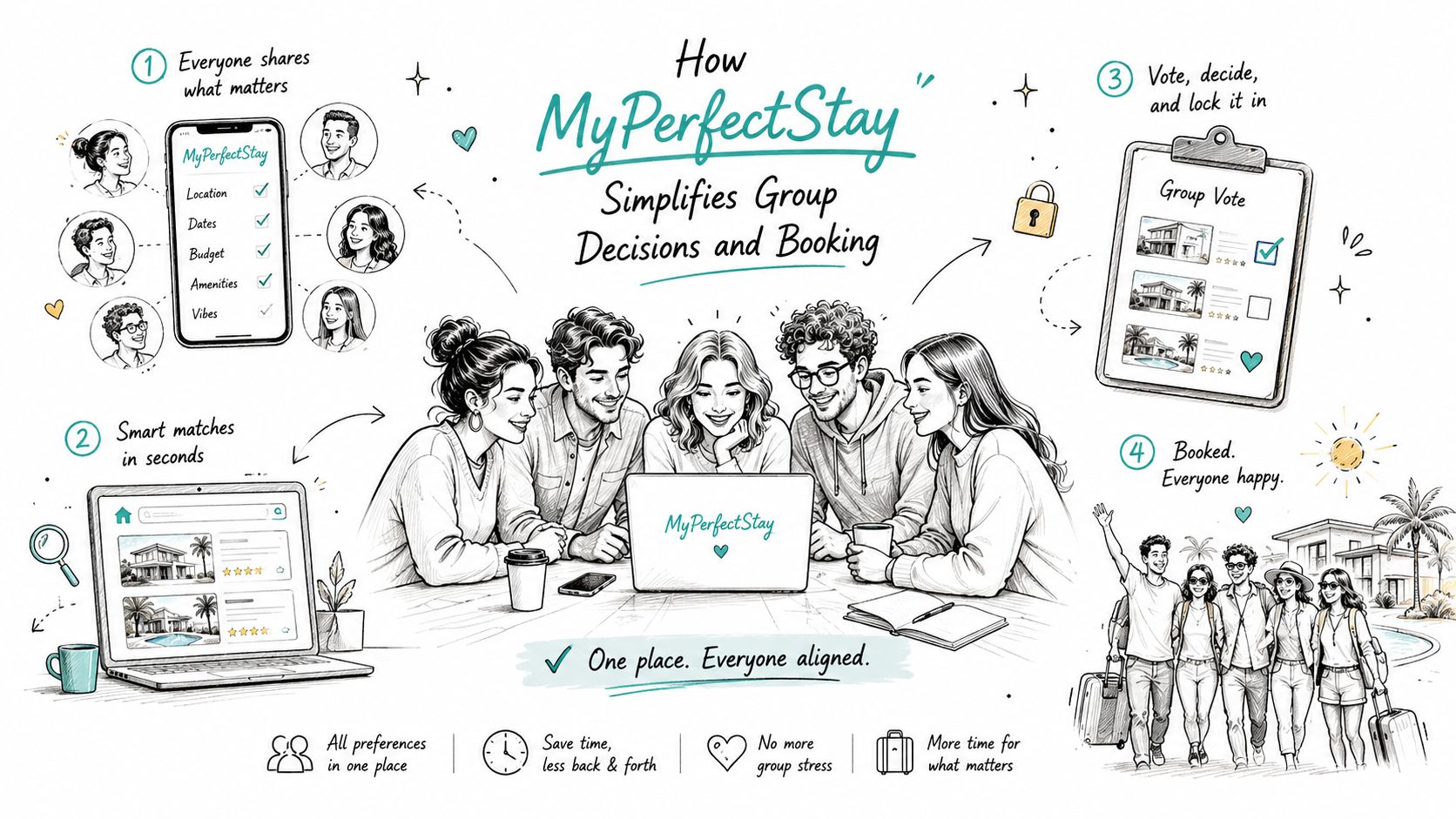
Open a retreat draft, add three venue candidates, set the voting deadline, and send the decision request. The goal is to replace endless discussion with a visible choice and a clean audit trail.
Your Pre-Planning Checklist and Common Pitfalls
Run this checklist before you ask anyone to vote on a destination.
- Lock the objective: Write the strategic outcome first, not the activity list.
- Separate VAT: Set a per-head budget and show tax treatment as its own line.
- Shortlist three destinations: Compare access, venue supply, catering, experiences, and cancellation terms.
- Check availability first: Confirm venue capacity before asking people to book flights.
- Balance the agenda: Use a working assumption of 60% work and 40% shared experience, then adjust for the retreat objective.
- Name one decision-maker: The group can advise, but one person closes unresolved questions.
- Brief vendors in writing: Include timings, accessibility, dietary needs, room requirements, and escalation contacts.
- Send the pre-read: Give participants the material two weeks before arrival so the retreat isn't spent explaining background.
Three failure modes appear repeatedly.
No written objective: The retreat drifts into a holiday. Fix it with a one-page brief containing decisions, owners, and success measures.
Hard decisions scheduled last: Icebreakers consume the morning, while the roadmap debate starts when everyone is tired. Fix it by placing the most consequential work early and protecting recovery time afterward.
Group chat as the planning system: Decisions disappear, deadlines blur, and someone eventually says they weren't consulted. Fix it with a single decision record, a hard close date, and one source of truth for attendee data and booking status.
A retreat pays back when the team leaves with three written decisions and one owner per decision, not when the photos look good.
MyPerfectStay gives retreat organizers a structured way to collect attendee preferences, compare group options, coordinate shared plans, and keep booking information together. Visit MyPerfectStay to open a retreat draft, add your venue shortlist, and send the first decision request.