9-Step Corporate Event Planning Checklist
September 18, 2026·MyPerfectStay
You're coordinating a corporate offsite in Barcelona, and the event is already pulling people in different directions. Executives want a focused innovation agenda, attendees need sensible travel and activity choices, suppliers need firm deadlines, the finance team wants cost control, and someone still has to make sure the follow-up produces more than a folder of photographs. Without a shared sequence, small decisions become expensive surprises.
This corporate event planning checklist is designed to be printed, copied into a project workspace, or converted into assigned tasks. Work through the stages in order, then add an owner, deadline, approval status, supplier contact, and dependency to every line. The sequence moves from objectives and budget to venue, experiences, catering, approvals, risk, communications, feedback, and strategic review.
The market context makes disciplined planning worthwhile. Booking.com for Business puts the global corporate events market on a path from $325 billion in 2024 to $595.27 billion by 2029, a compound annual growth rate of 10.61%, and estimates that B2B events alone generate roughly $1.7 trillion in direct spending worldwide each year. Your event may be smaller than those market totals, but venue, travel, supplier, and attendee-experience decisions still deserve the same operational discipline.
Table of Contents
- 1. Define Event Objectives and Budget Parameters
- 2. Select Venue and Accommodation
- 3. Create a Comprehensive Activity and Experience Plan
- 4. Manage Catering and Dietary Requirements
- 5. Stakeholder Alignment, Approvals, and Vendor Contract Negotiation
- 6. Develop Risk Management and Contingency Plans
- 7. Create a Detailed Participant Communication and Engagement Plan
- 8. Gather Feedback and Execute Post-Event Analysis
- 9. Top Priorities and Strategic Checklist for Corporate Events
- 9-Point Corporate Event Planning Checklist Comparison
- Turn the Checklist Into Your Event Control Center
1. Define Event Objectives and Budget Parameters
Start with the decision the event must support. A Barcelona technology retreat might prioritize innovation workshops and cross-team problem solving. A London financial-services outing may need client entertainment and structured networking. A Lisbon startup offsite might combine strategy sessions with team-building, but those purposes require different venues, schedules, staffing, and success measures.
Write the outcome in operational language. “Improve collaboration” is too broad to guide suppliers. “Give product, sales, and engineering leaders a shared roadmap and a structured opportunity to resolve delivery barriers” gives the agenda a direction. Record the intended attendance range, format, duration, destination, audience, and the action participants should take afterward.
Create the budget before anyone falls in love with a venue. Break the estimate into venue, accommodation, catering, activities, transport, production, staffing, insurance, marketing, and technology. InEvent's corporate event planning checklist treats 10–15% as a safe contingency buffer, and the event budget approval checklist from CheckFlow sets the tiers: 10–15% of total budget as standard, rising to 15–20% for outdoor events, first-time venues, events in international locations with currency risk, or events with significant technology complexity — which covers most cross-border European and MENA programmes.
Set the approval gate
Budget approval should state the event format, expected attendance, duration, and whether the programme is single-day or multi-day. The same CheckFlow checklist also emphasizes documenting budget assumptions — attendance numbers, price-escalation assumptions, and any variable that could move the budget materially — and settling who can approve contingency spend, and at what level, before the budget is submitted.
- Define the outcome: Connect the event to a business decision, relationship objective, launch, or team result.
- Record assumptions: Note attendance, room nights, travel responsibilities, tax treatment, supplier inclusions, and escalation risks.
- Name the budget owner: No supplier should receive a verbal promise from someone who can't approve spend.
- Create the working brief: Keep objectives, budget, audience, destination, and success measures in one controlled document.
For preference-led retreat design, organizers can also use this corporate retreat planning guide as a planning reference. The brief becomes the test for every later choice. If an activity doesn't support the objective or the participant experience, it shouldn't survive just because it sounds impressive.
2. Select Venue and Accommodation
A venue isn't just a room with chairs. It controls arrival friction, room transitions, food service, production options, accessibility, accommodation, and the amount of time attendees spend in transit. Compare a Paris hotel with integrated conference and wellness facilities, a historic palace in Vienna, a Marrakech resort with access to desert experiences, and an Amsterdam canal-side hotel with flexible breakout rooms. Each can work, but each supports a different event rhythm.
Begin with the attendee journey. Check airport and rail access, transfer times, rooming requirements, meeting-room privacy, natural light, internet resilience, power access, loading routes, lifts, quiet areas, prayer or reflection needs, and accessible circulation. A virtual tour won't reveal every service corridor, sound bleed, restricted access window, or awkward distance between accommodation and the main meeting space. Visit in person where the event's financial or reputational stakes justify it.
Put the contract under pressure
Ask the venue to quote rooms, meals, meeting space, furniture, standard AV, Wi-Fi, parking, transfers, taxes, service charges, and overtime separately. Bundled pricing can simplify procurement, but it can also conceal exclusions. Get every inclusion in writing, including room access, setup time, breakdown windows, cancellation terms, headcount deadlines, and house or union rules.
Naboo's professional event management checklist puts objectives, budget and venue sourcing in a pre-event phase three or more months out, leaves mid-planning to the one-to-three-month window, and pins only two hard lead times: vendor and catering walk-throughs about two weeks before the event, and a technical dry run 48 to 72 hours before doors open. For premium European and MENA destinations, start venue sourcing substantially earlier when the date is fixed or the event depends on scarce inventory.
- Test the capacity: Walk the proposed seating, breakout, registration, catering, and storage layouts.
- Check the neighbourhood: Confirm transport, late-arrival options, medical access, local regulations, and nearby accommodation.
- Negotiate flexibility: Seek reasonable room-block adjustments, final-count flexibility, and practical cancellation language.
- Assign the contract owner: One person should track open clauses until signature.

A venue walk-through should end with a marked floor plan and a written list of unresolved questions. If the supplier can't answer who controls access, when vendors can load in, or what happens if the room changes, the venue isn't ready for signature.
3. Create a Comprehensive Activity and Experience Plan
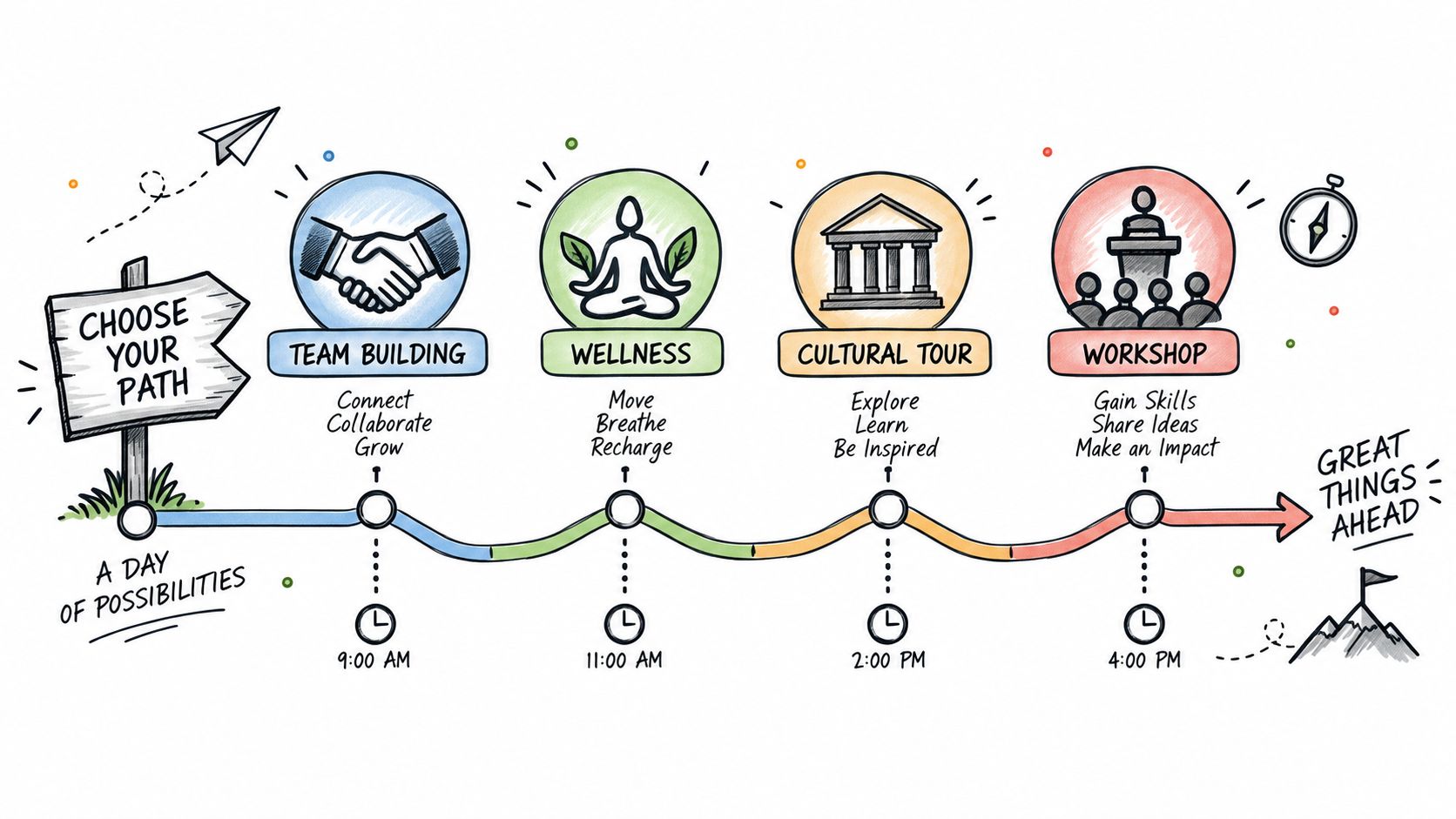
A strong agenda gives people purpose without treating every minute as a compulsory performance. Match the programme to energy, interests, mobility, dietary needs, cultural expectations, and the event objective. London could support a strategy workshop followed by a museum visit and a Thames dinner cruise. Barcelona might combine an architecture workshop, beach volleyball, and a tapas tasting. Dubai could pair an innovation lab with a desert experience or yacht networking.
Separate core programming, optional experiences, and recovery time. A senior leadership group may value an uninterrupted strategy block, while a wider team may benefit from smaller, choice-based sessions. High-energy activities can build connection, but they can also exclude people who don't want competitive sports, manage a health condition, observe religious practices, or need a quieter format.
Survey participants before finalizing the slate. Ask about interests, energy level, accessibility, dietary constraints, must-see ideas, and activities they want to avoid. This creates better matching than asking everyone to accept a fixed itinerary designed by the loudest stakeholder. A practical corporate team-building activities guide can help expand the shortlist, but local operators still need to confirm safety, transfers, capacity, insurance, and cancellation terms.
Build choice without losing control
- Offer contrasting formats: Pair a high-energy option with a cultural, creative, wellness, or low-mobility alternative.
- Protect unstructured time: Attendees need time to rest, handle messages, change clothes, or explore independently.
- Use local expertise: A Prague walking tour, a craft workshop, or a Marrakech culinary experience can feel more meaningful than a generic hotel activity.
- Define the operational brief: Every activity needs a meeting point, transport plan, duration, weather alternative, accessibility note, and accountable host.
Don't confuse a full itinerary with a valuable itinerary. The best agenda leaves enough space for informal conversations, because those interactions often carry the relationship and collaboration benefits the formal programme was meant to create.
4. Manage Catering and Dietary Requirements
Food service affects punctuality, comfort, inclusion, and the perceived quality of the event. Plan each meal around the programme rather than treating catering as a late supplier handoff. A Paris executive dinner may call for a formal French menu and carefully managed wine service. A Rome team lunch could include regional dishes and a cooking demonstration. A Marrakech dinner might use a private riad, tagine tasting, and Moroccan tea service. A Vienna gala may require formal Austrian cuisine alongside vegan, kosher, halal, and gluten-free choices.
Collect dietary information through registration and confirm how the caterer will store and use it. “Vegetarian” doesn't explain whether eggs or dairy are acceptable. “Allergy” needs a clear ingredient and cross-contact process. Cultural and religious requirements need the same care as medical restrictions, and the event team should never make attendees explain their needs publicly at the buffet.
Confirm the service mechanics
Ask for menu descriptions, ingredient details, service style, portion assumptions, beverage options, allergen controls, and the final-count process. Request separate preparation areas and utensils where cross-contact is a concern. Label dishes clearly, brief service staff, and give the event lead a confidential dietary summary.
- Survey early: Capture allergies, vegetarian, vegan, halal, kosher, gluten-free, and other requirements before final menu approval.
- Protect the schedule: Align breaks, room resets, speeches, transfers, and meal service with the run of show.
- Offer alternatives well: High-quality non-alcoholic drinks and mocktails should feel intentional, not like an afterthought.
- Check the final count: Confirm the total headcount and dietary breakdown through the venue's agreed process.
Catering contracts should specify how substitutions, late changes, unused portions, service charges, corkage, and extra staff are handled. A low per-person quote isn't useful if it excludes essential service elements or creates a poor experience for attendees with dietary needs.
5. Stakeholder Alignment, Approvals, and Vendor Contract Negotiation
A regional leader may own client hospitality, while the CTO sets the innovation agenda, the CFO controls budget release, and HR reviews wellness or inclusion provisions. Record those decision rights before suppliers receive competing instructions. Include a named event lead who can resolve conflicts and keep the delivery sequence intact.
Set approval gates around the decisions that can stop progress: event format, venue commitment, supplier appointment, contract signature, final scope, and budget changes. For each gate, record the owner, deadline, evidence required, and consequence of delay. A venue cannot hold space indefinitely while departments continue debating the format.
Build a comparable supplier brief
Send every bidder the same assumptions for rooms, schedule, service, accessibility, technology, staffing, and deliverables. Compare the resulting proposals on scope, lead times, payment terms, cancellation rules, service levels, insurance, data handling, emergency contacts, and relevant references. A lower quote can become expensive when exclusions, rigid deadlines, or limited support leave your team carrying the risk.
Use the contract review to settle operational details, not just the headline price. Seek included services, upgrade options, cancellation protection, and headcount adjustments where they protect the programme. Check liability, indemnity, force majeure, privacy, payment, intellectual property, and termination clauses. Assign one accountable internal contact and one named supplier lead, then record escalation routes for decisions during delivery.
Keep a change log for every approved amendment. It should show the request, commercial effect, approver, supplier action, and dependency on the run of show. This prevents a late speaker change or room adjustment from becoming an untracked cost.
Teams reducing spreadsheet sprawl can assess corporate event planning software alongside registration, CRM, communications, and finance tools. The purpose is a reliable record of current versions, approvals, ownership, and unresolved blockers.
Practical rule: Mark an item approved only when its owner, budget impact, supplier responsibility, and next dependency appear together in the working record.
6. Develop Risk Management and Contingency Plans
A workable contingency plan answers four questions: what changes, who decides, when the decision is made, and how attendees receive the update. For example, a storm can move a Barcelona beach programme to a museum and indoor workshop. Unsafe heat can shift a Dubai desert safari to wellness or retail activities. In Amsterdam, a canal cruise may give way to cycling and museum visits.
Build the risk register around the event's actual exposure. Cover weather, medical incidents, security, supplier failure, transport disruption, missing equipment, no-shows, registration or data issues, lost property, and programme changes. Rate probability and impact internally, then give each high-impact risk a trigger, owner, action, and deadline. The event director might decide on venue evacuation, while the transport lead manages a delayed coach.
Set decision gates before delivery
A risk plan only works if the team can act without reopening every approval. Before travel begins, record the latest decision time for each alternative, the budget limit, the person authorised to activate it, and the message that follows. Pre-clear substitute venues, transport providers, activity operators, and indoor locations. Keep the approved options with the run of show and staff contact sheet.
Technology requires the same discipline. For a hybrid event, test joining links, store presentation files locally, prepare spare microphones, and keep current contact lists accessible offline. Assign someone to continue the room programme if the online connection fails. Production coverage for 2026 points the same way on the room itself: Centric Events' corporate event trends put content-first A/V — readable visuals and one consistent slide template rather than a bigger screen — alongside structured networking and opt-in personalization, where attendees choose the introductions and session recommendations they receive rather than being profiled.
Staff should receive a concise response card covering:
- Trigger: the condition that activates the alternative.
- Communication: separate short messages for staff, attendees, suppliers, executives, and emergency contacts.
- Escalation: local medical contacts, security routes, venue procedures, and insurance details.
- Record: the decision, approver, time, cost effect, and next review point.
Review cancellation, liability, medical, and evacuation cover against the destination and programme. For catering continuity, ask the venue what happens if its kitchen loses a key chef or a supplier fails on the day: which dishes come off the menu first, who authorises the substitution, and how quickly your team is told.
7. Create a Detailed Participant Communication and Engagement Plan
A delayed airport transfer in Muscat or unclear border instructions for Petra can unsettle an entire programme before the first session begins. Build communication around the decisions participants must make, the information they need, and the person responsible for each update.
Start with an invitation that states the event purpose, destination, dates, format, response deadline, travel expectations, and planning questions. A corporate retreat in Petra, Muscat, or Dubrovnik requires different guidance from an evening event in London or Vienna, particularly for attendees crossing borders.
Assign each channel a clear job. Email can carry the full itinerary and forms. SMS, Slack, or WhatsApp can deliver same-day transport changes. One owner should maintain the shared calendar, mobile itinerary, contact list, maps, meeting points, and packing guidance so conflicting versions do not circulate.
Make participation easier
Collect preferences before activities and groups are confirmed. Ask about interests, dietary needs, accessibility, energy levels, arrival details, and networking formats. Use those answers to match participants with suitable options and identify anyone who needs a direct conversation.
- Invite clearly: State each decision required and its response deadline.
- Publish the practical pack: Include the itinerary, maps, packing notes, contacts, transport details, dietary confirmation, and emergency information.
- Use reminders carefully: Contact non-responders while excluding people who have completed the required forms.
- Close the loop: Send thanks, appropriate photos, useful resources, and the feedback link after the event.
For international groups, use accessible language and explain local customs, currency, dress expectations, alcohol arrangements, prayer considerations, and transfer procedures. Give staff a final distribution check before each major message, especially when timings or meeting points change.
Engagement depends on timing and relevance. Send participants the detail they need before a decision, journey, or activity, then stop messaging once the required action is complete.
8. Gather Feedback and Execute Post-Event Analysis
Close the event operationally before assessing it. Reconcile actual spending with the approved budget, record unpaid invoices, settle supplier accounts, return hired equipment, and secure photographs, recordings, presentations, attendance data, and consent records. The event lead and finance owner should be able to explain the result and each material variance.
Send the participant survey while details remain fresh. Cover the venue, agenda, activities, food, accessibility, communication, travel, networking, and progress against the stated objective. Combine rating questions with space for comments, keeping the form short enough to complete.
A late coach, unclear signage, or missing dietary meal is an operational defect. Dislike of a jazz club is a preference. Treating both complaints alike produces poor decisions.
Hold an internal debrief within the agreed post-event window. Ask each function to record one success, one failure, one unresolved supplier issue, and one change for the next event. Assign an owner and deadline to every action that requires follow-up.
Use this review sequence:
- Reconcile the budget: Compare approved, committed, and paid costs, then explain material variances.
- Test the outcome: Connect survey responses and business follow-up to the objective agreed at the start.
- Assess suppliers: Mark each vendor “hire again,” “conditional,” or “do not hire,” with reasons and any contract issues.
- Preserve learning: Store the run of show, risk log, contract notes, attendee insights, and recommendations in a searchable workspace.
A structured post-event report turns comments, invoices, and operational records into something an executive can read in one sitting. Show what worked, what failed, why it happened, and which decision should change at the next event. Fix the outline before the event so owners know where to drop attendance counts, supplier notes, and incident summaries the moment it ends; completeness collapses once the team is reconstructing the week from memory. This record gives the next planner a usable starting point rather than a folder of disconnected files.
9. Top Priorities and Strategic Checklist for Corporate Events
When the event date is close, reduce the plan to the decisions that protect purpose, people, money, and continuity. This condensed view works for an executive retreat in Paris, a multi-market gathering in Istanbul, a strategy offsite in Lisbon, or a MENA programme in Abu Dhabi, Doha, or Marrakech.
Protect the outcome first. A polished event that misses its objective is still an expensive miss.
Use the following as the final control list:
- Confirm the purpose: Every major agenda item, supplier, and spend line should support the approved outcome.
- Lock the commercial basis: Verify format, attendance, duration, venue contract, supplier scope, payment terms, and contingency authority.
- Protect participant choice: Check accessibility, dietary needs, energy levels, cultural preferences, and meaningful alternatives.
- Test the experience: Walk registration, room transitions, transport, catering, presentations, networking, and digital participation.
- Prepare the fallback: Confirm triggers, decision owners, backup locations, alternative activities, supplier substitutes, and communication templates.
- Run the event from one document: Keep the current run of show, contact list, room plans, cue sheets, and escalation route together.
- Close the learning loop: Collect feedback, reconcile costs, evaluate suppliers, and publish actions for the next event.
Technology integration deserves a place in this final review. Event planners coordinate an average of 7–10 different tools per event on Hopskip's research, collected in BoomPop's event management statistics, and the same reference puts the payoff of consolidating them at 58% of planners reporting that event management software saved more than 30 hours of planning per event. It also shows the measurement gap closing rather than closed: 40% of organizers still struggle to prove event ROI in 2026, down from 70% in 2025, which it credits to better measurement and CRM integration. Every tool left outside that chain leaves registration, approvals, reminders, and follow-up dependent on a manual handoff.
The event management software market is projected to grow from USD 18.6 billion in 2026 to USD 36.8 billion by 2031, with corporate enterprises representing about 46.2% of market share in 2025, according to MarketsandMarkets. Treat the final checklist as an operating system for decisions, not a decorative document.
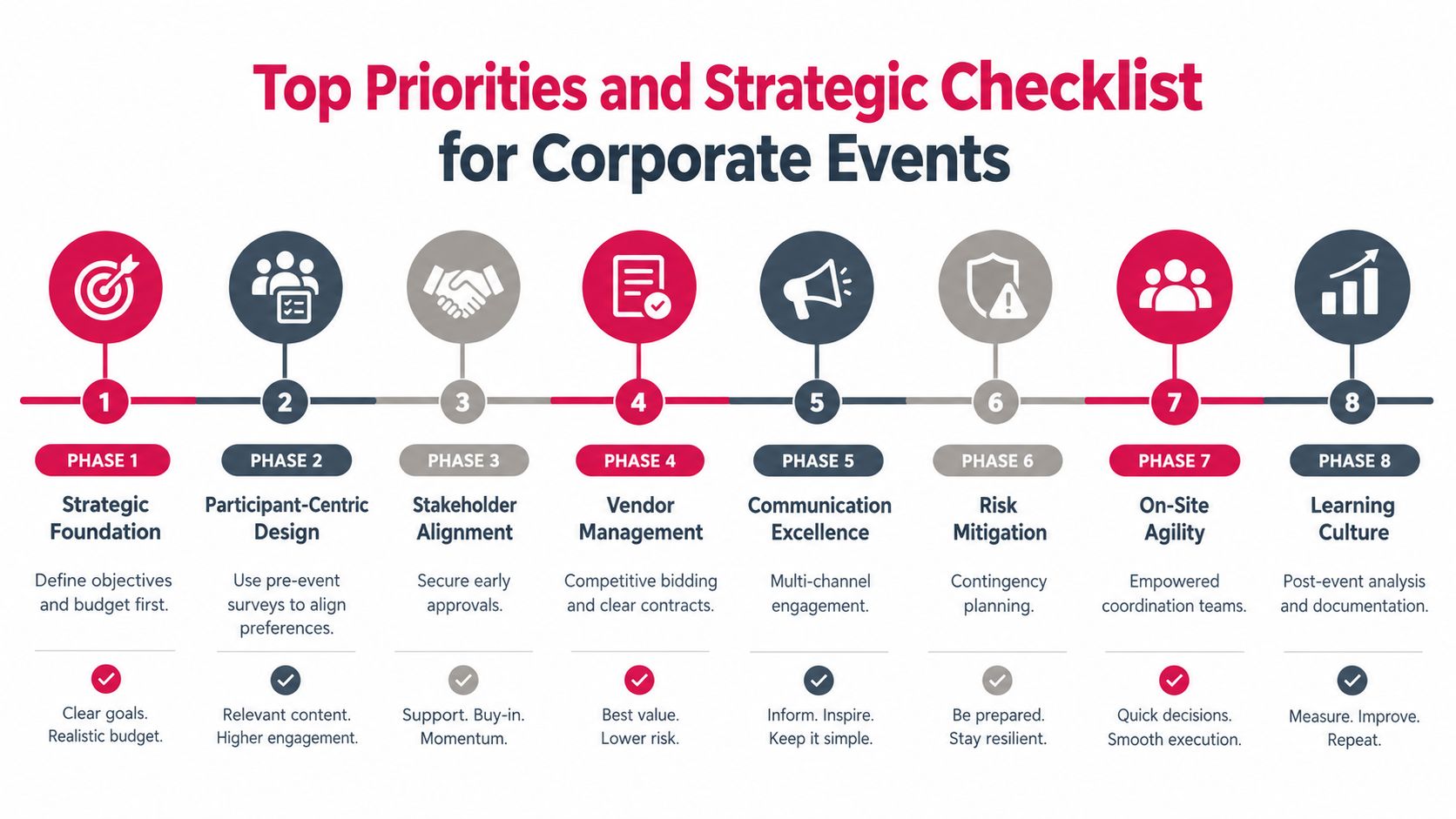
The graphic groups the nine steps above into eight delivery priorities — read it as a map of where attention goes during the run-up, not as a replacement for the sequence, with venue and catering sitting inside its vendor management phase.
For large programmes, walk the same list through the technology layer: registration and check-in throughput, streaming and recording, presentation playback, networking tools, data capture and consent, and who provides on-site support. Confirm with the venue that any stream sits on a hardline separate from the public Wi-Fi, and that mission-critical hardware has backup power.
9-Point Corporate Event Planning Checklist Comparison
| Planning Step | 🔄 Planning Effort | ⚡ Budget & Team Load | 📊 What Good Looks Like | ⭐ Best Suited To | 💡 Practical Tips |
|---|---|---|---|---|---|
| Define Event Objectives and Budget Parameters | Medium, stakeholder alignment and approval workflows | Low (strategic time, finance input) | Clear goals, budget guardrails, measurable ROI | All events; essential for retreats, launches, and sponsor-backed projects | Prevents scope creep; build 10–15% contingency; document assumptions |
| Select Venue and Accommodation | Medium–High, site visits, contracts, negotiations | High (deposits, site visits, logistics) | Consolidated logistics and improved attendee experience | Multi-day offsites, international groups, executive retreats | Price each inclusion separately rather than as a bundle; get every inclusion in writing; start sourcing at least three months out, earlier for fixed dates or scarce inventory |
| Create Comprehensive Activity and Experience Plan | High, multiple tracks, vendors, scheduling complexity | High (vendors, local partners, coordination tools) | Greater engagement and memorable experiences | Team-building, cultural programs, large diverse groups | Survey attendees; mix energy levels; protect unstructured time in every day |
| Manage Catering and Dietary Requirements | Medium, data collection and vendor coordination | Medium–High (per-person costs, specialist prep) | Improved satisfaction, inclusivity, reduced allergy risk | Dinners, multi-day events, international audiences | Collect requirements before menu approval; request separate prep areas and utensils; confirm the final count through the venue's agreed process |
| Stakeholder Alignment, Approvals & Vendor Contract Negotiation | High, multi-stakeholder reviews, legal checks, RFPs | Medium (procurement time, legal resources) | Clear contracts, cost savings via competitive bidding | Large budgets, regulated industries, complex vendor mixes | Send every bidder identical assumptions; compare on scope and exclusions, not headline price; name one internal contact and one supplier lead |
| Develop Risk Management and Contingency Plans | Medium–High, risk assessments and backup arrangements | Medium (insurance premiums, standby vendors) | Faster incident response and financial protection | Outdoor events, remote locations, high-profile gatherings | Create risk matrix; secure cancellation/liability/med-evac insurance; pre-negotiate backups |
| Create Detailed Participant Communication & Engagement Plan | Medium, multi-channel content and cadence management | Low–Medium (email/SMS/app tools, content time) | Higher RSVPs, reduced no-shows, better on-site alignment | Events with pre-registration, complex schedules, hybrid audiences | State every required decision and its response deadline; give each channel one job; send the survey while details are fresh |
| Gather Feedback & Execute Post-Event Analysis | Medium, surveys, debriefs, financial review | Low–Medium (survey tools, analysis effort) | Actionable lessons, ROI evidence, vendor insights | Recurring programs and any event seeking continuous improvement | Keep the survey short enough to finish; debrief within the agreed post-event window; record each vendor as hire again, conditional, or do not hire |
| Top Priorities & Strategic Checklist for Corporate Events | Low, high-level framework but needs follow-through | Low (checklist adoption, planning alignment) | Focused planning sequence; higher-impact decisions | Early-stage planning for offsites, retreats, large gatherings | Use as sequencing tool; integrate surveys, approvals, risk and post-event analysis |
Turn the Checklist Into Your Event Control Center
A checklist only protects the event when it has an owner. Convert each stage into a task with a named person, deadline, approval status, supplier contact, dependency, budget effect, and contingency note. If a task has no owner, it isn't controlled. If it has no deadline, it isn't scheduled. If it has no approval status, it isn't ready to drive a supplier commitment.
Use the sequence as a set of decision gates. First, measure the objective and protect the budget. Then choose a venue and destination that support the attendee journey, not just the brand image. Design varied experiences for different interests, energy levels, abilities, dietary requirements, and cultural expectations. Confirm catering, transport, room use, production, accessibility, registration, and communications before the run of show becomes fixed.
Resilience belongs in the main plan. Build alternatives for weather, supplier failure, medical incidents, security concerns, transport disruption, and digital touchpoints. Test hybrid flows rather than assuming the technology will work because it worked during a demonstration. Give staff a clear escalation route, current contact list, emergency procedure, and authority to make the decisions they've been assigned.
Post-event analysis completes the sequence. Reconcile approved, committed, and actual spend. Collect participant and staff feedback. Record vendor performance, unresolved issues, useful destination knowledge, and changes for the next event. A corporate event becomes more valuable when the organization can reuse what it learned in Barcelona, London, Prague, Dubai, or any future European or MENA destination.
MyPerfectStay can support the preference and coordination layer when a retreat includes shared experiences. Participants can privately submit budget, interests, energy level, and must-see ideas, then use group voting and match scores to narrow choices. Organizers can share itineraries, set deadlines, send nudges, and coordinate group bookings, which can reduce the chat-based debate that often slows activity selection.
Use the platform where it fits the event workflow, while keeping formal approvals, contracts, risk controls, and financial records in the systems your organization already governs. The strongest operating model combines human ownership with clear tools. It gives attendees a voice without giving up decision discipline.
Use MyPerfectStay to collect private group preferences, compare activities through match scores, organize shared itineraries, and coordinate bookings for a corporate retreat or offsite. Visit the platform to turn participant input into a clearer, more manageable experience plan.