Corporate Retreat Meaning: What It Really Is in 2026
September 17, 2026·MyPerfectStay
You've probably seen it happen in a Slack thread. Someone suggests a “company retreat,” another person proposes an “offsite,” and a third starts building an agenda for a “strategy session.” Within minutes, the team is debating destinations before anyone has agreed on what the gathering must accomplish.
That confusion is more expensive than it looks. A retreat designed for trust needs different people, activities, and pacing from an executive planning session. A meeting that moves to a hotel may still be a meeting, no matter how attractive the setting is.
The practical corporate retreat meaning is this: a deliberately structured, time-bounded gathering that takes a defined group away from daily operations so it can pursue one or two specific outcomes. The rest of the terminology becomes easier once you identify the outcome first.
Table of Contents
- The Moment Every Planner Hits the Same Wall
- How the Corporate Retreat Got Its Modern Shape
- The Three Ingredients That Define a Corporate Retreat
- Retreat vs Offsite vs Meeting in Plain English
- Four Retreat Types Startups Actually Use
- KPIs That Match the Purpose You Picked
- Startup Retreats Across Europe and MENA
- Choosing the Right Format Without Burning the Budget
The Moment Every Planner Hits the Same Wall
The planning problem usually starts with a reasonable instinct. A founder notices that priorities feel scattered, a leadership team has stopped having difficult conversations, or remote colleagues barely know one another beyond scheduled calls. Someone writes, “We should do a retreat,” and the planning begins before the business problem has a name.
That creates predictable friction. Finance asks for a budget, people operations asks who should attend, and department leaders submit unrelated agenda ideas. One group wants workshops, another wants hiking, and someone else wants a celebration. Each suggestion may be sensible, but they don't belong in the same event unless the team decides which result matters most.
Start with the problem, not the property
Ask one question before comparing villas, hotels, or countryside estates:
What must be different when everyone returns to work?
A strategy gathering might need a short list of agreed priorities and owners. A team reset might need better trust between groups that have been operating in silos. A leadership retreat might need a decision on roles, governance, or a difficult organizational change. These outcomes require different levels of confidentiality, facilitation, preparation, and informal time.
A meeting normally supports ongoing operations. It has a recurring rhythm, a defined set of agenda items, and decisions or updates that move work forward. An offsite takes a team away from its normal workplace to focus attention on a concentrated business problem. A retreat adds a broader experience, often combining strategic work with reflection, relationship-building, culture, or recovery.
The definition to use in planning
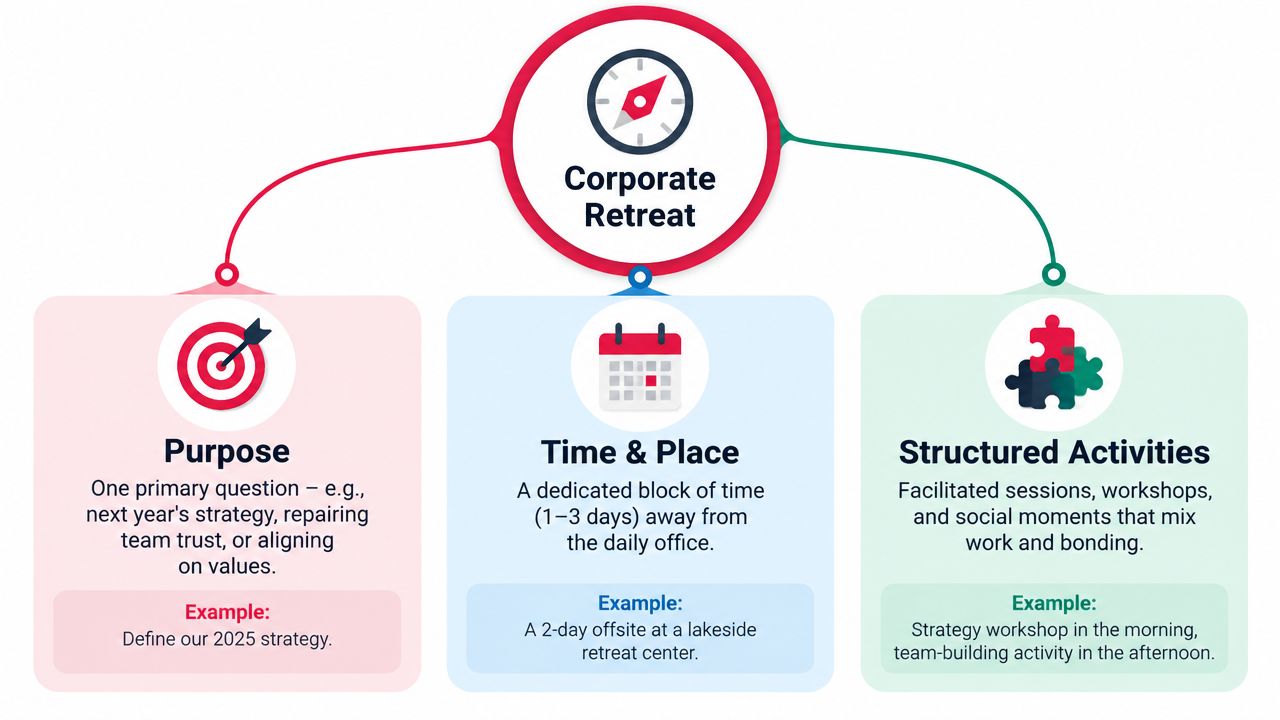
A gathering qualifies as a corporate retreat when three conditions are present:
- The group leaves normal operating conditions: Participants gain distance from everyday interruptions and routine responsibilities.
- The event has a defined purpose: The organizers can state the primary question in one sentence.
- The agenda is intentionally designed: Sessions, meals, activities, and downtime support the desired outcome rather than filling open space.
This definition keeps the term useful. It also prevents a common mistake, booking an expensive destination and hoping meaning appears once everyone arrives.
How the Corporate Retreat Got Its Modern Shape
The modern retreat didn't emerge from one business tradition. It combines several older ideas about how leaders and teams learn, make decisions, and build relationships.
Its early shape came from postwar management development. Companies such as IBM used multi-day off-site development programs in the 1950s, while General Electric opened its Management Development Institute in Crotonville, New York, in 1956, as documented in this history of the corporate retreat. Senior managers were taken away from their ordinary workplace because development required more than another desk-side conversation. Distance created room for reflection, instruction, and peer exchange.
By the 1960s and 1970s, the format had moved beyond executive education. Companies held off-site gatherings at resorts, country clubs, and conference centers for strategic planning, team building, and morale. The setting became part of the method. A different physical environment changed how colleagues interacted, while facilitated group work made it possible to examine problems that routine meetings tended to avoid.
Three traditions converge
The first tradition is the executive residency, where leaders step away from daily demands to think about direction and responsibility. The second is experiential team-building, where shared tasks and informal time help colleagues develop trust. The third is the operational planning sprint, where a group works intensely toward decisions, priorities, or deliverables.
Startups later repackaged these traditions as company offsites. A small team could combine annual planning, customer learning, product debates, and a shared dinner in one carefully chosen setting. The label changed, but the underlying logic remained: remove routine noise, create shared context, and use concentrated time for work that is difficult to complete asynchronously.
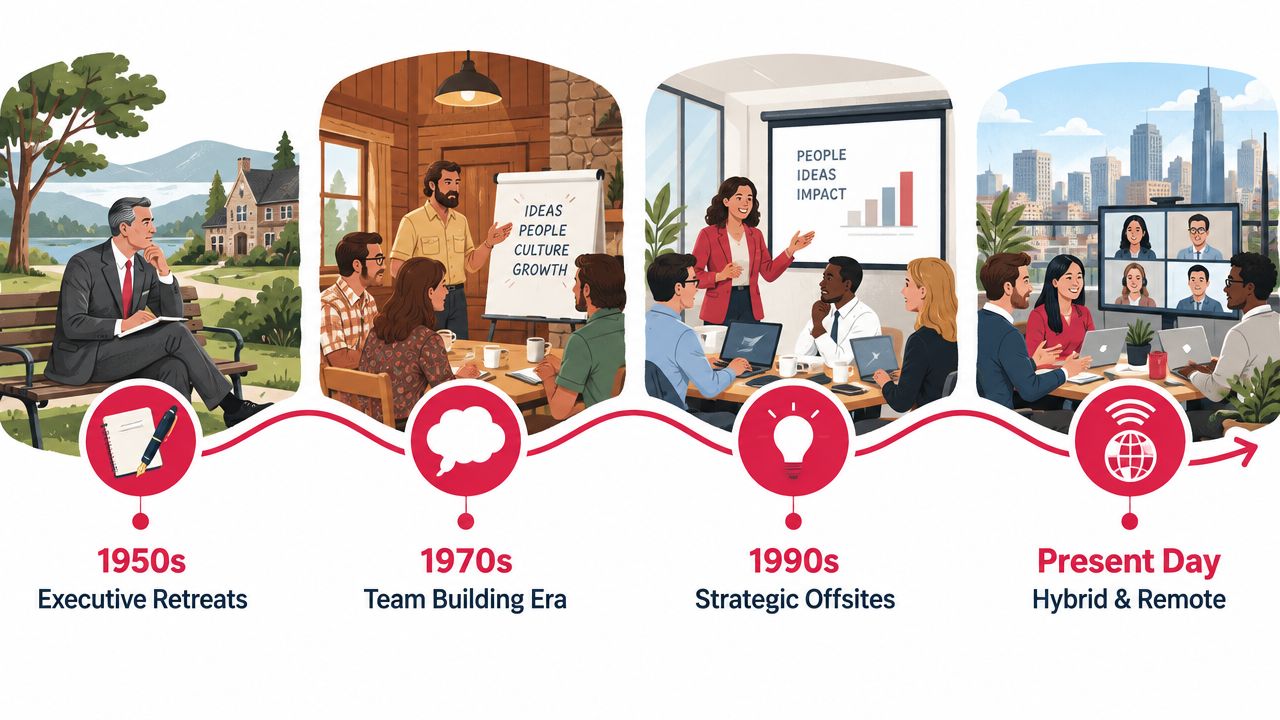
Remote and hybrid work have made the distinction more important. Distributed teams lose many of the small, unplanned interactions that help colleagues interpret intent and build familiarity. A retreat can provide that high-bandwidth contact, but only if the organizers choose whether they're prioritizing strategy, connection, development, or recovery.
By the 1990s, the retreat had become a fixture of American business culture, and its modern meaning had broadened again. It isn't a vacation or an executive seminar. It's a structured pause that borrows from executive reflection, team experience, and planning discipline.
The Three Ingredients That Define a Corporate Retreat
A useful definition should help you make decisions. Break the concept into purpose, structure, and duration, then test the proposed event against all three.
Purpose answers the primary question
Every effective retreat has one dominant question, even when it includes secondary goals. Examples include setting the next year's strategy, repairing trust after a layoff, onboarding a new leadership layer, or aligning a cross-functional group around values.
That question determines almost everything else. A strategy retreat needs pre-reading, decision owners, and a process for resolving disagreement. A trust-focused retreat needs space for personal exchange and activities that don't turn every interaction into another performance exercise.
Don't confuse a list of topics with a purpose. “Marketing, hiring, culture, product, and team bonding” describes an overloaded agenda. “What will we prioritize over the next planning cycle, and who owns each priority?” gives the group a usable target.
Structure turns time away into an intervention
A retreat needs a deliberate sequence. Facilitated sessions may handle the hardest decisions in the morning, while shared meals, walks, or optional activities create the informal contact that structured workshops can't produce. Reflection also needs protection, especially after emotionally demanding conversations.
The organizers should decide which parts are mandatory, which are optional, and where participants can recover. An open calendar isn't freedom if everyone spends it answering messages or improvising logistics.
For practical planning, review this guide to corporate team-building activities when choosing experiences that support the stated purpose instead of distracting from it.
Duration creates separation from routine
A retreat must last long enough to interrupt normal habits and create shared momentum. Industry guidance often places retreats across multiple days, while shorter offsites tend to be denser and more workshop-oriented, as outlined in this corporate retreat definition guide.
The exact length depends on travel, group size, and objective. A leadership decision may need a concentrated format. A culture reset may benefit from more informal time. The important test is whether the event has enough room for meaningful work and the human interaction that makes the work stick.
If purpose, structure, and duration aren't explicit, the event is probably a trip with meetings attached. It may still be enjoyable, but the planning team won't know what success looks like.
Retreat vs Offsite vs Meeting in Plain English
The labels overlap, so use them as planning signals rather than rigid legal categories. A quarterly planning gathering can be both an offsite and a retreat if it combines concrete decisions with reflection and relationship-building.
| Criterion | Meeting | Offsite | Corporate Retreat |
|---|---|---|---|
| Primary objective | Handle recurring operations, updates, and decisions | Solve a defined business problem away from daily distractions | Combine a clear outcome with connection, reflection, culture, or rest |
| Typical duration | Usually brief and recurring | Often concentrated and shorter than a retreat | Commonly spans multiple days when the agenda needs work and shared experience |
| Location choice | Office, video call, or regular meeting venue | A workshop-ready venue chosen for focus | A setting that supports both structured sessions and informal interaction |
| Agenda ownership | Meeting owner or rotating facilitator | Project lead, executive, or team lead | A planning owner, often supported by people operations or a facilitator |
| Expected outputs | Decisions, updates, assignments, and follow-up actions | A roadmap, resolution, plan, or aligned decision | Business outcomes plus stronger relationships, shared context, or cultural clarity |
A meeting asks, “What needs attention today?” An offsite asks, “What concentrated work can we complete if we remove normal interruptions?” A retreat asks, “What outcome and shared experience does this group need to move forward together?”
That difference affects the participant list. A product offsite may need the product, engineering, design, and commercial leaders closest to a roadmap decision. A company retreat may include a much broader group because connection and culture are part of the intended result.
A practical naming test
Use meeting when the event could happen in the normal weekly rhythm without losing its value. Use offsite when the location mainly protects focus. Use retreat when the setting, pace, and social design are essential to the outcome.
The label should help stakeholders understand what they're being asked to do, not make an ordinary meeting sound more important.
Four Retreat Types Startups Actually Use
Startups rarely need a retreat because the calendar says so. They commission one when a specific organizational need has become difficult to solve through normal work. Four patterns appear repeatedly.
Strategy retreat
A strategy retreat converts ambition into choices. A Series A SaaS team might gather in the Dolomites to decide which opportunities deserve attention over the next twelve months, what the company won't pursue, and which leaders own the resulting bets.
The defining outcome is a small set of decisions with accountable owners. The budget posture should favor facilitation, reliable meeting space, and travel that protects concentration over decorative extras. Leadership signals that the company will make room for serious thinking instead of adding another planning document to an already crowded week.
Team-bonding retreat
A team-bonding retreat addresses trust, familiarity, and collaboration. A remote-first group of 40 people might spend two days in Andalusia using shared meals, low-pressure activities, and facilitated conversations to help colleagues understand how others work.
The outcome isn't a vague feeling of fun. It may be improved willingness to ask for help, clearer cross-team relationships, or a stronger sense of belonging. The budget should protect shared experiences and accessibility, while avoiding activities that embarrass, exclude, or force personal disclosure.
Training retreat
A training retreat pairs skill development with peer learning. An engineering leadership group in Lisbon could combine manager workshops, case discussions, practice sessions, and time for leaders to compare how they handle common situations.
The useful test is application after the event. Participants should leave with a behavior to practice, a shared language, or a capability that managers can observe. This format sends a development signal: the company treats leadership and technical growth as operating infrastructure, not a reward reserved for quiet periods.
Culture or values retreat
A culture retreat becomes relevant when norms need deliberate attention, often after a merger, rapid expansion, or leadership change. A MENA fintech might bring its Dubai and Cairo teams together to define how decisions are made, how disagreement is handled, and which values should appear in everyday management.
The outcome is behavioral clarity, not a wall of polished words. The budget should support inclusive participation, thoughtful facilitation, and enough time for different groups to explain their expectations.
For programs that deliberately include restoration alongside business work, this overview of body and soul retreats can help planners distinguish wellness elements from a full wellness objective.
A retreat can contain elements from all four types, but one should lead. Without a dominant archetype, the agenda tends to become a collection of reasonable requests with no shared measure of value.
KPIs That Match the Purpose You Picked
The right metric follows the retreat's primary question. Generic satisfaction scores can tell you whether people liked the venue or enjoyed the activities, but they can't prove that a strategy retreat produced strategic clarity.
Measure the change the event was designed to create
| Retreat Type | Primary KPIs | Time Horizon |
|---|---|---|
| Strategy | Clarity of priorities, alignment feedback, decisions locked, and ownership recorded | During the event and in the following work cycle |
| Team bonding | Pulse feedback, peer-trust indicators, and observed collaboration across teams | Immediately after the retreat and through subsequent project work |
| Training | Skill application, completed learning requirements, and manager confidence in the new capability | After participants return to their roles |
| Culture or values | Evidence of values in performance conversations, management behavior, and retention checks | Across later review and people cycles |
A strategy retreat should produce a visible decision trail. If leaders leave with attractive notes but no owners, deadlines, or communication plan, the event created discussion rather than alignment.
A team-bonding retreat needs a different reading. Participants may report stronger connection, but leaders should also watch whether people contact colleagues outside their usual group, share information earlier, or collaborate more easily on cross-functional work.
Keep the measurement proportional
Don't build a measurement system larger than the retreat's purpose. A small leadership session may need a decision log and a follow-up review. A company-wide culture gathering may justify broader feedback and later checks on behavior.
For a wider reference point on selecting startup success metrics by Founder Connects, planners can compare retreat measures with the metrics already used to run the business. That connection matters because a retreat shouldn't become a separate measurement universe. Its outputs should feed the operating system leaders already trust.
The strongest follow-up happens before people travel home. Assign owners, schedule the review point, and tell participants how the organization will use what they produced.
Startup Retreats Across Europe and MENA
A destination becomes useful when it changes the quality of the interaction, not when it merely looks impressive on a proposal. Three examples show how the same broad format can serve different startup needs.
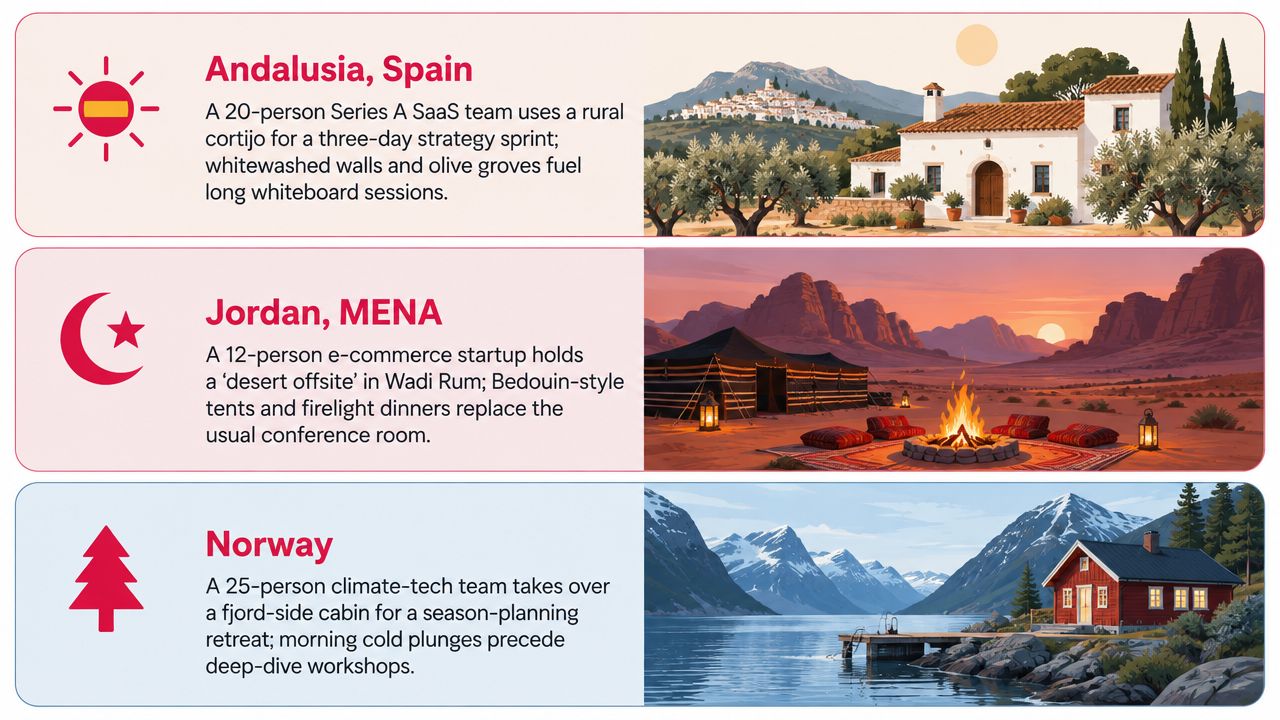
A 20-person Series A SaaS team could use a rural cortijo in Andalusia for a strategy retreat. Whiteboards in a courtyard create a physical record of the debate, while a chef-led tapas dinner closes the working day without turning dinner into another presentation. The format gives the team a clear boundary between demanding planning and informal conversation, which can help leaders examine trade-offs without carrying every discussion into the evening.
A Dubai-based fintech might choose a desert lodge outside Abu Dhabi for a leadership retreat. Quiet time in the dunes provides a change of pace, while structured one-on-ones between founders and direct reports create room for conversations that crowded offices often postpone. This is a leadership and culture format, not a sightseeing itinerary. The destination supports privacy and reflection, while the agenda carries the actual work.
A Lisbon remote-first startup could book a coastal estate for a cross-team alignment retreat. Workshop blocks handle role clarity and decision-making, while surf lessons give colleagues a shared activity that doesn't resemble another collaboration exercise. The contrast helps the organizer protect both sides of the design, focused work and low-pressure contact.
Match place to the work
Destination guidance currently places Lisbon first in one 2026 team-building index, followed by Barcelona, Prague, Mallorca, and Budapest. The same index describes Lisbon's appeal through coastal activities, flight connectivity, and competitive ground costs in its corporate team-building destination ranking.
That doesn't make Lisbon the automatic answer. Barcelona may suit a larger urban program, Prague may work for a compact planning group, and Andalusia may provide the privacy a sensitive leadership conversation requires. In MENA, Dubai and Abu Dhabi can support polished hospitality, while Jordan offers a more pronounced change of environment for teams seeking distance from office routines. The same logic produces other pairings: a Wadi Rum desert camp suits a small team that wants a complete environmental reset, and a Norwegian fjord property suits a season-planning retreat that rewards early starts and long, uninterrupted focus blocks.
Choose the destination after deciding the retreat type. A beautiful location can't repair a vague purpose, but the right setting can make the intended behavior easier.
Choosing the Right Format Without Burning the Budget
Longer doesn't automatically mean more productive. A five-day international trip may sound substantial, but a nearby two-day format can serve a narrow decision much better if the team arrives prepared and leaves with clear ownership.
Start with a cost-per-outcome lens. Divide the fully loaded budget by the number of decisions, behaviors, or connections the event is intended to produce. This isn't a universal finance metric, but it forces useful questions. Are you paying for a destination because the work requires privacy and immersion, or because nobody has defined a more suitable format?
A regional property may be appropriate for a strategy sprint. A local venue may be enough for a leadership decision. A virtual or hybrid format can work when the objective is information sharing or preparation, but it may not replace face-to-face time when trust, conflict repair, or relationship-building is the central need.
Pressure-test the quote
Before signing, separate the budget into clear categories:
- Venue: Meeting rooms, bedrooms, shared areas, equipment, and cancellation terms.
- Travel: Flights, transfers, local transport, and arrival timing.
- Food and beverage: Meals, refreshments, dietary requirements, and social dinners.
- Facilitation: External facilitators, workshop materials, interpretation, or production support.
- Contingency: Changes in attendance, weather alternatives, unexpected transport, and other operational risks.
For European retreats, some countries apply 15% to 25% VAT to accommodation, catering, and event services, according to this Europe corporate retreat locations guide. A separate Europe budgeting guide estimates flights at about €130 to €350 per person, accommodation at roughly €80 to €180 per night for a group block or Airbnb, and a three-night offsite at about €600 to €1,100 per person all-in. Treat those figures as planning references, not a substitute for a venue-specific quote, and review the assumptions in the Europe retreat budget guide.
For the practical logistics behind rooming, travel windows, dietary needs, attendance, and shared itineraries, review corporate retreat planning before you commit to a format.
MyPerfectStay helps corporate teams collect private preferences, travel windows, rooming details, dietary needs, and attendance status, then use group voting and a shared itinerary to coordinate the retreat. Visit MyPerfectStay to compare options, align the group, and turn the agreed retreat plan into bookable activities and logistics.