Creating a Trip Itinerary: A Stress-Free Framework
September 7, 2026·MyPerfectStay
Someone has already suggested Paris, someone else wants a desert safari in Dubai, and a third person has dropped six restaurant links into the group chat without saying which night they fit. Notifications keep arriving, but nobody knows what's been decided. By the time the trip gets close, the group has a long list of ideas, no shared priorities, and several people privately expecting a different holiday.
Creating a trip itinerary for a group isn't a matter of copying attractions into a calendar. It's a process of turning different budgets, energy levels, interests, and assumptions into a plan people can follow. The right framework reduces debate before it starts, protects time for rest, and leaves enough flexibility for the trip to feel like travel rather than project management.
Table of Contents
- Why Most Trip Itineraries Fail Before They Start
- Laying the Foundation for Your Trip
- Researching and Prioritizing Activities
- Structuring Your Day-by-Day Itinerary
- Managing Group Dynamics and Communication
- Fine-Tuning Your Itinerary and Troubleshooting
Why Most Trip Itineraries Fail Before They Start
The first planning meeting often uncovers the underlying problem. One traveler wants museums in London, another is researching nightlife in Barcelona, and someone else is saving beaches near Santorini. Everyone is contributing, but each person is building a different version of the holiday.
Group chats amplify the confusion. Suggestions arrive without context, useful details disappear under reactions, and silence gets treated as agreement. A busy conversation can continue for weeks without answering the questions that shape the itinerary: What should this trip feel like? Which experiences deserve protected time? How much movement can the group handle without exhausting the least energetic traveler?
The planning burden is measurable. Priceline's 2024 travel-planning research found that 22% of U.S. adults consider creating a trip itinerary one of the most frustrating parts of planning, while the average traveler spends the equivalent of two full workdays, or 16 hours, planning and booking a trip. Among Gen Z and Millennials, planning takes more than 20 hours. Every unresolved preference adds another decision to that workload.
Practical rule: Don't solve an alignment problem with more links.
The process matters more than the list
A long list can feel like progress, yet every additional option creates another comparison and another chance for preferences to collide. This is especially draining for groups with mixed energy levels. The traveler who wants an early hike may not want a late dinner, while someone else may value nightlife enough to accept a slower morning.
Use a staged process. Agree on the trip's purpose, record the constraints that limit viable choices, and ask each traveler to name a few genuine priorities rather than submit an unlimited wish list. Select a small set of defining experiences, then arrange the schedule around recovery time and realistic travel distances. Restaurants, optional stops, and spare-time ideas come last.
This order reduces decision fatigue and makes trade-offs visible. A traveler whose preference is not selected can still see whether the group protected their budget, rest time, or one requested experience. The final itinerary will not satisfy every preference equally, but it can give everyone a clear reason to support the plan.
Laying the Foundation for Your Trip
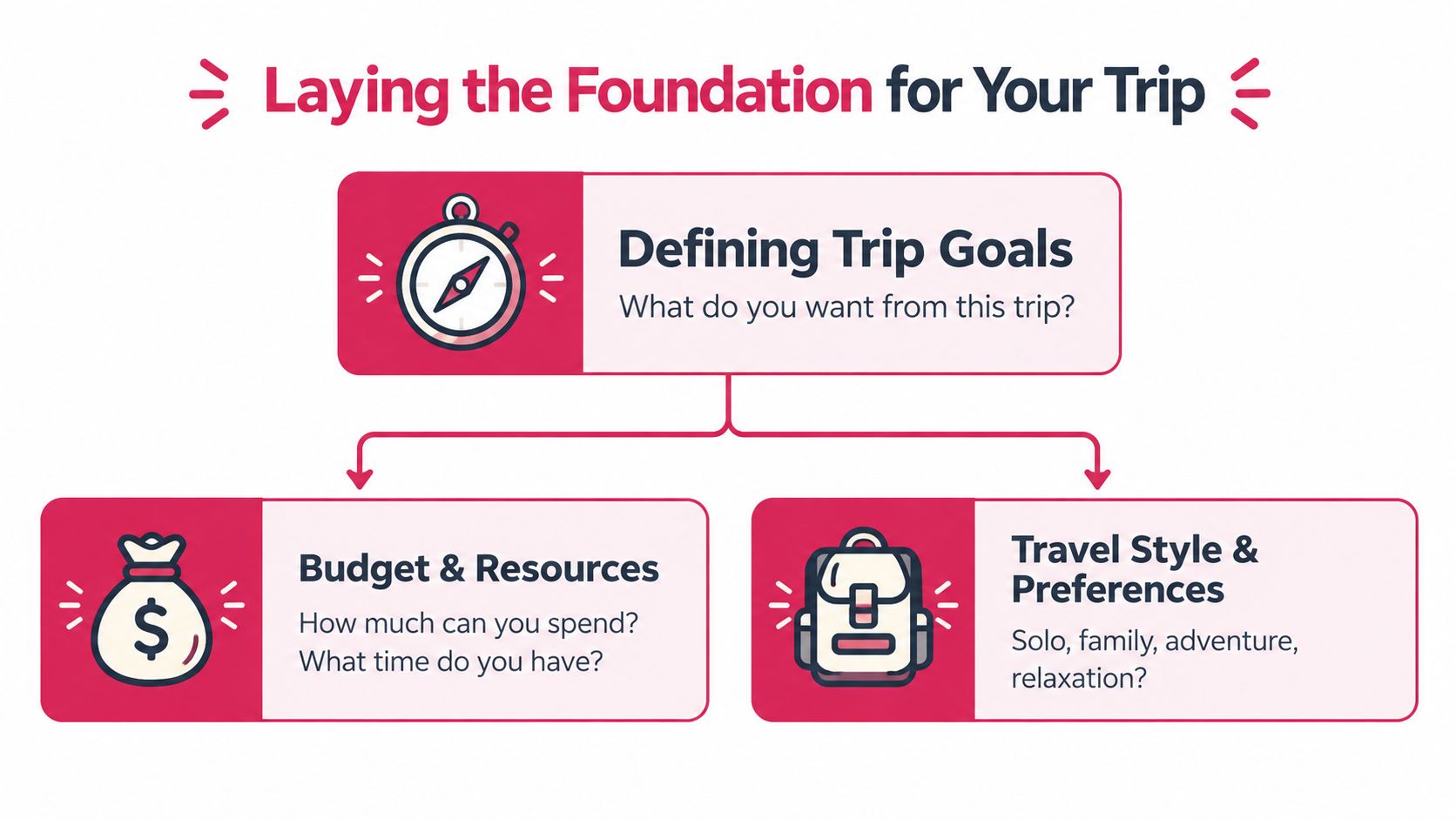
A group can spend an evening comparing hotels, then discover that half the options exceed the budget or require a pace nobody wants. Set the trip's operating rules before researching activities. This keeps conflicting preferences visible and prevents wasted decisions.
Define what the trip should feel like
Start with one question: What do we want to remember about this trip? The answer gives the group a filter for later choices and a way to resolve disagreements.
A group seeking slow mornings, swimming, and scenic dinners may choose Santorini and protect unstructured time. Travelers interested in archaeology, food, and walking could build an Amman and Petra plan around cultural visits and local meals. A Prague city break may prioritize architecture, galleries, and compact neighborhood walks. A multi-generational holiday in Tuscany may require accessible sightseeing, long lunches, and fewer hotel changes.
Turn the answer into observable rules. “Relaxing” might mean one major cultural activity per day. “Social” could mean free evenings for shared dinners, while “active” may allow early starts but require recovery after demanding outings.
Record constraints before preferences
Hard constraints narrow the field before personal preferences create debate. Record:
- Dates and arrival conditions: Note when the group lands, when rooms are available, and whether the first day is likely to be low-energy.
- Budget boundaries: Set a comfortable range for accommodation, transport, meals, and activities. Clarify whether travelers prefer paying costs before departure or keeping spending flexible during the trip. Agree on who pays deposits and how shared expenses will be settled.
- Transport preferences: Decide whether the group will walk, use public transport, hire drivers, rent a car, or combine methods.
- Pace and access needs: Note mobility limitations, young children, dietary requirements, preferred start times, and tolerance for changing locations.
Put these rules in writing. A budget that exists only in one person's head will become a conflict later.
Map traveler styles
Private responses usually reveal more than a group-chat debate. Ask each traveler to name must-haves, pleasant extras, hard noes, preferred daily start time, and acceptable walking or travel intensity. This separates genuine priorities from ideas that sounded appealing only because someone shared a link.
Research can quickly become another source of decision fatigue. Expedia Group's 2023 Path to Purchase findings report that travelers consume an average of 303 minutes of travel content and view 141 pages during the 45 days before booking. A shared planning system should turn that material into decisions, not another pile of tabs.
Finish with a short brief covering destination, dates, travelers, purpose, constraints, and individual priorities. If an activity fails that test, remove it before the group spends time arguing about it.
Researching and Prioritizing Activities
Research should produce decisions, not an ever-growing folder of possibilities. Begin with the experiences that would make the trip feel incomplete if they disappeared.
Most workable itineraries are organized around a few pillar activities: schedule-defining experiences that anchor a day and determine what can realistically sit beside them. That gives you a useful sequence: identify the pillars first, then arrange everything else around them.
Find the pillars
Each trip needs only a limited set of anchors. A London plan might revolve around a specific museum visit, a West End performance, or a major historic site. A Dubai itinerary might be built around a desert safari, while a Rome trip could center on a carefully timed visit to the Colosseum area. In Barcelona, a particular architectural tour or food experience may become the day's defining event.
A pillar usually has one or more of these characteristics:
- It has limited availability: Tickets, timed entry, or departure schedules make it harder to move.
- It defines the day: The group will naturally choose nearby meals and activities around it.
- It matches the shared purpose: It serves the experience the group wanted.
- It requires recovery: A physically demanding excursion may need a quiet evening afterward.
Research official attraction pages, reputable local operators, transport information, and recent traveler reviews. Record location, operating days, expected duration, booking requirements, accessibility information, and cancellation terms. Don't rely on a saved link alone. A place's location and hours determine whether it belongs in the itinerary.
Turn the long list into a shortlist
Separate activities into three categories: essential, preferred, and optional. Then score the essential and preferred choices against the same criteria, such as group interest, logistical fit, cost comfort, energy demand, and weather dependence.
A simple shared sheet works well. For larger groups, anonymous voting can prevent the most vocal traveler from dominating. Give each person a fixed number of votes, require a short reason for every “must,” and set a decision deadline. The objective isn't mathematical perfection. It's a transparent way to expose overlap and reveal where compromise is needed.
A shortlist should make the trip clearer, not prove how much research the organizer completed.
Apply ordinary prioritization discipline. Put high-impact, time-sensitive choices at the top, defer low-consequence extras, and stop reopening a decision once the group has accepted the trade-off.
For a more detailed look at digital planning workflows, review this travel planning app resource. Whatever tool you use, preserve one authoritative shortlist. Without that, rejected ideas will keep returning to the conversation.
Structuring Your Day-by-Day Itinerary
A day-by-day itinerary works when the route feels obvious. It fails when the group crosses a city repeatedly, underestimates every visit, and treats meals and transport as invisible time.
Start with the pillar activity, then look at the map. In Rome, the Colosseum, Roman Forum, and Palatine Hill belong in the same geographic cluster because separating them creates unnecessary movement. In Paris, a similar approach might group activities around the Louvre and the surrounding central neighborhoods rather than placing a distant attraction between them.
A workable Paris day
Suppose the group wants a cultural day in Paris. A poor version might begin with a morning museum on the Left Bank, move to Montmartre for lunch, return toward the center for another timed visit, and finish across the city at a restaurant. The schedule may look impressive, but the group spends much of the day in transit and has no protection against queues, delayed trains, or a slow lunch.
A more resilient version starts with one timed anchor in central Paris. The group leaves room before entry for breakfast and the journey from the hotel, explores nearby streets or gardens afterward, takes a proper lunch break in the same area, and reserves the late afternoon for a lower-pressure activity. Dinner stays close to the evening base.
The difference isn't the number of attractions. It's the order and density. The second plan clusters geography, alternates concentration with rest, and gives the group permission to stop before exhaustion sets in.
Build the schedule in layers
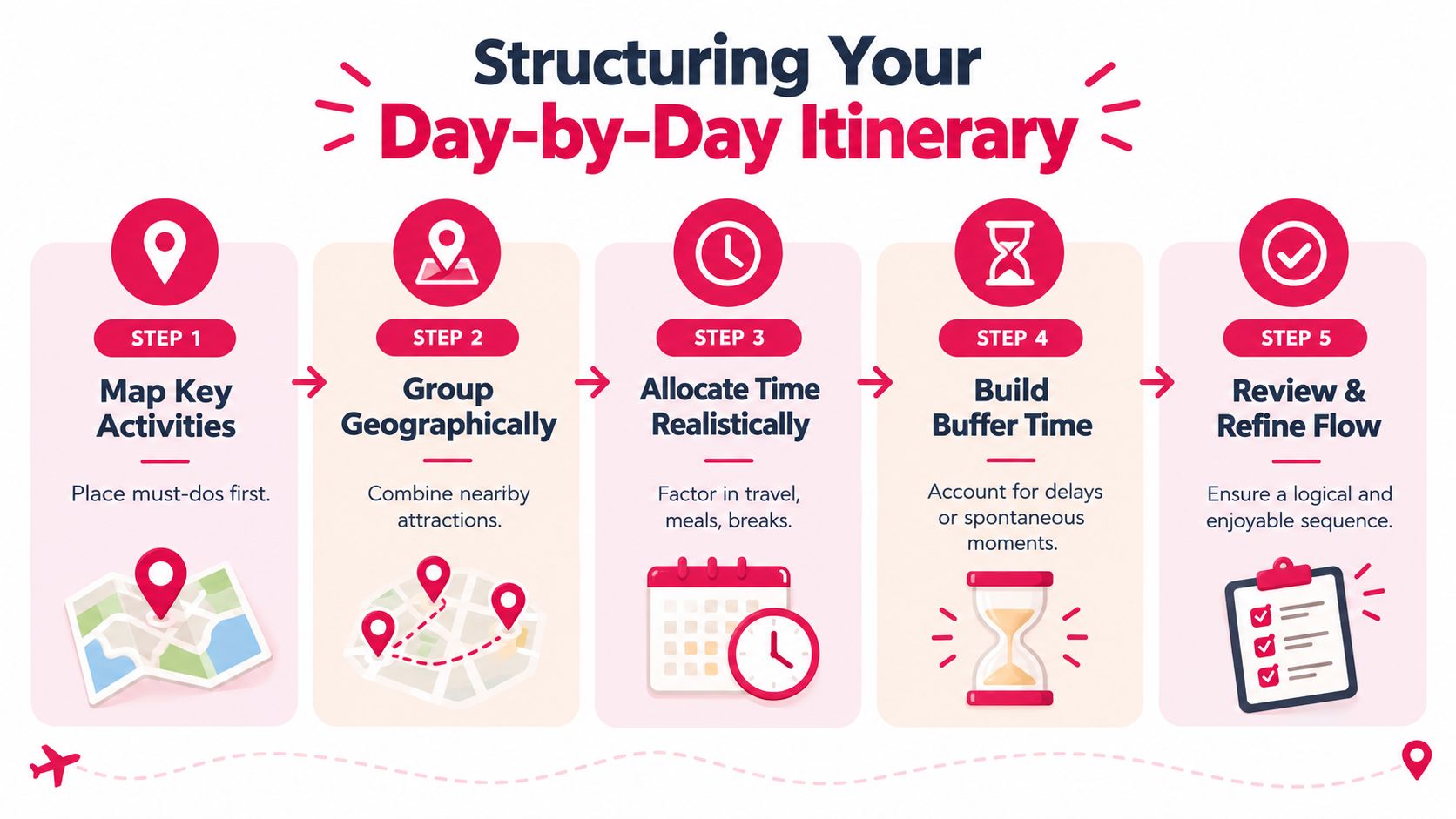
Place fixed commitments first, then add flexible elements. Use this sequence:
- Anchor the day: Add the timed museum, performance, tour, or excursion.
- Cluster the area: Choose nearby sights, cafés, markets, or parks.
- Allocate realistic time: Include transport, security lines, meals, toilets, photos, and regrouping.
- Add a buffer: Leave open space after major transitions and before anything that can't be missed.
- Review the flow and protect an exit: Check that the day reads as a sensible sequence, and decide what can be dropped if the group runs late or loses energy.
Don't schedule every hour. A group moves at the speed of its slowest transition, not the speed of the fastest traveler walking alone. Leave some evenings open, particularly after an arrival, a long excursion, or a day with substantial walking.
Lunch deserves deliberate placement rather than being treated as an afterthought. Inside a travel day it carries more weight than dinner, for a practical reason: midday food affects energy, location, and the group's willingness to continue.
For a city-break itinerary that balances landmarks with breathing room, use this city break planning guide as a further reference.
If you would rather build the schedule in a spreadsheet, this tutorial walks through a simple itinerary template:
Managing Group Dynamics and Communication
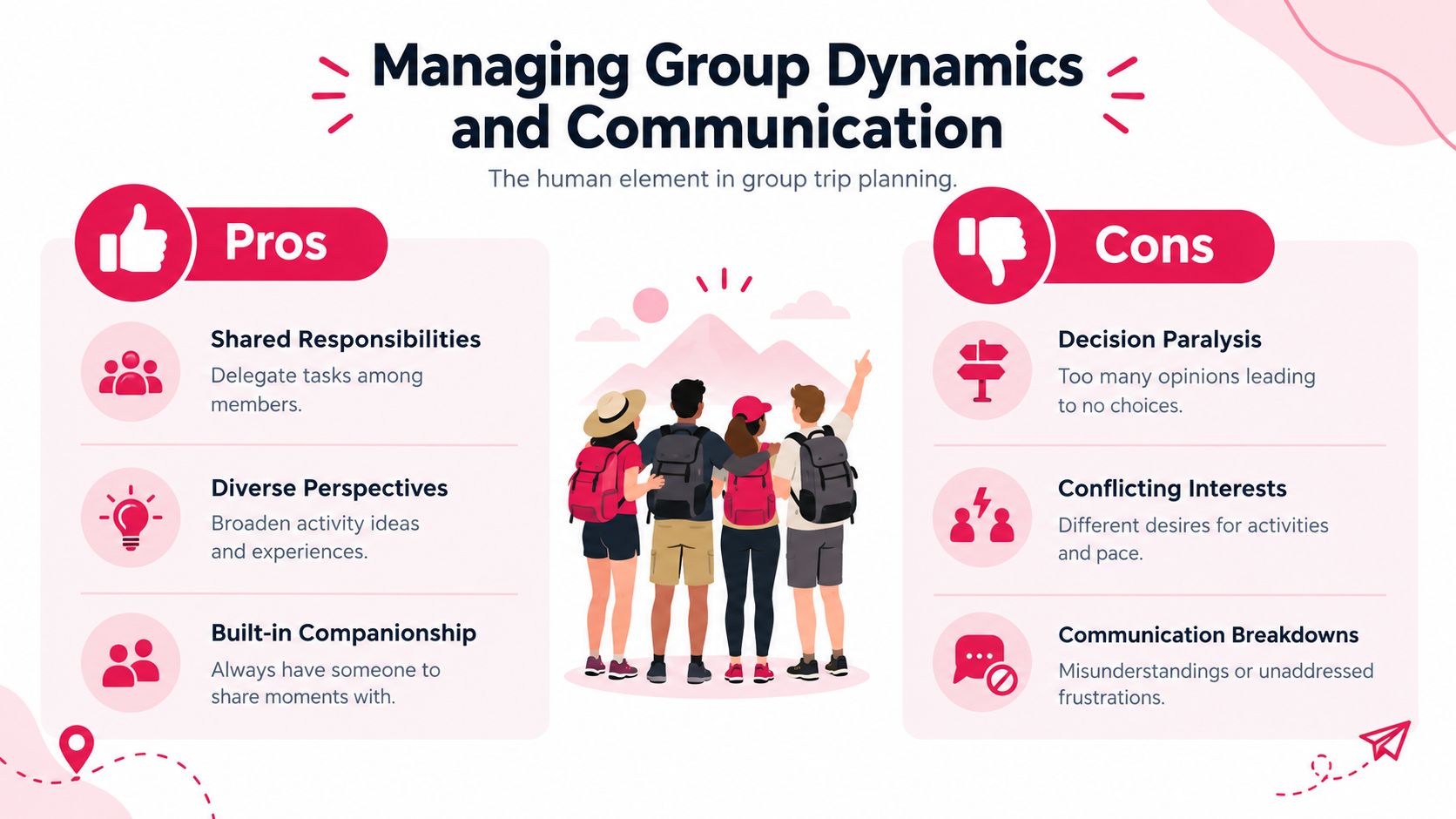
The itinerary is only as strong as the group's decision process. Logistics tell you what can fit. Group psychology determines whether anyone can agree on what should fit.
Choice overload is a practical planning risk, not a personality flaw. Skyscanner's 2025 “Wanderlost” research found that 60% of travelers feel overwhelmed by the pressure of planning the “perfect” trip, and that 30% abandoned travel plans in 2024 altogether because of overthinking. Those figures illustrate why more inspiration can make commitment harder, particularly when several travelers are comparing different standards of a “good” holiday.
Replace open debate with clear decisions
A group chat is useful for enthusiasm and quick updates. It's poor at storing final decisions. Use a defined process instead:
- Collect privately: Each traveler submits preferences without pressure to agree publicly.
- Present a shortlist: The organizer shares a small set of options that already fit the constraints.
- Vote once: Give everyone the same criteria and a clear deadline.
- Record the result: Mark the chosen option, the rejected alternatives, and the reason for the trade-off.
- Assign ownership: One person confirms tickets, another checks transport, and another tracks dietary or access needs.
This structure prevents repeated negotiation. It also makes disagreement safer because a traveler can say, “This doesn't suit my energy level,” without having to challenge the whole group in real time.
Make compromises visible
Groups often argue about activities when the deeper issue is pace. Someone wants a full day of sightseeing, another wants time by the pool, and a third wants to stay out late. Solve the conflict at the itinerary level rather than forcing everyone into every activity.
Build optional branches. One traveler can take a morning walking tour while another starts slowly and joins for lunch. A family group can split briefly for a strenuous excursion, then reunite for a shared meal. The plan remains collective without pretending that everyone wants identical days.
A decision framework can help organizers handle competing priorities without relying on instinct. This decision-making frameworks guide offers a useful reference for setting criteria and moving from opinions to an agreed choice.
The fairest plan isn't the one with equal activity time for everyone. It's the one where every traveler understands the trade-offs before departure.
Keep one final version of the itinerary. Add dates, meeting points, booking references, cancellation information, and the name of the person responsible for each reservation. Send updates through one channel, and label superseded versions clearly so nobody follows an old restaurant or meeting time.
Fine-Tuning Your Itinerary and Troubleshooting
Final review is where a flexible plan becomes executable. Check every reservation against the actual route, arrival time, group needs, and cancellation conditions. Book the elements that control availability first, while leaving low-risk meals, neighborhood walks, and optional stops open where possible.
Work back through the hard constraints first: dates, party composition, home base, and transport mode. Then filter the remaining activities by time and energy, which matters most for mixed-energy and multi-generational groups. Finish with one practical check: don't ask whether the schedule looks exciting in isolation. Ask whether this specific group can execute it comfortably.
Lock the essentials
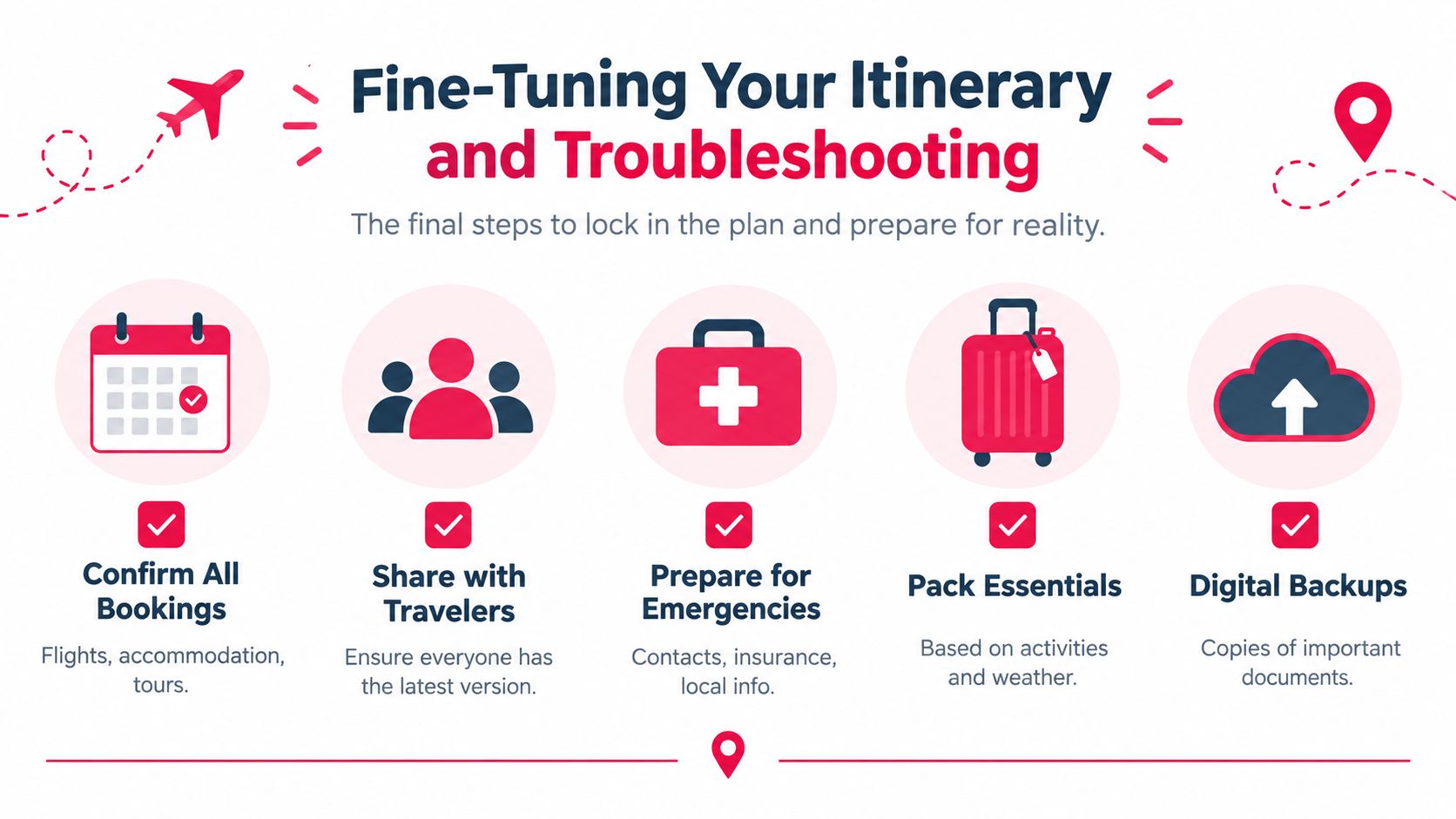
Confirm the details that could derail the day:
- Reservations: Verify names, dates, start times, meeting points, and ticket requirements.
- Route logic: Check the distance between the hotel, activity, meal, and next commitment.
- Energy demands: Flag early starts, long walks, stairs, heat exposure, and late finishes.
- Communication: Share the current itinerary with every traveler and identify the organizer for urgent decisions.
- Backups: Save confirmations and key contact details offline, not only in a single person's inbox.
A sold-out attraction in Barcelona shouldn't destroy the day. Keep a nearby alternative that serves the same purpose, such as another cultural site, a market, or a guided neighborhood walk. If rain changes an Amsterdam plan, move outdoor sightseeing to a shorter window and substitute an indoor museum, café route, or food experience. The backup doesn't need to be equally famous. It needs to preserve the day's character.
Design for real people
Mixed-energy groups need permission to diverge temporarily. Write optional activities directly into the itinerary, state where the group will reunite, and avoid making the tired traveler negotiate from scratch. If the morning runs late, remove the least important item rather than compressing every remaining activity.
A useful final itinerary contains three layers:
- Fixed: Booked activities, transport, accommodation, and meeting times.
- Preferred: Meals, neighborhoods, and visits that can move within the day.
- Optional: Extras that happen only if energy, weather, and time allow.
That hierarchy turns disruption into a simple decision. Keep the fixed layer, protect the group's energy, and choose from the preferred or optional layers without reopening the entire trip.
MyPerfectStay helps groups collect private preferences, vote on activities, surface shared matches, and organize the results into a shared daily itinerary that can be booked together. Visit MyPerfectStay to start coordinating your next Europe or MENA group trip with fewer chat debates and a clearer plan.