Customized Travel Planning: The Complete 2026 Guide
September 25, 2026·MyPerfectStay
In one 2025 survey, 61% of U.S. travelers said they value personalized travel recommendations, but the harder problem is reconciling those preferences across a group. Effective customized travel planning balances individual desires with collective agreement, turning competing wish lists into a trip everyone can support.
The familiar version starts in a group chat. One person wants museums in Paris, another wants late dinners and nightlife, a parent needs a slower pace, and someone worries that the budget is already too high. After days of links, polls, spreadsheets, and unanswered messages, the organizer usually makes the decisions alone. The group then discovers the itinerary only after it's booked.
That process treats travel as an individual recommendation problem. Group travel is a consensus problem. The destination may be Paris, London, Barcelona, Rome, Dubai, or Prague, but the planning failure looks much the same: preferences stay hidden, trade-offs remain vague, and the loudest participant wins.
Table of Contents
- The Reality of Group Travel Planning
- How Customized Travel Planning Works
- Why Groups Need Smarter Planning Tools
- The MyPerfectStay Workflow
- Benefits for Hotels, Creators, and Groups
- Getting Started with Group Travel
The Reality of Group Travel Planning
A family planning a city break often begins with good intentions. Everyone shares one or two ideas, someone creates a spreadsheet, and the chat fills with restaurant links and screenshots. Then the disagreements arrive. One traveler wants to walk all day through Barcelona, another prefers short outings with time to rest, and a third wants to spend as little as possible on paid attractions.
The organizer tries to compromise. They add one museum, one food tour, one free afternoon, and one activity that nobody strongly requested. The result looks balanced on paper but feels generic in practice. Each person gets a small concession, yet nobody sees their priorities reflected in the trip.

Traditional planning fails because it collects opinions without giving them structure. A person who replies quickly can dominate the conversation, while a quieter traveler's mobility needs, budget ceiling, or essential activity may never become visible. A poll can identify a winner, but it rarely shows whether the losing option was essential to someone who was outvoted.
Practical rule: Don't ask only, “What do you want to do?” Ask, “What would make this trip disappointing if it were missing?”
Customized travel planning changes the objective. Instead of building one traveler's itinerary and negotiating down, the group submits preferences privately and looks for the overlap. That overlap might be a food experience in Lisbon, a flexible museum day in London, or a slower neighborhood itinerary in Paris. The point isn't to make every choice unanimous. It's to make the decision process visible and defensible.
Groups still need to settle dates, accommodation, transport, and spending limits before activities can fit together. A practical guide to master group trip budgets and dates is useful because financial and calendar constraints should be captured before the group falls in love with an impossible itinerary.
How Customized Travel Planning Works
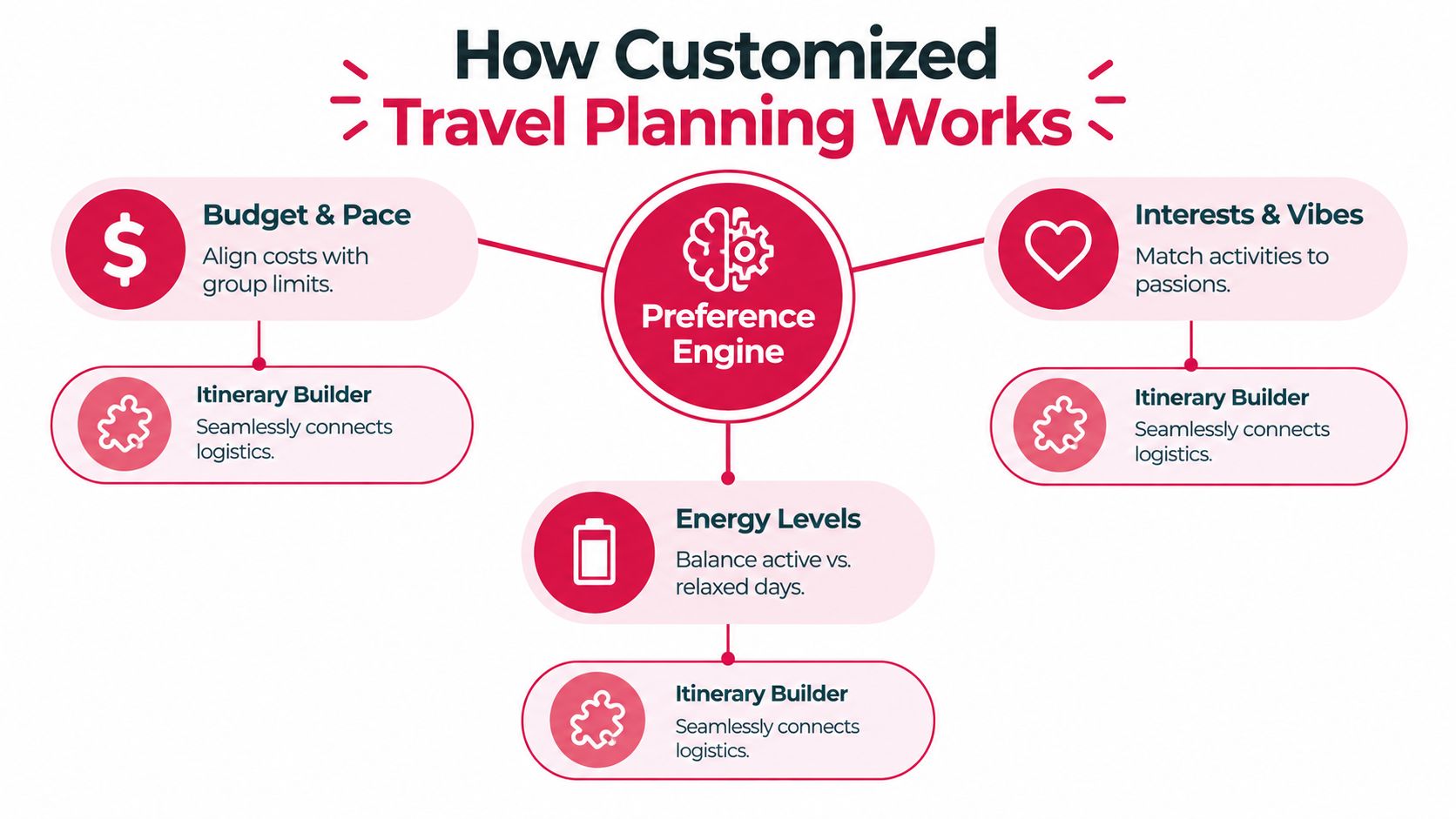
A useful planning engine begins with a preference survey, not a destination list. Each traveler should be able to state their budget range, interests, energy level, and preferred pace without having to defend those answers in front of the group.
The system then converts those responses into a decision matrix. An activity can match several travelers' interests, fit the agreed budget, and suit the group's energy level. Another option may appeal strongly to one person but create a mobility or cost problem for everyone else. A match score makes that distinction clear instead of hiding it inside a long chat thread.
The inputs that matter
The survey should separate preferences that are flexible from constraints that aren't. “I'd enjoy a cooking class” is different from “I can't walk for several hours,” and both are different from “I won't spend above the group limit.”
A robust input model covers:
- Budget: Set a ceiling for activities, meals, and optional upgrades.
- Interests: Capture food, history, architecture, nightlife, shopping, nature, and local culture.
- Energy: Distinguish between active days, relaxed days, and mixed schedules.
- Must-sees: Mark activities that need a serious attempt to enter the itinerary.
- Availability: Identify arrival days, rest periods, and fixed reservations.
Voting algorithms work best when they don't pretend every vote has equal context. A simple majority might favor a demanding walking tour, while a weighted system can show that it conflicts with a participant's stated energy limit. The fairest result may then be a shorter route, a seated experience, or a split schedule with a shared meal afterward.
From preference data to a bookable plan
The engine should surface high-match experiences, explain why they fit, and connect them to practical logistics. A food tour that matches the group's interests but starts far from the hotel may be less useful than a slightly less popular option nearby.
The final itinerary shouldn't be a rigid list of obligations. It should contain confirmed shared activities, sensible gaps, and enough flexibility for weather, fatigue, or spontaneous discoveries. A personalised travel itinerary becomes more valuable when it reflects not just one traveler's taste, but the group's agreed priorities.
Why Groups Need Smarter Planning Tools
Personalization has moved from a nice feature to a commercial expectation. A 2025 consumer survey found that 61% of respondents value personalized travel recommendations beyond basic itineraries, with Millennials (31%) and Gen Z (33%) singled out as particularly eager for tailored experiences, according to Data Axle's survey of 1,000 U.S. travelers. The same survey found that travelers want customized suggestions for activities and dining, not just accommodation, and that nearly half of Millennial (45%) and Gen Z (49%) travelers have switched providers over a lack of personalization or a poor digital experience.
The individual recommendation model still leaves a major operational gap. Travelers can use AI tools to generate ideas, compare destinations, and outline a route, but a group needs to choose together. Simon-Kucher reports that over 60% of Gen Z and Millennials use AI tools for travel inspiration and itinerary planning, while 81% of Chinese, 76% of Saudi Arabian, and 71% of Indian travelers have already used AI-powered travel features, as described in its 2026 travel analysis. Inspiration isn't the same as a confirmed, fair, shared plan.
The difficult travelers are the point
Multi-generational holidays expose the weakness of solo personalization. A grandparent may value comfort and shorter transfers, parents may prioritize reliable scheduling, teenagers may want independence, and younger children may need frequent breaks. Milestone trips and corporate offsites create similar tension because the group shares a purpose but not necessarily a preferred pace or spend level.
Booking.com's 2026 research, based on more than 29,000 travelers across 33 countries, places individuality at the center of trip design in its travel trends coverage. The 2025 U.S. Family Travel Survey from NYU SPS and the Family Travel Association reported that 71% of grandparents had taken a multi-generational trip recently and 57% planned one in the future. Those figures make the planning gap practical, not theoretical.
More choice can create more friction unless the planning process helps people agree.
A useful travel planning app should therefore do more than recommend attractions. It should expose conflicts early, protect private preferences, show the cost of each decision, and give the organizer a clear way to resolve exceptions. The product opportunity lies in decision automation, converting preference data into a plan that people can easily book and manage.
The MyPerfectStay Workflow
Traditional group planning spreads the work across messages, spreadsheets, booking sites, and personal reminders. One traveler researches museums, another checks restaurants, and the organizer tries to reconcile different versions of the schedule. Information gets duplicated, prices change, and nobody knows which option has final approval.
A structured workflow changes the sequence. Each traveler completes a private survey in about two minutes, covering budget, interests, energy level, and must-see ideas. The survey doesn't eliminate discussion. It makes the discussion more useful because the group starts with comparable inputs instead of scattered opinions.
Traditional planning versus structured planning
| Traditional approach | Structured workflow |
|---|---|
| Opinions appear at different times in a chat | Each traveler submits comparable preferences |
| The organizer guesses what matters most | Private responses reveal priorities and constraints |
| Polls show popularity without much context | Match scores show how activities fit the group |
| Links sit across messages and spreadsheets | Options stay connected to the shared itinerary |
| Booking happens after repeated debate | The group can vote, lock plans, and book together |
The voting algorithm analyzes the responses and surfaces activities with clear match scores. For a group considering Rome, the result might distinguish between a high-match food experience, a popular but expensive excursion, and a lower-energy cultural visit. In Dubai, it might help separate a full-day desert safari from a shorter evening option. The value comes from making trade-offs visible before someone pays.
From voting to confirmation
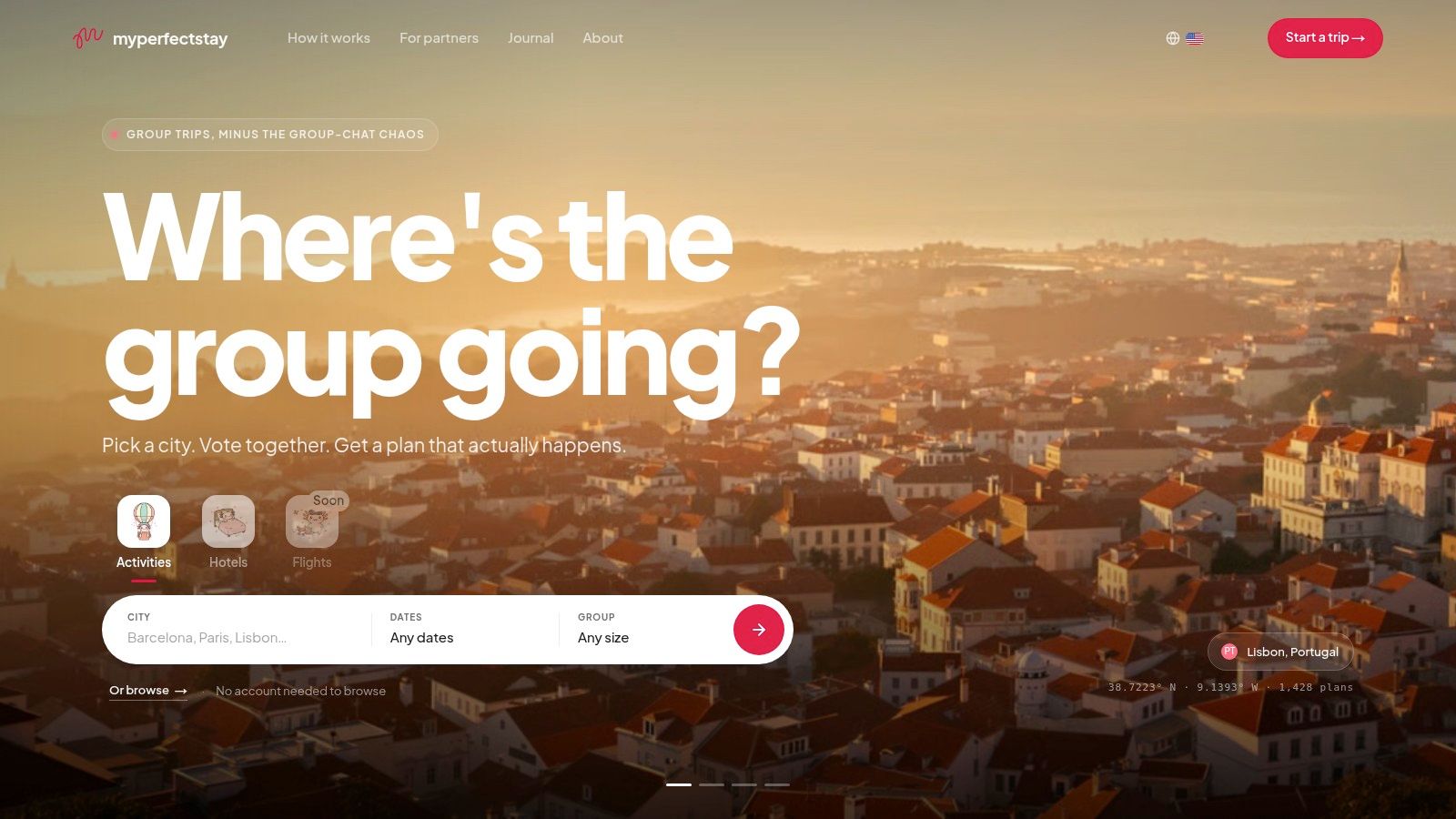
MyPerfectStay provides access to 450k+ bookable experiences across 150+ countries, including desert safaris, museum tours, food tastings, and yacht cruises.
Once the group votes, participants can lock activities and book for the group in one checkout. The daily itinerary is organized automatically, giving everyone the same reference point. Instant confirmations reduce the familiar failure where one person thinks an activity is reserved while another assumes the group is still comparing options.
The workflow still needs human judgment. A match score can't know that a birthday dinner matters more than a highly rated attraction, or that one traveler would rather skip an activity than make the rest of the group wait. It gives the group a clearer starting point, then leaves room for deliberate exceptions.
Benefits for Hotels, Creators, and Groups
Customized travel planning creates different value for each participant in the travel ecosystem. Hotels can connect guests with relevant local experiences, creators can guide audiences toward bookable activities, and groups can replace informal negotiation with a shared process.
The commercial case for hospitality brands is tied to relevance. Medallia's November 2023 study of 1,749 hotel guests and 1,905 retail consumers found that only 23% reported high levels of personalization after recent hotel stays, even though earlier Medallia research showed 61% of consumers are willing to spend more with companies offering a customized experience, according to Medallia's personalization research. The gap suggests that generic activity recommendations may leave ancillary demand unaddressed.
A practical operating model
-
Start with consent and privacy. Explain what preference data the group shares, what remains private, and who can see booking details. People answer more when they don't have to justify every constraint publicly.
-
Collect the hard limits first. Ask about budgets, mobility, dietary needs, arrival windows, and rest requirements before collecting aspirational ideas. This prevents the itinerary from being built around options that later become impossible.
-
Separate group-wide choices from personal options. Shared dinners, transport, and headline activities need consensus. Optional excursions can remain individual, provided the schedule makes meeting points and costs clear.
-
Show the reason behind each recommendation. Match scores should be accompanied by useful context, such as shared interests, pace, location, or price fit. A score without an explanation can feel like an arbitrary verdict.
-
Give people a deadline and a safe way to respond. Nudges help busy participants complete the survey, while private voting protects quieter travelers from social pressure. The organizer should be able to see participation without seeing sensitive comments unnecessarily.
-
Confirm only after the group locks the plan. Instant confirmations sent to participants reduce uncertainty, but they should follow a clear decision point rather than create accidental commitments.
Hotels and destination partners can use a partner-focused overview to assess how experience planning might fit their guest journey. Creators need a different layer, including deep links and reliable payouts, so a recommendation can move naturally from content to booking without relying on manual coordination.
Getting Started with Group Travel
The fastest way to improve a group trip is to stop asking everyone to plan everything. Choose the destination, define the shared constraints, and let each participant contribute structured preferences. That approach works for a family trip to Rome, a weekend in Prague, or a corporate retreat in Dubai because it addresses the same underlying problem, too many opinions and no decision system.
Start with a link invite. Participants shouldn't need to download an app before they can contribute. A short private survey can collect budget, interests, energy level, and must-see ideas while keeping personal responses out of the group chat.
A workable starting sequence
- Set the boundary: Agree on dates, destination, accommodation area, and the maximum activity spend.
- Invite every decision-maker: Include the person who pays, the traveler with mobility needs, and the participant whose schedule is least flexible.
- Collect preferences privately: Ask people to rank priorities rather than copy links into a shared conversation.
- Review match scores together: Discuss high-match options first, then address activities that matter to a smaller number of travelers.
- Lock the shared plan: Confirm the activities everyone accepts and label optional items clearly.
- Book and distribute confirmations: Make sure every participant receives the final details, meeting points, and timing.
- Keep breathing room: Leave space for rest, weather changes, and the unplanned discoveries that make a city feel real.
Deadlines and nudges matter because group planning rarely fails from a lack of ideas. It fails when nobody owns the next action. A structured process gives the organizer a gentle way to move the group forward without repeatedly chasing replies, while instant confirmations prevent uncertainty after booking.
For hospitality providers, the same workflow can turn a generic concierge interaction into a relevant experience conversation. Creators can package destination knowledge into bookable recommendations, and corporate organizers can reduce the private labor involved in coordinating an offsite. Groups benefit most when the tool preserves fairness without pretending that every preference carries the same urgency.
The right standard isn't an itinerary that includes everything. It's a plan where people understand what was chosen, what was declined, and why the final schedule fits the group's real constraints.
MyPerfectStay helps groups collect private preferences, compare activities through voting and match scores, and turn shared decisions into a bookable itinerary. Visit MyPerfectStay to replace the endless group chat debate with a clearer path from ideas to confirmed travel plans.