Family Reunion Planning App: How Groups Agree on Trips
November 25, 2026·MyPerfectStay
Your cousin has sent another hotel link, someone's asking which dates everyone agreed on, and a grandparent wants to know whether anything is booked. In this illustrative scenario, you're not short of ideas. You're missing a reliable way to turn everyone's answers into decisions.
A family reunion planning app should do more than collect votes. It should help relatives choose a trip they can afford and participate in, without making anyone explain their finances or health needs in the family chat. The organizer still owns the difficult calls, but the software can make those calls clearer.
Table of Contents
- Why Reunion Plans Stall in Group Chats
- How a Reunion Planning App Works from Invite to Booking
- Collecting Private Preferences Without Group Pressure
- Planning for Mobility, Diet and Energy Limits
- Ranking Activities So Every Generation Agrees
- Splitting Costs Fairly Across Households
- Reunion Itineraries in Lisbon, Rome and Amman
- Start Your First Reunion Plan This Week
Why Reunion Plans Stall in Group Chats
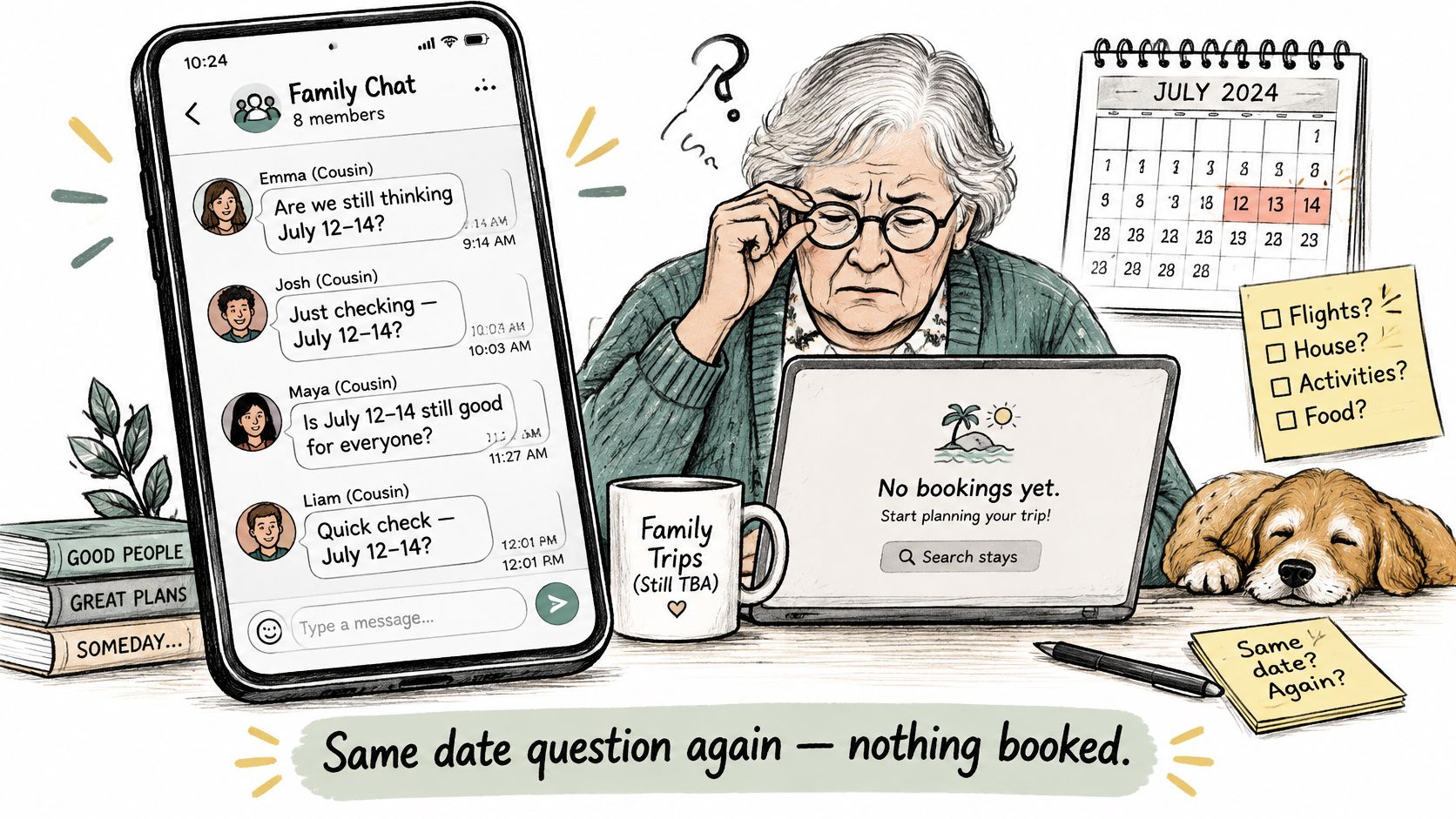
Say your reunion chat has been running for days. Cousins keep repeating the date question, while a grandparent mistakes a suggested excursion for a confirmed booking. Nobody's being difficult. Everyone's reading a different slice of the conversation.
The failures that create extra work
- Lost options: Hotel links, restaurant suggestions and transport details scroll out of sight.
- Repeated questions: Relatives answer again because nobody can find the original response.
- Public pressure: A tight budget or mobility limit gets announced to everyone, or never surfaces.
- Accidental decisions: Whoever posts last appears to have settled the question, even when others haven't agreed.
Our founders' 2024 planning experience involved five days of WhatsApp messages, 47 votes that weren't real votes, and a spreadsheet. That frustration led to the company's start. A busy conversation wasn't producing a usable plan.
The potential planning audience is substantial: in 2024, 54% of surveyed families said they planned to take a holiday, according to a 2,000-person study reported by Travel Weekly. For organizers, enthusiasm still needs a process.
Separate logistics from discussion
Keep chat for conversation, not the definitive booking record. For a practical checklist of responsibilities, The Merrill Hotel's reunion planning tips for Midwest families offers a useful companion to the digital planning work.
Before choosing software, ask: Which failure point hurt your last trip most? Lost links call for a central trip record. Repeated questions call for structured responses. Hidden needs call for private input. Decisions dominated by the loudest relative call for an explicit voting rule.
How a Reunion Planning App Works from Invite to Booking
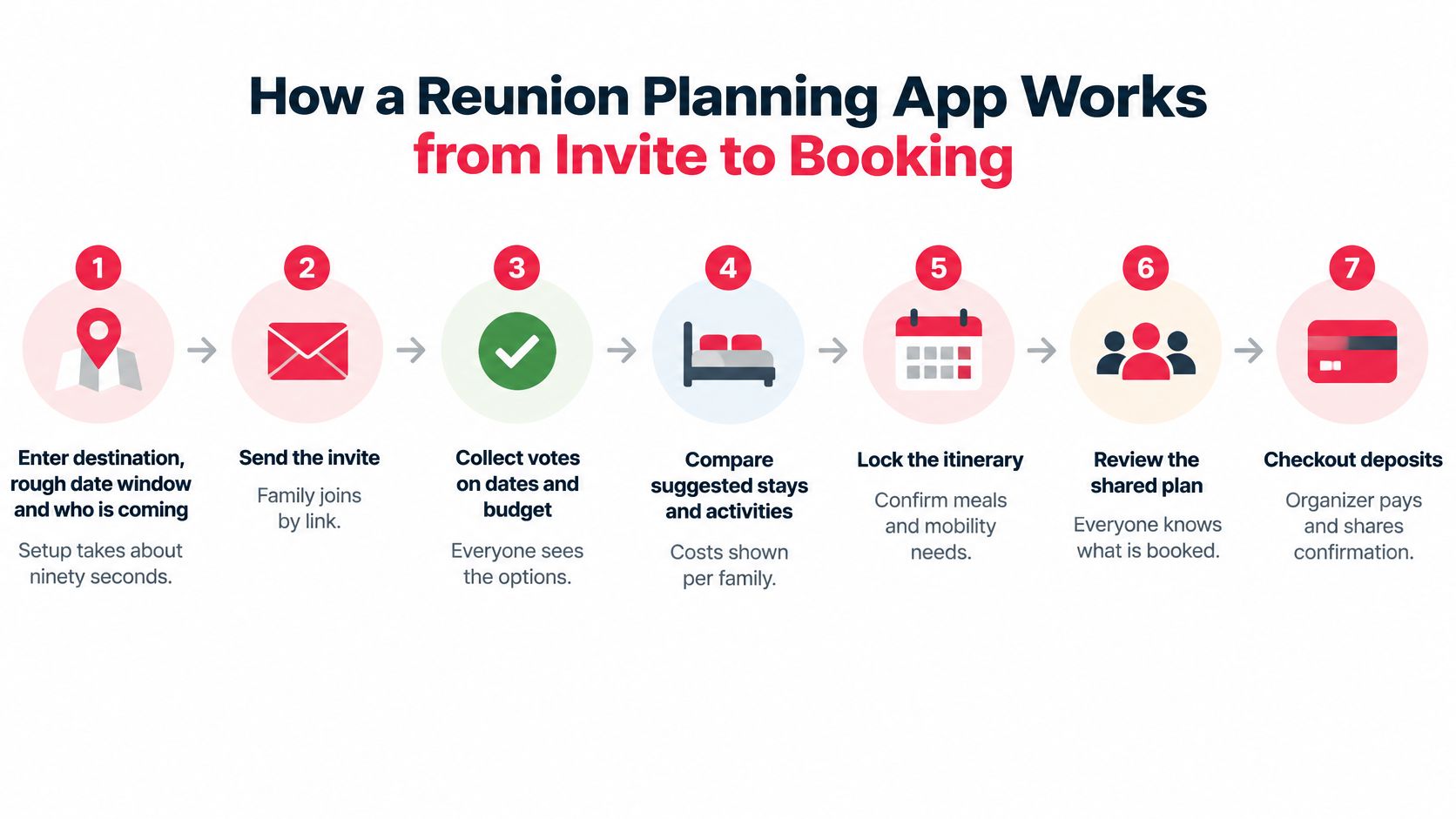
The basic sequence is straightforward: someone picks a city, invites the group, and everyone votes so a plan appears. The practical work sits between those actions, especially when an organizer must distinguish a promising suggestion from something ready to book.
Move through the decisions in order
-
Enter the trip basics. Add the destination, rough date window and who's coming; setting up a first trip takes about ninety seconds, although building the plan takes longer. The organizer owns the destination and dates, including whether either remains provisional.
-
Send the invitation. Travelers can join through a link without creating an account or downloading an app. You decide who belongs in the planning group and whether someone will help relatives who need assistance responding.
-
Collect private answers. Each traveler completes a two-minute survey covering budget, interests, energy level and must-see ideas. The organizer sets the spending ceiling before answers start arriving, rather than letting an expensive favorite become the default.
-
Review activity matches. The app analyzes travelers' inputs and shows clear match scores so the group can compare suggestions. You decide which options deserve a place on the shortlist, checking unresolved practical details before presenting them as viable.
-
Vote on the shortlist. Family members choose among the shortlisted activities, and selected options become part of the shared daily itinerary. The organizer decides which activities belong in the common program and which should remain optional.
-
Set the response deadline. Use deadlines and nudges to bring outstanding votes back into view. You choose the cutoff and follow up personally when silence might mean confusion rather than indifference.
-
Lock and book. Book the winning activities together and pay through one checkout, with confirmations sent to participants. The organizer checks the final participant list, booking conditions and payment arrangements before authorizing the purchase.
Define finished before you start
A finished plan isn't a board full of popular suggestions. It means every traveler has voted, every must-have is covered, and one itinerary is confirmed.
Keep unresolved items visibly provisional. A restaurant awaiting an allergy response or an excursion with unverified access information shouldn't look identical to a confirmed booking.
Organizer's responsibility: Software can collect answers and coordinate bookings. It can't decide whether an unanswered question is safe to ignore.
Collecting Private Preferences Without Group Pressure
A shared poll asks relatives to choose in front of one another. Private input gives them room to answer without defending a spending limit or explaining why they don't want a strenuous day. The group needs to know whether an option works, not the personal circumstances behind every answer.
Children need a usable way to contribute, too. 85% of respondents said children participate in deciding where to travel or what type of vacation to take, according to Recommend's 2024 Family Travel Trends survey. Use plain questions that young travelers can understand, with adult help where needed.
Preference inputs and who sees them
The following is a useful collection and visibility model. Configure permissions deliberately rather than assuming every answer belongs on the shared board.
| Input | Example entry | Who sees it |
|---|---|---|
| Budget band | Band A, B or C against a shared ceiling | Private; group sees only whether an option fits |
| Must-have needs | Step-free access, a dietary rule, medication timing | Private; group sees a feasibility flag only |
| Activity interests | Food tours, museums, beaches, sport | Shared as match scores |
| Energy level | Low, medium or high daily walking | Private; sets the daily pacing |
| Age and availability | Child, teen, adult or grandparent; travel dates | Shared as scheduling constraints |
| Must-see ideas | One to three named activities | Shared on the group board |
Budget bands need a common definition before the invitation goes out. Specify whether travelers are considering activities alone or the broader trip cost, and whether the answer describes an individual or a household.
For must-haves, ask functional questions: Is step-free access required? Must a meal avoid a particular ingredient? Is a protected break necessary? Yes-or-no requirements are more useful than medical histories, and they expose less personal information.
Use answers to change the plan
Energy level should alter pacing, not become a label attached to a relative. A lower-energy answer can mean a later departure, a shorter outing or a longer lunch, rather than automatic exclusion from an activity.
If someone skips the survey, mark their preferences as unknown, not unrestricted. Follow up privately before treating the shortlist as representative.
For repeat reunions, carry preferences forward only with the traveler's permission and a request to review them. Interests may stay familiar while budgets, availability and access requirements change. Reuse should reduce typing, not preserve outdated assumptions.
Planning for Mobility, Diet and Energy Limits
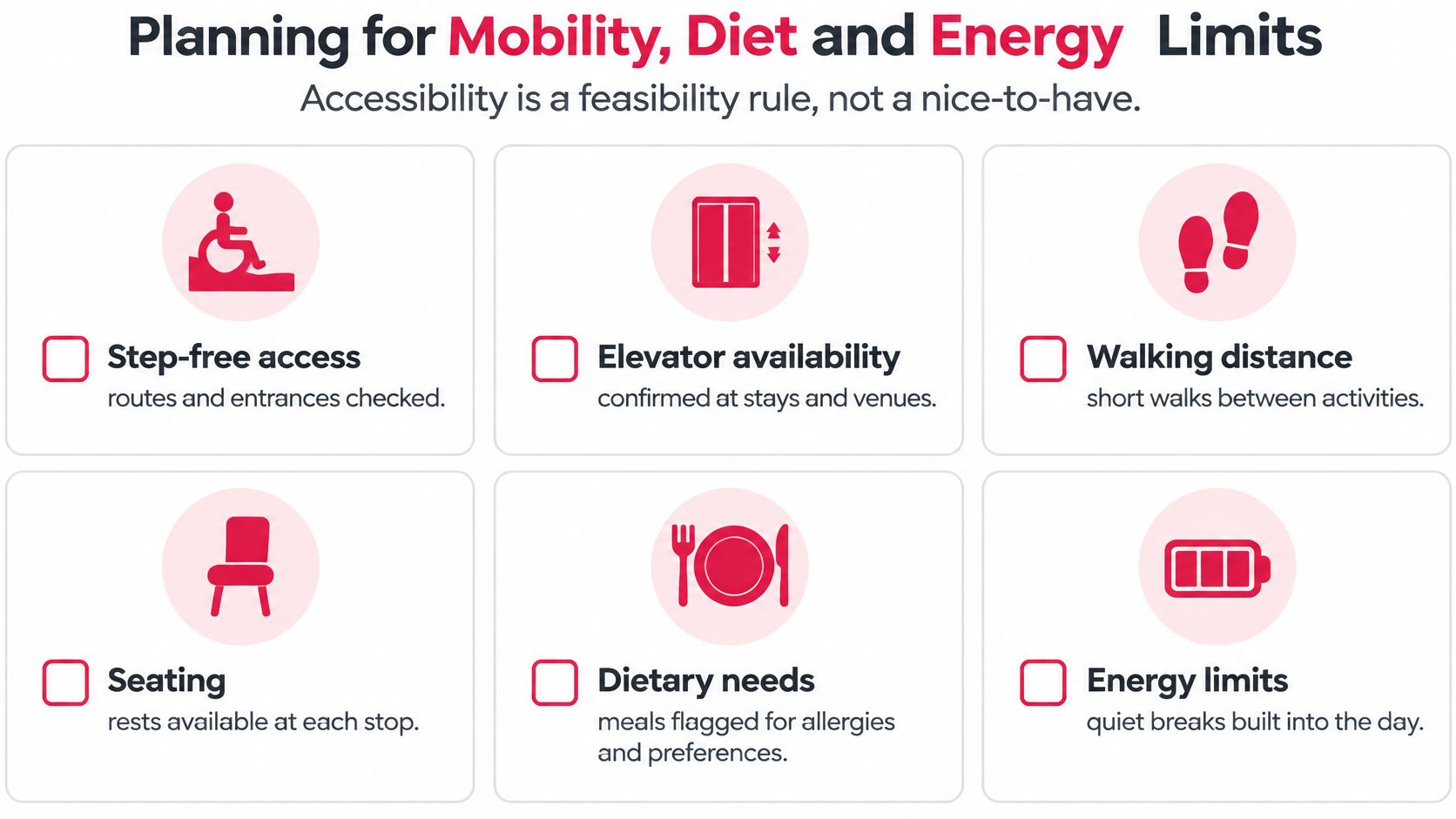
Accessibility is a feasibility rule, not a preference to trade away. A highly rated activity still fails if a participant can't enter the venue, manage the route or eat safely. Accessible-tourism research on aging-related constraints and technology acceptance supports treating travelers' capabilities and the planning system's usability as central to participation.
Start with structured activity information: step-free access, elevator availability, walking distance, seating frequency, restroom access, terrain, transfer time, sensory intensity and caregiver suitability. Record dietary suitability separately, including whether a venue has confirmed it can meet an essential requirement.
Check the whole day, not isolated activities
A workable itinerary should account for cumulative walking and transfers, not just each attraction's description. Add travel between stops, waiting time and the return journey before deciding that an outing is manageable.
In European and MENA settings, inspect routes for cobbles, steep streets, uneven surfaces and heat exposure. Map distance alone doesn't tell you how demanding a journey will feel. A nearby entrance may still involve stairs or a difficult approach.
Recommend parallel activities, protected rest periods and clear opt-out routes. Our multigenerational family vacation ideas can help you build alternatives around a shared meal or meeting point, rather than forcing everyone through the same outing.
Verify before paying
A planning app should support the checks below. Where it doesn't, the organizer needs a separate verification record.
- Confirm each must-have: An unverified accessibility claim isn't a passed requirement. Resolve it directly with the venue.
- Check the evidence: Keep a source, timestamp and confidence level for access information, especially when a listing is incomplete.
- Protect personal details: Share the practical accommodation, not the diagnosis. Medical information should remain with the traveler and only the organizer or caregiver they authorize.
A shorter shared program with good alternatives is more inclusive than a packed itinerary that relatives quietly abandon.
The final test is practical: Can every traveler find an appropriate option for each block of the day? A rest period counts when it's planned, comfortable and connected to a clear reunion point.
Ranking Activities So Every Generation Agrees
A popular excursion can still be a poor shared choice if a relative cannot participate or afford it. Remove activities that break a must-have before ranking them: budget ceilings, availability, age suitability and required access belong ahead of popularity. Use private preferences to identify workable choices without asking relatives to explain personal needs to the group.
Then compare the feasible options. Research on group recommender systems and explainable social-choice aggregation distinguishes additive utility, majority approval, least-misery and most-pleasure approaches. Each answers a different question, so the same preferences can produce different winners.
Group ranking rules compared
| Rule | How it ranks | Risk for a reunion | Best use |
|---|---|---|---|
| Majority vote | Most approvals win | Can exclude relatives with different needs | Quick choice between similar options |
| Average satisfaction | Highest mean match score wins | One strong dislike gets hidden | Broad interests and low-stakes choices |
| Least misery | Option whose lowest score is highest wins | Can favor bland options | Protecting the least-keen traveler |
| Most pleasure | Option with the single highest score wins | Favors the most enthusiastic person | Optional add-ons only |
| Hard constraints first | Removes options that break a must-have, then ranks the rest | Requires accurate venue data | Mobility, diet and opening hours |
Majority voting and averages can both hide exclusion. Enthusiastic ratings may outweigh a serious objection, leaving a grandparent without a workable way to join the winning excursion. Passing the feasibility check must remain separate from scoring enjoyment.
Least misery protects the lowest individual satisfaction score. It's useful for the shared program, but may favor safe, unexciting choices. Optional add-ons give enthusiastic relatives room for specialist interests without making everyone participate.
Make the trade-off visible
A transparent ranking should show average satisfaction, lowest individual score and participation coverage. These reveal different compromises: broad appeal, the least-satisfied traveler's experience and how many relatives can join. Before combining ratings, account for travelers who consistently score generously or harshly.
For an illustrative display, an option might show: 8 of 10 travelers match, the lowest score is 3 out of 5, and the option fits everyone's budget. That makes the compromise visible without exposing anyone's private budget or access needs.
Agree on a family group decision-making process for ties and objections before voting begins. MyPerfectStay lets friends vote on activities and book the winner together with one tap. The organizer still owns the decision rule and must resolve objections before booking.
I'd rank by lowest satisfaction first for a shared activity involving different mobility or energy limits. For relatives with similar capabilities and interests, average satisfaction is a reasonable starting point once must-haves are met.
Splitting Costs Fairly Across Households
A reunion budget isn't one number. Grandparents may want to fund grandchildren, a larger household faces a different total from a couple, and a traveler who can afford lodging may still need to skip a paid excursion.
Affordability deserves its own planning process: 73% of parents identified affordability as their top travel obstacle, according to the 2025 family travel survey reported by NYU's School of Professional Studies. A popular option isn't a fair choice if relatives feel pressured to spend beyond their private limits.
Cost-split models for multi-household reunions
| Split model | How it works | Fits when | Watch-out |
|---|---|---|---|
| Equal per person | Every adult and child pays the same share | Households are similar in size and income | Penalizes larger families |
| Per household | Each household pays one share | Households differ in size | Children's costs can disappear into the total |
| Grandparent-covered | Grandparents fund a set amount per grandchild | Grandparents want to contribute | Can create unspoken obligations |
| Tiered budget bands | Options grouped by price band with equivalent alternatives | The group has a wide budget range | Relies on honest private band choices |
| Shared essentials plus add-ons | Lodging and transport split equally; activities are opt-in | Interest levels vary across the group | Add-on tracking needs clear labels |
Use private household budget bands, then separate shared essentials from optional add-ons. Keep per-person and per-household totals side by side in the cost record. Our family vacation budget planner provides a useful basis for organizing those categories.
Agree on responsibility before checkout
Friends vote on activities, and our group booking flow purchases the winner with a single payment for everyone. That convenience doesn't settle who ultimately owes what. Before paying, give each household a clear statement of its share and agree who will collect reimbursements.
For every paid add-on, offer a lower-cost option with a comparable social role, such as a self-guided outing that ends at the same lunch stop. Confirm the split privately with every household, especially when someone offers a subsidy.
Fairness test: A slightly more expensive plan that everyone can join can be better value than the cheapest plan relatives have to skip.
Equal-looking shares aren't automatically fair. The organizer still needs explicit consent, not silence interpreted as agreement.
Reunion Itineraries in Lisbon, Rome and Amman
The following are illustrative reunion plans, not documented customer trips. Each uses the same invite-to-checkout workflow, but the organizer changes a different decision after reviewing the group's needs. The point is practical: a city gives the plan shape, while private requirements decide which route, meal, or rest window works for the group.
These destinations offer concrete settings rather than interchangeable backdrops. A city such as Lisbon, Rome, or Amman gives relatives a shared target, then the app keeps the details attached to the trip: saved links, menu photos, activity choices, routes, timings, and pickup arrangements. That matters because reunion decisions often fail when one useful suggestion sits in a chat thread and the latest message replaces it.
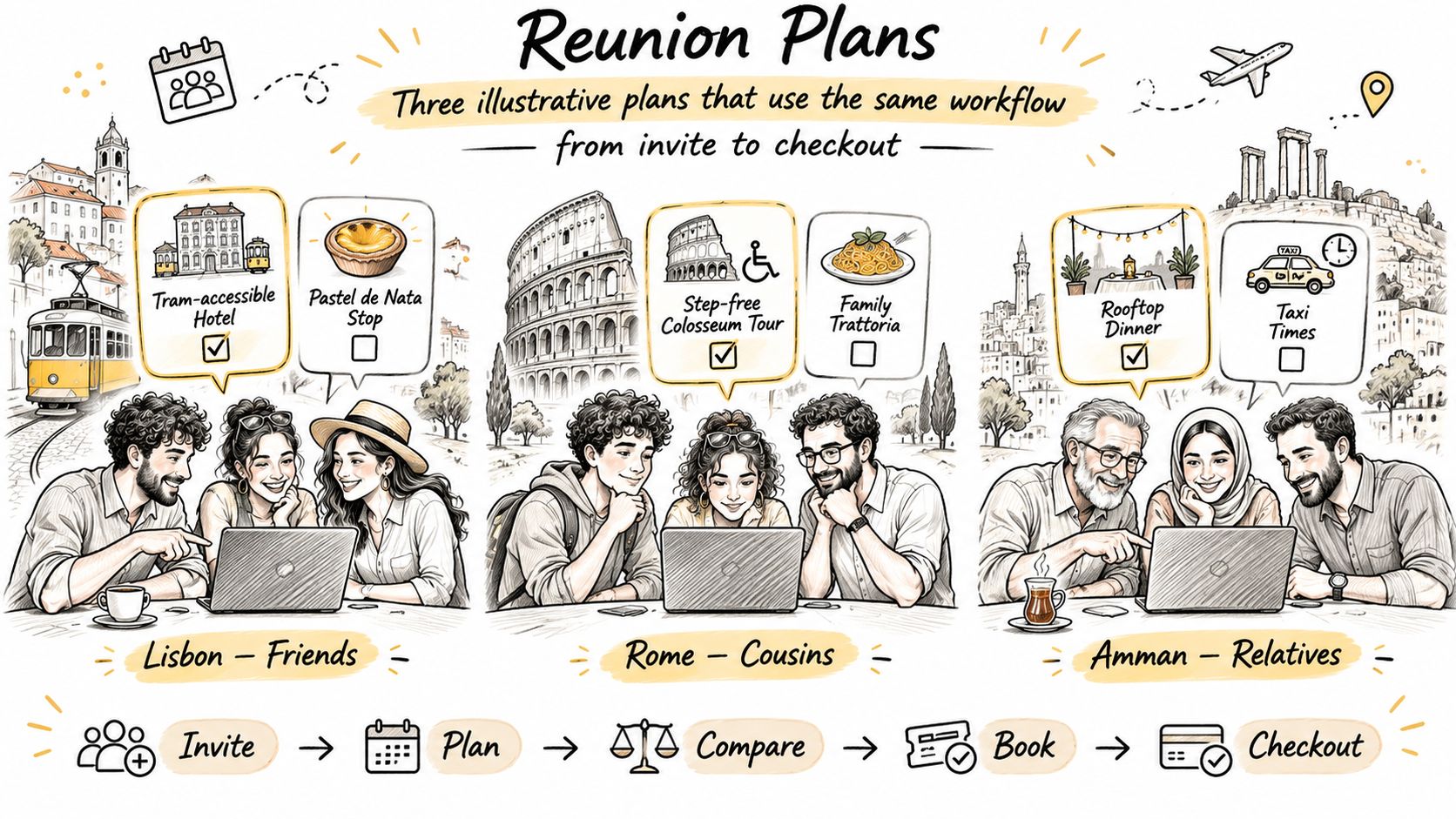
Lisbon chooses the flatter route
Say households with children and grandparents are comparing a tram tour with a walking tour. During review, the organizer flags hill climbs against the group's walking requirements and checks boarding access rather than assuming the tram solves everything. A cool, scenic route can still be a poor choice if the meeting point, steps, or long waits exclude part of the group.
The revised plan pairs a riverside lunch with a verified flatter-route option. More energetic relatives can choose an additional walk before meeting everyone for lunch. The changed decision is the route, not whether grandparents should be included. Accessibility works best as a planning input here, because the organizer can compare options privately and keep the final choice social rather than personal.
Rome keeps the restaurant shortlist usable
For an illustrative long weekend in Rome, relatives add restaurant links, menu photos and tentative suggestions to the trip. Our trip record keeps every link, photo and tentative idea with that trip instead of burying them in chat. This is especially useful when meal needs are private, since a shortlist can be narrowed without making one relative's requirements the center of the group conversation.
The organizer can compare the saved shortlist against meal needs and the day's location before booking. A restaurant that suits the group's timing may still fail if it sits far from the morning route or offers little for relatives with dietary limits. The changed decision is which shortlist remains authoritative: relatives vote from the maintained trip record rather than a mixture of old screenshots and newer messages.
Amman and Petra protect a rest window
For an illustrative heritage-and-desert trip based around Amman and Petra, the organizer reviews heat exposure, walking demands and transport before filling the itinerary. A midday rest window stays protected, and a shorter site visit is offered only after its route and access have been checked. The trade-off is clear: fewer sights can produce a day that more people join.
Travelers choosing the shorter option receive a clear pickup arrangement; others can continue with the longer outing. The changed decision is the timing, with rest treated as part of the plan rather than an emergency adjustment. Energy limits deserve the same status as budget bands, because a cheap day with an exhausting middle block can cost the group the evening together.
The city matters less than whether every generation has a planned option each day. A destination becomes workable through specific routes, meeting points and verified arrangements, not a high group match score alone.
Start Your First Reunion Plan This Week
Decide the core inputs before inviting everyone:
- Destination shortlist: Choose a small set of realistic places, then settle on the city.
- Date window: Identify the period relatives can travel.
- Headcount and ages: Include children and anyone who needs help responding.
- Private must-haves: Collect essential requirements without posting personal details publicly.
The organizer owns destination, dates and spending ceiling. If your group is small, dates are fixed and nobody has access needs, a shared document may be enough. Several households, mixed ages or private requirements make a planning app more useful.
MyPerfectStay brings together private surveys, group voting, a shared daily itinerary and one checkout, with no account or download needed to start. Before the product, our co-founders' group spent weeks debating where to go; they describe their process now as picking a city, sending the link and letting a plan appear.
Set the first voting deadline this week. Send the invitation before another chat thread turns an open question into an assumed decision.
Visit MyPerfectStay to create your reunion trip, invite relatives by link and collect their preferences privately. Compare activity matches, vote on a workable shortlist and book the chosen experiences together, while keeping the organizer in control of the decisions that matter.