Family Vacation Europe: A Practical Planning Guide
September 21, 2026·MyPerfectStay

Your family vacation Europe plan probably started the same way most of them do. Someone opened ten tabs. Grandma said she wants a villa in Tuscany. Your teenager said only a London to Berlin train trip counts as a real vacation. You looked at school dates, flight prices, and room layouts, then realized the argument isn't really about Europe. It's about pace, comfort, and who gets to decide.
That's the kitchen-table problem. Multi-generational trips don't fail because Europe is hard. They fail because five people are planning five different trips and calling it one vacation.
A workable family vacation Europe plan needs three things. A destination that matches the season, transport that matches the ages in the group, and a decision process that stops the loudest person from winning by default. If you get those three right, the trip gets easier fast.
Table of Contents
- The Kitchen-Table Problem Most Family Europe Trips Start With
- Who Actually Travels to Europe as a Family Group
- Choosing Kid-Friendly Destinations That Work for Multi-Gen Groups
- Building a Realistic Family Budget Before You Book
- Getting Around Europe With Kids and Grandparents
- How Many Cities and How Many Nights Make Sense
- Using Group Planning Tools to Settle the Trip in Two Minutes
- A Sample Multi-Gen Day Plan and Pre-Departure Checklist
The Kitchen-Table Problem Most Family Europe Trips Start With
It's a familiar scene. A family spreads out around the kitchen table after dinner. One laptop shows Barcelona apartments. Another has rail passes for Amsterdam and Berlin. Someone has circled Florence on a paper map. Nobody agrees on whether this is supposed to be relaxing, cultural, cheap, or ambitious.

The grandparents often want space and comfort. Parents want logistics that won't wreck the week by day two. Kids want momentum. Teens want cities, trains, and at least one thing they can brag about when they get home. Those aren't silly preferences. They're real constraints, and pretending otherwise is how families end up with a trip that looks good on paper and feels exhausting in real life.
What actually goes wrong
The hidden cost isn't only money. It's time and friction.
- WhatsApp overload: One chat thread turns into fifty opinions and zero decisions.
- Bad compromise: Families mash together beach days, museum days, and long transfers until nobody gets enough of anything.
- Planning by volume: The most forceful person drives the itinerary, even if they won't be the one pushing the stroller uphill in Florence.
Practical rule: If you can't explain in one sentence why you chose a destination, you haven't chosen it yet.
Europe gives families excellent options, but it also punishes vague planning. Eurostat reported that 43% of all tourism nights in the EU in 2021 happened in just two months, July and August (Eurostat tourism seasonality data). The pattern held in 2024: in 1 in 6 EU regions, more than 40% of annual tourism nights fell in the top two months, with coastal regions the most seasonal and capital regions the least (Eurostat seasonality at regional level). That matters because your argument about “where should we go?” is usually also an argument about crowds, heat, room supply, and whether grandparents can still enjoy the day after lunch.
The fix
Good family trip planning is less romantic than people expect. It's not about building the perfect dream trip first. It's about removing the obvious bad fits early.
Start with season. Then pick a base style. Then choose transport. Families who do that usually stop arguing because the wrong options fall away on their own.
Who Actually Travels to Europe as a Family Group
A lot of family travel advice is written as if every group is two adults and two small children. That's not how Europe works anymore. The market is broader, older, and much more mixed.
Eurostat counts nearly 249 million Europeans aged 15 and over, about 65% of the EU population, who made at least one personal tourism trip in 2024, 5.7 million more than in 2023 and 5.5 million more than in pre-pandemic 2019 (Eurostat participation in tourism). That rebound matters because families aren't planning in a niche category. They're planning inside a travel market that has fully reactivated.
The groups that matter most
In a UK survey, people aged 35 to 44 were the most likely to prefer holidaying with the whole family, at 43%, and in the European Travel Commission's sentiment tracking both the 35 to 44 group and the over-55 group showed 74.6% intent to travel in Europe within the next six months (both summarized in Radical Storage's travel statistics by age). That pairing tells you a lot. Parents and grandparents are both highly relevant to Europe planning, which is exactly why multi-gen trips now dominate so many family discussions.
The CBI's market study on multigenerational tourism cites a Virgin Holidays survey in which 52% of respondents chose multigenerational getaways over traditional family trips, and a Sainsbury's Travel Insurance survey finding that 12.5 million British people, or 18% of the population, went on a multigenerational holiday in 2013 (CBI multigenerational tourism market potential). Those figures are old, but Euronews' 2026 trends outlook still expects multi-generational trips to keep growing, including skip-gen trips where grandparents travel with grandchildren (Euronews 2026 travel trends). This is not a quirky side trend. It's a real planning category with its own rules.
| Family Europe Travellers by Group Type | Typical Size | Trip Length | Budget Tier |
|---|---|---|---|
| Parents with young kids | Small family unit | Usually shorter and simpler | Mid, with strong accommodation sensitivity |
| School-age family group | Standard nuclear family | Moderate, often city-break friendly | Mid to upper-mid |
| Multi-generational family | Larger shared group | Often longer lead time and more coordination | Mid to high, depending on room mix |
| Grandparents joining one leg | Flexible add-on group | Best on slower itineraries | Varies widely |
What this means in practice
If your group includes grandparents, don't plan like you're backpacking with children attached. If your group includes teens, don't plan like everyone's happy sitting by the pool for six days. The modern family vacation Europe decision is usually a negotiation between age bands, not a simple parent-and-kids purchase.
The best trips aren't the ones with the most attractions. They're the ones where each age group gets a win without dragging the others through it.
That's why generic “best cities in Europe for families” lists often miss the point. The question isn't whether a place is family-friendly. It's whether it fits your actual group.
Choosing Kid-Friendly Destinations That Work for Multi-Gen Groups
Pick the wrong city in the wrong month and the rest of your planning won't save you. That's the blunt truth. Families should choose destinations by heat, transit ease, access, and attraction density, not by postcard appeal.
LateRooms' 2026 Family Breaks Index put Copenhagen first, followed by Berlin, Barcelona, Florence, and Amsterdam (Euronews on the Family Breaks Index). The index scores flight and airport-transfer times from the UK alongside walkability, pushchair access and family attractions, so weigh the first factor against where you're flying from. That top five is still a useful starting point because each city solves a different family problem.
Five cities worth serious consideration
Copenhagen is the strongest pick for families who want low stress. It's orderly, manageable, and easy to get around with children and older adults. It suits families who value smooth days over big-name checklist sightseeing.
Barcelona works best for families who want city energy plus beach relief. It's a strong summer option if your group needs breaks from museums and appreciates outdoor time, but heat and crowds can wear down grandparents faster than people expect.
Amsterdam is compact and efficient. That's a strength. Families can cover a lot without long transfers. The trade-off is space. Rooms can feel tight, and some canal-area access points are less forgiving for strollers and slower walkers.
Berlin is excellent for older kids and teens. There's room to spread out, transit is practical, and the city doesn't force every day into a tourist bottleneck.
Florence is beautiful and high-reward, but only if you keep the footprint small. It's not the city for endless crisscrossing. Stay central, walk in short bursts, and don't pretend everybody wants a full day of Renaissance seriousness.
If you'd rather compare options visually, this short video roundup covers more family-friendly European destinations.
Two cooler counter-picks that deserve more attention
Trip.com data reported by Euronews shows a 74% year-on-year rise in searches for “coolcations” in 2026, with cooler places such as Iceland, Norway, Slovenia, Switzerland and Wales drawing far more searches as southern Europe heats up. The same data shows hotel bookings by families with children 12 and under notably up this summer (Euronews coverage on coolcations and family demand). If your family melts in high summer, stop trying to force a Mediterranean itinerary in peak heat.
That's where Edinburgh and the Austrian Lakes come in. Edinburgh suits families who want walkable drama, castle appeal, and a cooler climate, but its hills punish overloaded day plans. The Austrian Lakes work well for multi-gen groups that want nature, slower pacing, and easy split days where one subgroup swims while another rests.
- Best for low-heat summer planning: Copenhagen, Edinburgh, Austrian Lakes
- Best for mixed city and downtime: Barcelona, Amsterdam
- Best for older kids and teens: Berlin, Florence
- Most likely to frustrate stroller-heavy families: Steeper, older-core cities unless you stay very central
Families comparing destination styles can also look at these multigenerational family vacation ideas to pressure-test whether they need a city break, a regional base, or a split itinerary.
Building a Realistic Family Budget Before You Book
Most family budgets for Europe fail in one place. Accommodation. Parents underestimate room needs, then spend the rest of the trip compensating with taxis, bad meal choices, and cranky transfers.
If you want a functional budget, build it around four pillars. Sleep, movement, food, and one paid highlight per day at most. Everything else is noise.
Start with the room, not the flights
A central apartment or serviced apartment usually gives families more control than standard hotel rooms. You get space, a fridge, a washing machine in many cases, and the ability to split adult downtime from children's bedtime. Two cramped rooms in a badly located hotel can wreck a trip even if the nightly rate looks acceptable at first glance.
For a family vacation Europe plan, spend more on location and layout rather than on a fancy lobby. A central base saves energy every single day.
| Family of 4 Europe Budget by Category (illustrative) | Low (€/day) | Mid (€/day) | High (€/day) |
|---|---|---|---|
| Accommodation | €160 | €220 | €280 |
| Transport | €100 | €170 | €240 |
| Food | €80 | €130 | €200 |
| Activities | €0 | €50 | €100 |
Where to save and where to spend
- Save on breakfast: Buy fruit, yogurt, pastries, and coffee supplies near the apartment instead of paying hotel breakfast rates for everyone.
- Spend on location: A central base cuts taxis, reduces stair-heavy detours, and makes naps possible.
- Save on souvenirs: Tourist-core gift shops are budget leaks with almost no upside.
- Spend on one anchor experience: A cooking class, aquarium, castle visit, or canal cruise gives the trip shape.
Budgeting works better when every adult sees the same numbers before anyone pays a deposit.
If you want a simple framework to turn rough ideas into line items, use a family vacation budget planner before you start booking. It's much easier to trim a plan on paper than after tickets are locked.
The overspending traps
The mistakes are repetitive.
- Hotel dining: Convenient, yes. Good value, rarely.
- Short-notice taxis: Families take them when they're tired, and that's exactly why they add up.
- Too many paid attractions: Kids don't need every museum. They need one thing they'll remember.
Getting Around Europe With Kids and Grandparents
Transport is where families either look smart or look very tired. Europe rewards people who choose the right mode for the route. It punishes people who chase the cheapest headline fare without thinking about bags, stairs, seat reservations, and off-airport transfers.
When rail wins
Rail is often the cleanest option for multi-city family itineraries, especially across major European corridors. Interrail says the Global Pass covers 33 countries, and children aged 4 to 11 travel free on a Child Pass, up to 2 per adult, youth or senior pass holder, while under-4s need no pass at all (Interrail Global Pass conditions). That structure makes rail especially attractive for families comparing a pass against separate tickets.
The catch is important. A pass is not automatically cheaper. High-speed and night trains can require extra reservations even with a pass, especially in Italy (Inside the Travel Lab on multi-country trips), so separate advance tickets can beat a pass once you factor in those supplements and the exact legs you'll use. Families of two to four adults and children should compare both before buying.
When flights and cars make sense
Budget flights are fine for long jumps that would burn too much daytime on rail. They're a poor choice for short hops when you add baggage stress and airport transfers to the equation. The flight itself may be short, but the family travel day often isn't.
Cars make sense for Tuscany, Bavaria, or Scotland, where the point is the countryside and not a city-to-city checklist. For city breaks, cars are usually a burden. Parking, traffic restrictions, loading luggage, and finding step-free drop-off points often create more work than freedom.
| Transport Mode Comparison for a Family of 4 | Family of 4 Cost | Door-to-Door Time | Baggage | Senior-Friendly |
|---|---|---|---|---|
| Rail | Variable, compare pass vs tickets | Strong on direct city pairs | Good if packed sensibly | Usually strong with reserved seats |
| Budget flight | Variable, often misleading at first glance | Weaker on short routes once transfers are added | Often restrictive | Mixed |
| Rental car | Best for rural loops | Good where rail is sparse | Strong for bulky gear | Good if walking is limited |
Transfer rules that keep a family moving
- Reserve train seats early on popular routes: You want the group together. Don't leave that to luck.
- Avoid tight connections: Families need margin, not heroic platform sprints.
- Keep one adult responsible for tickets and one for people: Split the job.
- Don't improvise mobility gear logistics: If someone travels with a wheelchair, scooter or walker, tell the airline or rail operator in advance and confirm the transfer vehicle has room for it.
A slower transfer that keeps everyone seated and calm usually beats the “faster” option that burns the entire group out.
For a family vacation Europe itinerary with grandparents, seat certainty matters more than theoretical speed.
How Many Cities and How Many Nights Make Sense
Families ruin good Europe trips by moving too much. They confuse variety with quality, then spend half the holiday packing, checking out, storing bags, and finding the next apartment.
Europeans already travel this way. In 2024, 56.3% of EU residents' tourism trips lasted three nights or fewer and 84% lasted a week or less (Eurostat characteristics of tourism trips), and Trip.com's summer 2026 bookings averaged 2.92 to 3.8 days (Euronews on summer travel trends). That instinct is right. For mixed-age groups, shorter and tighter usually beats grand and sprawling.
The rule that actually works
Use this framework.
- One week: Two cities, one country
- Two weeks: Four cities across two countries at the absolute upper limit
- Any city with a major attraction load: Four nights is safer than three
- Travel day: Count it as half a city, because that's what it takes from your energy budget
Kids under eight don't care how elegant your route map looks. They care whether they got enough sleep and whether lunch happened before the meltdown. Grandparents usually tolerate faster pacing better than small children, which surprises parents every time.
Why “seeing more” backfires
Seeing more places isn't the same as having a better trip. If your group wants London, Amsterdam, Paris, Rome, Florence, and Barcelona in twelve days, the answer is no. Cut it in half and enjoy what remains.
Four cities in fourteen days beats eight cities in fourteen days every single time for a mixed-age family.
Build one light day into every cluster of sightseeing. That could be a hotel pool afternoon, a long park stop, or a simple neighborhood day with no timed entries. Those low-pressure days are what keep the ambitious days possible.
Using Group Planning Tools to Settle the Trip in Two Minutes
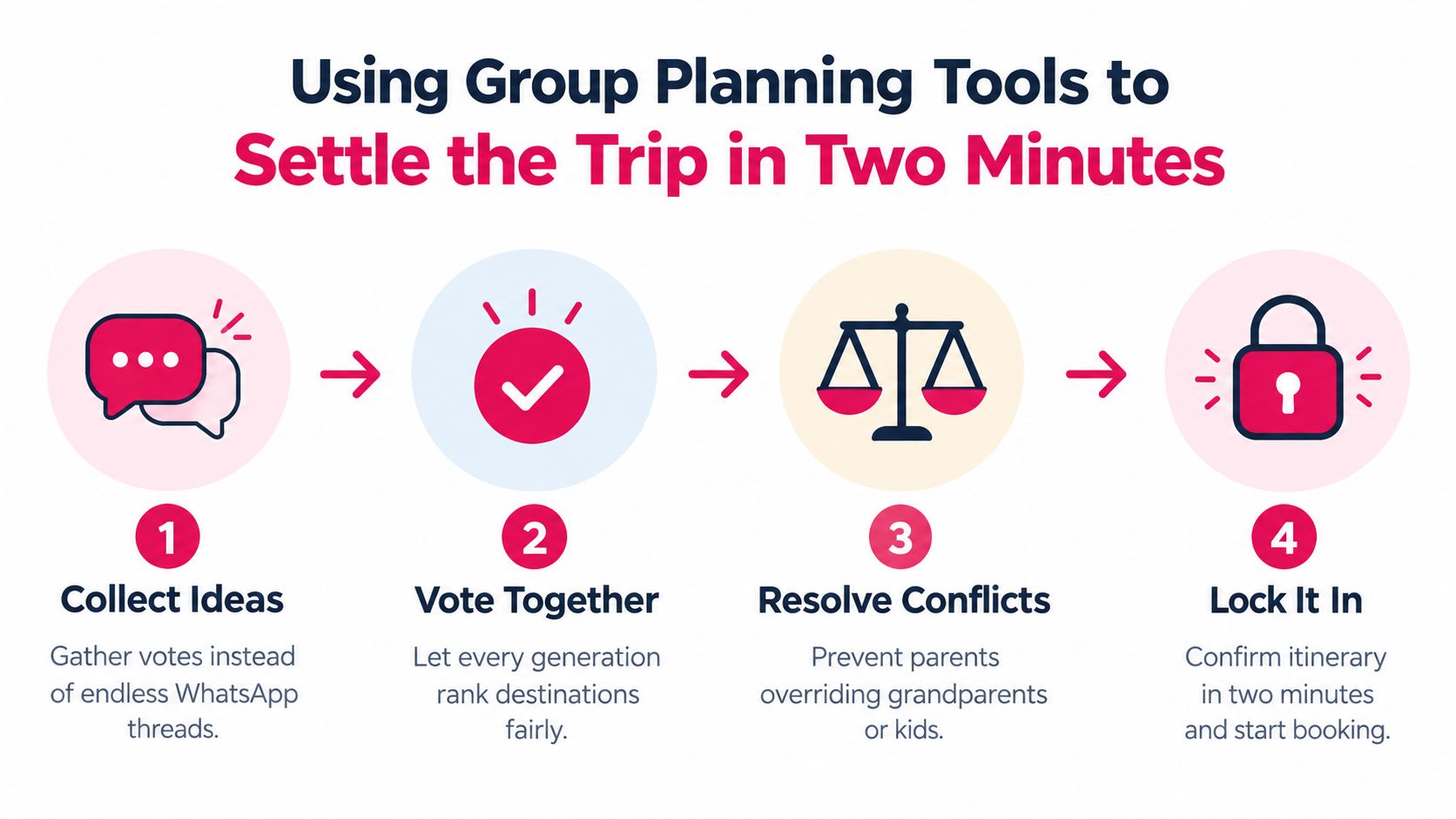
The planning bottleneck isn't choosing between Rome and Amsterdam. It's getting six or eight people to stop revisiting the same decision. Families don't need more ideas. They need a clean way to close loops.
Where coordination breaks down
The pattern is always familiar.
First, everyone drops suggestions into chat. Then two people research. One parent starts making executive decisions because time is running out. A grandparent objects late. Kids get asked last, if at all. Then the same arguments restart when it's time to choose hotels, trains, and activities.
That process is sloppy because it mixes brainstorming with decision-making. Those are different jobs.
What works better
Use a short survey and ranked-choice workflow. One link. Each person submits destination preferences, budget comfort, energy level, transit tolerance, and must-do activities. Then someone turns that into a shortlist and locks it.
A tool can earn its keep. MyPerfectStay lets each traveler share preferences privately, compare match scores and vote on activities, which pushes a group toward an actual answer instead of another debate. This guide to choosing a decision-making tool for your group trip covers the options. That's useful for destination choice, hotel shortlists, and whether the group wants rail, car, or one anchored city base.
Keep some things manual
Tools help with pre-trip agreement. They don't replace common sense on the road.
Use a shared document for:
- Restaurant backups: Plans change fast when kids are hungry.
- Medical and mobility notes: Keep these visible and simple.
- Arrival instructions: Apartment codes, host contacts, and printed addresses still matter for older relatives who don't use their phones much.
- Day-of changes: Transit delays and weather pivots need a human decision, not another vote.
The handoff is simple. Use voting to settle the big questions once. Use a shared itinerary to keep the answers from drifting.
A Sample Multi-Gen Day Plan and Pre-Departure Checklist
Florence is a good test city because it rewards a compact plan and punishes overreach. If your family can do Florence well, you can do almost any European city break well.
A realistic Florence day
9:00 a.m. breakfast near the apartment
Start with pastries, fruit, and coffee close to your base. This serves everyone. Kids eat before walking. Grandparents don't start the day with a long hunt for the “perfect” café.
10:15 a.m. Cathedral entry
The Duomo opens to visitors at 10:15 Monday to Saturday, free and without a ticket, and is closed on Sundays for worship (Opera del Duomo). Shoulders and knees need to be covered. Arrive at opening, before the streets thicken and everyone gets overheated. This is the high-energy slot, so use it on the biggest draw. The dome climb and bell tower are separate timed tickets, so book those ahead only if your teens want them.
11:30 a.m. gelato stop
This isn't fluff. It's a reset point. Kids get a reward, adults sit for ten minutes, and nobody starts snapping at lunch.
12:30 p.m. lunch in a family-friendly spot
Choose somewhere with simple food, fast service, and enough room to sit without stress. Midday is not when you test your group's patience with a fashionable reservation.
2:00 p.m. Boboli Gardens
The day opens up. Grandparents can sit. Kids can move. Parents don't have to keep whispering. The gardens close on the first and last Monday of each month, and last entry is an hour before closing (Uffizi Galleries).
4:30 p.m. riverside walk back
Keep the return scenic and light. Don't add another museum just because you're still standing.
6:00 p.m. early dinner
Mixed-age groups do better with early dinners in Europe than people expect. Service is calmer, children are still functional, and adults can still have a proper evening.
8:00 p.m. split evening
Children under ten go to bed. Adults who still have energy can step out for a walk or a drink nearby. This is why apartment layout matters.
Leave one flex point in every day. If the group is thriving, extend lunch or add a carousel, market, or short museum. If they're fading, go home early without guilt.
Pre-departure checklist
Six weeks out
- Passports: Check validity for every traveler.
- Accommodation: Confirm sleeping layout, lift access, and exact check-in process.
- Major entries: Book timed attractions that matter most.
- Rail planning: Lock any long-distance train seats you already know you'll need.
- Dietary prep: Create allergy or dietary cards in the local language.
Two weeks out
- Health cards and pharmacy kit: Pack what your family uses, not a fantasy first-aid shop.
- Adapters and chargers: Label who owns what.
- Shared saved places map: Add your apartment, stations, parks, pharmacies, and groceries.
- Group decision deadline: Stop debating. Finalize the itinerary.
- Printed basics for older relatives: Hotel or apartment addresses, host numbers, and transfer notes.
Seventy-two hours out
- Tickets folder: Keep digital and printed copies of key bookings.
- Transit check: Reconfirm train times, airport transfers, and seat assignments.
- Packing split: One bag for room essentials, one for daytime movement.
- Snacks and kid kit: Don't board a train without them.
- Cash and cards: Spread payment methods across adults.
On day one, revisit the plan after lunch. If the group is dragging, reduce tomorrow by one activity and protect the rest of the week.
MyPerfectStay gives families a practical way to settle group trip decisions before the chat thread takes over. If you're trying to organize a family vacation in Europe across parents, kids, and grandparents, MyPerfectStay helps you collect preferences, align on activities, and keep one shared itinerary everyone can follow.