Group Planning App Guide for Travel, Hotels, and Creators
September 24, 2026·MyPerfectStay
You've opened a group chat to plan a weekend in Paris, and within minutes the conversation has split into hotel links, flight screenshots, budget caveats, and unrelated reactions. One person wants a boutique stay near Le Marais, another is pushing for a Marrakech riad instead, and the organizer is trying to turn scattered opinions into a workable itinerary.
A group planning app addresses that specific problem. It captures preferences separately, compares them in a shared decision space, and turns the result into an itinerary or booking flow. For hotels, creators, and trip organizers, that makes the tool more than a chat replacement. It becomes a way to resolve decisions before commercial intent disappears.
Table of Contents
- Why Group Trips Still Stall Before They Start
- What a Group Planning App Actually Does
- Core Features That Make These Apps Work
- Where Group Planning Apps Create Real Revenue
- Evaluation Criteria for Choosing the Right Platform
- Real Use Cases Across European and MENA Destinations
- Common Misconceptions About Group Planning Apps
- Choosing the Right Group Planning App for Your Goals
Why Group Trips Still Stall Before They Start
Six friends can spend an evening planning a long weekend without settling a single decision. One posts a Paris hotel, another recommends a riad in Marrakech, and a third asks about flight prices. A poll follows, limited to emoji reactions. Later, someone mentions a food allergy or firm spending limit, after earlier suggestions have vanished into the thread.
The organizer inherits the work that the chat does not record. They interpret “I'm flexible,” compare different ideas of affordable, remember who needs late check-in, and chase unanswered messages. The group may appear democratic, yet the person with the most time often chooses the destination, accommodation, and trade-offs by default.
A user study of groups choosing a destination to visit together found that the more members' stated preferences diverged, the worse the group performed and the lower individual members' well-being. The authors measured that divergence in several ways, which is the useful part: disagreement can be measured rather than dismissed as an isolated inconvenience (Delic, Masthoff and Werthner, ENTER 2020).
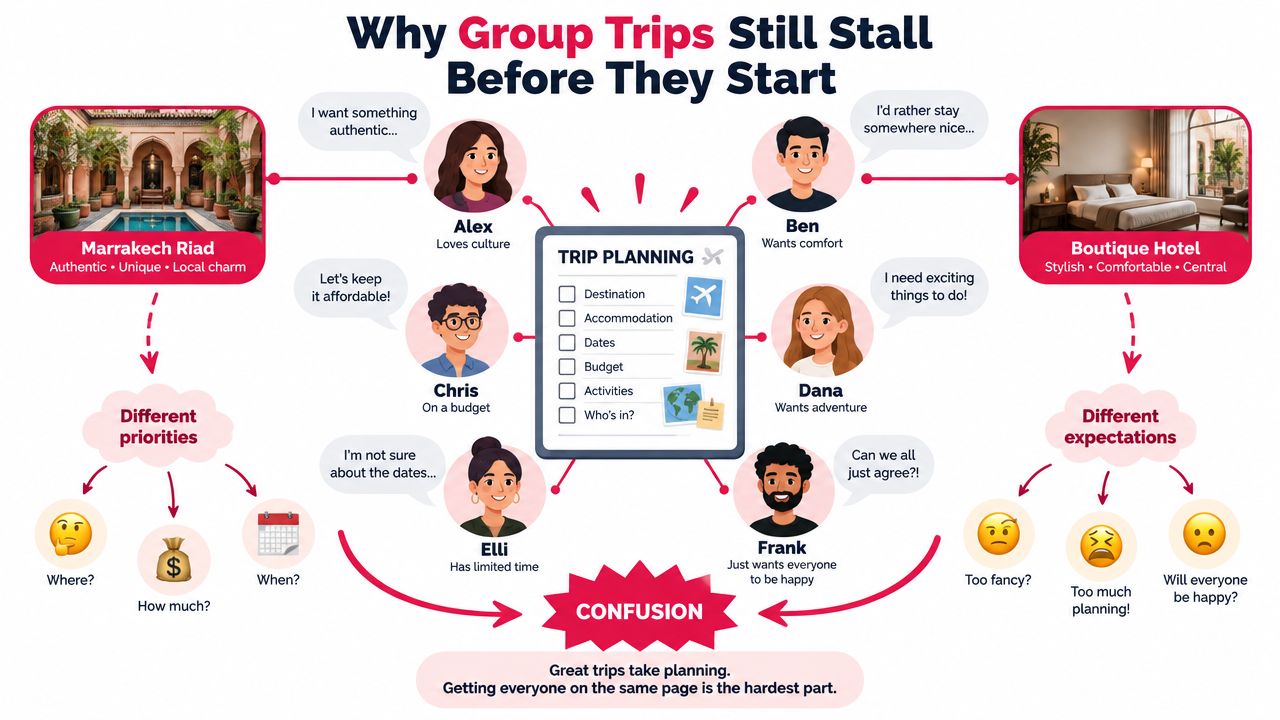
The organizer carries more than the itinerary
When preferences pull in different directions, the group tends to hand the problem to one person. That is how a volunteer organizer ends up filtering the hotel list, selecting activities, and absorbing complaints when a plan fails to suit the whole group.
A group planning app introduces a defined decision process before public reactions dominate. Each traveler can record a budget, preferred pace, location, accessibility requirement, or deal-breaker, giving the group a clearer basis for comparing options.
Our guide to choosing a decision-making tool for your group trip makes the same case: collect individual input, identify overlap, and make the shared choice visible. For a hotel promoting a Barcelona weekend, a creator planning a Marrakech itinerary, or friends comparing Rome and Lisbon, that structure turns conflicting preferences into a decision the group can act on.
What a Group Planning App Actually Does
A group planning app is best understood as a decision-resolution layer connected to travel options. It separates three jobs that chat tools often blend together: collecting preferences, combining them, and carrying the agreed plan into booking.
First, collect preferences privately
For a Barcelona weekend, Marrakech itinerary, or Rome and Lisbon comparison, the organizer begins with a destination, date range, or trip idea and shares an invitation link. Each traveler records a budget, interests, energy level, accessibility needs, food requirements, and must-see ideas. Private responses reduce the pressure to follow the loudest suggestion in a public thread.
The survey might compare a relaxed beach day, an active excursion, and a cultural activity. It can request a spending ceiling and offer a none-of-the-above choice. Keep it short, around 10 to 15 questions, mixing multiple-choice items with scaled preferences, room for comments, and a completion deadline.
Next, aggregate the answers
The app converts separate responses into a shortlist that the group can inspect. A Lisbon sailing trip may rank above an inland activity because more travelers value time on the water. A Rome hotel may rise because it meets accessibility and dietary requirements for several participants.
Group travel decision research describes methods such as building a shared preference model, averaging ratings, and combining individual recommendations. It also examines plurality voting, Borda count, Copeland rule, approval voting, average ratings, and multiplicative aggregation (group travel decision aggregation research). The product implication is practical: the ranking should show how an option fits the group, not hide the reasoning behind a single score.
Finally, move from choice to action
After the group selects an activity, accommodation, or itinerary, the platform should preserve that decision and support bookings, deposits, reminders, and updates. The goal is to give participants a clear object to approve rather than forcing negotiation across disconnected tools.
Core Features That Make These Apps Work
A useful platform doesn't win because it has the longest feature list. It wins because each feature removes a particular source of uncertainty from the trip.
Preference surveys
The survey should capture information that chat hides:
- Budget boundaries: Ask what each traveler can realistically spend, not whether a proposal “sounds good.”
- Date flexibility: Record firm dates separately from preferred dates.
- Must-haves: Identify beach access, nightlife, accessibility, dietary needs, or a central location early.
- Deal-breakers: Let travelers reject options that fail a core requirement.
- Travel style: Distinguish between early starters, slow mornings, active days, and relaxed schedules.
A 2023 methodology paper in Transportation introduced the Text-aided Group Decision-making Process Observation Method, or x-GDP, a survey method for collecting data on joint leisure activities from all members of a group, because joint travel decisions are poorly explained by data from one member alone (x-GDP methodology for travel choices). That supports a simple product lesson: collect input from every traveler before asking the group to agree.
Match scoring
A raw catalog creates more work. Match scoring narrows the catalog by comparing each option with the group's stated preferences. It should show why an activity fits, while also exposing a veto or missing requirement.
A field study of OutWithFriendz, a group-event planning app used by more than 500 people across 300 events, found that user mobility, individual preferences, host preferences, and the voting process all shaped what the group chose (mobile group planning decision support research). A ranking therefore needs context. A high score shouldn't hide that an option exceeds the agreed budget or excludes a participant.
Shared itinerary
The itinerary should behave like a shared, editable record. Flights, rooms, transfers, restaurant reservations, and activities belong on one timeline, with changes visible to everyone.
A map view helps the group see how the days fit together geographically. The itinerary is also where the group's remaining negotiations belong: where and when to go, which activities make the cut, and how shared expenses are tracked.
Voting and reactions
Voting gives the group a bounded decision. Participants can approve, reject, rank, or comment on a proposal without reconstructing the entire chat history. A good system also records the deadline and prevents a settled decision from reopening indefinitely.
Payment coordination
Shared deposits and balances need to be visible before the booking is final. The app should clarify who has paid, who still owes money, whether costs are equal or customized, and how refunds will be handled.
Organizer controls
The organizer needs practical authority, not arbitrary power. Deadlines, reminders, invite links, and decision locks keep a trip moving while preserving participation.
| Feature | Problem It Solves |
|---|---|
| Preference survey | Vague opinions and hidden constraints |
| Match scoring | Too many destinations, stays, or activities |
| Shared itinerary | Fragmented reservations and outdated notes |
| Voting and reactions | Repeated debates and unclear consensus |
| Payment coordination | Unpaid deposits and disputed balances |
| Organizer controls | Missed deadlines and endless reopens |
For a wider view of the category, this guide to a travel planning app places collaboration alongside itinerary and booking workflows.
Where Group Planning Apps Create Real Revenue
The same decision engine can serve different buyers because each buyer needs a different commercial outcome.
A boutique hotel in Barcelona may receive a group inquiry with several room types, mixed dietary requirements, and interest in local experiences. Instead of sending a long email exchange, the hotel can collect preferences, identify the appropriate room mix, and present options such as wine tasting, spa appointments, or late checkout. The platform turns an uncertain inquiry into clearer booking intent and creates opportunities for ancillary sales.
A Dubai-based travel creator has a different objective. They might invite followers to vote on a retreat theme, compare desert activities with cultural visits, and guide the winning group toward bookable experiences. The creator can then connect the itinerary to affiliate links, partner placements, or a branded post-trip recap. The commercial value comes from connecting audience preference with a measurable booking action.
For a Marrakech trip organizer, deposits and reminders can reduce the amount of personal chasing required before departure. The organizer isn't merely collecting money. They're creating a commitment point for every participant, which makes room blocks, transfers, and activities easier to confirm.
| Buyer | Primary Revenue Surface | Example Destination | Monetization Trigger |
|---|---|---|---|
| Boutique hotel | Experiences and room upgrades | Barcelona | A group confirms preferences and adds services |
| Travel creator | Affiliate and partner bookings | Dubai | A poll turns audience interest into reservations |
| Trip organizer | Coordination fees or deposits | Marrakech | Participants commit financially to the plan |
The infrastructure is shared, but the buyer-facing surface changes. Hotels need ancillary catalogs and operational handoffs. Creators need attribution, branded journeys, and payout clarity. Organizers need commitment tools that don't make them act as a full-time accounts department.
Evaluation Criteria for Choosing the Right Platform
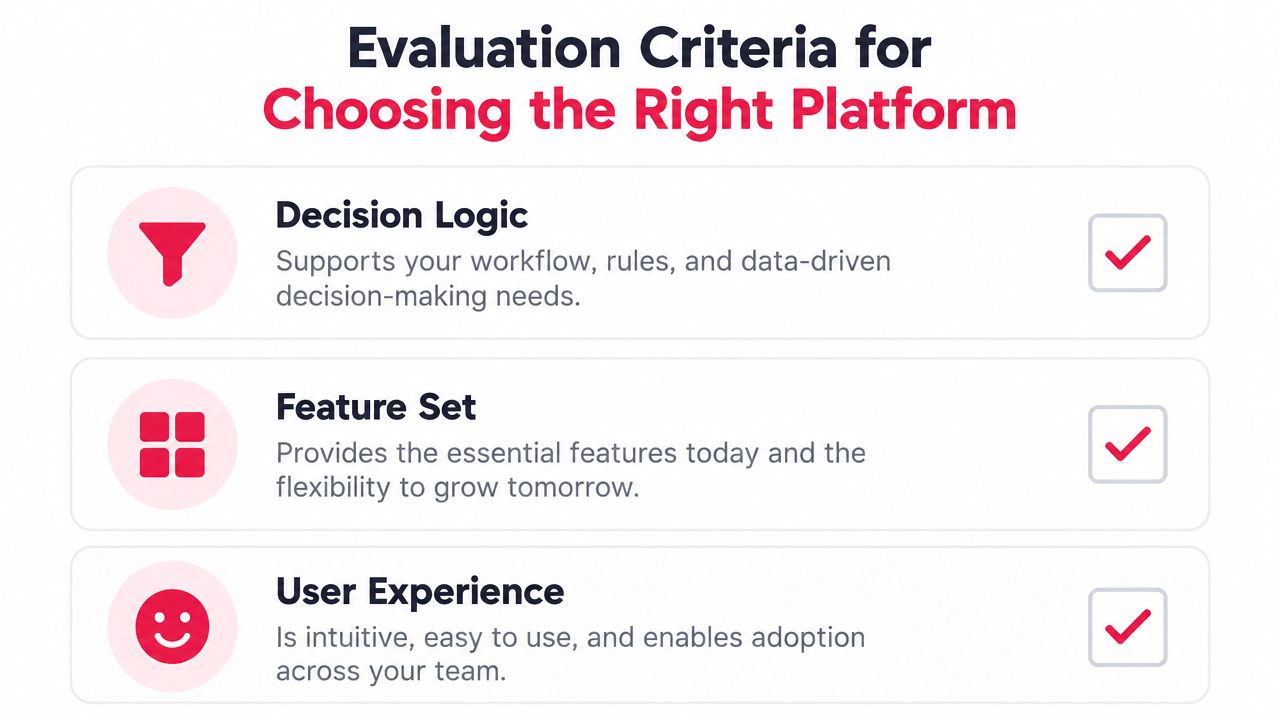
Start with the decision you need the platform to make. A tool that only gathers answers won't help a group choose between three restaurants in Lisbon, while a powerful booking catalog won't compensate for weak voting logic.
Check the decision logic
Ask whether the system can rank options, handle vetoes, expose ties, and explain the result. A useful platform should show why a Sintra wine route fits the group and identify which requirement caused another proposal to fall behind.
Test the catalog
Review the destinations and categories that matter to your business. A hotel serving European city breaks may need Paris, Rome, Barcelona, and Dubrovnik. A MENA-focused operator may need reliable coverage for Doha, Muscat, Abu Dhabi, and Marrakech. If the catalog is thin, the organizer will return to email and spreadsheets.
Protect the buyer's identity
Hotels and creators should test branding controls before committing. White-label pages, custom invitation links, consistent visual identity, and clear ownership of participant data matter when the planning flow represents a property or a creator brand.
Examine payments and onboarding
Test split payments, deposits, refunds, and currency handling with a real scenario. Then invite someone who isn't comfortable with travel software. If they need a tutorial before they can vote, the platform has a participation problem.
Pilot rule: Use a real Lisbon, Doha, or Barcelona group rather than a scripted demo. Watch where participants hesitate, abandon the survey, or ask the organizer to repeat information.
Teams that need broader operational software can compare these software options for travel agencies, but the same practical test still applies. The right platform should help a real group reach a decision with less intervention from the organizer.
Real Use Cases Across European and MENA Destinations
In Lisbon, a bachelorette organizer has to balance different ideas about the weekend. Some travelers want a sailing day, others prefer a food-focused route, and someone is already campaigning for a private fado dinner. The organizer sends a survey, sets a response deadline, and lets the group vote on a shortlist rather than asking everyone to write an essay in the chat.
The shared itinerary then holds the selected sailing day, a wine route in Sintra, and the dinner in one place. Deposits are attached to the decisions, so the organizer can see whether the plan is ready to confirm instead of relying on verbal promises.
Dubai and the creator-led retreat
A creator organizing a paid retreat in Dubai may want more than a headcount. They can ask attendees about photography interests, preferred activity intensity, and the type of content they want to make. Match scoring can help the creator form a more coherent program, such as pairing a sunrise desert shoot with a lower-energy cultural afternoon.
The creator also gains a clearer commercial path. Partner activities can be proposed transparently, followers can respond to the itinerary theme, and confirmed bookings provide a stronger basis for sponsor reporting than a collection of informal comments.
Rome and the multi-generational reunion
A family reunion in Rome often involves requirements that don't fit neatly into a group chat. One traveler may need step-free access, another may need gluten-free dining, and late arrivals may require flexible check-in. A preference survey collects those details before the family chooses a hotel or builds the daily schedule.
The group can then compare accessible routes, meal options, museum visits, and rest periods on one shared itinerary. Organizer controls keep the plan stable after the family reaches agreement, while comments preserve room for practical questions without reopening every settled decision.
These examples show why the category serves more than friends planning leisure. Hotels, creators, families, and retreat leaders all need a process that turns individual requirements into a shared, bookable plan.
Common Misconceptions About Group Planning Apps
More features don't automatically create better coordination. A platform may include dashboards, message threads, maps, payment tools, and recommendation engines, yet still lose participants if the first vote is difficult to find.
For a Marrakech riad weekend or Barcelona hen trip, travelers need a direct mobile flow. They should open a link, answer clear questions, review a shortlist, and vote. If account creation or dense setup screens hide those actions, extra capability becomes friction.
Chat provides context. Voting resolves preferences.
Chat preserves useful details, but preferences can remain unclear. The loudest participant may dominate, quiet participants can appear flexible when they're uncertain, and old proposals remain mixed with new ones.
A defined question, deadline, and outcome give voting a clearer job. The organizer also gets a record of the group's decision, which helps hotels, creators, and trip leaders work from an agreed brief rather than scattered messages.
Artificial intelligence needs a trustworthy catalog
Recommendation tools can suggest activities, but each option still needs destination availability, relevance to the group's constraints, and a realistic booking path. A desert excursion for Marrakech or a food tour in Barcelona has value only when participants can evaluate and arrange it.
Payment features follow the same rule. If split payments are hard to find or appear only after a booking commitment, participants may return to manual collection.
For buyers, the test is decision resolution: can the product turn different preferences into one usable plan without adding work for the organizer?
The strongest pattern is fewer screens, clearer prompts, and faster consensus. A lightweight product can outperform an elaborate one when it fits casual participation.
Choosing the Right Group Planning App for Your Goals
The right configuration depends on who owns the decision and what happens after the group agrees.
| Buyer Profile | Primary Goal | Must-Have Features |
|---|---|---|
| Hotel or hospitality brand | Convert group interest into rooms and add-ons | White-label experience, ancillary catalog, PMS connectivity |
| Travel creator | Turn audience participation into bookings | Affiliate links, payout terms, attribution, audience analytics |
| Friend-group organizer | Reach agreement without chasing everyone | Mobile voting, low-friction invites, split payments |
| Family or reunion planner | Balance practical needs across generations | Private surveys, accessibility filters, shared itinerary |
| Corporate retreat organizer | Coordinate schedules, activities, and approvals | Deadlines, permissions, budget visibility, exportable plans |
Hoteliers should prioritize brand control, experience inventory, and integration options. A Barcelona property with a strong local activity program has different needs from a chain coordinating stays across Europe and MENA.
Creators should inspect the full path from poll to booking. Transparent payout terms, deep links, and conversion reporting matter more than decorative itinerary features if the trip is part of a commercial content strategy.
Friend groups should choose simplicity first. A casual city break in Prague or Vienna rarely needs enterprise permissions, but it does need invitations that work quickly, voting that is understandable, and payment handling that doesn't leave one person financing the weekend.
A lightweight tool suits informal trips. A mid-tier platform fits creator retreats and recurring organizer-led travel. Enterprise-grade systems make sense for hotel groups with multiple properties, destinations, and operational teams.
MyPerfectStay works this way for groups: someone picks a city, shares a link, everyone swipes yes or no on activities without downloading an app, and the group's yeses become a draft itinerary. Hotels can join the partner network with a QR code at check-in and no PMS integration, and creators can use the creator program for personal links and commission on bookings. Visit MyPerfectStay to see whether that flow fits your next hotel, creator, or group trip.