Group Travel Planning Website Guide
September 13, 2026·MyPerfectStay

Seventy-six percent of group trips discussed in chats never happen. Only 24% become real journeys, according to a 2026 survey of 2,000 women run by Talker Research for Discover Puerto Rico and reported by Hotel News Resource. The planning failure usually starts long before anyone cancels a flight. It starts when a group mistakes conversation for coordination.
A dedicated group travel planning website replaces the endless stream of opinions with private preferences, visible deadlines, match scores, shared itineraries, and a direct path to booking. That matters even more for multi-destination trips across Europe and MENA, where a single journey might combine Lisbon and Barcelona, or Dubai and Muscat, with different budgets, energy levels, and priorities competing for space.
Table of Contents
- The Hidden Cost of Chat-Based Trip Coordination
- How Smart Voting Algorithms Replace Groupthink
- Essential Features That Keep Group Itineraries on Track
- Real-World Applications Across European and MENA Destinations
- Monetization Strategies for Hotels and Travel Creators
- The Buyer Checklist for Platform Partnerships
- Transitioning from Endless Debates to Confirmed Bookings
The Hidden Cost of Chat-Based Trip Coordination
The group chat looks convenient because everyone already knows how to use it. Add a few friends, share a destination idea, and wait for the suggestions. Then the work begins. Someone proposes Rome, another person pushes for Istanbul, a third asks whether the trip should include a beach stop, and the original organizer starts tracking preferences across scattered replies, reactions, screenshots, and private messages.
The workload is far heavier than most groups expect. The same survey found that planning a group trip takes an average of 83 messages, nearly 19 hours, and 11 days, with respondents spending the most time researching activities, at 2.6 hours, and selecting destinations, at 2.5 hours (Hotel News Resource). That's a lot of unpaid administrative work before anyone has chosen a hotel or reserved a table.
The bigger problem isn't message volume. It's decision distortion. The person who replies fastest or writes most confidently can steer the group, while someone with a strict budget, limited mobility, or strong dislike of nightlife may stay quiet until the itinerary is already taking shape.
Practical rule: If a preference matters, collect it before the group starts arguing about options.
Why the loudest voice wins
Chat-based planning rewards visibility, not fairness. A persuasive traveler can turn “I'd love to see this” into the assumed group plan, even when others haven't had a meaningful chance to respond. A thumbs-up reaction rarely explains whether someone loves an idea, tolerates it, or hasn't had time to object.
This becomes especially risky on European and MENA multi-destination trips. A traveler who wants museums and slow lunches may struggle with a schedule built around late-night clubs in Barcelona. A family member who prefers relaxed cultural visits may not want every day in Marrakech organized around high-energy excursions. A colleague joining a Lisbon offsite may be unable to participate in an activity chosen by the most enthusiastic members.
Research on holiday decision-making found that group travel choices often aren't made through equal influence. Kristyna Marcevova's 2011 Exeter thesis on travel parties of 18- to 35-year-olds, based on quantitative surveys of 412 and 200 respondents plus longitudinal interviews, concluded that individual trip sub-decisions are frequently dominated by a single person rather than shaped equally by the entire group, and that larger parties skew further that way (University of Exeter, Group Influences on Individual Holiday Decision-Making and Behaviour). The practical lesson is straightforward: don't treat every decision as a final group vote. Identify who contributes, who validates, and who needs a private veto.
Replace conversation with a decision record
A structured platform should capture the destination, dates, budget range, accommodation needs, transport requirements, meal preferences, special events, tours, and daily activities in one place. Write each of those down as a decision with an owner and a deadline, then check the itinerary for gaps before anyone pays a deposit.
The WhatsApp planning problem isn't solved by creating a better chat thread. It's solved by turning preferences into usable data, routing each sub-decision to the people affected, and giving the organizer a clear record of what the group agreed to.
How Smart Voting Algorithms Replace Groupthink
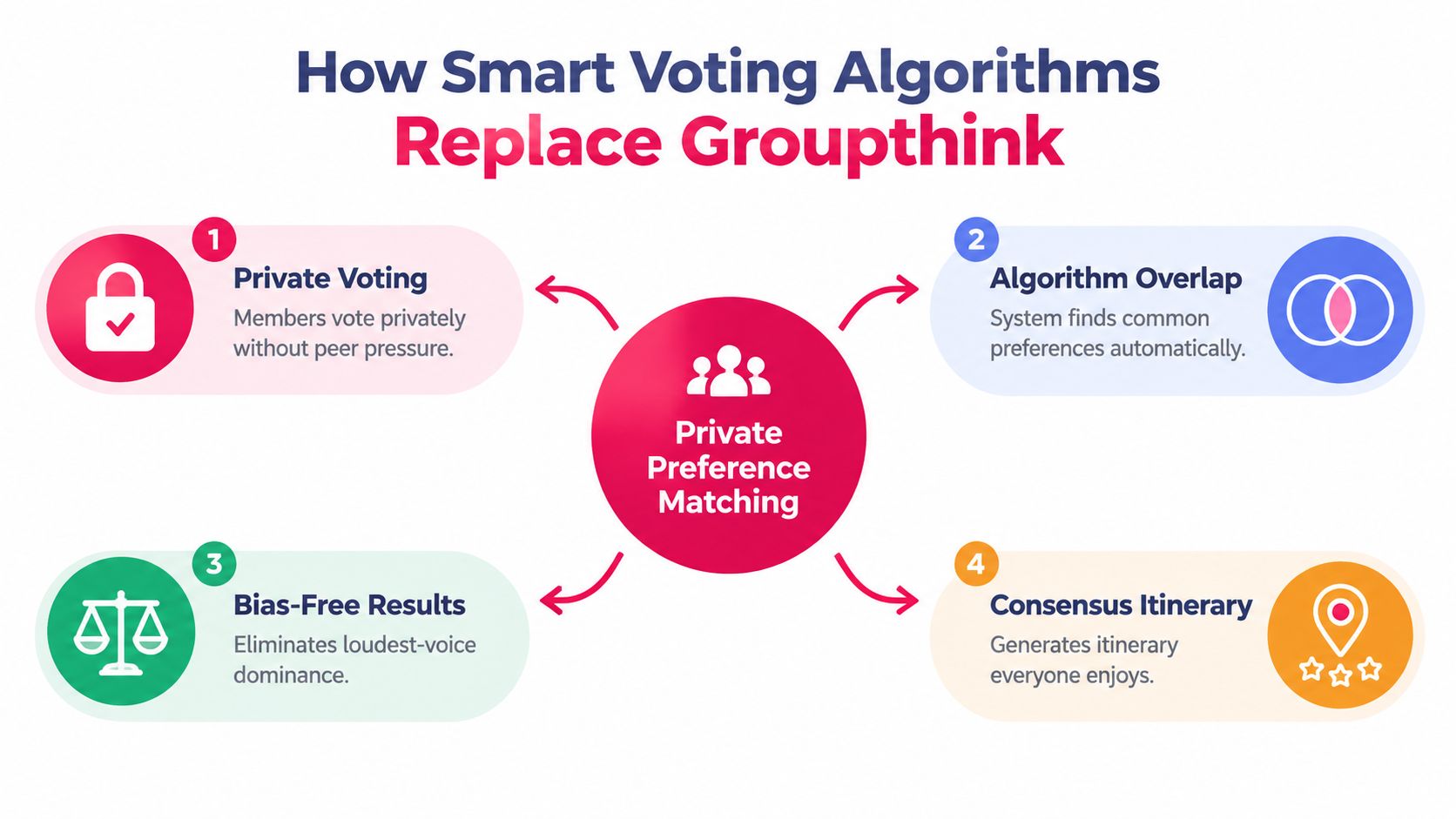
Basic polls ask, “Which option do you prefer?” That's useful for a simple choice, such as Paris or Vienna. It breaks down when the decision includes cost, pace, timing, interests, and participation. A modern group travel planning website should collect those signals privately, compare them, and show the overlap instead of asking the most vocal traveler to negotiate every disagreement.
Private input changes the social dynamic first. Each traveler can state a budget, energy level, interests, and must-see ideas without having to defend them in front of friends, family, or colleagues. That matters because group choices are negotiated in real time, not settled once: a Swansea University thesis on in-destination decision-making, built on 19 tourist interviews and 515 surveys, found activity selection is shaped by group dynamics, context, and emotion as the trip unfolds (Swansea University thesis).
The mechanics behind private matching
The platform doesn't need every traveler to want the same experience. It needs to find options that satisfy enough of the group's constraints. Someone seeking luxury and someone protecting a tight budget may disagree about accommodation, but still overlap on a food tour, a historic district, or a short cultural excursion.
The workflow should work like this:
- Collect preferences privately: Ask each participant about budget, interests, energy, timing, and must-see activities.
- Compare overlap: Match responses against available activities, destinations, and time slots.
- Expose trade-offs: Show where the group aligns and where an option has meaningful objections.
- Rank practical choices: Surface activities with clear match scores rather than presenting an unfiltered catalog.
- Create the itinerary: Place accepted options into a shared schedule that reflects the group's actual constraints.
A peer-reviewed study in Transportation, published in 2023, proposed x-GDP, a text-aided method for observing joint travel decisions. Cliques coordinate a real activity through a group-chat interface, letting researchers watch how shared preferences emerge and where consensus breaks down rather than only recording the outcome (Springer study on x-GDP). The important product insight is that synchronized input creates better decision data than asking one organizer to remember what everyone said earlier.
Match scores are more useful than arguments
Suppose a group is choosing between a Dubai desert safari, a museum afternoon, and a yacht cruise. A simple majority vote may select the most exciting option, even if several participants dislike the timing or cost. A matching system can show which activities satisfy the group's combined interests and which ones create avoidable friction.
That doesn't eliminate disagreement. It makes disagreement visible early, while alternatives still exist. As the consensus algorithm primer puts it, consensus isn't magic agreement; it's decision-making under disagreement, and a match score gives that disagreement a shape the group can act on. The organizer can then approve a high-overlap activity, schedule a split itinerary, or offer a clear compromise instead of reopening the same argument in another chat.
Essential Features That Keep Group Itineraries on Track
A voting tool alone will not rescue a failing trip. The platform must take the group from invitation to confirmed booking without forcing the organizer to transfer details between chat apps, spreadsheets, booking sites, and email threads. That coordination cost becomes harder to control on European and MENA trips with multiple cities, languages, budgets, and travel paces.
Start with frictionless invitations. A shareable link should let travelers review the trip and submit preferences before requiring an account or app download. Every extra step removes quieter participants from the process, leaving the organizer to chase opinions privately and giving the loudest voice in the chat undue influence.
Build a system that keeps decisions moving
Deadline controls close decisions. A suitable platform should let the organizer set a voting deadline, remind non-responders, and show which choices still block the itinerary.
Use this sequence:
- Set the trip frame: Confirm destinations, dates, purpose, and budget range.
- Gather private input: Ask about interests, pace, dietary needs, and must-haves.
- Rank the overlap: Show a short list with match scores and relevant context.
- Close the vote: Set a deadline and stop reopening settled choices without a clear reason.
- Lock the plan: Add approved activities to a shared daily itinerary.
- Book together: Keep confirmations, references, and tickets available to the group.
Keep the survey short enough to complete in one sitting. A group-travel decision framework recommends 10 to 15 questions, combining multiple-choice and scaled preferences, with comments available for context (SquadTrip group decision framework).
The shared itinerary should update when the group approves an activity. It should display the day, time, location, participants, booking status, and ticket details. One record stops travelers from repeating the same questions and prevents the organizer from becoming a human notification system.
Integrated booking completes the workflow. Travelers should move from an accepted activity to a group reservation without re-entering details or searching through separate confirmation emails.
Real-World Applications Across European and MENA Destinations
A friend group planning a bachelor party in Barcelona usually doesn't have an idea problem. It has a priority problem. One person wants a late-night club plan, another wants a beach day, and someone else is watching the budget. A private survey lets each traveler state those preferences before the group begins defending its favorite version of the weekend.
The platform can then separate shared activities from optional ones. A high-overlap food experience might become the group anchor, while nightlife or beach time can remain a smaller-participant choice. That structure prevents the entire itinerary from being held hostage by one expensive or energy-intensive activity.
Marrakech creates a different coordination challenge for multi-generational families. Younger travelers may want a desert safari and long days exploring, while older relatives may prefer museums, gardens, or a slower afternoon at the riad. The right answer isn't forcing every person into every activity. It's collecting energy and interest preferences, then designing shared anchor points with flexible blocks around them.
One platform, different participation patterns
Corporate teams planning an offsite in Lisbon need more than an activity list. Organizers must account for physical ability, professional objectives, dietary requirements, and the fact that colleagues may not feel comfortable objecting publicly to a senior person's suggestion.
Private preference collection gives participants room to state constraints without turning them into a group discussion. The organizer can compare options such as a food-focused neighborhood experience, a low-intensity cultural tour, or a structured team activity, then select choices with broad compatibility.
Common interest remains a strong foundation. That doesn't mean every traveler needs identical tastes. It means the platform should identify the interests that can bring people together and avoid building the entire itinerary around a narrow preference.
For a multi-destination route, use the same system at each stage. Gather input on whether the group wants to move from Lisbon to Porto, stay longer in one city, or add a MENA extension such as Marrakech or Doha. Record the decision, assign a deadline, and move forward once the group has enough agreement to book.
Monetization Strategies for Hotels and Travel Creators
Hotels and creators should stop treating group planning as an afterthought. The planning phase is where travelers decide which neighborhood to visit, which experiences fit the group, and which add-ons deserve money. If a property or creator only appears after the hotel room is booked, much of that commercial opportunity has already moved elsewhere.
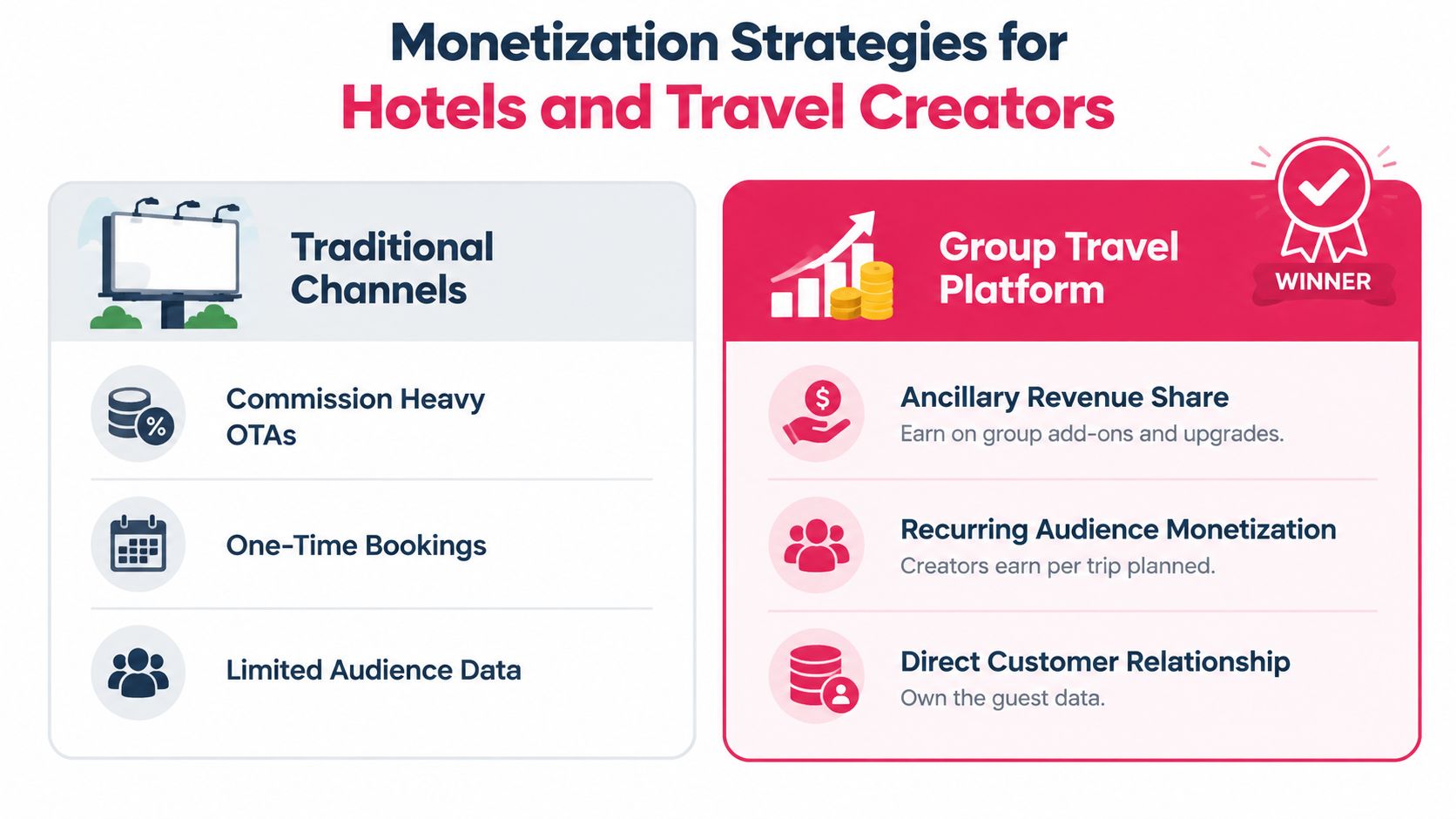
Traditional affiliate marketing usually depends on a link, a click, and a single booking event. That model can work for a hotel recommendation or a standalone tour, but it offers limited control over the wider group journey. A structured platform can connect accommodation, activities, upgrades, and group decisions in one planning flow.
Hotels can sell the stay and the experience
A Dubai hotel might promote a desert safari, airport transfer, private dining, or yacht cruise after a group has selected its preferred activity style. A boutique property in Santorini could present a coordinated food experience, sunset cruise, or island excursion that suits the travelers' shared interests.
The commercial advantage is relevance. The platform isn't showing random add-ons to an anonymous visitor. It's presenting bookable options after the group has expressed what it wants to do. That gives the property a stronger opportunity to earn from ancillary services while keeping the guest relationship connected to the stay.
Creators can monetize planning, not just attention
Travel creators often influence destinations long before followers make a booking. A creator who publishes a Lisbon weekend itinerary, a Santorini group escape, or a Doha experience guide can turn that content into a shareable trip that followers adapt together.
Deep links should lead directly to the relevant destination, itinerary, or experience rather than a generic homepage. Reliable payouts matter too, because creators need a clear connection between the trips their audience plans and the revenue they receive. A creator program built around structured itineraries can produce a more useful commercial relationship than scattered affiliate links.
The distinction is simple:
- Traditional channel: A follower clicks a recommendation and manages the rest alone.
- Group platform: Travelers join a shared plan, compare preferences, select activities, and book as a coordinated party.
- Hotel partnership: The property can present relevant upgrades and local experiences during planning.
- Creator partnership: The creator can earn from a trip that followers actively build and reserve.
The strongest model doesn't replace trust-based recommendations. It gives those recommendations a practical route to group action.
The Buyer Checklist for Platform Partnerships
Hotels, tourism boards, and creators should evaluate a group travel planning website as an operating layer, not just a marketing widget. The platform needs to support discovery, participation, decision-making, booking, payment attribution, and post-booking communication without creating a second administrative burden.
Start with inventory. A platform that works for European city breaks should offer more than hotel suggestions. Buyers should check whether it includes experiences such as Parisian food tastings, Rome walking tours, Dubrovnik boat trips, Marrakech excursions, and Doha yacht cruises. The catalog must match the destinations and traveler segments the partner serves.
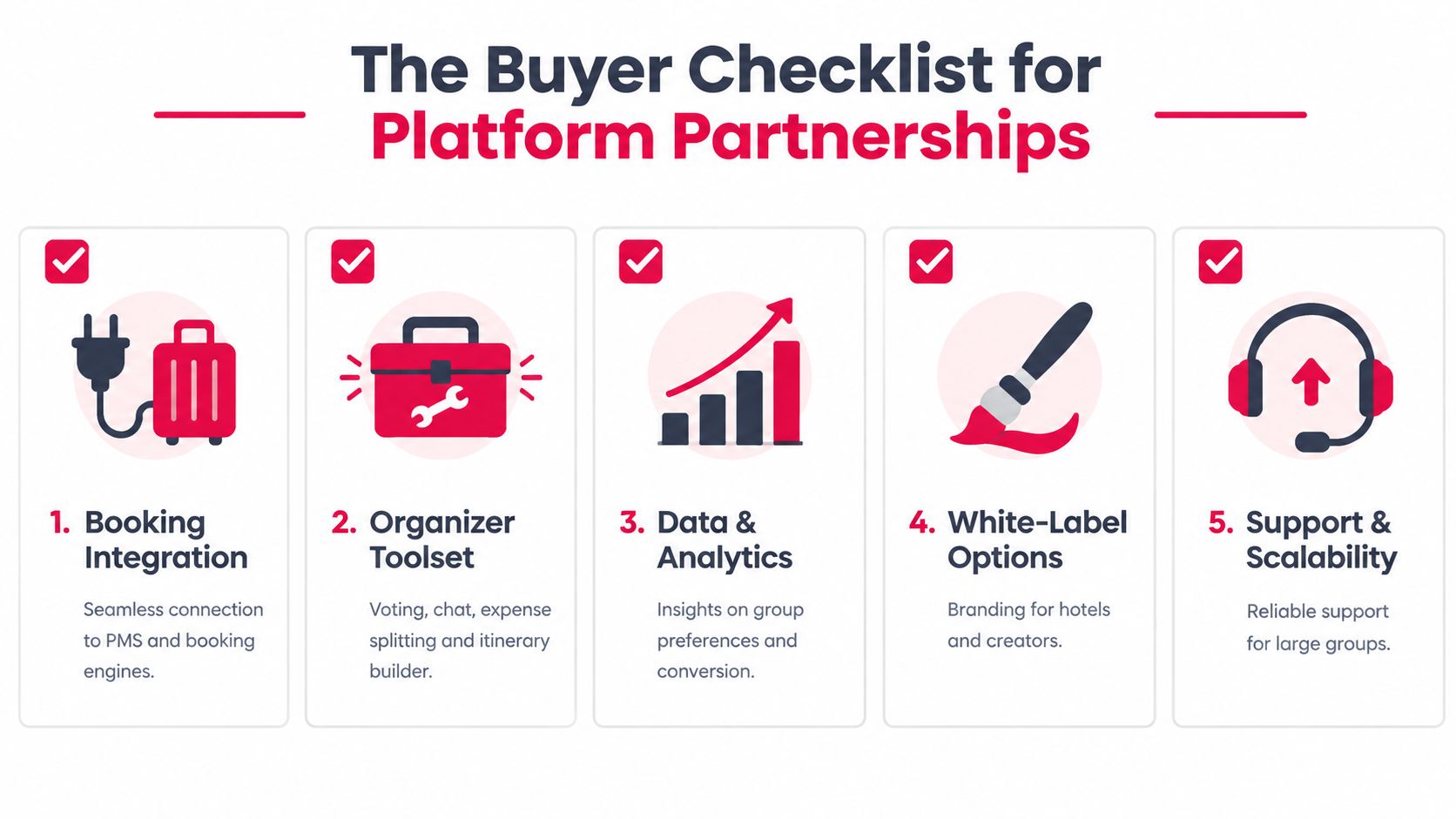
Evaluate the product across five areas
Booking integration comes first. Ask how the platform connects with booking engines, property systems, payment flows, confirmation messages, and ticket delivery. Travelers shouldn't have to leave the planning environment to complete every reservation.
Organizer tools determine whether the product can handle real groups. Look for private surveys, voting, deadline controls, nudges, link invites, expense splitting, itinerary building, and participant visibility. A pretty activity catalog won't help if one organizer still has to chase every response.
Data and analytics should show where users drop out, which activities attract group agreement, and which campaigns convert into bookings. Partners need actionable insight, not a dashboard filled with vanity metrics.
White-label options matter for hotels and creators protecting their brand. Check whether the experience can carry the partner's identity while still preserving the platform's booking and support functions.
Support and scalability should be tested before launch. Ask who handles booking changes, cancellations, failed payments, traveler questions, and larger groups with multiple activities across several cities.
Don't buy from a feature list. Ask each vendor to demonstrate the exact group journey, from invitation through confirmation, using your own inventory and a realistic party size.
Finally, inspect the commercial terms. Confirm the payout schedule, cancellation treatment, attribution window, reporting access, refund responsibility, and whether the partner can export or use customer data appropriately. Review the partner model described by MyPerfectStay for partners against those requirements, rather than accepting broad promises about growth or reach.
Transitioning from Endless Debates to Confirmed Bookings
A chat thread manages excitement well but handles constraints, accountability, and booking readiness poorly. In European and MENA multi-destination trips, different budgets, energy levels, interests, and schedules quickly turn conversation into a contest led by the loudest participant. Structured preference data gives every traveler equal weight and shows which options fit the group.
The market supports a serious product category. Industry research puts the global group travel market at $369.80 billion in 2024, projected to reach $651.83 billion by 2034 at roughly a 5.8% CAGR over the 2025-2034 forecast window (Market Research Future). On the business side, the U.S. Travel Association's first State of Group Travel report describes a flat, uneven 2025 in which RFP volumes still ran at 109% of 2019 levels (U.S. Travel Association). The demand sits across leisure, corporate, reunion, and organized group travel.
Set up the trip, invite participants with a link, collect private preferences, set deadlines, compare match scores, and lock activities that satisfy the group. Book from the shared itinerary once the plan is confirmed.
This workflow cuts repeated arguments, protects quieter travelers from being overlooked, and keeps decisions tied to booking readiness. MyPerfectStay lets groups collect private preferences, vote on activities, build shared daily itineraries, and book experiences across European and MENA destinations. Visit MyPerfectStay to replace the next chaotic debate with a decision system that gets everyone moving.