Group Trip Planner Explained: How to Choose and Book Faster
September 8, 2026·MyPerfectStay

You're in the group chat trying to choose between Paris, Barcelona, and Marrakech. One friend wants museums, another wants late dinners, someone else is watching every expense, and the person who created the chat is turning into the travel agent, accountant, and customer-support desk. The trip hasn't even been booked, yet everyone already feels tired.
A group trip planner changes the job. It isn't just a faster way to reserve a hotel or activity. It's a decision engine that helps a group reveal preferences, find genuine overlap, handle uneven budgets, and build a plan that leaves room for people to separate when they need to. That distinction matters whether you're arranging a city break in Rome, a family stay in Dubai, or a team retreat in Lisbon.
Table of Contents
- Why Group Trips Get Messy Before They Get Memorable
- What a Group Trip Planner Actually Does
- Features That Make Group Decisions Fast and Fair
- How Different Groups Use a Planner in Europe and MENA
- Group Trip Planner Versus Chats Spreadsheets and Booking Sites
- How to Choose the Right Platform Without Overpaying or Overplanning
- Your Next Group Trip Starts With One Shared Decision
Why Group Trips Get Messy Before They Get Memorable
The first problem usually looks small. Someone asks, “What dates work?” Three people answer in the chat, two respond privately, and one reacts with a thumbs-up that nobody can interpret. Then the conversation jumps to accommodation, restaurants, airport transfers, and activities before the group has agreed on the basics.
A few days later, the chat contains several versions of the itinerary. A spreadsheet has one budget, a message thread has another, and the organizer is chasing people who still haven't said whether they want a rooftop dinner or a quiet evening. Nobody is being difficult on purpose. The group has no shared place to make decisions.
That's why group planning is better understood as a coordination problem, not a personality problem. A friend who doesn't answer a poll may be busy. A parent who rejects an expensive excursion may be protecting the family budget. A grandparent who skips a long walking tour may need recovery time, not a less enjoyable holiday.
Research on group trip planning found that collaboration is shaped by both personal attributes and group characteristics, including group size, common interest, group type, and travel style. The study identified common interest as the strongest positive factor for collaboration, connectedness, preparation, and flexibility, while also noting that Chinese groups generally spent less time planning before departure and placed greater emphasis on itinerary detail. The human-factors study on group trip planning supports a useful principle: planning quality depends on how well people discover shared priorities, not on how long they spend debating.
Practical rule: Don't ask the group to agree on everything. Help them see what they already agree on, then make the remaining tradeoffs visible.
This approach resembles the logic behind decision-making frameworks for travel groups. Instead of allowing the loudest voice to steer every choice, the organizer creates a process where quieter preferences count too.
A dedicated planner can bring dates, budgets, activities, confirmations, and daily timing into one workflow. The result feels less like managing five competing opinions and more like laying a table where everyone can see the available dishes. You still need judgment, but you're no longer trying to reconstruct the group's preferences from scattered messages.
What a Group Trip Planner Actually Does
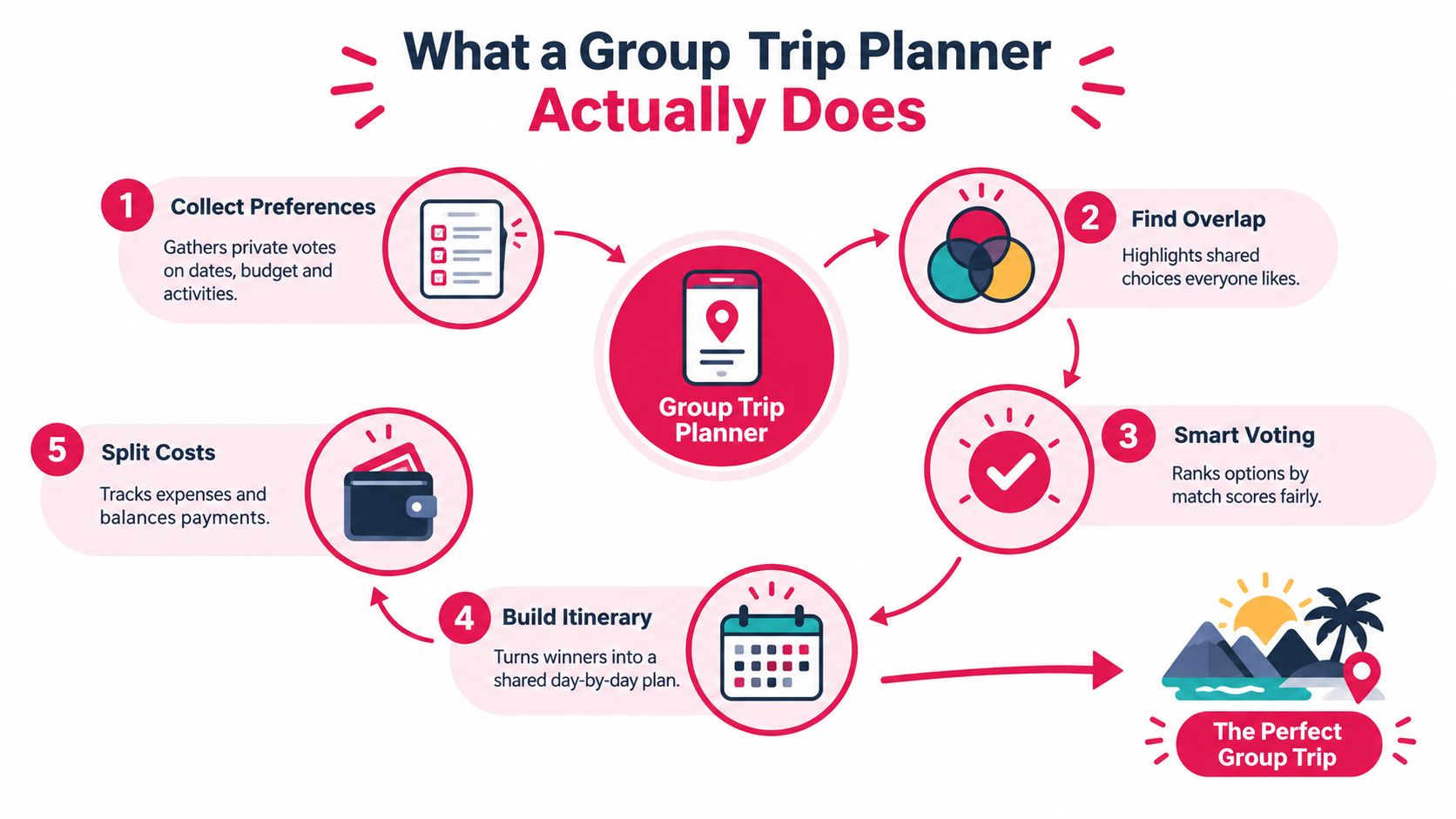
Think of a group trip planner as a shared kitchen. Each traveler brings ingredients, but nobody wants five people cooking separate meals without a recipe. The planner collects what each person likes, identifies combinations that work, and turns the agreed choices into one meal, or in this case, one bookable itinerary.
The process usually follows a clear sequence.
-
Collect preferences privately. Each traveler shares suitable dates, budget comfort, interests, energy level, and must-see ideas. Private input matters because people answer more candidly when they don't have to defend their choices in front of friends or relatives.
-
Find overlap. The system compares responses and highlights activities, dates, and experiences that appeal to several people. For a Paris trip, that might reveal broad support for a museum visit and a food tasting, while showing that a costly private tour is an optional choice rather than a shared commitment.
-
Rank options fairly. Match scores or structured votes help the group see which choices have the widest support. This doesn't remove human judgment. It gives the organizer a clearer starting point than counting enthusiastic messages.
-
Build the itinerary. Selected activities become a shared day-by-day plan, with times, addresses, booking links, and confirmation details available in one place.
-
Track the money. A useful planner distinguishes shared costs from optional add-ons and records who has paid, what remains outstanding, and where a group member chose a different level of spending.
A booking site generally starts with one person searching and choosing. A group planner starts earlier, at the point where travelers need to decide together. That difference is important because travel decisions are often delegated. A survey of 404 American travelers found that a median of 25% handed the destination choice to someone else in their party, and a median of 50% handed over dining and activity decisions once the trip was underway. The study of delegation in tourism decisions shows why one organizer often becomes the final decision-maker, even when the holiday belongs to everyone.
A geocollaborative trip-planning portal has also been tested experimentally on groups planning a trip together. Participants rated the process gains — how well the tool supported the group's task and built a sense of community — above the outcome gains of efficiency and results, and the outcome gains they did report were group consensus plus savings in time and effort. The peer-reviewed study of collaborative trip planning is a useful corrective: a shared tool earns its place by scaffolding the group's task and its communication, not simply by producing a faster answer.
The goal isn't perfect agreement. It's a transparent route from individual preferences to a plan the group understands.
Features That Make Group Decisions Fast and Fair
A good platform should earn its place by solving organizer tasks, not by collecting an impressive list of buttons. Evaluate each feature by asking, “What frustration does this remove?”
Start with private input
A private survey is the foundation. It should let travelers share budget comfort, dates, preferred pace, and interests without turning every answer into a public negotiation.
Private input helps in mixed groups. A younger traveler may want a packed activity schedule, while a parent or older relative may prefer a slower morning. A friend who can't afford every upgrade can mark an optional splurge without feeling as though they're holding everyone back.
Use voting that shows overlap
Simple yes-or-no polls create false certainty. They may tell you that people like a desert safari, but not whether the same people can afford it, have the energy for it, or prefer it to a museum day.
Look for match scores, ranked choices, and visible tradeoffs. The point isn't to automate taste. It's to make the group's shared ground easier to recognize. The decision-making tool guide offers useful context for assessing structured choices rather than relying on message reactions alone.
Keep booking attached to the decision
Once the group chooses, the organizer shouldn't have to copy the winning activity into another system, resend the address, and ask everyone to confirm again. A practical platform should support shared booking, central confirmations, and a record of who is included.
The same applies to itinerary changes. If the group moves a museum visit in Vienna or replaces a late-night activity in Marrakech, every participant should see the updated timing without searching through old messages.
Make the itinerary usable on the move
A shared itinerary should show the essentials clearly:
- Times and meeting points: Travelers need to know when and where to gather.
- Addresses and booking links: The organizer shouldn't become the group's live search engine.
- Confirmation details: Participants should be able to find tickets without asking for screenshots.
- Daily structure: The plan should show fixed commitments alongside free periods.
- Mobile access: People should be able to check the plan while walking through Rome or navigating a souk in Marrakech.
Keep budgeting fair and visible
Preferences and payments belong at the same level. A planner that collects votes but leaves the money in a side conversation solves only half the organizer's problem, because cost is what undoes a consensus after the group has already chosen the activity.
Look for expense splitting, a record of who has paid and what is still outstanding, and clear labels separating shared costs from optional add-ons. Those labels are what let one traveler skip a premium excursion without renegotiating the whole day, and they spare the organizer from doubling as the group's accountant.
Give organizers gentle control
Participation often drops because nobody knows when a decision closes. Deadlines, link invites, and reminders help the organizer move the trip forward without sending repeated personal messages.
No-account participation can also reduce friction at the start. If travelers need to register before they can vote, some will postpone the task. A mobile app can support the trip later, but the first invitation should be easy to open and act on.
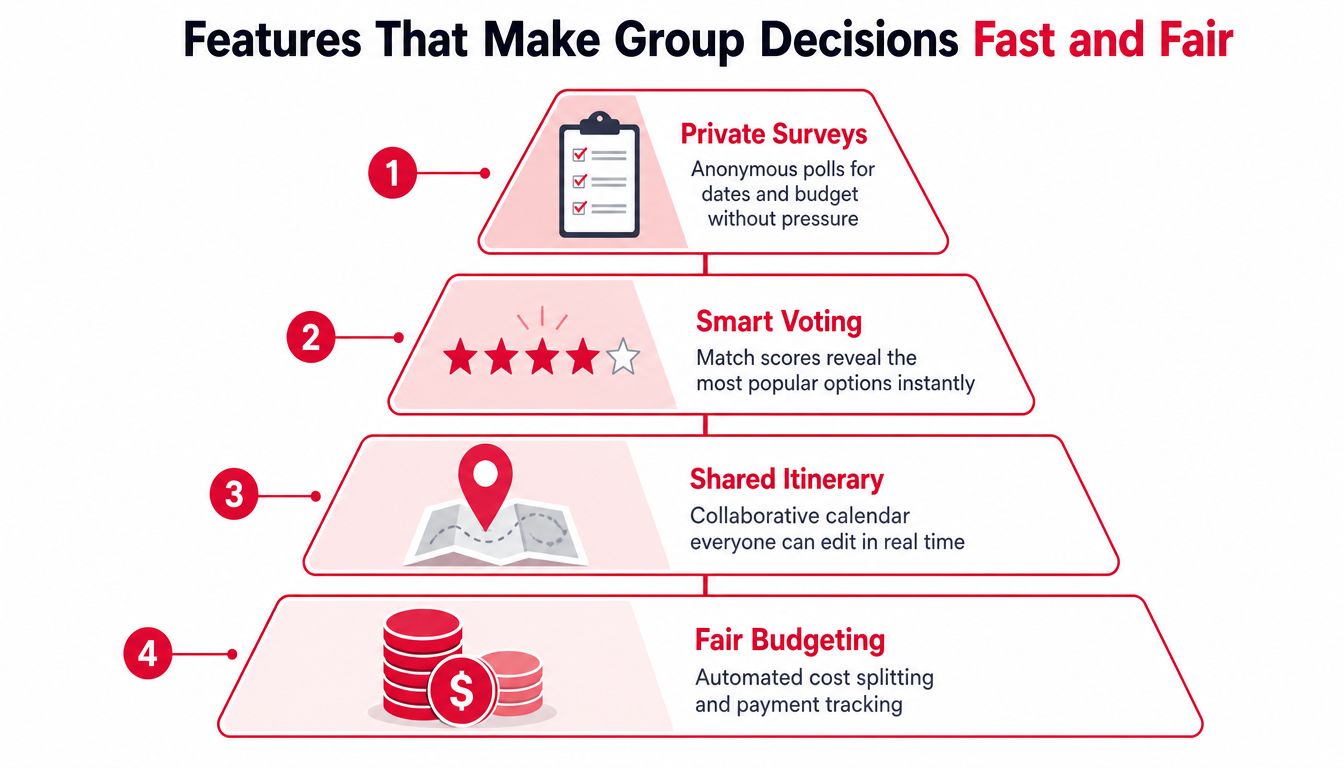
Together, these features answer one question: can the group reach a decision it understands, and pay for it, without the organizer chasing anyone? How that workflow plays out depends on who is traveling.
How Different Groups Use a Planner in Europe and MENA
The right workflow depends on who is traveling. A group of friends visiting Barcelona doesn't make decisions in the same way as a multi-generational family staying in Dubai, even if both groups need an itinerary and a payment record.
Friends on a European city break
Four friends planning Paris may agree on the destination immediately, then stall over the days. One wants galleries, one wants bakeries and neighborhood walks, another wants nightlife, and the fourth wants time to shop.
A private survey can separate must-dos from nice-to-haves. The group might choose a museum and food experience as shared anchors, then leave an afternoon open for shopping or a smaller subgroup. In Barcelona, the same method can balance architecture, beach time, tapas, and late evenings without forcing everyone to attend every activity.
Families coordinating Rome or Dubai
Family groups often contain several decision-makers, but responsibility isn't evenly distributed. Hilton's APAC travel trends reporting says younger travelers' input is strong on activities and destinations — 69% of APAC parents pick the destination based on their children's interests — while the logistics stay with the parents: dining (39%), transportation (38%), accommodation (32%), budgeting (20%), and trip duration (18%). Hilton's 2025 APAC travel trends report describes a coordination gap that a shared planner can make visible.
For a Rome stay, the family might vote on a historical tour, a relaxed meal, and a free block near the accommodation. In Dubai, younger travelers may choose a high-energy experience while parents set the shared budget and keep transport practical. The planner works best when it records these different kinds of agency instead of pretending every person contributes to every decision equally.
Bachelor and bachelorette groups
A Lisbon or Marrakech celebration usually combines shared activities with different spending limits. Some travelers may be happy to pay for a private experience, while others need a lower-cost alternative.
The organizer can mark a dinner or transfer as shared, then present a rooftop event or premium excursion as optional. That distinction protects the group from the familiar moment when someone agrees in the chat and worries about the bill later.
Creators organizing audience trips
A travel creator planning a group experience in Santorini, Istanbul, or Marrakech needs more than a list of recommendations. They need a way to collect audience preferences, coordinate participation, and connect decisions to bookable experiences.
A creator can use a shared invitation to gather interest around food tours, cultural visits, sailing, or photography walks. The audience gets a clearer process, while the creator can focus on shaping the experience rather than manually reconciling every response.
Corporate teams and offsites
A team planning an offsite in Amsterdam, Prague, Doha, or Abu Dhabi may need to balance work sessions, meals, transport, and optional activities. Employees don't all have the same energy level or interest in social events, and attendance may vary by activity.
A planner can separate core events from optional blocks. That makes the schedule more inclusive, especially when some team members want a museum visit or group dinner while others need quiet time between meetings.
Group travel is particularly relevant in MENA, where 31% of travelers choose organized group travel, compared with 10% in Europe, according to YouGov's global travel-planning research. Digital coordination also fits how people discover trips, with 26% of European travelers turning to travel websites first when planning, as reported by TGM Research — though the same research notes that in MENA, social media leads discovery instead. Europe and MENA are a strong setting for this model either way: Statista's ranking of top cities for international visitors puts Dubai (19.5 million), Mecca (18.7 million), and Paris (18.3 million) in the 2025 global top ten.
Group Trip Planner Versus Chats Spreadsheets and Booking Sites
Most organizers don't start by looking for a dedicated platform. They start with whatever the group already uses, usually a chat, a spreadsheet, or a familiar booking website. Each option can work, but each handles a different part of the problem.
| Method | Preference Visibility | Time to Consensus | Booking Effort |
|---|---|---|---|
| Chat polls | Low, answers get buried | Unpredictable | High, details must be copied |
| Shared spreadsheet | Moderate, if everyone updates it | Slow when preferences conflict | Moderate to high |
| Solo-focused booking site | Usually limited to the searcher | Fast for one decision-maker | Low for the organizer, less transparent for the group |
| Group trip planner | High, with structured private input | Faster when overlap is clear | Lower when voting, itinerary, and booking connect |
A chat is useful for conversation and quick questions. It's poor at preserving context. A poll may show that people prefer Friday, but it won't necessarily explain who can stretch the budget, who needs a slower pace, or which choice is optional.
A spreadsheet offers more structure, especially for accommodation comparisons and payment records. It still depends on consistent participation, and it can turn into a document that only the organizer understands. Updating rows doesn't automatically create consensus.
A solo booking site is efficient when one person has authority and the rest of the group trust that person completely. That arrangement isn't always a problem. In fact, the tourism-decision research cited earlier shows that delegation is common. The weakness appears when delegated decisions remain invisible, leaving travelers unsure how the organizer reached the result.
A lightweight tool is enough when the group is small, aligned, and already responsive. Choose a dedicated planner when preferences, budgets, or responsibilities are pulling in different directions.
The practical test is simple. If the organizer can explain the final itinerary, the cost split, and the reason for each shared activity without reopening several apps, the method is working. If not, the group needs a decision layer, not another conversation channel.
How to Choose the Right Platform Without Overpaying or Overplanning
The cheapest option isn't automatically the fairest option. A low-cost activity can create resentment if half the group doesn't want it, while a more expensive shared choice may feel reasonable when everyone understands the tradeoff and has a lower-cost alternative.
Start by separating shared essentials, optional splurges, and personal time. For a family trip to Rome, shared essentials might include accommodation, airport transport, and one accessible cultural activity. An upscale dinner can be optional. A free afternoon can be personal time rather than a scheduling failure.
Money is already a major travel constraint. 73% of parents identify affordability as their biggest obstacle, and families are changing plans by using kitchens, limiting paid attractions, and avoiding extra fees, according to the NYU family travel survey coverage. A planner should help the group make these compromises openly rather than presenting only a cheapest-option result.
Use this platform filter
| Decision area | What to check | Why it matters |
|---|---|---|
| Budget transparency | Expense splitting, payment tracking, optional-cost labels | Travelers can see what they're agreeing to |
| Pricing clarity | Free versus paid tiers, booking or transaction costs | Nobody discovers the platform's own cost late |
| Flexible togetherness | Solo blocks and subgroup activities | Different ages and energy levels can coexist |
| Inventory breadth | Activities suited to varied interests and budgets | The group gets meaningful alternatives |
| Organizer controls | Deadlines, nudges, link invites, edit permissions | One person can keep progress moving |
| Participation friction | Mobile sharing, simple voting, privacy settings | More travelers can contribute comfortably |
Intentional time apart deserves special attention. Multi-generational travel often works better when people can gather for meals or anchor experiences, then split into smaller groups for shopping, rest, galleries, or higher-energy excursions. Separate spaces and flexible accommodation can make the shared moments more enjoyable because nobody feels trapped in the same rhythm.
For teams arranging retreats, judge a travel platform the way you would judge any event partner: on the process, not the size of the catalog. How do preferences get collected, how does a decision close, and who can see what the day actually costs?
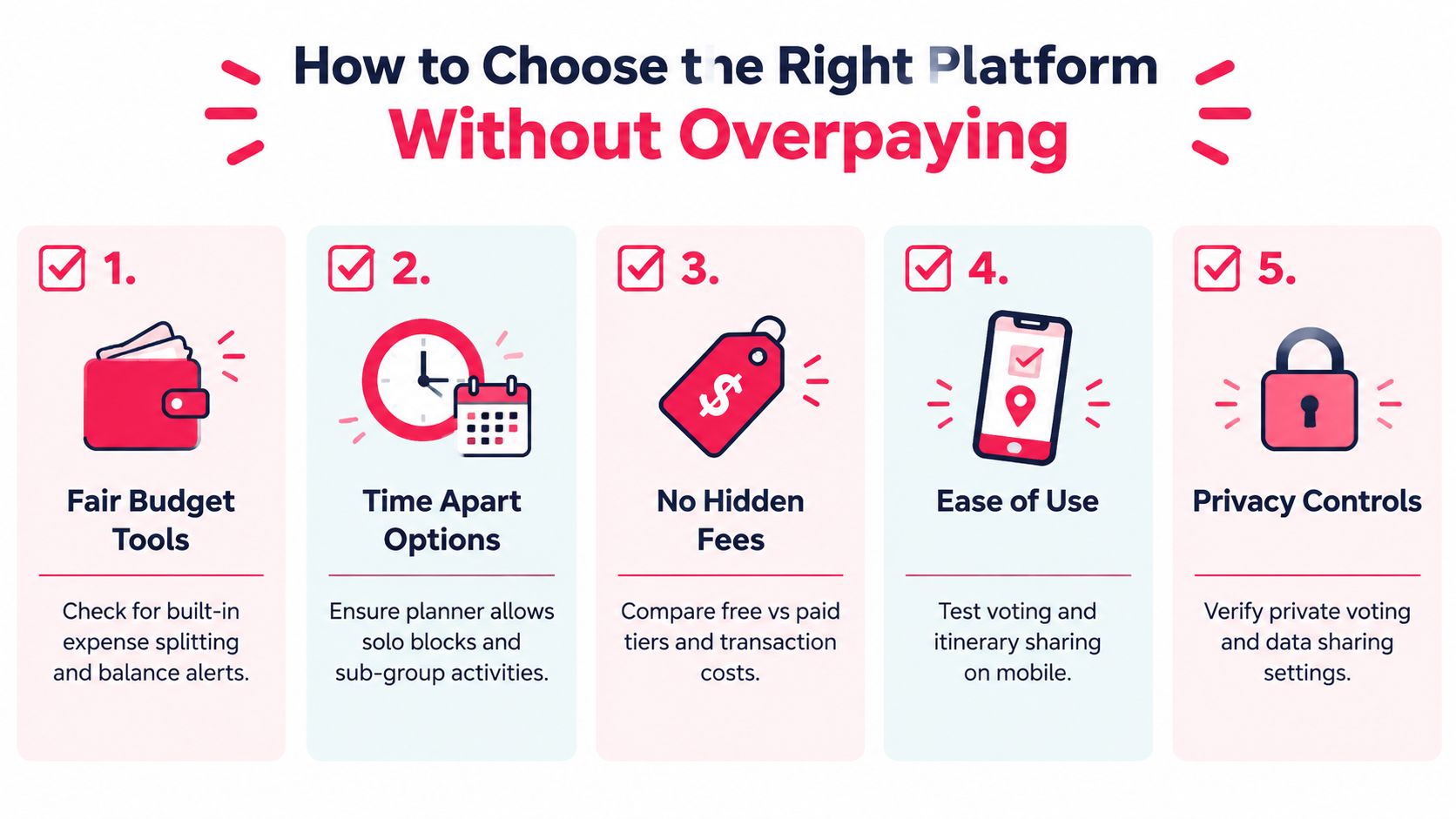
Finally, test the workflow on a phone before committing. Can people vote without creating an account? Can the organizer label an activity as optional? Can everyone find the updated itinerary and payment status? A broader travel-planning app guide can help you compare those practical details before your group invests time in setup.
Your Next Group Trip Starts With One Shared Decision
A memorable group trip doesn't require everyone to want the same holiday. It requires a process that respects different travelers while making the common plan clear.
Start with private preferences. Ask each person about budget, interests, energy, dates, and must-see ideas before the group begins arguing over individual activities. Then vote on overlap, not volume. The most enthusiastic message shouldn't automatically defeat the quieter majority, and the cheapest choice shouldn't automatically become the fairest one.
Separate the itinerary into three layers:
- Shared anchors, activities most travelers value and can afford.
- Optional choices, upgrades or special experiences for people who want them.
- Open time, deliberate space for rest, independent plans, or smaller groups.
Once the group has agreed on those layers, book together and keep the confirmations in one shared itinerary. Set a clear response deadline, send one invitation link, and ask the group to make the first meaningful decision before expanding the plan with every possible restaurant and excursion.
Try the process with a single day first. For example, let a group visiting Paris vote on one cultural activity, one meal, and one flexible block. If the workflow feels clear, use it for the rest of the trip. The organizer still leads, but leadership becomes coordination rather than constant chasing.
The best group trip planner won't eliminate every disagreement. It will help the group disagree earlier, more fairly, and with enough visibility to choose confidently.
MyPerfectStay lets groups privately share preferences, vote on activities with match scores, build a shared daily itinerary, and book selected experiences together. Visit MyPerfectStay to invite your travelers, set the first decision deadline, and turn your next Europe or MENA getaway into a plan everyone can follow.