10 Group Vacation Ideas for Every Travel Style
September 1, 2026·MyPerfectStay
You're in the group chat, and nobody's arguing about whether to travel. The problem is that everyone wants a different trip. Friends want late dinners and nightlife, parents need flexible pacing, grandparents want comfort, and a corporate team needs enough structure to make the offsite worthwhile. After a few days, the chat contains plenty of opinions but no bookable plan.
These group vacation ideas are organized around traveler type, duration, budget pressure, and energy level, with European and MENA destinations leading the way. You'll find city circuits, cultural expeditions, beach retreats, active escapes, reunions, and corporate offsites. Each concept includes a practical itinerary framework, a sensible group size, logistics safeguards, and a quick way to test whether the idea fits your travelers.
Group travel is now a collective decision process. Nearly all respondents to Minor Hotels' 2026 travel behaviour survey planned to travel with companions, and 86% said spending quality time with friends or family was a key priority when planning a leisure trip, most often with a partner (66%), immediate family (46%), or friends (32%) (Minor Hotels' 2026 travel trends report). The fastest way to avoid endless debate is to have every traveler complete a private, two-minute MyPerfectStay survey covering budget, interests, energy level, and must-see ideas. The platform then surfaces overlapping preferences before anyone pays a deposit.
Table of Contents
- 1. European City Break Tours
- 2. MENA Cultural Immersion Trips
- 3. Adventure and Active Retreat Vacations
- 4. Culinary and Food-Focused Group Tours
- 5. Beach and Mediterranean Resort Retreats
- 6. Festival and Event-Based Group Trips
- 7. Wellness and Spa Retreat Vacations
- 8. Historical and Archaeological Expeditions
- 9. Multi-Generational Family Reunions
- 10. Corporate Team-Building and Offsite Retreats
- 10 Group Vacation Ideas Comparison
- Turn the Shortlist Into a Booked Group Trip
1. European City Break Tours
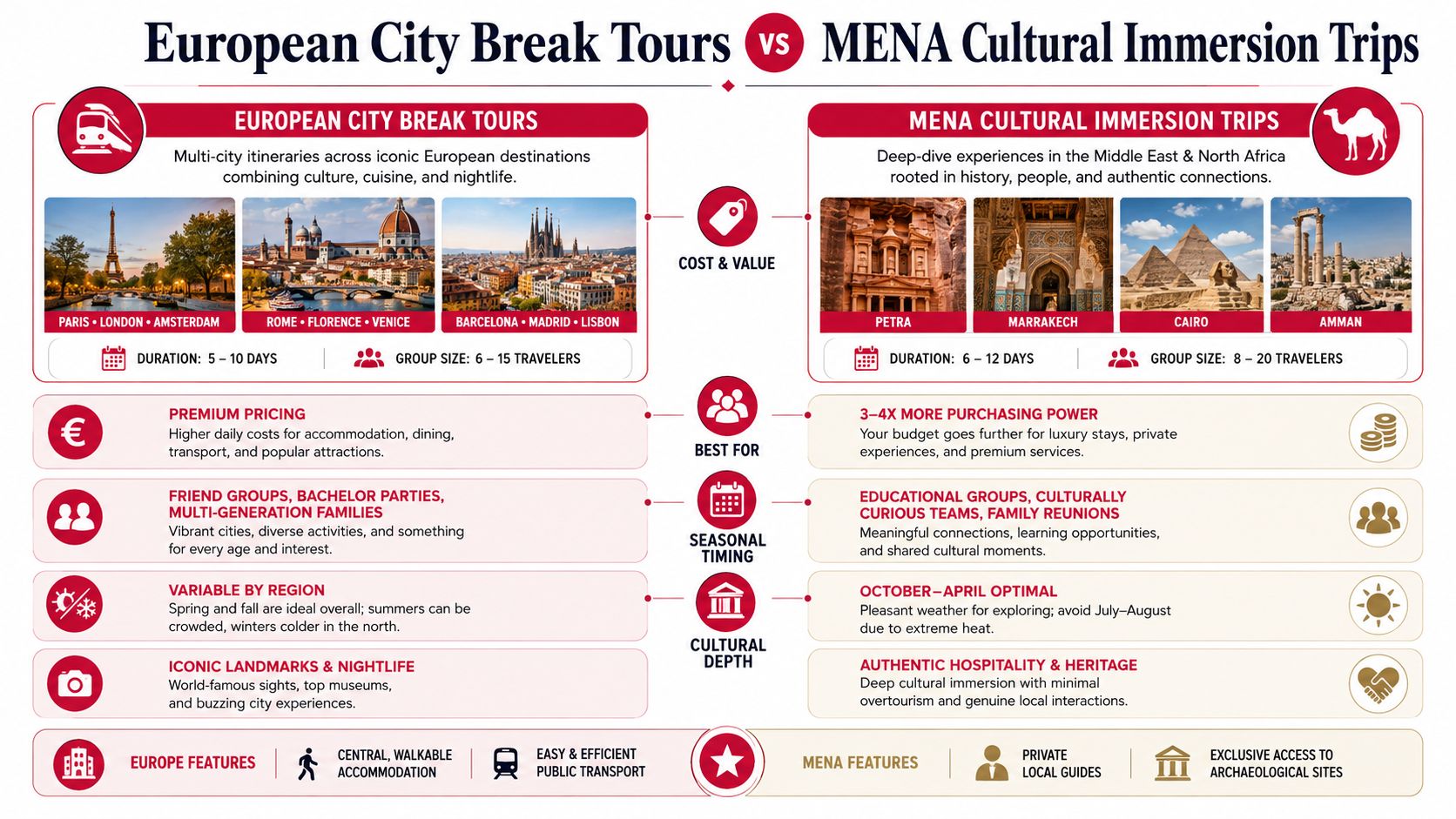
A European city circuit works when your group wants variety without sacrificing a clear structure. Paris, Amsterdam, Berlin, Barcelona, Rome, Athens, Prague, Vienna, Budapest, Madrid, and Lisbon all offer strong combinations of landmarks, food, museums, walkable neighborhoods, and evening options. These are also established city-break markets. Europe holds four of the top five places in Euromonitor International's Top 100 City Destinations Index 2025, with Paris ranked first for a fifth consecutive year on more than 18 million international visitors, followed by Madrid, then Rome and Milan; international arrivals across the top 100 cities rose 8% to 702 million (Euromonitor's 2025 city destinations index).
Build the route around two to four cities over five to ten days, rather than trying to cover every famous stop. A Paris, Amsterdam, and Berlin circuit can combine rail travel with a carefully chosen flight, while Barcelona, Rome, and Athens create a stronger beach-and-culture balance. Prague, Vienna, and Budapest suit groups that prefer historic streets, architecture, and evening dining.
A workable city-break rhythm
Stay near the center in apartments or hotels with easy public transport access. Plan one major attraction, one shared meal, and one optional activity each day. That gives art lovers time for a museum, night owls room for a late evening, and older travelers a chance to rest without missing the group's main experience.
Use private voting to identify clusters such as food, art, nightlife, and architecture, then weight the itinerary toward the interests that overlap most. Pre-book major attractions, schedule only a few formal meetups daily, and add rest time between transfers. The practical planning principles in this city-break planning guide help turn a long wish list into a manageable route.
2. MENA Cultural Immersion Trips
MENA cultural trips suit travelers who want a destination to shape the itinerary, rather than using a resort as a backdrop. A Jordan route can connect Amman, Petra, and the Dead Sea. Morocco can combine Marrakech, Fez, Tangier, and the Atlas Mountains. Egypt offers a heritage-focused progression from Cairo to Luxor and Aswan, with a Nile cruise providing continuity between major archaeological stops.
The best version balances guided context with unscripted time. Use a private guide for Petra, a medina walk in Marrakech, or a museum visit in Cairo, then leave space for markets, cafés, galleries, and independent exploration. Dubai and Abu Dhabi work for groups that want a modern and traditional contrast, with museums, souks, desert experiences, and contemporary dining. Tunis and Djerba can pair Roman ruins with Mediterranean downtime.
Plan around climate and cultural context
Heat changes the energy calculation, and it also narrows the calendar: October to April is the comfortable window across most of the region, and July and August are worth avoiding outright for anything involving a full day outdoors. Within a day, put demanding outdoor activities in the morning, use the afternoon for rest or air-conditioned shopping, and schedule dinners or cultural performances later. This isn't just a comfort preference. It determines whether children, older travelers, and people unused to hot weather can stay engaged.
Budget expectations should be set per destination rather than for the region. Jordan, Morocco, Egypt, and Tunisia generally stretch a group budget much further than Western Europe does, which is what makes private guides and premium stays realistic on a mid-range budget. Dubai and Abu Dhabi do not follow that pattern — plan them at or above Western European prices.
Survey the group for walking tolerance, heat sensitivity, interest in history, and preferred pace before selecting activities. Budget for local crafts and spontaneous market purchases without treating them as mandatory expenses. A short cultural briefing on dress, photography, religious sites, and bargaining norms also prevents avoidable misunderstandings.
Practical rule: Schedule the hardest walking before lunch, and protect the afternoon as recovery time rather than filling every hour.
3. Adventure and Active Retreat Vacations
Adventure travel succeeds when the group shares a desire to be active but not necessarily the same fitness level. The Swiss Alps can support guided mountain walks and alpine-lodge evenings. Croatia's Dalmatian coast works for sea kayaking, island camping, and relaxed waterfront time. The Scottish Highlands suit climbing groups, while the Portuguese Algarve can combine cycling between beach towns with easier coastal walks.
Start with a basecamp or a resort that supports multiple activity tracks. A five-day mountain retreat might open with a gentle hike, move into longer routes after the group acclimatizes, and finish with a lower-intensity day. In the Algarve, stronger cyclists can take the longer route while others join a shorter ride or meet the group at lunch.

Separate interest from physical readiness
MyPerfectStay can collect general interests, but active trips need a second layer of screening. Ask about outdoor experience, fitness, medical considerations, comfort with heights or open water, and risk tolerance. Then offer easy, moderate, and challenging versions of the main activity.
Pair travelers with similar ability levels, provide proper equipment guidance, and confirm insurance and local medical support. Build in yoga, journaling, casual walks, or free time for recovery. The group should share the destination and evening meals without needing to complete every challenge together.
A kayaking day, climbing session, or alpine hike creates strong shared memories, but only when nobody feels forced into an unsafe pace. Use the pre-trip vote to identify which activities deserve group status and which should remain optional.
4. Culinary and Food-Focused Group Tours
Food gives groups a natural reason to gather, but a culinary itinerary shouldn't turn every meal into a scheduled performance. Provence can combine cooking classes, Avignon markets, and wine tastings. Tuscany can link Florence and Siena with producer visits and hands-on cooking. Madrid, Seville, and Barcelona suit tapas-focused travelers, while Marrakech offers spice markets, tagine workshops, and desert dining.
Portuguese groups can base themselves around Lisbon and the Douro Valley, adding olive oil, seafood, and wine experiences. The itinerary should alternate between participation and observation. One day might involve a market tour and cooking class, while the next focuses on a long lunch and a free evening.
Make the menu inclusive
Ask about allergies, dietary restrictions, vegan preferences, alcohol preferences, and cooking confidence before booking. A hands-on class can delight experienced cooks but intimidate travelers who'd rather watch and taste. Private or small classes keep instruction useful and make it easier to manage safety and dietary needs.
Arrange transport between vineyards, farms, and restaurants so nobody has to drive after tastings. A bilingual food guide can explain local ingredients and producers in a way a generic restaurant booking can't. For more ideas on structuring wine-centered experiences, see these wine-tasting tour planning suggestions.

Food is the social anchor, not the entire schedule. Leave room for a walk, a market detour, or a quiet meal chosen by smaller subgroups.
Use MyPerfectStay to vote separately on cooking, tastings, markets, and fine dining. That prevents one enthusiastic foodie from turning every activity into a commitment for the whole group.
5. Beach and Mediterranean Resort Retreats
A beach retreat is the safest choice for groups that want low coordination and plenty of personal space. Use one property as a home base, then add a small number of shared activities. Dubrovnik or Hvar can support boat trips and historic exploration. The Costa Brava and Balearic Islands offer beach towns with restaurants and excursions. Santorini, Mykonos, Crete, the Algarve, Bodrum, and the Turkish Riviera all work for groups that want coast, dining, and optional day trips.
Choose a hybrid property rather than one that forces everyone into the same schedule. Kitchenettes, different room categories, and nearby restaurants help travelers manage different budgets and spending habits. A villa complex can work particularly well when some people want communal breakfasts while others prefer to sleep late.
Use the home-base model
Organize one shared activity per day, such as a boat lunch, sunset gathering, or cultural excursion. Keep the rest open. Active travelers can kayak or hike, while others stay at the beach, book a spa treatment, or explore a village independently.
A mid-trip island hop or heritage visit adds variety without dismantling the relaxed structure. For seasonal planning, July and August are the busiest months in Europe, especially in France, Italy, Spain, and Greece, according to Lonely Planet's Europe travel guidance. Consider May or September to October when the group wants fewer crowds and more flexibility, while checking local weather and operating calendars.
Survey travelers into activity groups before arrival. MyPerfectStay can reveal who wants excursions and who prefers downtime, so the organizer can reserve the right number of places rather than guessing.
6. Festival and Event-Based Group Trips
An event gives a group an instant centerpiece, but it also creates the biggest risk of planning around something that not everyone wants. Oktoberfest in Munich, the Edinburgh Festival, La Tomatina near Valencia, a Lisbon Fado event, or Vienna's ball and concert season can all anchor a memorable trip. The destination matters as much as the event. Munich offers Bavarian culture and countryside, Edinburgh supports museums and historic walks, and Valencia adds paella, markets, and coastal time.
Confirm genuine interest privately before booking. People often say they're open to a festival because the group is excited, then discover that crowds, noise, alcohol, or late nights don't suit them. A two-minute MyPerfectStay survey can distinguish strong enthusiasm from polite agreement.
Protect the trip from event overload
Book tickets, accommodation, and transport early. Event dates compress availability, and central lodging can disappear before the group has agreed on the rest of the itinerary. Keep shared meals outside the most intense event hours, then add non-event days for neighborhood exploration, museums, countryside trips, or recovery.
Arrange a clear return plan. A hired coach, shuttle, or pre-agreed meeting point is safer than asking everyone to travel separately after a long day. Build a fallback plan for cancellation, weather disruption, or transport failure. An alternative could include a museum circuit, cooking class, brewery visit, or guided city walk.
A useful test: If the trip would be disappointing without the headline event, the group needs a firm cancellation and contingency policy before anyone pays.
7. Wellness and Spa Retreat Vacations
Wellness trips can bring together colleagues, friends, or several generations, but only when the group agrees on what “wellness” means. For some travelers, that means yoga and meditation. Others want thermal pools, hiking, massage treatments, healthy food, or a quiet room away from work. Interlaken, Austria's thermal regions, Lisbon's Atlantic coast, Lake Como, and rural Andalusia offer different ways to build a restorative stay.
A five-to-seven-day retreat can open with gentle movement, add spa treatments and workshops, include a cultural or outdoor day, and close with personal downtime. The adventure day matters. Without variety, a wellness schedule can feel repetitive, especially for travelers who don't enjoy group meditation or structured reflection.
Make participation flexible
Ask each traveler whether they want communal activities, private treatments, outdoor exercise, education, or unstructured rest. Keep core gatherings optional wherever possible. A group hike, solo spa block, quiet meditation session, and shared dinner can coexist if the itinerary doesn't treat one preference as more legitimate than another.
Collect dietary requirements, health conditions, and physical limitations well before arrival so providers can plan appropriately. Include practical education, such as breathing exercises, sleep routines, or mobility practices, that travelers can use after returning home. MyPerfectStay's body and soul retreat guide can help groups compare restorative formats before they commit.
The strongest wellness itinerary gives people a shared environment without demanding constant togetherness. That balance is especially important for introverts and multi-generational travelers.
8. Historical and Archaeological Expeditions
Historical trips reward groups that enjoy depth, but the wrong guide or pace can turn a fascinating destination into a sequence of exhausting lectures. Rome, Athens, and Turkey can form a classical-antiquity route. Cairo, Luxor, and Aswan support an ancient-Egypt itinerary. Prague, Vienna, and Budapest offer medieval, imperial, and architectural layers, while Petra and Amman provide a focused route through Nabatean history.
Start by asking how much background travelers already have. A history professor, an enthusiastic amateur, and a child may all enjoy Petra, but they'll need different levels of explanation. Hire a certified specialist or archaeologist for the central sites, then use museums and independent walks to vary the format.
Build intellectual breathing room
Send a short reading list or documentary suggestions before departure. Keep daily walking reasonable, especially at large outdoor sites, and let travelers revisit areas that interest them. A museum in the morning, an archaeological site after a break, and an evening discussion works better than stacking major sites without recovery time.
MyPerfectStay can collect interests across ancient civilizations, architecture, military history, religion, art, and local food. The match scores help the organizer see whether the group wants a tightly academic program or a broader cultural journey.
An Egyptologist-led visit to Luxor may be the trip's anchor, while a Nile cruise, local meal, or market walk gives less specialized travelers a way to connect with the destination. The itinerary should respect expertise without allowing the most knowledgeable person to set every decision.
9. Multi-Generational Family Reunions
Family reunions need stability more than novelty. Moving hotels every other night may look efficient on paper, but grandparents, young children, and parents managing luggage rarely experience it that way. Choose a home base such as a Costa del Sol resort, nearby Algarve villas, a Greek island family complex, an Austrian lake resort, or a Turkish Mediterranean property with children's programming and quieter adult areas.
A five-to-seven-day stay can include shared breakfasts, one daily gathering, one excursion, and plenty of opt-out time. A 2022 OnePoll survey for Motel 6, reported by Study Finds, found that 57% of 2,000 US adults planning summer travel were attending a family or friend reunion, and 70% were getting there by car — 40% in their own vehicle, 30% in a rental. The sample is American, so the distances don't transfer directly, but the preference does: accessible regional destinations, and properties where households can arrive independently. The same poll put the ideal reunion length at about three days, which is worth knowing if you are pitching a full week to relatives who would rather commit to a long weekend.
Give every household a voice
Survey each nuclear family privately, then aggregate preferences at family level. This avoids letting the loudest adult speak for children, partners, or older relatives. MyPerfectStay can help identify overlapping priorities, such as a pool, easy dining, a boat trip, or a child-friendly excursion.
Set shared costs and optional costs before booking. Clarify which meals, transfers, childcare services, and activities are communal, then let households choose extras without embarrassment. Arrange a family meeting early in the trip to confirm communication channels, meal times, emergency contacts, and decision rules.
Pair relatives across generations for smaller moments, such as a grandparent and grandchild breakfast or a cousin activity for teenagers. These interactions often create stronger memories than another large group photograph. Parents and grandparents also need scheduled adult time, so reserve babysitting or kids' club support where available.
10. Corporate Team-Building and Offsite Retreats
A corporate offsite needs a business purpose and a human rhythm. Amsterdam can combine strategy sessions, cycling, and a canal dinner. Barcelona supports workshops, Mediterranean meals, and outdoor team activities. Prague can pair leadership planning with an opera evening and cultural challenges. Lisbon suits a shorter startup retreat, while Vienna offers a more formal setting with imperial history, classical music, and structured dining.
Keep the itinerary within a realistic two-to-five-day frame. Put strategic work when attention is highest, use one meaningful team activity to change the energy, and protect unstructured time for relationships that don't develop in conference rooms. A facilitator should connect activities to the team's actual issues, rather than running generic games.
Design for different work styles
Survey the team about social energy, accessibility, dietary needs, preferred activities, and comfort with public performance. Mix departments and seniority deliberately, but provide alternatives for people who don't want competitive or highly visible roles. Optional museum visits, walking routes, or quiet work blocks make the program more inclusive.
Clarify business and personal expenses before departure. Organizers should also define attendance expectations, alcohol boundaries, emergency contacts, and how feedback will be collected. A short follow-up session can turn a pleasant trip into action on communication, cross-functional work, or leadership alignment.
MyPerfectStay's private survey and voting workflow can help the organizer compare activities without turning the company chat into a popularity contest.
10 Group Vacation Ideas Comparison
| Trip Type | 🔄 Planning Effort | ⚡ What You'll Need | ⭐ What the Group Gets | 📊 Trade-Offs | Best For | 💡 Key Tips |
|---|---|---|---|---|---|---|
| European City Break Tours | Medium, multi-city logistics & timed transfers | Moderate, trains/flights, central hotels, guides | High, varied cultural exposure and social bonding | Strong variety per short timeframe; risk of feeling rushed | Friend groups, corporate teams, multi-gen families | Pre-book attractions; build 1–2 rest days |
| MENA Cultural Immersion Trips | Medium–High, visas, cultural coordination, sensitive planning | Moderate, private guides, local hosts, curated access | High, authentic cultural depth and personalized learning | High value-per-cost; deeper cultural engagement | Educational groups, culturally curious teams, family reunions | Book private guides; schedule mornings to avoid heat |
| Adventure and Active Retreat Vacations | High, safety, route planning, fitness screening | High, professional guides, safety gear, insurance | Very High, team-building, fitness gains, resilience | Strong bonding and memorable challenges; injury risk exists | Corporate teams, active friend groups, wellness families | Pre-screen fitness; offer tiered difficulty tracks |
| Culinary and Food-Focused Group Tours | Medium, vendor coordination, dietary planning | Moderate, chefs, kitchens, transport, tasting fees | High, sensory bonding and cultural insight | High emotional memorability; scalable by budget | Foodies, corporate entertaining, couples, adult families | Survey dietary needs; limit class sizes (8–12) |
| Beach and Mediterranean Resort Retreats | Low, single base logistics, optional excursions | Moderate, resort bookings, on-site activities | High, relaxation, low-decision vacationing | Predictable costs and family-friendly structure | Families, mixed-energy groups, friend relaxation trips | Choose hybrid resorts; segment activity preferences |
| Festival and Event-Based Group Trips | Medium–High, fixed dates, ticketing, timing constraints | High, event tickets, premium lodging, transfers | Very High, intense shared energy and memories | High atmosphere but high cost and crowding | Enthusiast communities, milestone celebrations, friends | Book 4–6 months ahead; plan non-event days |
| Wellness and Spa Retreat Vacations | Medium, program scheduling, dietary needs | High, instructors, spa facilities, curated menus | High, stress reduction, improved wellbeing | Tangible health benefits for engaged participants | Corporate wellness groups, health-focused friends, multi-gen | Offer optional activities; collect wellness goals pre-trip |
| Historical and Archaeological Expeditions | High, expert access, academic partnerships, permissions | High, scholars, private access, specialized transport | Very High, deep learning and intellectual bonding | Strong educational outcomes; may limit social programming | University groups, history enthusiasts, lifelong learners | Pre-distribute reading; hire credentialed guides |
| Multi-Generational Family Reunions | High, complex scheduling, multiple needs & budgets | High, large accommodations, childcare, varied activities | High, strengthened family bonds and traditions | Strong emotional impact; significant coordination burden | Extended families, milestone celebrations | Use home-base model; survey each family separately |
| Corporate Team-Building & Offsites | High, facilitation design, measurable objectives | High, professional facilitators, venues, AV, travel | Very High, engagement, alignment, actionable outcomes | Measurable ROI when followed-up; risk of fade without follow-up | Corporate teams, startups, leadership groups | Balance structured vs. unstructured time; plan follow-up sessions |
Turn the Shortlist Into a Booked Group Trip
The list isn't the decision. The decision happens when the group narrows the options to plans people can afford, enjoy, and physically manage. Start with two or three concepts that fit the travelers. For example, a mixed-age family might compare an Algarve villa stay, a Greek island home base, and a cultural route through Jordan. A friend group might compare Barcelona, a Croatian coast retreat, and a culinary itinerary in Tuscany.
Compare each option against the same criteria:
- Duration: Does the trip fit available leave, school schedules, and travel time?
- Budget structure: Which costs are shared, which are optional, and where can households choose different room types?
- Energy level: Does the plan support nightlife, rest, walking, adventure, or a combination?
- Group fit: Can children, older travelers, introverts, and different dietary or mobility needs participate comfortably?
- Logistics: Can the group stay mostly in one place, or will transfers create unnecessary coordination?
The need for a clear process is substantial. In a June 2026 survey of 2,000 US women, conducted by Talker Research for Discover Puerto Rico, 76% of group trips never made it out of the group chat. The ones that did took 83 messages and nearly 19 hours of planning across 11 days, with the most time going to researching things to do (2.6 hours) and picking the destination (2.5 hours) (Hotel Online's report on the Talker Research survey). The sample is one slice of the market rather than all travelers, but those two research tasks are exactly what a structured voting workflow should absorb.
Send a private MyPerfectStay survey to every traveler. Each person can enter budget, interests, energy level, and must-see ideas without having to negotiate publicly. The platform's algorithm identifies overlap and displays match scores for activities, helping the organizer separate genuine group priorities from isolated preferences.
Set a decision deadline
Give the group a firm voting deadline. Without one, people keep adding destinations, changing dates, and reopening decisions that were already close to settled. After the deadline, remove options that fail the basic budget, timing, or accessibility test, then vote on the remaining plan.
Lock the activities that have strong group support and leave lower-match options open for smaller subgroups. This is especially useful in beach retreats, city breaks, and multi-generational reunions, where togetherness works best when travelers can choose their own pace.
MyPerfectStay supports a shared itinerary, participant invitations, reminders, deadlines, and link-based participation. The catalog covers 300,000+ bookable experiences across 190+ countries, including museum tours, desert safaris, food tastings, and yacht cruises. Travelers can start without creating an account or downloading an app, and iOS and Android apps are available for on-the-go planning.
Once the group chooses, share the auto-organized daily itinerary with everyone. Include meeting points, transport details, booked activities, free blocks, payment responsibilities, and emergency contacts. Travelers should know what's fixed and what remains flexible before departure.
The best group vacation isn't the one with the longest activity list. It's the one where the group agrees on the core experience, understands the trade-offs, and has enough autonomy to enjoy the trip in different ways. A fast survey, a visible deadline, and match-based voting turn inspiration into a plan people can book.
MyPerfectStay helps groups collect private preferences, compare activities through match scores, vote on shared plans, and keep the final itinerary organized in one place. Visit MyPerfectStay to start a group trip survey, invite your travelers, and turn these ideas into a bookable plan.