How to Plan a Bachelor Party Everyone Will Love
September 10, 2026·MyPerfectStay

The group chat starts innocently enough. Someone suggests Barcelona, another person wants a quiet weekend, a third asks what it will cost, and suddenly the best man is collecting opinions, chasing replies, and wondering who has agreed to attend. By the time a decision appears, flights are expensive, budgets have shifted, and the groom's “surprise” feels more like an administrative burden.
The practical answer to how to plan a bachelor party isn't a longer list of bars, activities, or destinations. It's a decision system. Start with the groom's vision, collect private preferences before the loudest voice takes over, set a firm spending ceiling, and choose an itinerary that the widest group can realistically join. That approach works for a local celebration in Lisbon as well as a multi-day weekend in Prague, Marrakech, or Dubai.
Bachelor parties also have deeper roots than the modern format suggests. Historical accounts trace the custom to ancient Sparta, where soldiers toasted one another on the eve of a friend's wedding. The modern term wasn't recorded until 1922, which helps explain why the ritual feels traditional while the destination-weekend format is comparatively new (Live Science's history of bachelor and bachelorette parties).
Table of Contents
- Introduction to Stress Free Bachelor Party Planning
- Your Bachelor Party Timeline and Who Does What
- How to Set a Bachelor Party Budget Everyone Can Afford
- Choosing Themes Destinations and Activities That Fit the Group
- Booking Travel Accommodation and Vendors Without the Hassle
- Safety Legal Tips and Your Ready to Use Bachelor Party Checklist
Introduction to Stress Free Bachelor Party Planning
A few years ago, a best man I know opened a planning chat with a simple question: “What does everyone want to do?” Within hours, the answers had split into nightlife, hiking, food, beaches, and “anything except a forced activity.” Nobody was being difficult. They were answering a broad question with different assumptions about money, energy, and what the groom would enjoy.
The mistake was asking for public opinions first. People tend to agree loudly in a group chat, then drop out when the real cost or travel time appears. A calmer method starts with private preference collection. Ask each guest for their maximum budget, preferred dates, energy level, travel tolerance, and non-negotiables. Then share the overlap, not every individual answer.
Practical rule: The party isn't successful because every guest gets their first choice. It succeeds when everyone understands the choice and can afford to participate.
The groom still comes first. He should have the final say on the guest list, and his preferences should shape the tone, whether that means a food-focused weekend, a football match, a brewery tour, a coastal escape, or a relaxed dinner with close friends. Confirm his boundaries before you invite anyone. A surprise should concern the details, not the basic experience he wants.
Replace group-chat noise with clear decisions
Use three filters before discussing destinations:
- The groom's brief: What does he want more of, and what does he definitely not want?
- The group's overlap: Which dates, budgets, and activity types work for the largest number of guests?
- The operational reality: Can you book transport, accommodation, food, and a fallback plan without relying on heroic last-minute coordination?
Keeping the shortlist to Europe and MENA keeps the search grounded. Barcelona may suit a group seeking food, architecture, and nightlife. Prague can work for a compact city weekend. Lisbon offers a flexible mix of restaurants, viewpoints, and activities, while Marrakech and Dubai create a more distinctive destination feel. The right answer depends less on reputation than on whether the group can reach it, pay for it, and enjoy the pace.
Bachelor parties are commonly longer than a single night. The Knot's 2023 Bach Study, which surveyed roughly 500 US respondents, puts the average bach party at two days, with 17% of bachelor parties running four days or more and about 10 attendees per party (The Knot's bach-party cost data). That makes early alignment essential.
Your Bachelor Party Timeline and Who Does What
Planning gets easier when every decision has an owner and a deadline. Destination trips need earlier commitments because flights, accommodation, and activity availability can narrow quickly. Local events are more forgiving, but they still fail when nobody takes responsibility for the guest list or payment collection.
Set the calendar before you set the itinerary
For a destination weekend, notify guests 3 to 6 months in advance. A local event can usually be organized with 4 to 6 weeks' notice, according to a bachelor-party planning timeline. Another etiquette guide recommends sending save-the-dates 6 to 8 weeks before a trip and 4 weeks before a local event, so use the earlier point when flights or international travel are involved (bachelor-party rules and etiquette).
Use this working schedule:
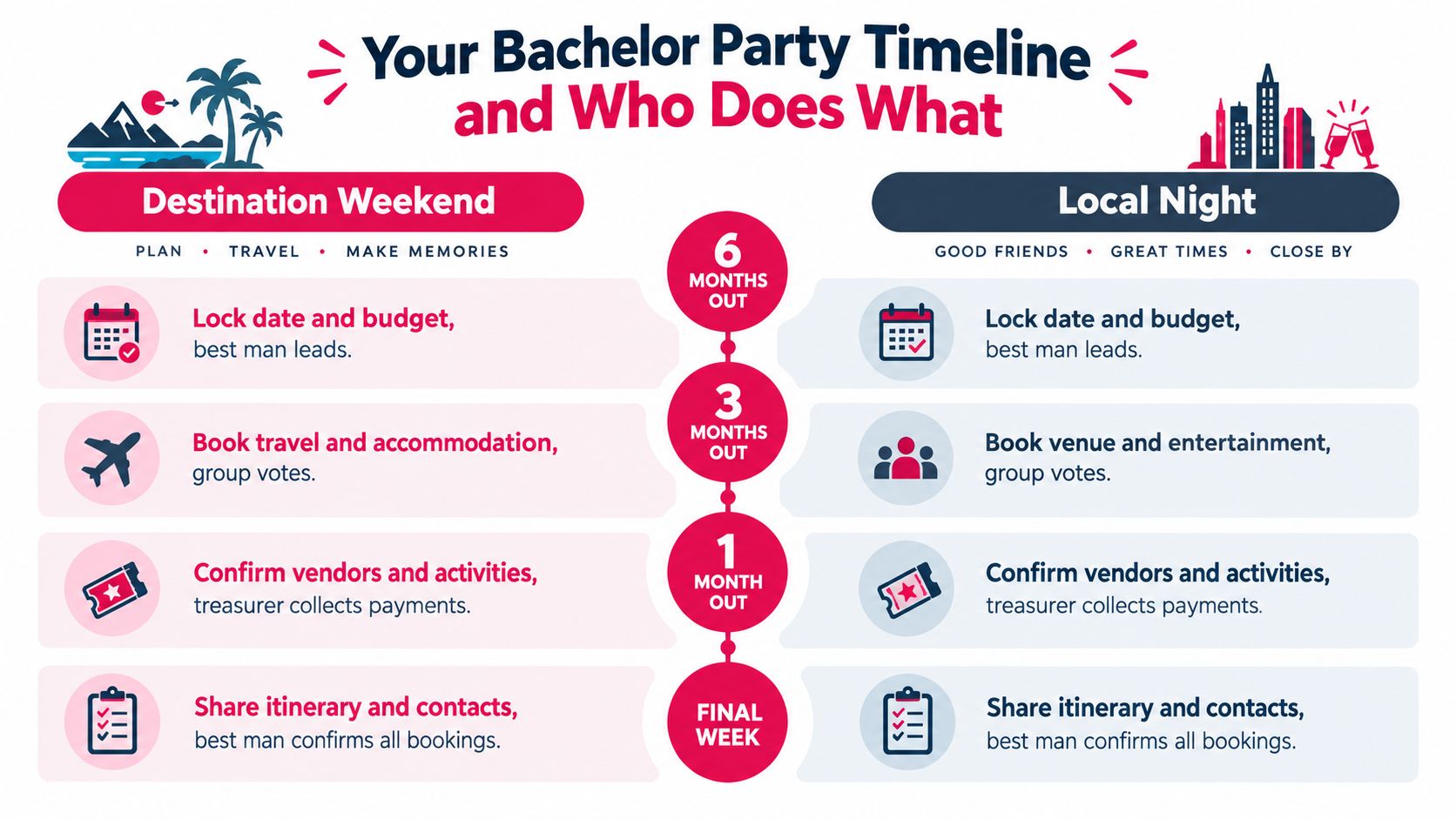
- Six months out for a destination trip: The best man proposes date options, confirms the groom's guest-list preferences, collects private budget ceilings, and narrows the destination.
- Three months out: The group votes on the final destination, accommodation, and anchor activity. Book the items that affect everyone.
- One month out: Confirm vendors, transport, meals, and the fallback activity. The person managing payments collects deposits and records who has paid.
- Final week: Share the itinerary, booking references, addresses, emergency contacts, and meeting points. Confirm every reservation directly.
For a local party, the milestones are the same but the clock is much shorter: run the whole sequence inside four to six weeks rather than six months. Begin with the groom and guest list, send the invite, collect preferences and budget limits, reserve the venue and anchor activity, then confirm attendance and payments during the final week.
Assign ownership instead of asking everyone to help
The best man should own the master plan, deadlines, and final booking record. The groom approves the guest list, confirms the tone, and has the final decision on sensitive activities. Attendees should provide accurate availability, state their budget clearly, pay by the agreed deadline, and flag access, dietary, or travel needs early.
Keep groups manageable. Thrillist puts the ideal size at 10, on the grounds that anything larger means splitting tables at meals and bars (Thrillist's bachelor-party planning guidance), and the etiquette guide above calls 6 to 10 manageable and anything over 12 unwieldy. If the list is larger, separate the core booking from optional activities rather than forcing every person into every reservation.
A private survey or link invite is more useful than a sprawling chat. Set a voting deadline, send one reminder, and make the decision from the results. For broader city-break logistics, this city-break planning guide is a useful reference for organizing dates, accommodation, transport, and activities around a single itinerary.
How to Set a Bachelor Party Budget Everyone Can Afford
Treat the per-person budget as a hard ceiling, not a hopeful estimate. The Knot's Bach Study puts average bachelor-party attendee spend at $1,500, a $440 increase since 2019, with 37% of bach-party attendees spending more than $1,000 and 39% of male attendees doing so. Trips requiring a flight averaged about $2,000 per attendee, against about $1,000 where guests could drive (The Knot's bach-party cost data). These are US figures in dollars, so read them as a scale check rather than a European price list.
Those figures aren't a target for your group. They're a warning about how quickly a destination weekend can outgrow casual assumptions. Collect each guest's maximum privately before you name the city. The lowest workable ceiling should influence the plan, not the person with the most flexible disposable income.
Separate the shared bill from personal upgrades
Fixed costs belong in the first calculation. These include accommodation, shared transport, core activities, booking fees, and the groom's agreed share. Optional expenses should stay separate, including premium rooms, bottle service, yacht upgrades, extra excursions, and late-night spending.
| Cost Category | Local Party Estimate | Destination Party Estimate |
|---|---|---|
| Accommodation | Usually none or one shared night | Shared apartment, house, or hotel rooms |
| Transport | Local transfers or taxis | Flights or driving, airport transfers, local travel |
| Core activity | Restaurant, tasting, match, or venue | One anchor experience plus one fallback |
| Food and drinks | Meal and selected drinks | Groceries, group meals, and planned reservations |
| Optional extras | Upgrades paid by participants | Premium rooms, additional activities, or nightlife upgrades |
| Payment risk | Lower if bookings are made individually | Higher when deposits and non-refundable travel are involved |
Make the destination decision only after you know the ceiling. A local celebration can outperform a flight-required trip when guests have different financial limits, limited leave, or low travel tolerance. It may also allow more people to attend, which matters more than making the weekend look ambitious on paper.
Money rule: Nobody should discover the true cost after paying a deposit.
Use a shared payment page or clearly itemized spreadsheet. List the total, each person's share, the payment deadline, what happens if someone drops out, and which costs are refundable. Don't front the entire weekend on one card unless the group has agreed in writing how and when the money will return. If the groom's costs are being covered by the group, state that before collecting payments so nobody mistakes it for an unexpected surcharge.
Mixed-budget groups need optionality without embarrassment. Build a low-cost base itinerary that everyone can join, then offer paid upgrades as separate choices. Someone can attend the dinner and anchor activity without joining bottle service or an additional excursion. That design protects the group from the old planning failure where one expensive idea becomes mandatory.
Choosing Themes Destinations and Activities That Fit the Group
A theme should describe the experience, not dictate a costume. “Food and city discovery,” “outdoor challenge,” or “slow social weekend” gives you a useful filter for choosing activities without trapping the group in a gimmick.
Start with private votes on four subjects: interests, energy level, maximum budget, and must-see ideas. Turn the results into a match score based on overlap. The winning plan doesn't need unanimous enthusiasm. It needs a strong enough fit across the group to keep attendance and goodwill intact.
Compare destinations by friction, not fantasy
| Option | Works well for | Main trade-off |
|---|---|---|
| Barcelona | Food, architecture, nightlife, and a lively city base | A packed itinerary can exhaust quieter guests |
| Prague | A compact urban weekend with restaurants and evening options | Nightlife-first plans can exclude guests who don't drink |
| Lisbon | Food, culture, viewpoints, and flexible pacing | Hills and uneven surfaces require accessibility checks |
| Dubai | Polished dining, desert experiences, and planned transfers | Premium choices can push the budget upward quickly |
| Marrakech | Food, markets, cultural discovery, and distinctive accommodation | Heat, walking, and cultural expectations need careful planning |
A destination weekend is worthwhile when the location adds clear shared value. It isn't worthwhile when the group spends most of its time traveling, waiting, or negotiating expenses. If the budget ceiling is narrow or attendance is uncertain, a local event with one excellent anchor can beat a destination trip with a strained schedule.
Choose one anchor and one fallback
The anchor is the activity people are most excited to share. It might be a cooking experience in Lisbon, a guided food tour in Marrakech, a desert excursion from Dubai, or a private tasting in Barcelona. The fallback should use a different setting and lower operational risk, such as a restaurant reservation, museum visit, indoor games, or a relaxed group meal.
Consider these three sample structures:
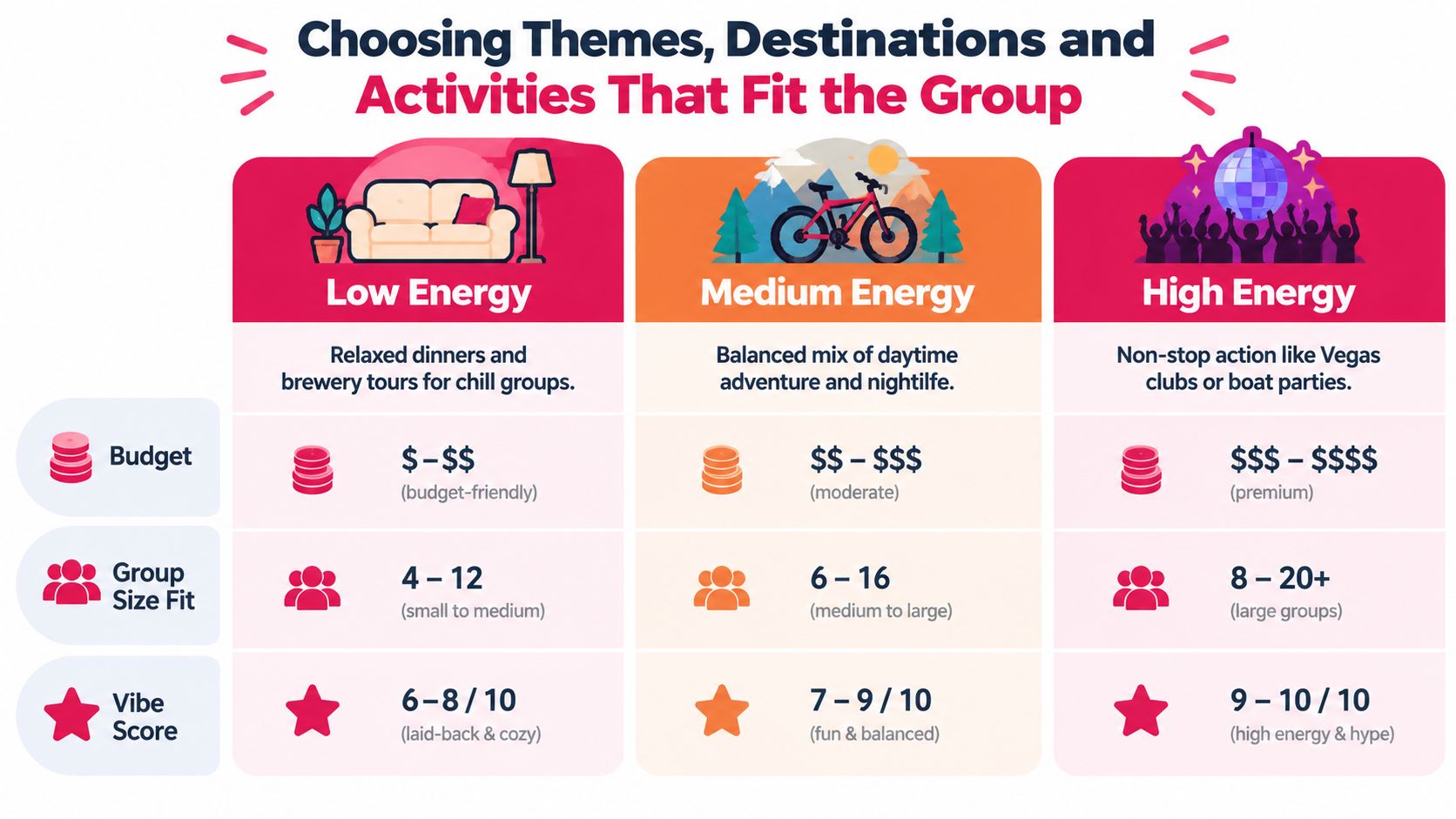
Lower-energy group
- Arrival and check-in with open downtime
- One planned dinner or tasting
- Late breakfast and a gentle cultural activity
- Optional evening drinks, with no required late finish
Medium-energy group
- Arrival and shared meal
- Daytime adventure or guided city activity
- Rest period at the accommodation
- Reserved dinner followed by optional nightlife
Higher-energy group
- Arrival, drop bags, straight into a booked activity
- Main event in the afternoon, such as a boat, a match, or a track day
- Deliberate rest and food block before the evening
- Reserved club, bar, or late venue with a stated end time and a booked way home
High energy isn't automatically better. The energy chart earlier in this section rates the vibe, not the fit, and a high-intensity plan often creates the widest gap between guests, especially when one person wants continuous activity and another needs recovery time. Larger groups tend to land here, which is exactly when the core booking should be separated from the optional segments. A good itinerary makes participation modular, so people can skip an optional segment without missing the central celebration.
For lower-cost group ideas, use this guide to cheap group activities, then score each option against budget, accessibility, travel time, and groom fit.
For a sense of how a full weekend actually runs — arrival, one anchor activity, meals, downtime — this walkthrough of a bachelor-party weekend in Montreal is a useful example, even though the city sits outside the shortlist above.
Booking Travel Accommodation and Vendors Without the Hassle
Booking should follow the order of dependency. Confirm the date and headcount first, then secure accommodation, transport, the anchor activity, and meals. Don't reserve a non-refundable experience before you know whether the group can reach the city or afford the full plan.
Book the parts that can break the weekend
For groups of 6 to 12, compare a whole apartment or house with hotel rooms. A shared property can simplify meals and social time, but it may create rooming disputes, cleaning rules, or noise restrictions. Hotels offer clearer service and individual privacy, though the group may spend more time separated and need extra coordination for meals.
Check the following before paying:
- Cancellation terms: Identify the last date for a refund and whether a name change is possible.
- Deposit exposure: Record who has paid and which person carries the booking liability.
- Transport coverage: Confirm airport transfers, late-night returns, and accessibility needs.
- Vendor conditions: Ask about weather, minimum attendance, insurance, equipment, and rescheduling.
- Plan B: Reserve an indoor or low-travel alternative if the anchor depends on weather or a tight connection.
A platform such as MyPerfectStay can collect private preferences, compare activities through group voting, and build a shared itinerary around selected experiences. Its stated inventory includes 300,000+ bookable experiences across 190+ countries, with confirmations sent to participants and organizer tools for deadlines and nudges. Those features are useful when the group needs one place to turn a vote into a booking, but you should still read each vendor's cancellation terms before confirming.
The difference between a booking service and a traditional travel agent matters when you decide who owns support, payment handling, and changes. Keep confirmation numbers, supplier contacts, and the final itinerary in a shared document that works offline. A polished app won't help if nobody can find the address of the dinner when mobile reception fails.
Make the itinerary readable
Give every day a simple rhythm: meeting point, main activity, meal, downtime, and optional evening plan. Avoid filling every hour. Delays, lost luggage, slow restaurant service, and one guest needing a break are normal parts of group travel, not signs that the plan has failed.
Safety Legal Tips and Your Ready to Use Bachelor Party Checklist
Safety planning isn't a lecture added at the end. It changes which venues you book, how guests move between them, and whether the group can participate without pressure. Collect dietary, medical, mobility, and accessibility information privately. Build downtime into the schedule, provide non-alcoholic options, and never make drinking the price of admission.
Amsterdam shows why local rules belong in the itinerary. Beer bikes have been banned from city-centre streets since 2017 and public alcohol is banned in most central streets (Amsterdam bachelor-party restrictions). Guided tours in the centre, pub crawls included, may have no more than 15 participants, need an exemption for groups of more than four, and may only run between 8am and 10pm (the city's rules for guided tours). The city also states plainly that fines for nuisance run from €100 to €650 (How to Amsterdam). A group planning Amsterdam should choose licensed venues and lawful transport instead of assuming that a familiar party format is permitted.
Protect people and bookings
- Documents: Check passport validity, identity requirements, venue age limits, and entry rules before departure.
- Transport: Pre-book licensed transfers and establish the return plan before alcohol is served. Nobody should drive after drinking.
- Health: Carry basic first-aid supplies, hydration, required medication, emergency contacts, and relevant insurance details.
- Accessibility: Confirm step-free access, seating, bathroom arrangements, walking distances, and alternative participation options.
- Weather: Keep one indoor or low-travel fallback for outdoor activities.
- Payments: Write down refund rules, deadlines, shared costs, and the process for replacing a dropout.
- Final check: Confirm every booking and vendor directly before the group travels.
Copy these planning messages
Guest-list confirmation
“The groom has approved this guest list. Please confirm your attendance by [date], and tell me privately about any accessibility, dietary, or travel requirements.”
Budget collection
“The maximum shared cost is [amount] per person. Accommodation, transport, and the anchor activity are included. Optional upgrades will be separate. Please pay [amount] by [date], and review the cancellation terms before sending payment.”
Voting deadline
“Please complete the private vote by [date]. We'll choose the option with the strongest group match, provided it stays within the agreed budget ceiling.”
Day-of contact sheet
“Best man: [name and phone]. Payment lead: [name and phone]. Accommodation: [address]. Anchor activity: [address and booking reference]. Emergency contact: [name and phone].”
The best bachelor party isn't the most expensive or the most intense. It's the version the widest set of attendees can realistically join, with the groom's priorities at the centre.
Use the checklist to make the first move today: confirm the groom's guest-list preferences, send a private survey for dates, energy, interests, and maximum budget, and set a decision deadline before anyone pays. MyPerfectStay lets groups collect those preferences, compare activities, and keep the confirmed itinerary in one place, so visit it when you're ready to turn the shortlist into a bookable plan.