How to Plan a Family Vacation on a Budget That Works
September 19, 2026·MyPerfectStay

You're probably doing what most families do. You open five tabs, compare flights to Rome, Barcelona, Dubai, or Marrakech, spot one “cheap” fare, and convince yourself the trip is workable. Then the costs show up. Bags. Airport transfers. Bigger rooms. Extra snacks. Attraction tickets. The taxi you take because your kids are melting down and your parents are tired.
That's how family vacation budgets break.
So let's say it plainly. Cheap airfare doesn't make a cheap vacation. The only number that matters is the all-in cost of the trip, then the all-in cost per day once you're there. If you don't build around that, the destination starts controlling you instead of the other way around.
The fix is simple, but you need to be disciplined. Set the cap first. Choose destinations that fit it. Lock the biggest costs early. Give yourself a real daily allowance. Then keep the group from changing the plan every other day. That's how to plan a family vacation on a budget without turning the trip into a spreadsheet punishment exercise.
Table of Contents
- Why Family Vacation Budgets Break and How to Fix Them
- Setting Your Real Family Budget and Daily Allowance
- Choosing Where and When to Go Without Overspending
- Booking Transport and Lodging That Protect Your Budget
- Saving on Meals Activities Packing and Safety Every Day
- Lock Plans Together and Keep Everyone Aligned
Why Family Vacation Budgets Break and How to Fix Them
You find a low fare to Lisbon for five people and feel like you've won. Two days later, the numbers start turning on you. The apartment that fits grandparents and kids charges a cleaning fee. The airline wants extra for bags. The airport transfer needs a larger vehicle. Suddenly the “cheap” trip is not cheap at all.
That is how family budgets break. The problem is not carelessness. The problem is using the wrong math.
Families usually choose the destination first, then force the budget to chase it. Rome wins because a grandparent has always wanted to go. Dubai stays on the list because the kids want a pool. Barcelona looks fine until you price two rooms in peak season. By the time everyone has had a vote, the expensive choice already feels emotionally locked in.
The spending pressure is real. The 2025 US Family Travel Survey found that the average US family spent about $8,052 on travel in 2024, up roughly 20% from the prior year, according to the NYU summary of the survey. When family travel costs rise that fast, bad budgeting habits get punished quickly.
Price the full day, not the headline deal
Headline airfare is the bait. Your real cost lives in the day-to-day total once you land.
For a family group, that means four numbers matter more than a flashy flight sale: where everyone sleeps, how everyone moves, what everyone eats, and what you will pay to keep the day comfortable enough that nobody melts down by 3 p.m. In Europe and MENA, that gap is obvious. A flight to Marrakech or Amman can look higher than one to a Southern Europe city, then win on apartment rates, taxi costs, and cheaper lunches. The reverse also happens. A “budget” fare into a major European city gets crushed by peak-season lodging and attraction prices.
Families already feel this. In the same survey's full report, affordability is the number one obstacle to planning a trip for 73% of parents, up from 59% in 2023 — and the three things families do about it are all ground-cost moves, not airfare moves: 50% book lodging with a kitchen, 46% limit the number of paid attractions, and 45% avoid hotels and airlines that charge extra fees.
Use one blunt test: if you cannot state your expected all-in daily family cost in one sentence, you are not ready to book that trip.
The fix is a decision order
Good budget trips are built in the right sequence. First set the total cap. Then estimate the daily cost by destination. Then cut the list fast.
I recommend a simple family workflow. Pick three realistic destinations, price each one as a full day, and compare them side by side. Include lodging large enough for the group, local transport that suits both kids and older adults, one paid activity every day or two, and the annoying extras people forget: city taxes, cleaning fees, baggage, airport transfers, tips, snacks, and laundry. Once one option is clearly cheaper without making the trip miserable, stop debating and commit.
That discipline matters more than finding a miracle deal. Families rarely blow the budget in one dramatic mistake. They do it through ten smaller choices that looked harmless on their own.
If you want the budget to hold, choose places that fit your daily number first and your wish list second. That is the fix.
Setting Your Real Family Budget and Daily Allowance
You need one number before you need any destination ideas. Your total trip cap.
Not a vague “we'll try to stay reasonable.” A hard ceiling. Families that skip this step end up negotiating every meal, every taxi, and every activity in real time. That's exhausting, and it usually costs more.
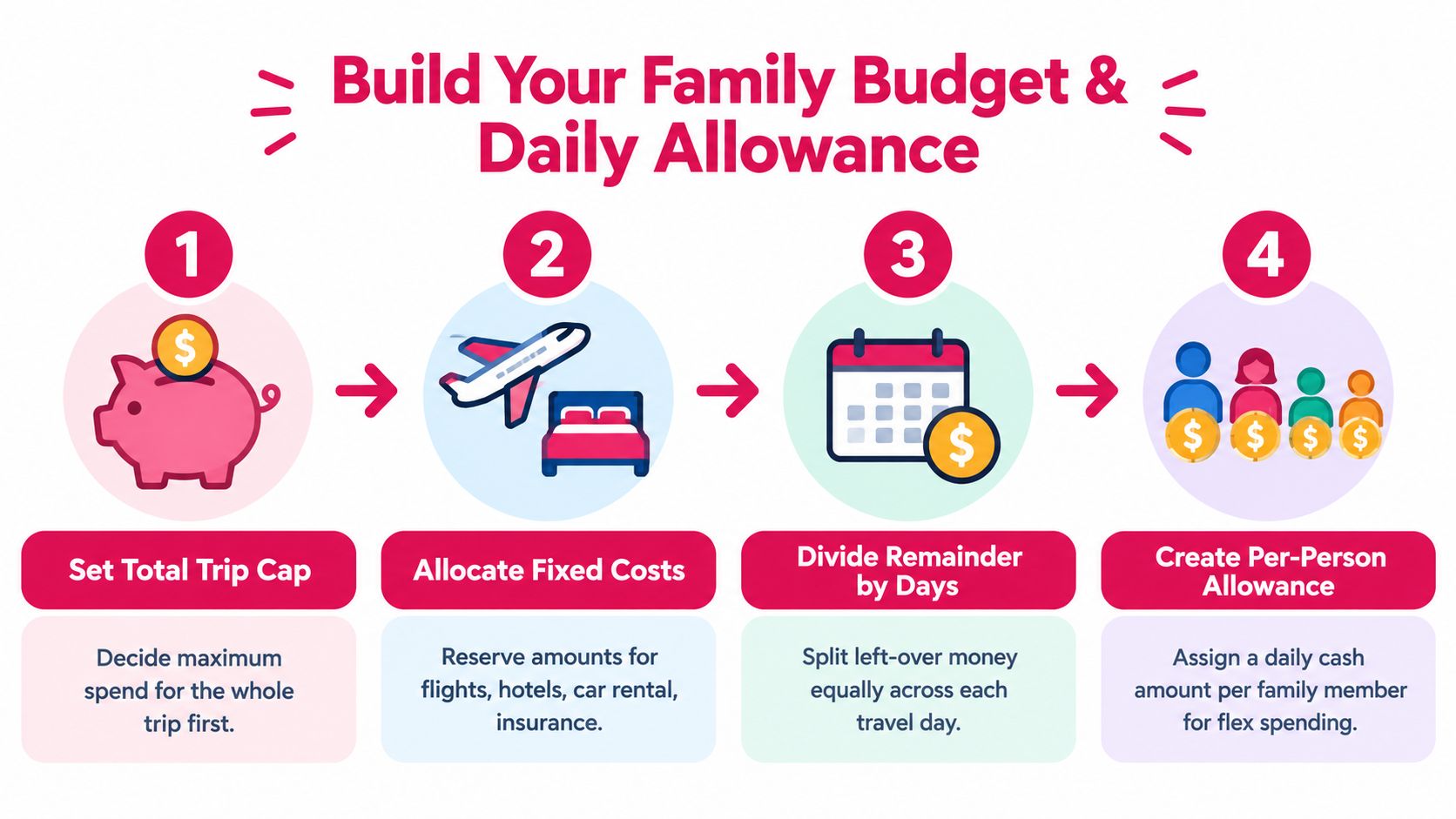
Costari's family vacation budget method sets out the same order: fix the total trip cap first, then allocate fixed costs such as transport, lodging, insurance and booked attractions before turning the remainder into a daily family allowance, holding back a 10% to 15% buffer for child-related surprises and small emergencies. It also makes the case for why the pre-trip stage matters most: for a family of four, flights, accommodation and a car routinely account for 60% to 75% of the whole budget, so most of your spending is decided before you leave home.
Use the cap-first formula
This is the cleanest way I know to budget a family trip.
- Set the total cap. Decide the maximum amount you're willing to spend for the whole trip.
- Subtract fixed costs. This includes flights or train tickets, lodging, insurance, visas if needed, and any attraction you know you'll pre-book.
- Hold back the buffer. Protect money for medicine, extra transfers, laundry, forgotten gear, or a change in plans.
- Divide what's left by travel days. That number becomes your working daily allowance.
That daily allowance covers flexible spending. Think food, local transport, coffee stops, snacks, playground treats, small entry fees, and souvenirs.
Two things worth being precise about, because simplified versions of this formula tend to skip them. The buffer comes out before you divide, not after, or you will spend it without noticing. And the allowance is a whole-family number for the day, not a per-person one. If you want each child to have their own pocket money, carve a fixed per-child souvenir budget out of the family number and agree it in advance — it ends the daily negotiation instead of adding a second budget to track.
A budget template families can actually use
I'd structure it like this:
- Trip cap: Your all-in ceiling
- Transport: Flights, trains, airport transfers
- Lodging: Total stay cost, not just nightly rate
- Insurance and booked items: Policies and pre-paid attractions
- Buffer: Protected cash you don't touch unless needed
- Daily allowance: The remainder divided by the number of days
If you want a more detailed worksheet format, MyPerfectStay has a useful family vacation budget planner that breaks fixed bookings and day-by-day spending into separate lines.
The daily allowance is what keeps a trip calm. Once the family knows the day's spending limit, you stop making every decision from scratch.
Make the daily allowance visible
Don't leave this in your head. Write it down in your notes app, shared doc, or printed itinerary. I like one simple line for each day:
- sleeping already paid
- transport already paid or not
- food budget for the day
- activity budget for the day
- flex money for treats and small surprises
That's enough.
Also, don't make the mistake of equalizing every day. Arrival day, long museum day, beach day, and travel home day won't cost the same. Keep the overall allowance in view, but move money between days as needed. That's normal.
One hard opinion that saves money
Don't build the budget from average prices you found in random search results. Build it from bookable reality. If a family room in Prague fits, use that real number. If your Istanbul hotel has breakfast included, count that advantage. If your Marrakech riad requires extra transfers and paid breakfasts, include both before you convince yourself it's cheaper.
This is how to plan a family vacation on a budget without fooling yourself. The budget has to survive real bookings, not optimistic browsing.
Choosing Where and When to Go Without Overspending
The destination should fit the budget. Not the other way around.
Families lose control because they confuse desire with feasibility. There's nothing wrong with wanting Santorini or Dubai. There is something wrong with forcing a trip to work after the numbers already told you no.
Compare places by ground cost, not just flight price
The useful comparison is what a day actually costs once you land. Budget Your Trip builds per-destination averages from travellers' own reported budgets, covering accommodation, food, local transport and sightseeing. Those averages answer the question a headline fare never does, and the spread across a typical shortlist is wider than most families expect.
If you're deciding between Lisbon, Prague, Budapest, Barcelona, Rome, Marrakech, and Dubai, compare them on daily ground reality:
| Destination | Average Daily Cost Per Person | Best For |
|---|---|---|
| Marrakech | about $100 | Short-haul winter sun, markets, riads, cultural contrast |
| Budapest | about $129 | Value-focused families, thermal baths, slower pace |
| Prague | about $146 | Walkable city breaks, history, compact sightseeing |
| Lisbon | about $194 | First Europe trip, easy pacing, food most families can manage |
| Barcelona | about $208 | Beach and city mix, older kids, strong food scene |
| Rome | about $240 | Classic first-timer choice, history-heavy trips |
| Dubai | about $289 | Easy logistics, winter warmth, high-comfort trips |
Those are averages across all travel styles, per person per day, so treat them as a ranking rather than a quote. Read the ranking and the point is blunt. Marrakech, Budapest, and Prague are far easier places to keep under control than Barcelona, Rome, or Dubai when you're working with a firm family cap — the gap between the cheapest and the most expensive on this list is close to three times, which no fare sale is going to close for you.
Timing matters almost as much as destination
Shoulder season is where sensible family travel lives. You avoid peak pricing, peak heat, and peak crowd fatigue. That matters even more with grandparents and younger children.
My preference for multi-generational trips is simple:
- Choose moderate-weather windows: Walking becomes easier and you rely less on taxis and emergency indoor breaks.
- Keep the trip shorter if the destination is expensive: A well-planned week in one region usually beats a longer, chaotic trip across too many cities.
- Limit city count aggressively: Fewer bases means fewer transfer costs, fewer lost half-days, and fewer tired arguments.
Use a decision filter that real families can live with
I'd score each destination against four things:
- Total daily cost: Can you afford the place without fantasy math?
- Energy level: Will kids and older relatives handle the walking, heat, stairs, and transfers?
- Food simplicity: Can your group eat without drama or expensive workarounds?
- One signature win: Does the place offer one thing everyone is excited about?
A destination isn't “good value” if the group is too tired, too hungry, or too spread out to enjoy it.
For Europe, I'd start with Lisbon, Prague, Budapest, or Vienna before jumping to more expensive or more logistically demanding choices. For MENA, I'd look at Marrakech, Amman, Muscat, or Abu Dhabi before committing to a trip structure built around constant paid activities.
The best budget destination is usually the one where your family can do less, spend less, and still feel like the trip was full.
Booking Transport and Lodging That Protect Your Budget
Once you've picked the destination, the two biggest budget buckets need discipline. Transport and lodging can rescue the plan or ruin it.
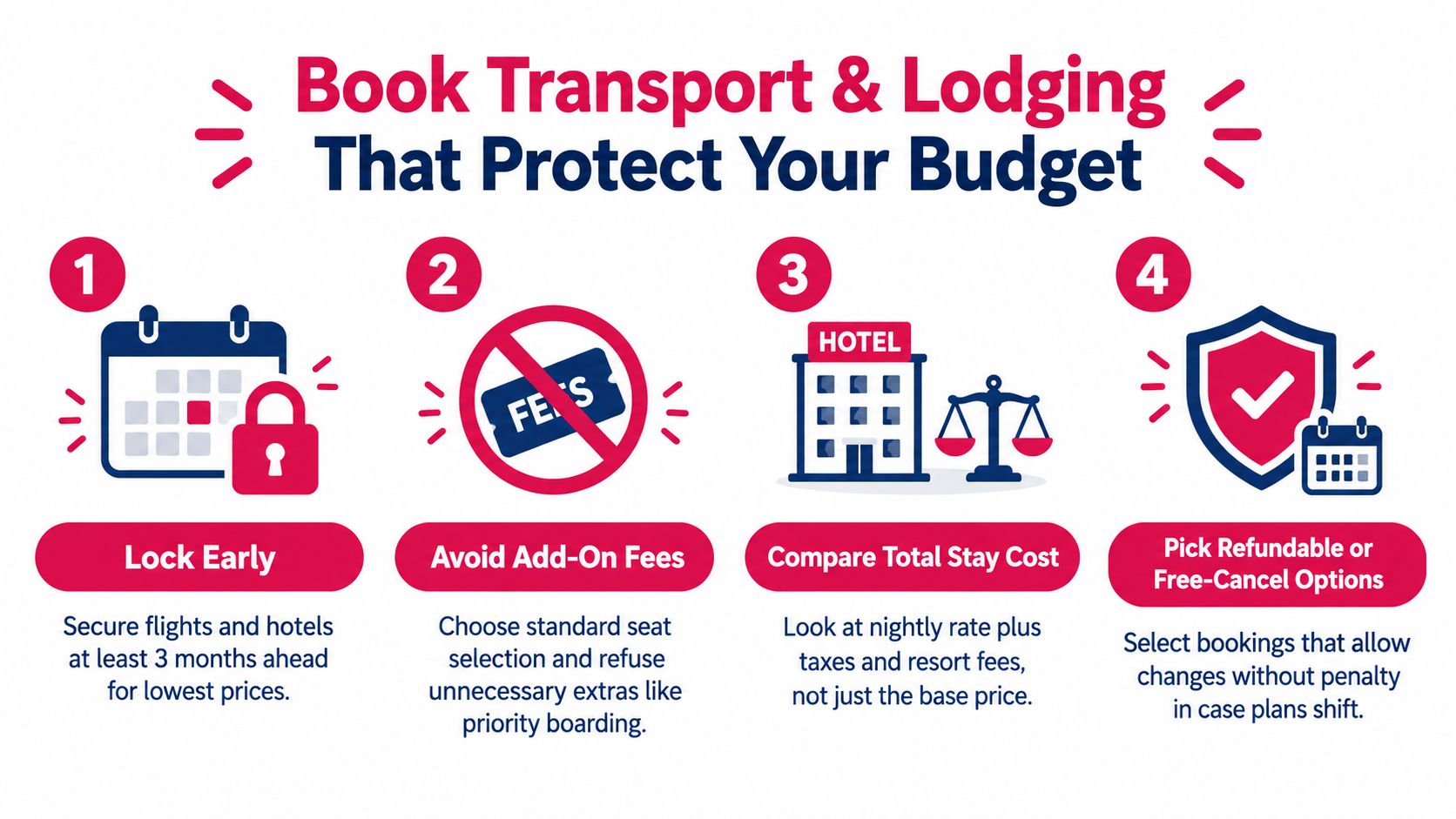
There is a normal window for this, and it is earlier than most families act. The 2025 US Family Travel Survey found the most common booking window is two to three months before departure (35% of families), with another 31% booking four to six months out. Booking two weeks before departure, or more than a year ahead, is rare. If you are inside a month and still comparing, you have already lost most of your leverage on the two line items that decide the budget.
Book for the total stay, not the nightly rate
I don't care if a hotel looks cheap per night. I care what the final bill says.
Families get trapped by low headline rates and then discover taxes, resort fees, cleaning fees, parking, breakfast charges, or paid baggage push the total somewhere else entirely. Always compare the final stay cost across hotels, aparthotels, apartments, and family rooms.
Official Australian tourism research gives a useful spending split, and the shape of it transfers even when the numbers don't. Across Australian domestic overnight family trips in 2019 — averaging 3.7 nights, with 86% of families driving rather than flying — average spend per trip was A$836: 31% food and drink, 28% accommodation, and 10% airfares, based on Tourism Research Australia family visitor data. Families in commercial accommodation spent A$638 on lodging, about A$154 a night. Read that airfare share carefully: it is small because almost nobody flew, not because flights are cheap. The transferable part is the other two lines. Food and a bed take roughly 60% of the trip, and that holds whether you drove two hours or flew four.
What I book for families in Europe and MENA
For cities like Lisbon, Rome, Istanbul, Prague, Vienna, and Barcelona, I often prefer:
- Aparthotels: You get a reception desk, more space, and basic kitchen access.
- Apartments with simple kitchens: Best when the fee structure is transparent and the location cuts transport costs.
- Hotels with breakfast included: Useful when mornings are chaotic and you need one reliable meal already handled.
For MENA destinations like Marrakech, Dubai, Muscat, or Amman, I lean toward properties that reduce daily friction. Walkable location. Family room setup that doesn't require a second booking. Breakfast that's included. Easy airport transfer options.
A checklist before you hit book
Run through this fast:
- Sleeping arrangement: Does this room fit the family, or are you pretending a sofa bed solves everything?
- Fee line review: Read every charge before payment.
- Location test: How much will you spend getting to the places you plan to visit?
- Cancellation terms: Flexible bookings can protect you from costly changes.
- Baggage reality: Budget carriers can stop being budget carriers once a family adds bags.
Cheap lodging far from the action often becomes expensive lodging plus daily transport plus tired children.
A final opinion. Don't automatically assume an apartment is cheaper. Sometimes it is. Sometimes the fees erase the savings. What matters is the full cost, the kitchen value, and whether the location reduces transport and meal pressure enough to justify the choice.
Saving on Meals Activities Packing and Safety Every Day
Trips stay on budget or drift off it. Not in one dramatic mistake. In twenty little ones.
A coffee here, a bottled water there, an overpriced museum café lunch because nobody packed snacks, a last-minute umbrella, a taxi because someone forgot sunscreen and everyone had to detour. Daily spending is messy unless you build habits that make the cheap choice the easy one.

Feed the family without turning meals into the main event
You do not need three restaurant meals a day. Most families don't even enjoy that pace for more than a day or two.
My standard rhythm looks like this:
- Breakfast in or included: Yogurt, fruit, bread, eggs, whatever is easy.
- Simple lunch: Market food, bakery items, sandwiches, picnic supplies.
- One proper paid meal: Usually dinner, or lunch if the city's midday menus are better value.
This works especially well in Lisbon, Barcelona, Rome, Istanbul, Marrakech, and Abu Dhabi, where local shops and markets make casual meals easy.
Don't pay for nonstop activities
Families overspend when they think every day needs a headline attraction. It doesn't. Kids usually want rhythm, not constant ticketing.
Try this instead:
- One paid highlight per day: A museum, a boat ride, a hammam visit, a desert activity, or a landmark.
- One free anchor: A beach, park, public square, market walk, viewpoint, or old town wander.
- One rest pocket: Pool time, playground time, café stop, or hotel downtime.
That structure keeps the day full without spending from morning to night.
The best budget days still feel generous. They just don't require paying every hour.
For extra ideas once you're narrowing down what to do each day, these cheap group activities are a solid starting point for families and mixed-age groups.
Pack to avoid tourist-price mistakes
Packing is a money decision. Every forgotten item becomes a premium purchase later.
I'd bring:
- Basic medicines: Children's fever relief, plasters, motion sickness essentials, anything routine for older relatives
- Refillable water bottles: Small habit, real savings
- Light snack kit: Crackers, fruit pouches, nuts if your family uses them
- Weather gear: Compact layers, hats, and rain protection
- Comfort items for kids: Not too many, just enough to prevent a store detour every afternoon
If you want a practical family packing reference, this InchBug kids road-trip packing checklist is written for the car but works for any trip, and it is good at catching the items families forget.
Safety and comfort save money too
A tired child, a dehydrated grandparent, or a family member with sore feet changes the whole spending pattern. You start buying convenience at every turn.
So I'd do the boring things early:
- Carry water and simple snacks
- Use shade and indoor breaks before anyone crashes
- Keep one low-pressure day after a heavy sightseeing day
- Save the longest outing for when everyone has settled in
That's not soft advice. It's budget protection. Comfortable families make better decisions and spend less on recovery purchases.
Lock Plans Together and Keep Everyone Aligned
Indecision is expensive.
Families rarely notice this because the cost doesn't show up on one invoice. It shows up as changed hotels, split taxis, duplicate bookings, late attraction purchases, random add-ons, and meals chosen out of desperation because nobody agreed earlier.
Use a fast decision system
For multi-generational trips, I use one rule. Everyone gets input once, then the plan gets locked.
That means collecting preferences privately before the booking stage. Budget tolerance. Energy level. Must-see items. Non-negotiables. Food concerns. Nap needs for younger children. Walking tolerance for grandparents. If you don't gather this early, you'll pay for confusion later.
A shared planning tool can help here. MyPerfectStay family group decision-making guidance lays out a practical approach built around collecting private preferences, comparing options, and keeping approved plans in one shared itinerary. That's the right model for families who are tired of endless message threads.

The workflow I recommend
Keep it simple and fast:
- Set the cap first
- Offer only two or three destination options
- Agree on trip length
- Pick one lodging base, or at most two
- Choose the must-do activities
- Leave the rest flexible within the daily allowance
This prevents the classic family mistake of trying to satisfy every possible preference. You won't. The goal is not perfect agreement. The goal is a workable plan that protects the budget.
A family trip improves the moment someone stops asking, “What do you want to do?” every two hours.
A clean structure for a week-long budget trip
For a seven-day Europe or MENA family trip, I'd keep the shape steady:
- Day 1: Arrival, local walk, easy dinner
- Day 2: Major sight, quiet afternoon, simple dinner
- Day 3: Free or low-cost exploration day
- Day 4: One paid highlight, slower evening
- Day 5: Rest-heavy day with one anchor activity
- Day 6: Final big outing or shopping window
- Day 7: Departure
That structure works because it respects money and energy at the same time. Which is the whole point.
If you want to know how to plan a family vacation on a budget that survives real life, this is the answer. Cap the trip. Price the full day. Choose destinations that fit. Book the biggest costs carefully. Then lock the plan before indecision starts charging interest.
MyPerfectStay helps groups make family trip decisions without endless chat arguments. You can collect everyone's private preferences, compare activities, and keep one shared itinerary so the budget and the daily plan stay aligned. If you're organizing a multi-generational trip and want the planning to move faster, visit MyPerfectStay.