Online Trip Planner Guide for Groups in 2026
November 1, 2026·MyPerfectStay

73% of surveyed global travelers said they chose to book online in TGM Research's Global Travel Insights 2025 survey of 21,000 participants across 21 countries. But booking online isn't the same as getting a group to agree. You can reserve every part of a trip digitally and still spend the evening untangling browser tabs, unanswered messages, and incompatible plans.
A useful online trip planner closes that gap. For a city break in Europe or MENA, the true test isn't how many attractions it suggests. It's whether the people traveling together can turn those suggestions into a day they can afford, reach, and enjoy.
Table of Contents
- What an Online Trip Planner Replaces
- Four Planner Types and the Job Each Finishes
- Features That Make a Day Actually Work
- How to Choose an Online Trip Planner
- City Breaks That Expose a Weak Planner
- When Budgets and Stamina Do Not Match
- Send One Link and Lock the Group Plan
What an Online Trip Planner Replaces
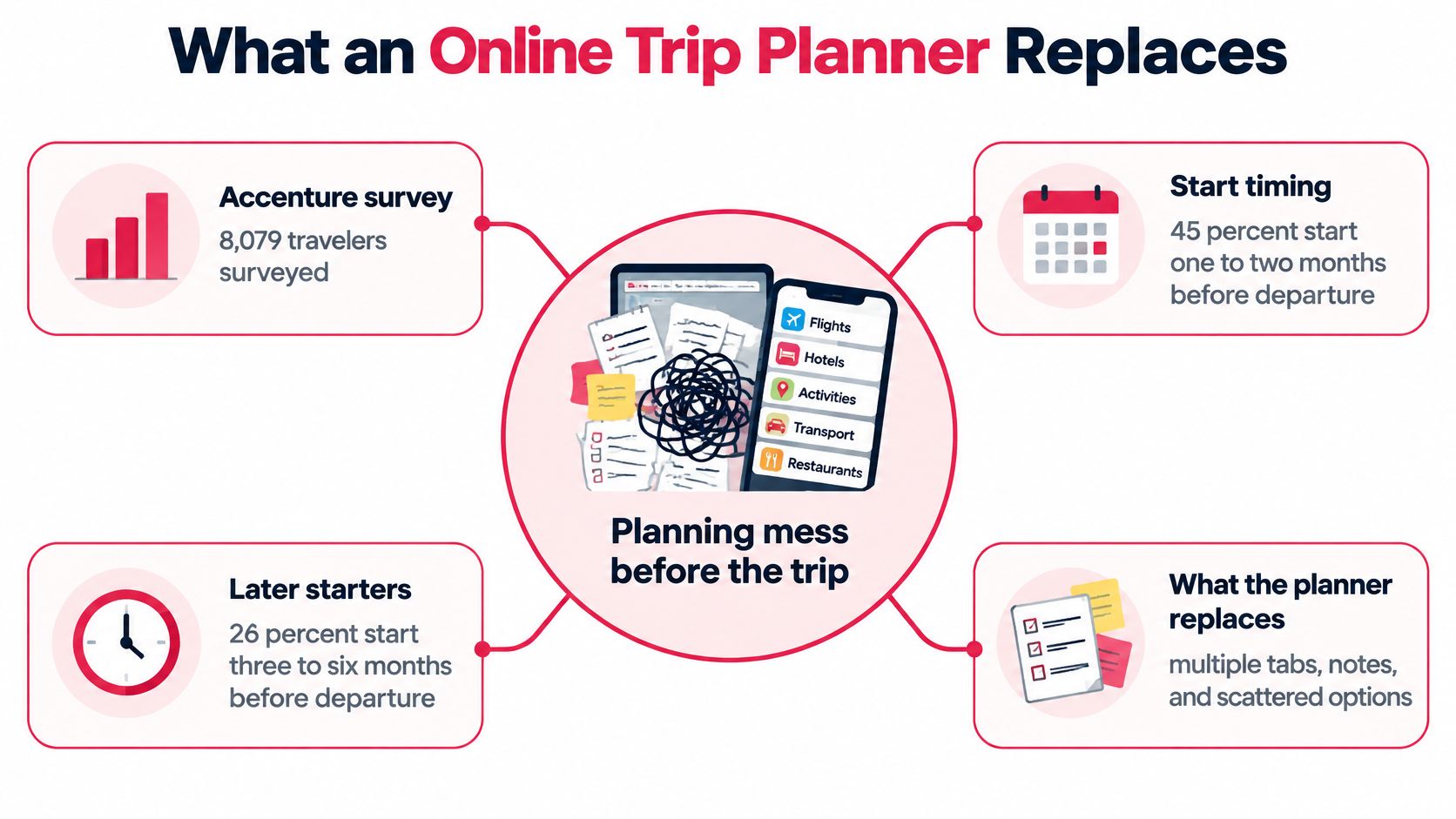
The planning mess starts well before anyone packs. In an Accenture survey of 8,079 travelers, 45% began planning one to two months before departure, while 26% started three to six months ahead. During planning, 68% used up to 10 websites, and 25% used 11 to 20 information sources; the same survey found that 55% already used dedicated travel-planning applications, with 37% saying they used them sometimes.
Say you're arranging a Lisbon break with friends. Someone saves an apartment, someone else sends a food tour, and another traveler finds flights that arrive after the proposed dinner. Each suggestion looks reasonable on its own. Nobody has checked whether they work together.
The clutter comes from collecting options without a shared place to resolve them.
From saved options to connected decisions
An online trip planner brings destination research, transport, accommodation, activities, and daily order into a working plan. It should help you see the consequences of a choice, not merely store the choice itself. Moving the hotel, for example, may change which neighborhood makes sense for dinner.
Think of a conductor versus a stack of sheet music. Search engines and chats produce the notes; the planner sets the tempo and helps everyone come in at the right moment.
That distinction also explains what a planner isn't:
- A flight metasearch alone compares transport options without organizing the stay.
- A hotel listing helps you select accommodation, not settle activity preferences.
- A friend's static PDF records a proposal but doesn't necessarily update when the group changes its mind.
If you're unsure which category you need, Approved Experiences Traveler offers a useful starting point to compare travel planning tools by the work you want them to finish.
Group travel makes disconnected planning harder because each person brings different sources, spending limits, and assumptions. The organizer becomes the human connection between every booking and every objection.
Practical rule: You need a planner when the trip has more than one decision to reconcile. A single hotel night can stay on a booking site.
Four Planner Types and the Job Each Finishes
| Planner type | Best for | What it decides | What it leaves open | Typical output |
|---|---|---|---|---|
| Itinerary builder | Solo city break | Order of sights and meals | Flights, hotels, and group taste | A day-by-day list |
| Booking platform | Travelers ready to pay | Price and availability | Whether the group agrees | Separate reservations |
| AI itinerary generator | A fast first draft | Suggested stops from a prompt | Opening hours, walking load, and votes | An editable draft plan |
| Group decision planner | Friends, families, and teams | Shared activities from private input | Sometimes the flights | A voted plan and one group checkout |
Pick a row before comparing features. These are functional categories, not promises that every product with the same label behaves identically. A tool may combine several roles, so inspect what happens between receiving a suggestion and confirming a booking.
An itinerary builder suits a solo long weekend in Lisbon when you already know what interests you. Your problem is sequence: where to start, where to eat, and which stops belong together. You don't need a voting system to negotiate with yourself.
A booking platform suits a couple who have already agreed on a Barcelona hotel. Their remaining questions concern the room, availability, payment, and reservation conditions. Adding preference surveys at that point would create work rather than remove it.
A Rome decision shows the difference
Say six friends are choosing between a Rome food tour and a morning in the Vatican area. Some want to taste local dishes; others care more about art and architecture. One traveler can't afford the more expensive option, and another won't join a long walking route.
A booking platform can show available products and prices. It can't infer that a cheerful message in the chat hides a budget objection.
An AI itinerary generator can put both ideas into a draft. Unless the relevant information is supplied and checked, the draft doesn't establish whether everyone can participate or whether the proposed sequence is practical.
A group decision planner should collect those differences, identify eligible options, and record a decision. If it supports group booking, it can then carry the chosen activity into checkout rather than sending the organizer back to individual messages.
Choose the unfinished job
An AI draft is helpful when you're staring at an empty page. An itinerary builder is helpful when you have too many stops and need order. Neither automatically solves disagreement.
Before choosing, name the sentence you need the tool to complete:
- Organize: Put my chosen places into a sensible day.
- Reserve: Sell me the option I've already selected.
- Suggest: Give me a starting plan I can inspect.
- Agree: Help these travelers choose something they can do together.
For most readers coordinating a group, the last sentence matters first. If more than one person must agree, start with the group decision row and leave solo sequencing tools until the vote is settled.
Features That Make a Day Actually Work
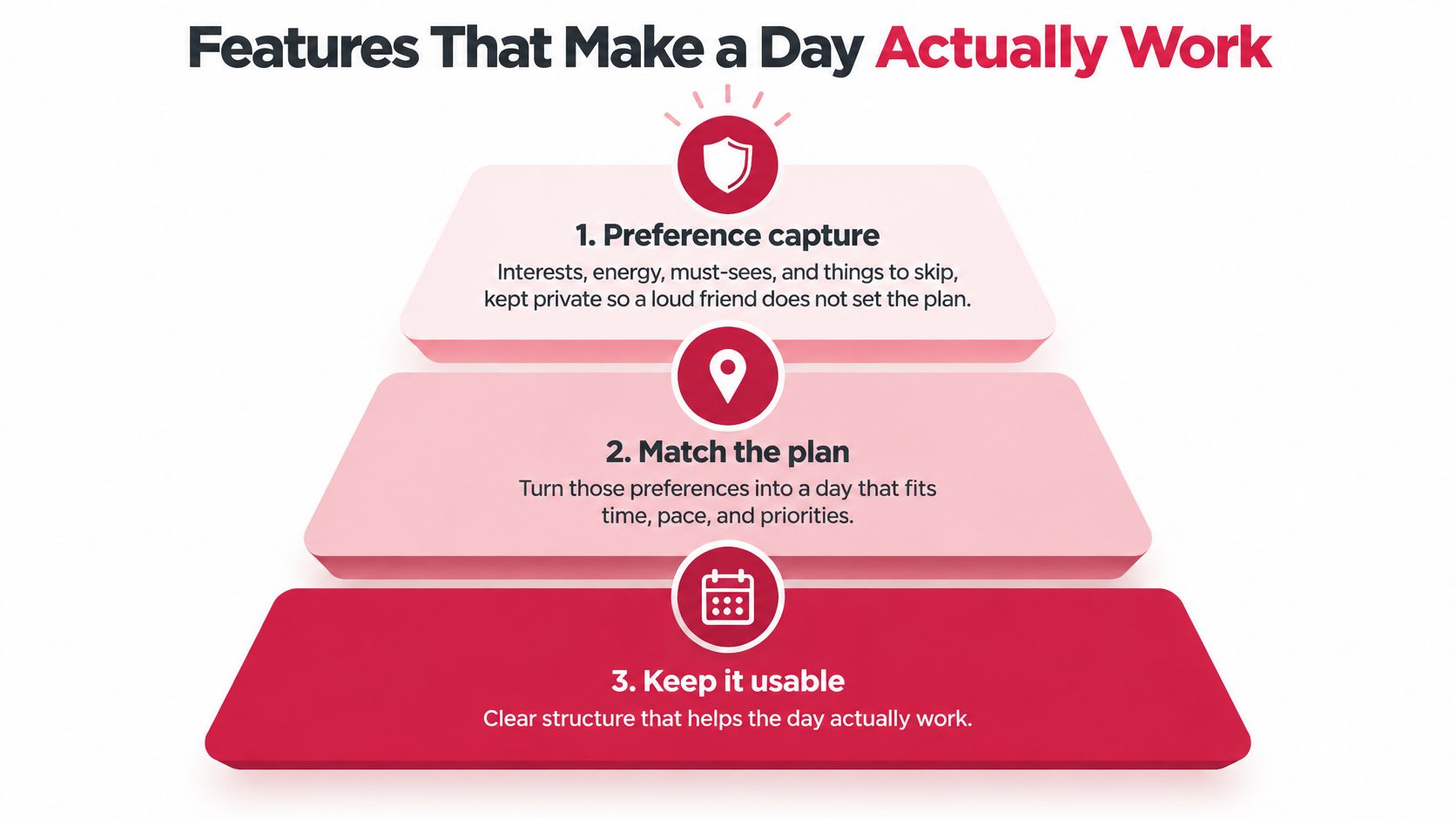
A usable planner needs connected layers, from private preferences to a shared schedule. A polished map isn't enough if the tool never asks who dislikes long walks or which reservation can't move.
The foundation is easier to understand as a stack rather than a feature checklist.
Start with people, then test the clock
Preference capture should cover interests, energy, must-sees, and things to skip. Private answers help prevent the most vocal traveler from defining everyone else's holiday.
Next comes an explainable match score. A useful explanation identifies the fit, such as food-focused travelers preferring a shorter route, rather than displaying an unexplained percentage.
Then the planner needs a feasibility layer: geographic coordinates, operating windows, visit duration, booking restrictions, and travel time. Personalized itinerary-planning research published in Information Technology & Tourism treats itinerary generation as a constrained optimization problem, balancing traveler interest against spatial and temporal limits.
In plain language, the planner should find appealing activities, then reject or move combinations that don't fit. A helpful explanation would say that an activity matches the group well but belongs on a different day because of its opening hours.
Let edits improve the shared plan
Adding, skipping, reordering, or replacing a stop should influence subsequent suggestions. An interaction-based recommendation study in Expert Systems with Applications found that using itinerary edits as feedback improved both the selection and ranking of recommended places.
The final layer is a shared daily view. Everyone should be able to distinguish a suggestion from a confirmed booking and see where to meet without reconstructing the organizer's reasoning.
AI can help create the initial draft within that system. In a 2025 Kaspersky survey conducted with Toluna among 3,000 respondents across 15 countries, 28% said they used AI to plan trips. Treat that capability as a drafting aid, not proof that hours, routes, or bookings have been verified.
For another view of the planning workflow, watch the accompanying video.
Try a sample Prague day with three stops and a booked entry slot. Check the actual route, allow room for a meal and a pause, then move a stop. If the rest of the day doesn't adjust coherently, you've found a list generator rather than a dependable planner.
How to Choose an Online Trip Planner
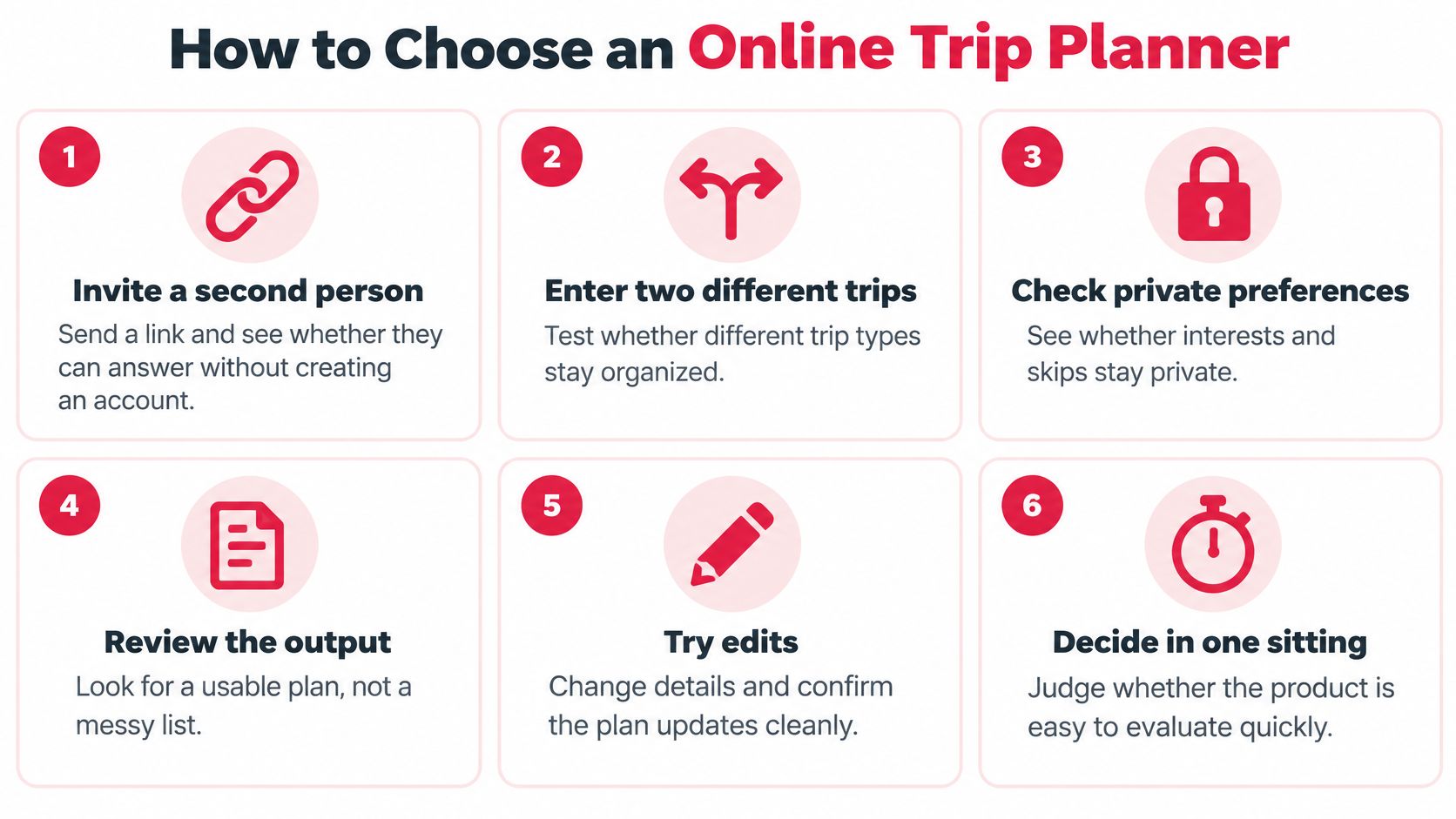
Test a product with a small, realistic trip before importing every saved idea. Use deliberately conflicting inputs: an enthusiastic walker and someone who needs frequent rests, or a generous activity budget alongside a firm ceiling.
The checklist gives you a quick evaluation route.
Run the checks with real disagreements
- Invite a second person. Send the invitation link and ask them to answer without your help. Check whether they can begin without creating an account or installing an app.
- Enter different budgets. Confirm that individual ceilings stay private and that the proposed activity shows a per-person price. A group total doesn't reveal who has been priced out.
- Add a must-see and a hard no. Try a restriction such as no long stair climbs. The important question is whether the restriction can exclude an unsuitable activity, not merely lower its ranking.
- Request a short, multi-day city plan. Inspect opening hours, transfers, and the relationship between stops. Famous names aren't evidence of workable sequencing.
- Follow the winner toward checkout. Find out whether the organizer can book the chosen activity for everyone or whether each traveler must repeat the purchase separately.
- Inspect the post-vote view. Look for organized days and a participation deadline or nudge. Silence shouldn't count as agreement.
Use this score sheet to record what you observe.
| Check | Question to ask | Pass | Fail |
|---|---|---|---|
| Join friction | Can a guest answer from a link? | Link invite, no download required to start | Account or app install before a single vote |
| Budget fairness | Can ceilings differ inside the group? | Private budget plus per-person price | One splashy total and social pressure |
| Hard constraints | Can one person's limit block a plan? | Mobility, stamina, or diet can exclude an activity | Majority taste overrides a hard no |
| Day sequencing | Does the order respect the clock? | Opening hours and transfer time are visible | A famous-name wishlist with no order |
| Group checkout | Can winners be booked together? | One payment for the chosen activity | Everyone sent to a separate cart |
| Shared plan | Is there one itinerary after the vote? | Auto-organized days plus a deadline or nudge | The decision lives on in a chat thread |
Weight the results for your trip
A solo Vienna weekend may need little beyond good sequencing. A bachelor or bachelorette weekend, family reunion, or company offsite needs stronger safeguards: reject the tool if budget privacy or hard constraints are missing, even if its gallery looks excellent.
Keep transport evaluation separate when the planner doesn't handle flights. If arrivals need specialist attention, MyAirlinesTrip lets you compare flight options with expert guidance; bring the agreed arrival and departure details into the shared schedule afterward.
For groups, keep a planner that passes checks 2, 3, and 5. Treat the remaining checks as conveniences when choosing between otherwise suitable products, but resolve any missing timing information before paying.
City Breaks That Expose a Weak Planner
Paris, Rome, Barcelona, Madrid, and Lisbon provide practical stress tests. Their 2024 guest nights booked through major online platforms were 23.5 million, 15.7 million, 12.5 million, 11.8 million, and 11.3 million respectively, according to the platform-accommodation figures summarized by Europe Says.
Those volumes show why the examples are worth using. Demand says nothing about whether one group can move through a day without friction, so read each city as a question the organizer has to answer.
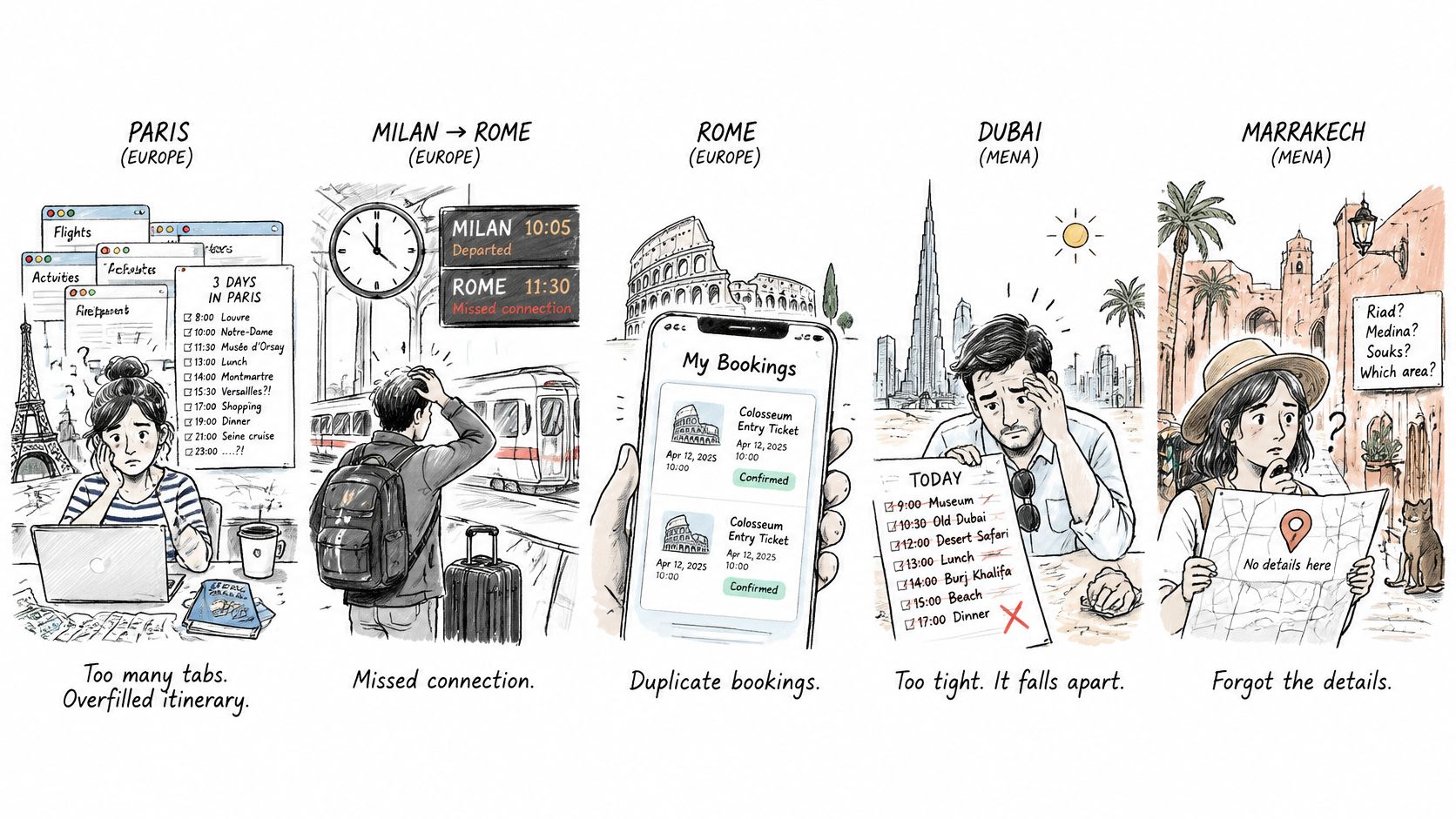
The stress test starts the morning after booking, when a pin on a map has to become an entrance, a time, and a route.
European days that need more than landmarks
- Paris tests walking load. For a hypothetical three-day stay, give a museum morning and a food-neighborhood visit distinct space instead of repeatedly crossing the city. Check the effort between stops before adding another highly ranked attraction.
- Rome tests opening windows. A Vatican-area morning followed by a long lunch across town needs a route and a realistic transition. A flexible lunch should support a fixed reservation, with the timing gap stated plainly.
- Barcelona tests agreement. A couple with a chosen hotel may only need a booking platform. Friends divided between a beach day and the Gothic Quarter need a way to choose before arranging the details.
- Madrid tests sleep schedules. A food-focused evening can suit some travelers while leaving early sleepers with an unwanted late finish. Make the evening extension optional and keep the return arrangements clear.
- Lisbon tests mixed energy. Check the route's terrain instead of judging it only by distance. A compact-looking map can conceal a day that leaves part of the group behind.
Use city-break ideas to narrow the destination first. A saved idea still needs hours, transfers, and energy checks before it becomes a daily plan.
Dubai tests who will actually join
Say a Dubai group is choosing between a desert safari, a marina outing, and a museum visit. Compare heat exposure, collection arrangements, transfer time, and willingness to participate before looking at star ratings. The most popular photograph can be the afternoon with the weakest attendance.
A venue name is a suggestion. An entrance, meeting point, and usable route make it actionable.
That principle also applies outside these city breaks. For a Bangkok stop, save a venue-specific resource such as directions to Little Zoo Garden beside the reservation, because the group needs the same details there: where to arrive, where to meet, and how the plan continues afterward.
When Budgets and Stamina Do Not Match
Higher travel budgets don't remove group friction. For summer-autumn 2025, 62% of Europeans expected to keep travel budgets steady and 22% expected to spend more, while the share planning trips in the €1,500 to €2,500 per-person range increased, according to the European Travel Commission's travel-sentiment release. Other 2025 research finds cost remains the leading barrier for Europeans who decide not to travel.
A group average can't settle an individual limit. Say a family visiting Amman and Petra wants a private guide: some relatives may welcome the upgrade, while another needs the standard option to remain a genuine choice. The vote only works if both stay on the table.
Compare the full commitment
A headline price works like a menu that hides the service charge: the number that matters is what each traveler owes. For each proposed activity, show the decision in terms everyone can evaluate:
- Total group cost: Include compulsory charges and necessary transfers.
- Per-person cost: Make individual obligations visible before the vote.
- Mandatory spending: Separate the shared baseline from personal purchases.
- Optional upgrades: Keep extras optional rather than adding them to everyone's bill.
- Non-participant alternative: Give anyone sitting out a practical place to spend that time and a clear reunion point.
Deposits and cancellation exposure belong beside the price. A vote isn't financially harmless if a traveler who withdraws still owes money, so read the booking conditions before anyone commits.
A family vacation budget planner can help separate common expenses from personal choices. That distinction matters as much for friends as it does for relatives.
Participation is more than an accessibility badge
Stamina needs the same care as affordability. For a multigenerational Amman day or a corporate retreat in Doha, inspect step-free access, seating, toilets, sensory conditions, walking intensity, and companion requirements. A listing that says only "accessible" leaves each of those unanswered.
A 2025 survey reported by the European Network for Accessible Tourism identified poor infrastructure and insufficient pre-trip information as barriers for travelers with mobility or accessibility needs. Treat vague descriptions as questions to put to the operator, not confirmation that everyone can join.
Collect budget, dietary needs, and stamina privately, then favor a feasible compromise over the most popular expensive outing. Before opening any planner, ask each traveler to write down their spending ceiling and one hard limit, and use those answers to screen the first shortlist.
Send One Link and Lock the Group Plan
Traveling solo with a hotel already chosen? A booking platform may be enough for the reservations you still need.
Only looking for inspiration? Use an AI generator for a draft, then verify opening hours and routes yourself.
Coordinating friends, a family reunion, a bachelor or bachelorette party, or a company offsite? Start with a group decision planner. MyPerfectStay fits: we connect individual preferences, activity voting, group booking, and the shared daily itinerary.
Give the organizer a clear starting point
To start, the organizer enters a destination, a rough date, and who's coming. Setting up a first trip takes about ninety seconds; building the plan takes a little longer.
The planning process follows a simple sequence:
- Pick the city and dates. Create the trip and invite the travelers by link.
- Collect private answers. Everyone shares budget, interests, energy, and must-see ideas, and match scores help rank activities against those inputs.
- Vote and book together. Friends vote on activities, the group books the winning option, and a single checkout covers everyone. The shared daily itinerary keeps the chosen activities in order.
Use explicit group decision-making methods to decide when a vote closes and how unresolved objections will be handled. Don't make the organizer guess whether an unanswered message means approval.
Try the process on a short break in Lisbon, Rome, Barcelona, or Dubai rather than a complicated extended tour. Pick the city, send the invitation, set a voting deadline, and book only the activities that survive both the vote and every traveler's spending ceiling.
MyPerfectStay brings private preferences, activity voting, shared daily plans, and group checkout into one online trip planner. Visit MyPerfectStay, create your next city break, and send the group an invitation link so you can choose and book activities together.