What Is Group Decision Making for Travel
September 26, 2026·MyPerfectStay

You're in a group chat trying to plan a trip, and the conversation has somehow turned into a negotiation about everything. One person wants museums in Paris, another wants long dinners, someone else is watching the budget, and the quietest traveler has already stopped replying. The group hasn't made a decision because everyone has an opinion, but nobody has a reliable way to turn those opinions into a shared plan.
That situation illustrates what group decision making is in practical terms. It's a collective process in which multiple people evaluate alternatives and choose an outcome together. For travel, that might mean selecting Rome over Barcelona, choosing a restaurant, deciding how much activity the group can handle, or agreeing on which experiences deserve space in the itinerary.
Table of Contents
- Defining Group Decision Making in Travel
- The Spectrum of Decision Models
- Why Structured Input Beats Open Debate
- Common Traps That Derail Consensus
- Applying the Nominal Group Technique
- How Modern Platforms Automate Fair Decisions
- Your Workflow for the Next Group Trip
Defining Group Decision Making in Travel
Suppose you're organizing a weekend in Rome. If you choose the hotel, restaurants, museums, and day trips alone, you're making a solo decision. You may move quickly, but you're relying on one person's preferences, knowledge, and tolerance for risk.
A group decision works differently. The travelers contribute information, compare priorities, discuss trade-offs, and settle on a plan that affects everyone. The final choice may not match any one person's first preference. It reflects a process of negotiation, compromise, and shared ownership.
That distinction matters because discussion doesn't just average personal opinions. A field experiment on team decisions under risk found that teams reached agreement after an average of 1.83 rounds of deliberation, although one team needed seven rounds. The same research found that, in aggregate, teams chose more risk than individuals. Talking changed the decision itself.
The travel version of a collective choice
Imagine that three people initially prefer a quiet food tour, while two want a late-night activity. During the conversation, someone mentions that the group's hotel is far from the nightlife area, another traveler explains a mobility concern, and a third points out that a food tour fits the available evening better. The group may choose an option that nobody ranked first at the start.
That outcome isn't a failure. It shows why group decision making differs from preference counting. People reveal constraints, identify missing information, and reshape the available options as they talk.
A useful working definition is:
Group decision making is a structured or unstructured process in which several people evaluate alternatives and commit to a shared choice.
The process can involve a family, a friend group, a hotel team, or colleagues arranging an offsite in Doha. It can happen face to face, through a group chat, with a survey, or through a platform that collects private preferences before presenting common options.
Why travel groups need structure
Travel decisions combine enjoyment with practical risk. A plan can fail because the transport is inconvenient, the walking is too demanding, the price feels unfair, or one traveler's must-see activity disappears from the schedule. A clear process gives the group a way to surface those issues before someone books.
The purpose isn't to eliminate disagreement. Useful disagreement exposes information. The organizer's job is to make sure disagreement leads to a better choice rather than an endless conversation dominated by the most persistent speaker.
The Spectrum of Decision Models
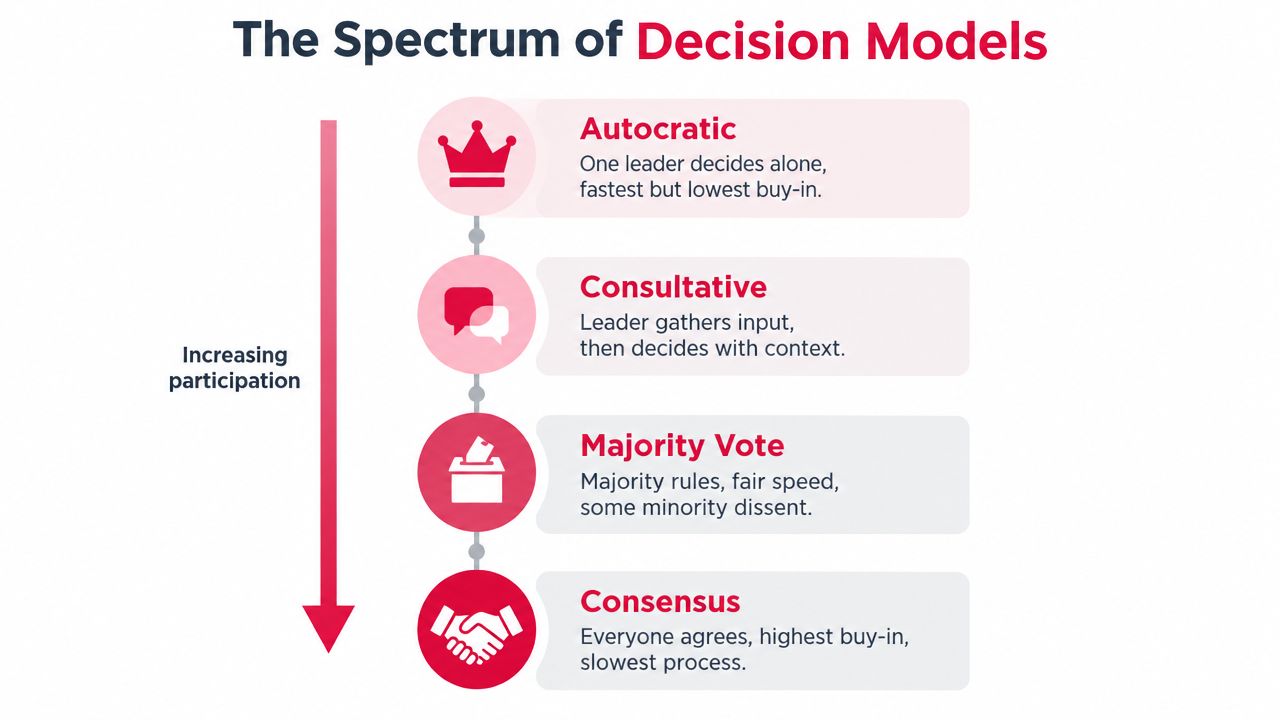
Not every group needs full consensus for every choice. Selecting the main destination may deserve broad participation, while choosing the airport transfer might reasonably belong to the organizer. Group decision making sits on a spectrum, and each model trades speed against participation and buy-in.
Autocratic decisions
In an autocratic model, one person decides. A corporate retreat organizer might select a Dubai hotel, reserve meeting rooms, and build the itinerary without asking the team. This is fast and clear, especially when the decision is routine or time-sensitive.
The cost is lower participation. Travelers may comply with the plan while feeling little connection to it, and the organizer can miss preferences or constraints that would have changed the result.
Consultative decisions
A consultative model keeps final authority with one person but gathers input first. For a family reunion in Lisbon, the organizer could ask everyone to name a preferred activity, a food restriction, and a maximum comfortable walking distance. The organizer then decides while considering that information.
This approach often works when someone must coordinate details but the group's knowledge matters. It also prevents a common mistake, treating the organizer's convenience as if it represented the whole group.
A long-running experiment with 598 teams and 2,673 participants compared the three styles on the same planning problem. Moving from autocratic to consultative decisions improved decision quality by 10.2%, and moving on from consultative to full group decisions added another 15.3%, for an overall gain of 23.9% over autocratic decisions. Consultative decisions beat the average individual team member in 71% of teams, while group decisions did so in 88% of teams. These figures come from a 2023 study on direct participation and decision quality in the Journal of Entrepreneurship, Management and Innovation.
Majority vote
A majority vote gives each person a clear choice and selects the option with the most support. It can settle a restaurant choice in Prague or decide between two evening activities without requiring everyone to prefer the winner.
The limitation is minority dissent. A majority can select an option that creates a serious problem for one traveler, such as an accessibility issue or a dietary restriction. Voting works better when the group agrees on the criteria before voting and gives members a way to flag essential constraints.
Consensus
Consensus means the group works toward an outcome everyone can accept. It doesn't necessarily mean every traveler would have made the same choice alone. It means no one has an unresolved objection serious enough to block the plan.
Consensus can produce strong commitment, but it takes time and careful facilitation. The group decision-making methods guide can help organizers compare approaches instead of assuming that one rule fits every travel decision.
Why Structured Input Beats Open Debate
Open debate feels democratic, but it often gives the most influence to the fastest thinker, loudest speaker, or person with the strongest attachment to an idea. A quieter traveler may know that a Barcelona attraction requires advance planning or that a long walking route won't work for a parent, yet never find a natural opening in the conversation.
Structured input protects information before personalities shape the outcome. Each person first forms an individual judgment, then the group shares and evaluates those judgments. This preserves useful differences instead of allowing early comments to anchor everyone else.
Four conditions for better group judgment
Guidance on wisdom-of-crowds research identifies four conditions that support accurate group judgments: expertise, cognitive diversity, independent judgments, and structured sharing. The framework is summarized in research on deliberative consensus and wisdom of crowds.
Consider a hospitality team in Barcelona choosing local experiences for guests. The restaurant specialist may understand dining quality, the operations manager may know transport limitations, the local guide may recognize seasonal patterns, and the accessibility lead may identify barriers others overlook. Their differences create value only if each person can contribute before the group settles around one early suggestion.
- Relevant expertise adds knowledge that the rest of the group may lack.
- Cognitive diversity introduces different ways to interpret the same itinerary.
- Independent judgment reduces the risk that everyone just copies the first confident opinion.
- Structured sharing gives the group a deliberate moment to compare evidence and resolve differences.
Independence comes before discussion
Ask the Barcelona team to score possible experiences privately before opening a meeting. One person might favor a market tour, another a cooking class, and another a neighborhood walk. Once the group sees those separate views, it can investigate why they differ.
If the team starts with an open conversation, the first persuasive speaker may frame the entire choice. Later participants often respond to that frame rather than evaluating the options independently. This creates agreement, but not necessarily accuracy.
For a practical framework that helps teams sequence criteria, alternatives, and decisions, see these decision-making frameworks. The key lesson is simple: collect individual signals first, then use conversation to interpret them.
Common Traps That Derail Consensus
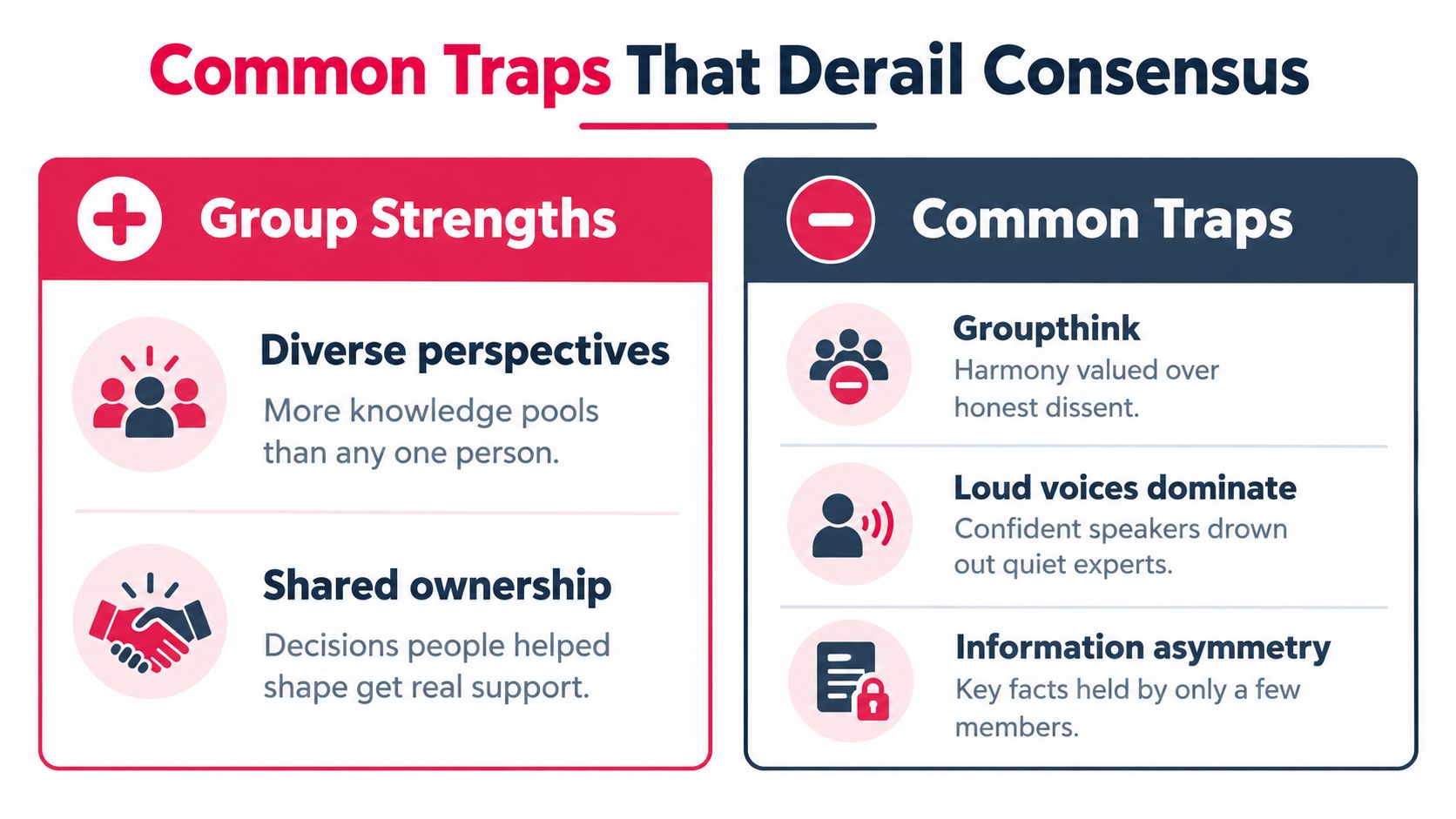
A group can contain more knowledge than any individual and still make a poor choice. The problem usually appears when the group fails to share what members know, treats confidence as evidence, or asks people to vote before they understand the decision.
Take a bachelor party in Amsterdam. One traveler knows the proposed activity requires a long journey from the hotel. Another has checked the total cost and found extra charges. A third wants a quieter alternative but stays silent because the group seems enthusiastic. If those facts remain private, a majority vote may select an option that looks popular but fits the group badly.
Difficulty changes the quality of agreement
Controlled experiments on human groups found that groups reached consensus in 469 trials and were correct in 412 of them. Easier conditions produced success rates nearing or surpassing 75%, while harder conditions with local information fell to only slightly above chance. These results are reported in the PLOS ONE study of consensus quality.
The implication for travel planning is practical. Choosing between two restaurants with complete menus is easier than selecting a multi-day itinerary when each person holds only part of the information. A group shouldn't treat a quick agreement as proof that it has made a sound decision.
The same research found that a minority of informed individuals could accelerate and improve consensus. That means an organizer should actively surface high-confidence outliers instead of averaging them away.
Warning signs in a group chat
Watch for these patterns:
- Groupthink: Members value harmony more than honest objections.
- Dominant speakers: Confident travelers answer first and quiet experts never contribute.
- Information asymmetry: One person has checked key details while others vote without them.
- Unclear criteria: The group argues about options without agreeing on budget, pace, or priorities.
- False consensus: Members say “fine” because they want the conversation to end.
- Unprotected minority needs: A health, mobility, dietary, or budget constraint gets treated as a preference.
Research on group decision making across different formats also emphasizes that groups aren't automatically better than individuals. Outcomes depend on information sharing, diversity, and the format used. Face-to-face discussion is only one method. Online surveys, Delphi groups, prediction markets, and judge-advisor systems can serve different purposes.
Applying the Nominal Group Technique
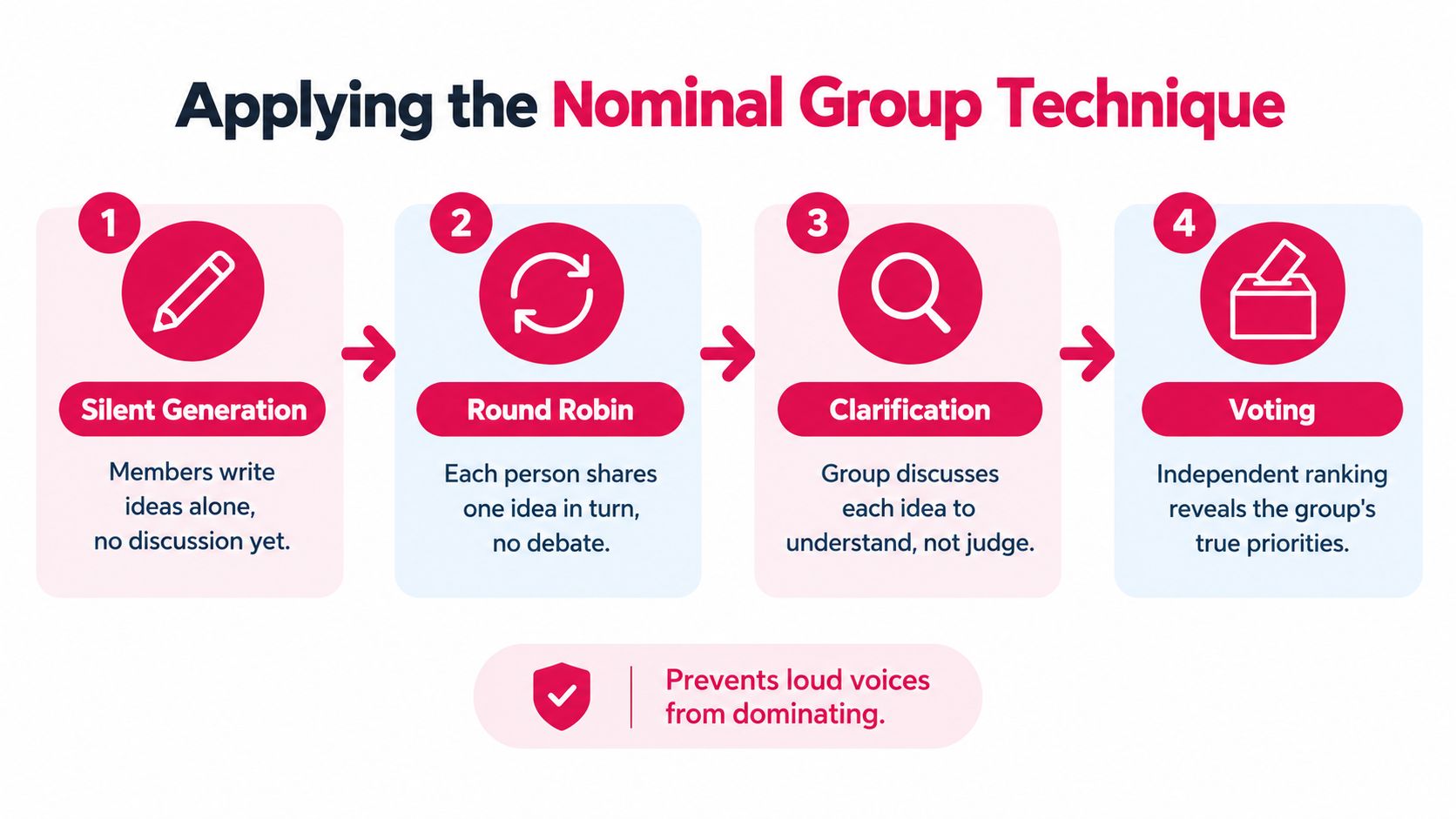
The Nominal Group Technique gives travel organizers a simple way to separate idea generation from debate. It uses silent generation, round-robin sharing, clarification, and private voting. Some practical descriptions add problem definition as the opening step, creating a five-part workflow that makes the decision easier to manage.
Start with a defined question
Don't ask, “What should we do in Santorini?” That invites an unbounded list of ideas. Ask, “Which evening activity fits our shared budget, energy level, and interest in local food?”
A precise question gives everyone the same task. It also makes later voting meaningful because the group is comparing answers to a common standard.
Generate ideas privately
Give each traveler time to write ideas alone. For a Marrakech trip, one person might suggest a cooking workshop, another a guided medina walk, and another a desert excursion. Nobody debates during this stage.
Silent generation prevents early enthusiasm from narrowing the group's imagination. It also gives quieter participants the same starting position as people who naturally speak first.
Share in a round robin
Each traveler presents one idea in turn. Continue until everyone has shared the relevant options, and record duplicates together without dismissing them.
The American Society for Quality overview of Nominal Group Technique describes the method as stating the question, having members write ideas down individually, sharing them one at a time in turn, discussing them for clarification rather than debate, and then prioritizing them with multivoting or a point system. Academic descriptions often use four stages: individual generation, round robin, clarification, and voting or ranking, as outlined in this review of the technique.
Clarify before judging
The group now asks factual questions. What does the activity involve? How long does it take? Is the route suitable for everyone? Clarification is not a debate about whose idea is best.
For a family considering Santorini, this stage might reveal that a sunset cruise conflicts with a ferry arrival or that a proposed walk is too demanding for one traveler. The group can revise or combine ideas before selecting anything.
Vote privately
Each person ranks or scores the clarified options without seeing other votes. Private voting reduces pressure to follow the most popular speaker and reveals the group's actual priorities.
Use a rule that matches the decision. A simple ranking may work for activities, while a hard constraint should remove an unsuitable option before the vote. The technique doesn't guarantee agreement, but it makes the path to agreement visible and fair.
How Modern Platforms Automate Fair Decisions
Distributed groups rarely have the patience for a long meeting. Friends may live in different cities, family members may have conflicting schedules, and colleagues may be traveling before an offsite. Digital planning tools can turn the principles of structured input into a workflow that works asynchronously.
Private preferences preserve independence
A private survey asks each traveler for information before group pressure takes over. Useful questions cover budget, interests, energy level, and must-see ideas. The organizer gets a clearer picture of constraints, while participants avoid performing agreement in a public chat.
MyPerfectStay is one example of this model. The platform lets travelers complete a private survey, analyzes the inputs, identifies overlap, and surfaces activities with match scores. It supports a catalog of 300,000+ bookable experiences across Europe and MENA, including museum tours, food tastings, desert safaris, and yacht cruises.
That approach operationalizes the same principle as the Nominal Group Technique. The system collects individual judgments first, then helps the group compare options rather than forcing everyone to negotiate from memory.
Algorithms can organize common ground
A smart voting flow doesn't need to replace human judgment. It can reduce the administrative work that makes group planning frustrating. Instead of copying responses from a chat into a spreadsheet, the organizer can review options that align with shared preferences and investigate where disagreements remain.
For teams evaluating digital workflows, this decision-making tool provides a relevant example of how voting, preference capture, and itinerary planning can connect in one process.
The best platform design doesn't hide disagreement. It makes disagreement legible. If one traveler strongly prefers a cultural tour while others favor a relaxed evening, the organizer can see the difference and decide whether to compromise, split the group, or ask a targeted follow-up question.
Your Workflow for the Next Group Trip
A reliable travel decision starts before anyone compares activities. Use a sequence that captures private preferences, sets boundaries, and gives the group a clear point at which discussion ends.
Define the decision
For a multi-generational trip to Vienna, begin with the outcome you need. Are you choosing daily activities, the neighborhood, restaurants, or the balance between scheduled plans and free time? Separate major decisions from minor logistics so the group doesn't spend equal energy on everything.
Write down the criteria in plain language. You might include budget, walking tolerance, cultural interest, meal preferences, rest periods, and weather flexibility. A corporate team planning an offsite in Doha may use different criteria, such as meeting space, team-building value, travel time, and evening availability.
Invite the right input
Send one link with the destination, decision question, and response deadline. Ask every traveler to complete the same private questions. If someone has a firm requirement, give them a clear place to state it rather than expecting them to interrupt a public conversation.
Deadlines protect the group from indefinite postponement. Nudges should remind people to participate without turning the organizer into a personal follow-up service.
Review overlap and exceptions
Once responses arrive, separate shared preferences from individual constraints. A family might broadly agree on museums and relaxed meals, while one traveler needs shorter walking routes. That doesn't require rejecting the whole plan. It may call for a nearby alternative, a rest window, or an optional activity.
Review the strongest options with the group, but don't reopen every settled question. Ask focused questions such as, “Can everyone accept this museum if we schedule a long lunch afterward?” Focused language keeps the conversation connected to a decision.
Lock the itinerary
Choose the decision rule before the final vote. Use consensus for requirements that affect everyone, majority vote for flexible activities, and organizer judgment for routine logistics. Record the final choices, unresolved compromises, meeting points, and booking responsibilities.
A shared, auto-organized daily itinerary helps everyone see the same plan. Instant confirmations reduce the risk that one traveler books a different time or assumes an option was only tentative. The organizer should also leave visible space for rest, weather changes, and personal time.
Keep the process humane
Fair planning doesn't mean every decision receives equal debate. It means every person gets a reasonable opportunity to contribute where the decision affects them. Structure the important choices, protect independent input, and close minor questions quickly.
MyPerfectStay helps groups collect private preferences, compare shared interests, vote on activities, and turn the result into a bookable itinerary for a trip across Europe and MENA. Visit MyPerfectStay to replace the endless group chat debate with a clearer, more balanced planning workflow.