Bachelor Party Planning App That Actually Works
October 12, 2026·MyPerfectStay
You're in the group chat right now, watching fourteen messages arrive before anyone answers the only questions that matter. Three people have named different budgets, two are in different time zones, someone has dropped screenshots of Barcelona apartments, and the groom has reacted with a thumbs-up to all of them. By tomorrow, nobody will know which activity was chosen, who paid the deposit, or whether the apartment can legally host the group.
A good bachelor party planning app should prevent that collapse. It should make preferences private, show the actual cost of each option, account for destination rules, and turn a messy discussion into a locked plan. The right choice depends less on how many buttons an app has than on whether it solves the social and logistical problems that make group trips fail.
Table of Contents
- Why Most Bachelor Parties Almost Fall Apart in the Group Chat
- The Six Decision Criteria That Actually Separate Planning Apps
- How the Top Bachelor Party Planning Apps Stack Up
- Destination Rules That Change Which App You Should Pick
- Real Use Cases Across Europe and MENA
- Why MyPerfectStay Wins for Most Europe and MENA Groups
- Your One-Evening Rollout Plan
Why Most Bachelor Parties Almost Fall Apart in the Group Chat
The usual breakdown starts innocently. One organizer posts three hotel links, another recommends a boat, and a third person says the group should “keep it reasonable.” Nobody wants to be the first to admit that their budget is lower, so the most expensive suggestion becomes the unofficial baseline.
Then the loudest participants take over. The person who wants nightlife votes early, the person with mobility restrictions stays quiet, and several invitees never respond because they don't want to challenge the organizer. By the time someone creates a poll, the group has already anchored around a destination, a price, or an activity that may not work for everyone.
The logistical mess follows quickly:
- Scattered evidence: Hotel screenshots sit beside restaurant menus, airline confirmations, and outdated links.
- Unclear costs: Per-person prices exclude transport, deposits, taxes, optional activities, or the groom's share.
- Lost decisions: A reaction in a chat isn't the same as a confirmed booking.
- Weak participation: Organizers repeatedly chase people who haven't expressed a preference.
- No constraint check: A venue may not fit the group, an apartment may lack legal capacity, or a high-risk activity may be unsuitable for a guest.
Organizer rule: If a decision can't be traced from private preference to shared result to confirmed booking, it isn't finished.
This category matters because bachelor parties aren't merely casual nights out. Historical reporting traces the ritual to ancient Spartan celebrations, where soldiers reportedly held a dinner and formal toasts for a groom by the 5th century B.C. The word “bachelor” appeared in Geoffrey Chaucer's 14th-century Canterbury Tales, while the phrase “bachelor party” first appeared in 1922 in Chambers's Journal of Literature, Science and Arts. The modern destination format became more visible during the 1960s and 1970s, with bachelorette-party traditions spreading mainly from the 1980s onward. Vogue's history of the bachelorx party
That history gives the event staying power, but modern travel gives it financial weight. A 2023 survey of roughly 500 attendees and planners found average bachelor-party spending of about $1,500 per attendee, while the broader average for bachelor and bachelorette celebrations was $1,400. WeddingWire's bachelor and bachelorette party travel data A planning app earns its place when it removes the friction around that money, not when it merely stores another itinerary.
Small details matter too. If the group needs reliable connectivity at a hotel, villa, or event venue, it can be useful to review how Splash Access simplifies guest Wi-Fi alongside the travel-planning workflow. Connectivity won't resolve a budget dispute, but it can stop a weak signal from creating another avoidable failure on the day.
The Six Decision Criteria That Actually Separate Planning Apps
Start with the decision process, not the brand names. A planning app should pass six tests before you trust it with a group that has different incomes, expectations, schedules, and comfort levels.
Private voting
Public votes create pressure. Psychology research summarized by Lumen Learning reports that public responses increase conformity, while private responses reduce it, making private voting a useful safeguard for group decisions. Lumen Learning's overview of conformity and private responses
Test: Can each guest submit a budget, interests, energy level, and exclusions without showing the organizer who rejected an option?
Budget transparency
A single per-person budget is too blunt. Groups need private, multi-tier budgets, optional components, and a visible breakdown of deposits, taxes, transport, currency conversion, and contingency costs.
Test: Can someone choose the full itinerary, only essential activities, or individual components without exposing their personal financial limit?
Booking depth
An app that suggests ideas but sends you elsewhere for every reservation leaves the hardest work unfinished. Look for relevant hotels, activities, transport context, and suppliers in the European and MENA destinations your group is actually considering.
Test: Can the group move from an agreed activity to a real booking without rebuilding the decision in another tool?
Shared itinerary control
A good itinerary should show the daily sequence, meeting points, confirmed reservations, payment status, and optional plans. It should update for everyone, not rely on one organizer forwarding screenshots.
Test: Can every participant see the same current plan on a phone after an activity or time changes?
Organizer tooling
The organizer needs invite links, deadlines, completion status, and targeted nudges. Repeatedly messaging the entire group is inefficient and makes late responders feel blamed.
Test: Can you see who has completed the survey and remind only the missing participants?
Mobile performance
Users open invitation links, compare activities, and complete checkout on phones. A travel-performance benchmark citing Deloitte and Google reports that a 0.1-second mobile speed improvement increased travel booking-rate progression by 10.1% and checkout completion by 2.2%. The same source identifies Core Web Vitals targets of LCP at or below 2.5 seconds, INP at or below 200 milliseconds, and CLS below 0.1. The travel web-performance benchmark
Test: Does the first useful recommendation load quickly on a mid-range phone and a constrained European or MENA network?
For a deeper look at the product category, compare these criteria with the workflow described in this guide to group planning apps. The strongest option isn't the one with the longest feature list. It's the one that handles the social decision, the financial reality, and the booking handoff in one controlled flow.
How the Top Bachelor Party Planning Apps Stack Up
The four tools below serve different jobs. Treating them as interchangeable is how organizers end up using one app for voting, another for payments, and a third for confirmations.
| Criterion | MyPerfectStay | GroupTrip | Splitwise | TripIt |
|---|---|---|---|---|
| Private voting | Private preference survey with group match scores | Group planning and discussion, depending on setup | Not designed for activity voting | Not designed for preference voting |
| Budget transparency | Supports private preferences and activity-level planning | Useful for shared planning, with budget depth depending on the trip | Strong expense splitting and settlement tracking | Limited budget coordination |
| Booking depth | Bookable experiences across Europe, MENA, and other destinations | Useful for organizing trip details | No experience marketplace focus | Aggregates travel confirmations |
| Shared itinerary | Auto-organized group itinerary | Shared trip planning features | Expense history rather than itinerary control | Strong confirmation aggregation |
| Organizer tooling | Invite links, deadlines, nudges, and group booking workflow | Group coordination tools | Payment reminders and balance tracking | Itinerary organization and alerts |
| Mobile decision test | Built around invite links, surveys, voting, and booking | Useful for collaborative trip planning | Best after expenses exist | Best after bookings exist |
The practical verdict is straightforward. MyPerfectStay fits the full decision-to-booking problem, especially when a Europe or MENA group needs private voting and experience selection. GroupTrip is a reasonable choice for collaborative trip organization when the group already knows what it wants. Splitwise remains the specialist for recording who paid and settling uneven expenses. TripIt is the specialist for gathering confirmations into one itinerary.
MyPerfectStay's stated catalog includes 300,000+ bookable experiences across 190+ countries, covering activities such as desert safaris, museum tours, food tastings, and yacht cruises. That breadth matters when the group is choosing between a Barcelona nightlife plan, a Marrakech desert escape, or a Lisbon activity weekend rather than just collecting flight emails.
None of these tools eliminates every job. An organizer may still use Splitwise for expenses that fall outside the booking flow, or TripIt when several travelers book flights independently. The better question is which tool should own the central decision. For most bachelor groups, that means the app that collects preferences, finds overlap, and produces a plan people can book. This comparison of group-trip planning apps offers another way to assess that workflow.
Destination Rules That Change Which App You Should Pick
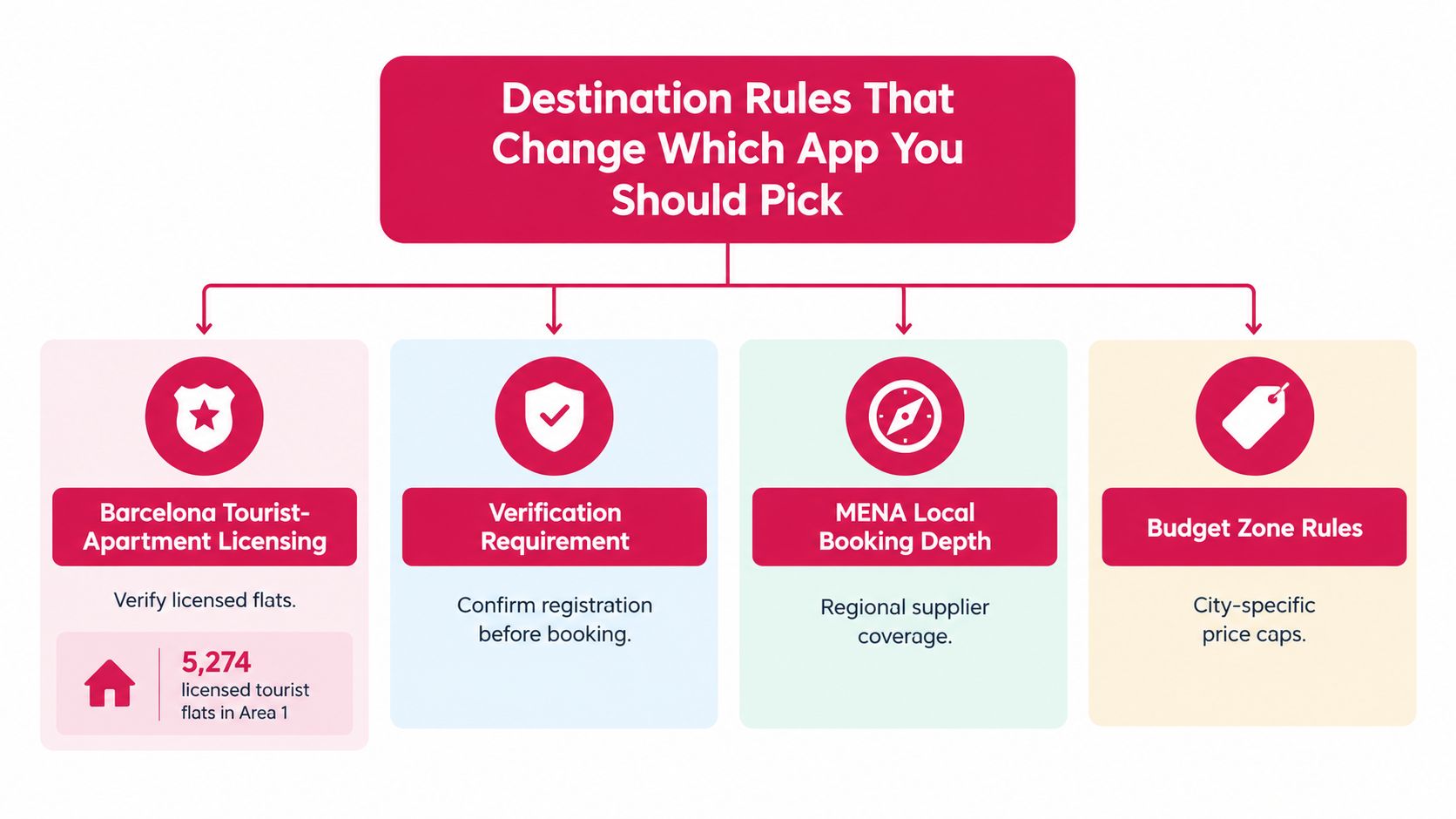
Destination context changes the app's job. A generic activity catalog can show attractive photos, but it won't tell you whether the lodging is licensed, whether occupancy is legal, or whether an evening plan conflicts with local rules.
Barcelona is a clear example. The city defines tourist-use flats as entire properties rented for stays of up to 31 days. They can't be shared with unrelated groups, must hold a municipal licence, and require a certificate of habitability stating the maximum occupancy. Barcelona's official guidance also tells groups to verify that an apartment is legal, respect its occupancy limit, and avoid disturbing residents or other guests. Barcelona's official holiday-let guidance
Barcelona requires verification before enthusiasm
Area matters as well as availability. Barcelona's planning data lists 5,274 licensed tourist-use flats with 32,962 places in Area 1, alongside separate hotel, apartment-hotel, hostel, guest-house, and tourist-apartment capacity. Barcelona's official tourist-accommodation plan Those figures don't make every large apartment suitable for a group. They reinforce the need to compare licensed properties by area, occupancy, and accommodation type.
A serious app should surface the licence status, permitted capacity, and relevant property documentation before the group pays. If it only ranks apartments by photos and distance from nightlife, it pushes the legal and safety work back onto the organizer.
Dubai requires venue and transport discipline
Dubai creates a different constraint. Available legal guidance states that non-Muslim visitors aged 21 or older may drink in licensed hotels, restaurants, bars, lounges, clubs, and beach clubs. Drinking in public or being publicly intoxicated remains prohibited, and the guidance describes zero tolerance for driving with alcohol detected in the system. Dubai alcohol rules and licensed-venue guidance
That means a Dubai itinerary should keep drinking activities inside licensed premises and arrange taxis or other transport. The app should flag age and venue requirements, not just recommend a nightlife district. For Europe and MENA groups, the correct recommendation engine is destination-aware. It understands that "best activity" means best activity that the entire group can attend legally, safely, and comfortably.
Real Use Cases Across Europe and MENA
A tool can look excellent in a feature comparison and still be wrong for your weekend. The deciding factor is the friction that threatens your specific plan.

Barcelona nightlife weekend
The group wants a central base, restaurant reservations, late venues, and a simple way to divide optional activities. The problem isn't a lack of ideas. It's making sure the chosen apartment is licensed, fits the permitted occupancy, and doesn't create conflict with residents.
Verdict: Use MyPerfectStay as the main planning layer if the group needs private voting and bookable experiences, then verify accommodation documentation directly. Use Splitwise for expenses that don't pass through the booking flow.
Marrakech desert escape
The group is split between a desert excursion, a hammam, rooftop dining, and a night out. Energy levels matter because a long transfer and early departure won't suit every guest, while alcohol preferences and dietary needs can affect the evening plan.
Verdict: MyPerfectStay fits the group decision because each participant can state preferences privately and the organizer can compare the overlap. GroupTrip can work if the itinerary is already agreed and the main need is collaborative scheduling.
Lisbon surf trip
Some guests want surf lessons, others prefer food tours or a slower coastal day. The group needs to distinguish essential plans from optional add-ons so nobody feels pressured to pay for an activity they won't use.
Verdict: Choose the planning app with private multi-option voting and component-level booking. MyPerfectStay is the stronger general workflow; TripIt becomes useful after flights and reservations have been confirmed.
Prague budget blowout
The group wants a lively weekend, but budgets vary sharply. A one-price itinerary can exclude someone before the trip starts, so the organizer should offer a core plan plus optional upgrades and show the effect of each choice.
Verdict: Use MyPerfectStay to find an activity package that matches the group, then use Splitwise when people pay different deposits or cover separate extras. For more destination combinations and activity ideas, these bachelor-party trip ideas provide a useful starting point.
The common thread is not the destination. It's the need to separate the shared decision from private financial and comfort constraints. The app wins when it lets the organizer build consensus without forcing anyone to announce that they can't afford, can't access, or don't want the most popular option.
Why MyPerfectStay Wins for Most Europe and MENA Groups
For most Europe and MENA bachelor groups, MyPerfectStay is the strongest general-purpose choice because it handles the part that usually causes the argument: deciding what the group should do before anyone starts booking.
Its private survey collects each traveler's budget, interests, energy level, and must-have ideas without exposing individual votes. The smart voting workflow then identifies overlap and shows match scores, giving the organizer a defensible recommendation instead of another open-ended chat debate. That approach directly addresses conformity pressure, especially when one confident participant normally sets the agenda.
The catalog is another practical advantage. With 300,000+ bookable experiences across 190+ countries, the platform can support the European and MENA city breaks most groups consider, from food experiences and museum visits to desert safaris and yacht cruises. The shared itinerary, instant confirmations, invite links, deadlines, and nudges keep the group aligned after the decision.
The trade-offs are real
MyPerfectStay isn't a replacement for every specialist tool. Splitwise still makes sense for detailed expense settlement, particularly when guests pay for unrelated extras or reimburse one another outside the booking. TripIt remains useful for aggregating independent flight and hotel confirmations. GroupTrip may suit a group that has already made its choices and only needs a shared planning space.
The recommendation rests on the six criteria, not on a claim that one app does everything perfectly:
- Private voting: Strong fit for sensitive preferences and uneven budgets.
- Budget transparency: Better when the group needs optional components and activity-level choices.
- Booking depth: Designed around bookable experiences across relevant destinations.
- Shared itinerary: Keeps confirmed plans visible to everyone.
- Organizer tooling: Reduces manual chasing through links, deadlines, and nudges.
- Mobile flow: Supports the link-first process people use on phones.
The honest conclusion is simple. Pick a specialist when your problem is narrowly defined. Pick MyPerfectStay when the problem is getting a mixed group from “we should do something” to a shared, bookable plan.
Your One-Evening Rollout Plan
Don't give the group another week to debate in public. Set up the process in one evening and make every step produce a decision.
-
Invite everyone with a link. Send one access link with the destination, dates, and a clear response deadline. A link-first flow lowers the barrier because participants can start without creating an account or downloading an app.
-
Ask for private input. Tell guests to complete the survey candidly, especially the budget, energy level, exclusions, and must-have ideas. Keep the request concrete. The survey should take about two minutes, based on the platform's stated workflow, and private completion status lets you nudge only the people who haven't responded.
-
Read the match scores. Look for the option with the strongest combined fit, not just the cheapest or loudest suggestion. Check whether the result respects must-have constraints and whether optional components can protect guests with different budgets.
-
Lock the plan. Confirm the destination activity, meeting point, payment timing, and any accommodation checks. For Barcelona, verify the tourist-flat licence and permitted occupancy. For Dubai, keep alcohol inside licensed premises and arrange transport rather than relying on a drinking guest to drive.
-
Book the full group. Complete the booking once the decision is locked, then check that every participant receives the confirmation and sees the shared itinerary. Keep Splitwise available for costs that sit outside the central booking.
The fastest organizer is the one who defines the decision process before asking for opinions.
Start with the invite tonight. A group that has private answers, a visible match, and a booking deadline has a real plan. A group that has another thread of screenshots has only postponed the argument.
MyPerfectStay combines private group surveys, match-score voting, bookable experiences, shared itineraries, and organizer nudges for bachelor trips across Europe and MENA. Visit MyPerfectStay to turn your group's preferences into a plan everyone can review, lock, and book together.