City Break Itinerary Planner for Group Weekends
October 24, 2026·MyPerfectStay
Most European overnight trips are short breaks, not extended holidays. That changes what a city break itinerary planner should do: help a group agree on what fits, rather than collect more attractions than anyone can enjoy. Before anyone books the headline museum or expensive dinner, settle the pace, the money, and the experiences everyone wants.
Table of Contents
- Why Short City Breaks Need a Planner
- Set the Pace Before You Pick Sights
- Collect Preferences and Vote Fairly
- Budget per Person and Block the Day
- Avoid Crowds and Fragile Routes
- Lock the Plan and Book Together
Why Short City Breaks Need a Planner
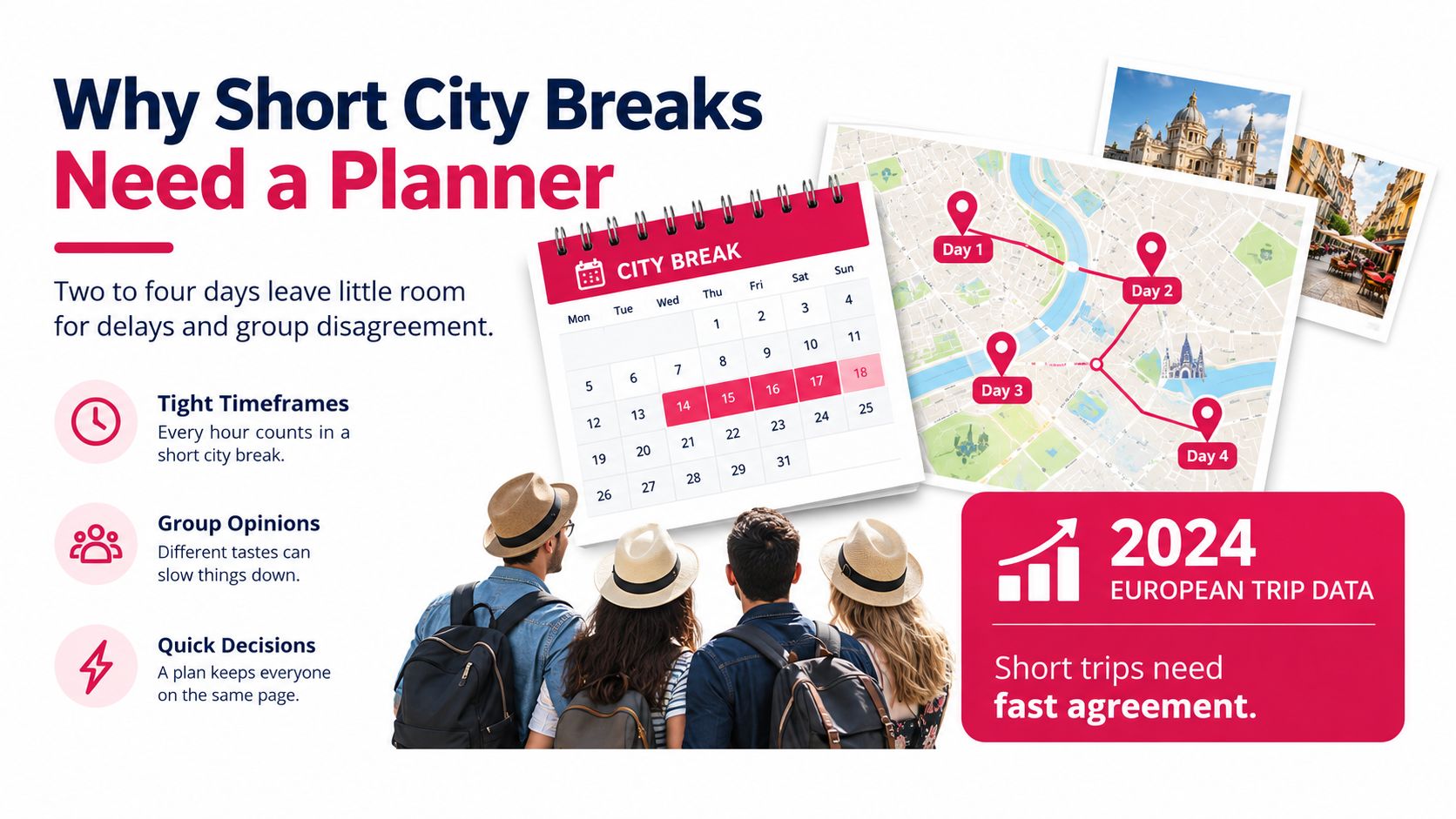
In 2024, EU residents took nearly 1.2 billion overnight trips, spending almost 6 billion nights away; trips of no more than three overnight stays represented 56.3% of tourism trips, the one-to-three-night category accounted for 48.0%, and average stays lasted 3.9 nights domestically versus 7.8 nights abroad, according to Eurostat's tourism trip statistics. These figures cover tourism beyond leisure alone, so they establish the planning context, not a direct measurement of city-break demand.
For a group spending two to four days away, the implication is straightforward: there isn't much usable time to negotiate after arrival. Airport transfers, check-in, meals, and departure arrangements already occupy part of the break.
The compact calendar makes that constraint visible.
Booked flights don't mean an agreed trip
Consider friends heading to Lisbon. Flights are booked, accommodation is confirmed, and the chat contains restaurant screenshots, saved viewpoints, and competing suggestions for the first morning. Nobody has established whether breakfast should be leisurely or whether everyone wants to leave early.
A Dubai team offsite can stall in exactly the same way. Someone assumes evenings are free for activities; someone else needs downtime after work. Both plans sound reasonable until the organizer tries to combine them.
A list records possibilities. A planner exposes conflicts. It should show when a preference requires more money, more movement, or more shared time than the group has agreed to give.
The expensive planning mistake isn't missing an attraction. It's spending your limited time negotiating a decision you could have settled before departure.
Separate the decisions that chat mixes together
Pace, sights, money, and the shape of each day are different jobs. When travelers debate them simultaneously, a discussion about lunch can become an argument about spending, walking, or whether the trip feels too structured.
Language preparation belongs outside that argument too. For groups crossing language barriers, Translate AI's guide to international travel preparation for multilingual adventures is a useful preparation resource to share before practical questions start arriving in the chat.
Don't turn planning into another sprawling research project. Agree on the important constraints, make unresolved choices visible, and stop browsing when the group has enough suitable options. Compact trips need fast decisions and day-by-day plans, not weeks of research.
Set the Pace Before You Pick Sights
Choose the city and its pace ceiling together. A destination can appeal to everyone while the proposed way of experiencing it suits almost nobody.
The scale of demand makes Europe a sensible starting point: EU accommodation recorded 3.02 billion overnight stays in 2024, including 47.2 million in Rome's capital region, 43.2 million in Paris, 41.2 million in Barcelona's tourism region, 32.3 million in Madrid, and 30.4 million in Berlin, according to Eurostat's regional tourism figures. These are accommodation-night measures with regional boundaries, not counts of individual city visitors.
Choose how the group wants to feel
For a first visit to Rome or Barcelona, I'd protect an unhurried block before accepting more sightseeing suggestions. Don't let enthusiasm for famous places become an obligation to keep moving all day.
Returning to Vienna, Prague, Lisbon, or Amsterdam? Give the group permission to trade a famous interior for a neighborhood walk. Use these European weekend getaway ideas to compare the kind of break you want, rather than voting solely on destination photos.
Write down these pace settings and ask everyone to choose:
- Relaxed: Late starts, generous meal breaks, and room to change direction without losing something prepaid.
- Mixed: A structured part of the day balanced with genuine free time. This is my default recommendation for groups.
- Packed: Frequent commitments and limited recovery time. Reject this setting when anyone has mobility limits, small children, or a work block that needs protecting.
A faster subgroup can always add an optional outing. It shouldn't determine the minimum effort required from everyone else.
Apply the same test in MENA
Dubai, Marrakech, and Cairo belong in the destination conversation, but don't copy a European schedule into them unchanged. Check forecast heat, relevant prayer and venue schedules, and actual transfer routes before deciding what a full day means.
For a Dubai trip with couples joining the wider group, Uptown Rent A Car's guide can help you find Dubai date spots for 2026. Treat that as inspiration for an optional pairing, not another commitment everyone must attend.
Energy level is a planning input, not a personality judgment. Ask whether travelers want long outings, recovery time at the accommodation, or evenings that end early. Nobody should have to disclose medical details to justify a slower pace.
Your decision at this stage is deliberately narrow: a city and an agreed ceiling on effort. Don't start assigning attractions to hours until both are settled.
Collect Preferences and Vote Fairly
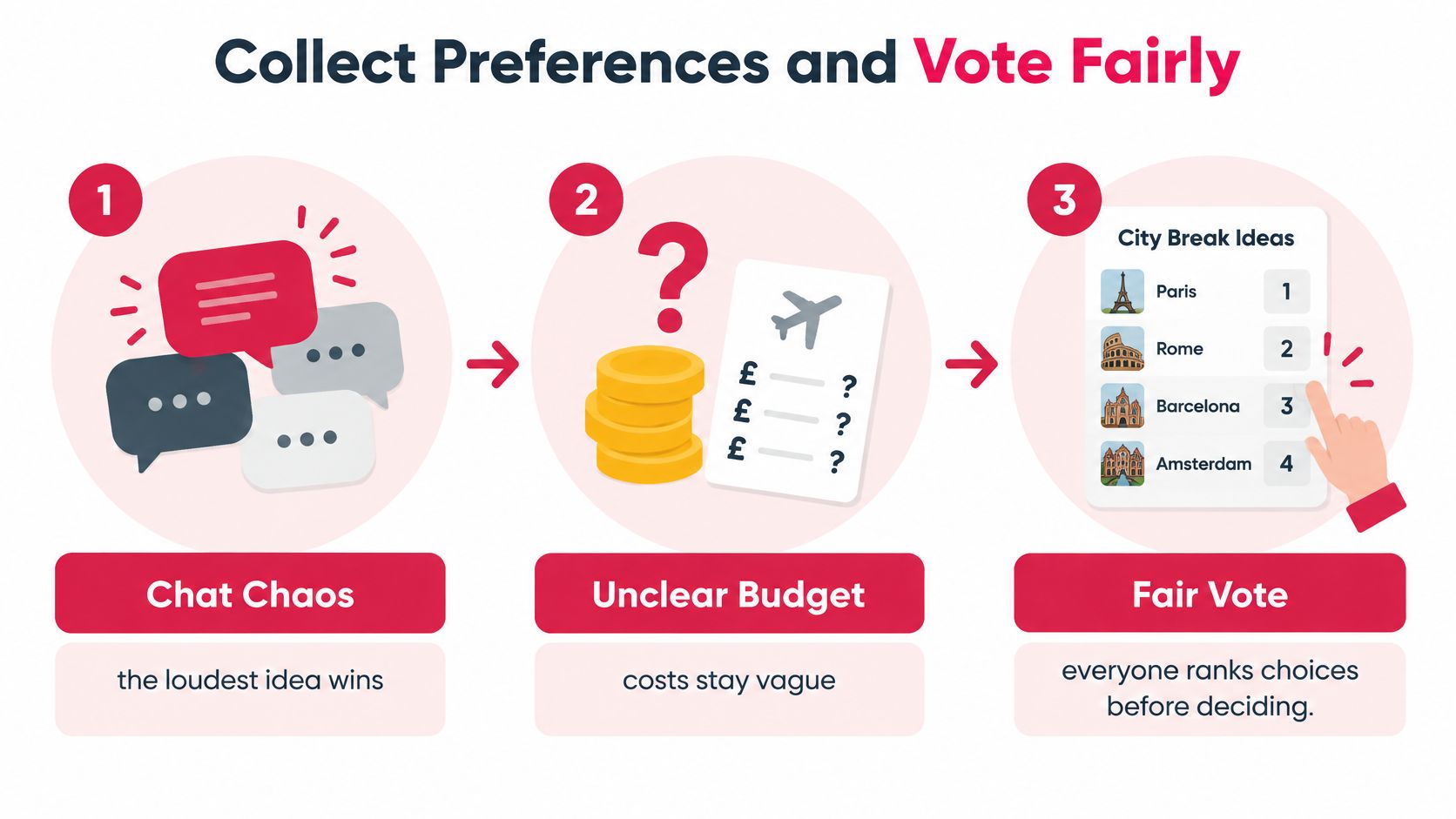
A group chat is useful for enthusiasm and terrible at making preferences comparable. The confident traveler posts an attractive suggestion, someone responds positively, and the organizer mistakes momentum for agreement.
Private answers produce a more useful starting point. Travelers can state what they can afford and how much activity they want without having to contradict a friend in public.
This is the shift from open-ended conversation to a decision everyone can inspect.
Match the tool to the decision
| Tool | Useful job | What the organizer still needs to resolve |
|---|---|---|
| Group chat | Questions, enthusiasm, urgent updates | Comparable preferences and explicit agreement |
| Google Maps | Seeing where suggested places sit | Budget compatibility and group priorities |
| Shared spreadsheet | Recording costs and commitments | Participation and how choices will be ranked |
| Private survey and scored vote | Comparing preferences consistently | Whether the winning options are feasible |
MyPerfectStay is one option for the survey-and-vote approach. Its group-planning platform starts with a two-minute private survey covering budget, interests, energy, and must-sees, then surfaces match scores from 300,000+ bookable experiences across 190+ countries.
No account is required to start. The catalog includes museum tours, food tastings, desert safaris, and yacht cruises, but the relevant shortlist should depend on the destination and the group's answers, not the breadth of the catalog.
Vote on overlap, not confidence
Set a response deadline and send a link invite. Use nudges for missing answers rather than interpreting silence as consent, then let everyone see the same shortlist before locking the winners into the shared daily itinerary.
The survey needs to work on a phone and support quick decisions. In research on Dublin city-break visitors, 65% booked travel online versus 40% of non-city-break leisure visitors, and most city breaks were purchased less than one month before departure. That's a timing lesson from that research, not a current booking forecast for every destination.
If the group disagrees about voting rules, compare these group decision-making methods before voting begins. Decide whether an activity needs broad support or can work as an optional subgroup outing.
The platform walkthrough offers a visual reference for the planning process.
Fairness check: A strong match score doesn't override an individual's spending limit or access requirement.
Don't demand unanimous enthusiasm for every suggestion. Aim for a defensible shortlist: everyone had an equal opportunity to respond, the same options were visible, and no essential constraint disappeared inside an average.
Budget per Person and Block the Day
Build the budget around the traveler, not the group total. A shared total can conceal unequal room costs, different arrival arrangements, and extras that some participants never wanted.
The European Travel Commission's travel-intention research defines trip budget per person as including accommodation, transportation, and travel activities, and identifies four-to-six-night trips as the leading duration category in its monitored markets. For a shorter city break, keep that complete cost view while making the cost of every addition explicit.
Show what each yes costs
Ask each traveler for a ceiling, then reserve a contingency within it for local transport, meals, fees, and price changes. Don't prescribe a universal contingency percentage without checking what's already prepaid and which costs remain uncertain.
Separate shared costs from personal extras. A taxi split among its passengers isn't the same as an optional ticket, and a restaurant reservation doesn't mean everyone has agreed to the same order.
Per-Person City Break Spend Split
| Cost type | What it covers | Treat as |
|---|---|---|
| Accommodation | Each traveler's actual share of the stay | Committed baseline |
| Arrival and departure transport | Flights, rail, transfers, and relevant luggage costs | Essential spend |
| Barcelona museum or Rome guided visit | An agreed timed experience for the sample weekend | Must-pay anchor once approved |
| Local transport | Journeys needed to connect the agreed plan | Essential allowance |
| Meals | Expected food spending, with booking terms checked separately | Protected allowance |
| Marrakech evening outing | Dinner, with any additional experience priced separately | Agreed meal plus optional extra |
| Shopping or additional drinks | Individual choices outside the shared plan | Personal spend |
| Contingency | Uncertain fees, changed routes, or price differences | Uncommitted reserve |
Rank shortlisted activities by preference fit against their total time and cost, including the transfer. Require a fresh yes whenever an addition exceeds a participant's ceiling or the agreed activity intensity.
Give the day a usable shape
Fix flights, timed tickets, and an agreed dinner before filling the gaps. Cluster the remaining choices by a workable walk or short transit journey, checking the actual route rather than straight-line distance.
My recommendation is two or three daily anchors. That's an organizing rule, not a target to fill regardless of arrival times, fatigue, or access needs.
For a sample Barcelona weekend day, a timed museum visit and dinner can provide enough structure. Keep the intervening neighborhood time flexible instead of inserting another prepaid commitment just because there's a gap.
- Protect transitions: Include the walk to the stop, waiting, venue entry, and getting everyone ready to leave.
- Keep additions reversible: Favor flexible options between anchors.
- Publish a fallback: Identify what the group will do if a queue or late train makes the original sequence impractical.
Use these practical group travel tips to agree who tracks payments and booking responsibilities. A usable daily block should survive a disruption without forcing the organizer to renegotiate the entire afternoon.
Avoid Crowds and Fragile Routes
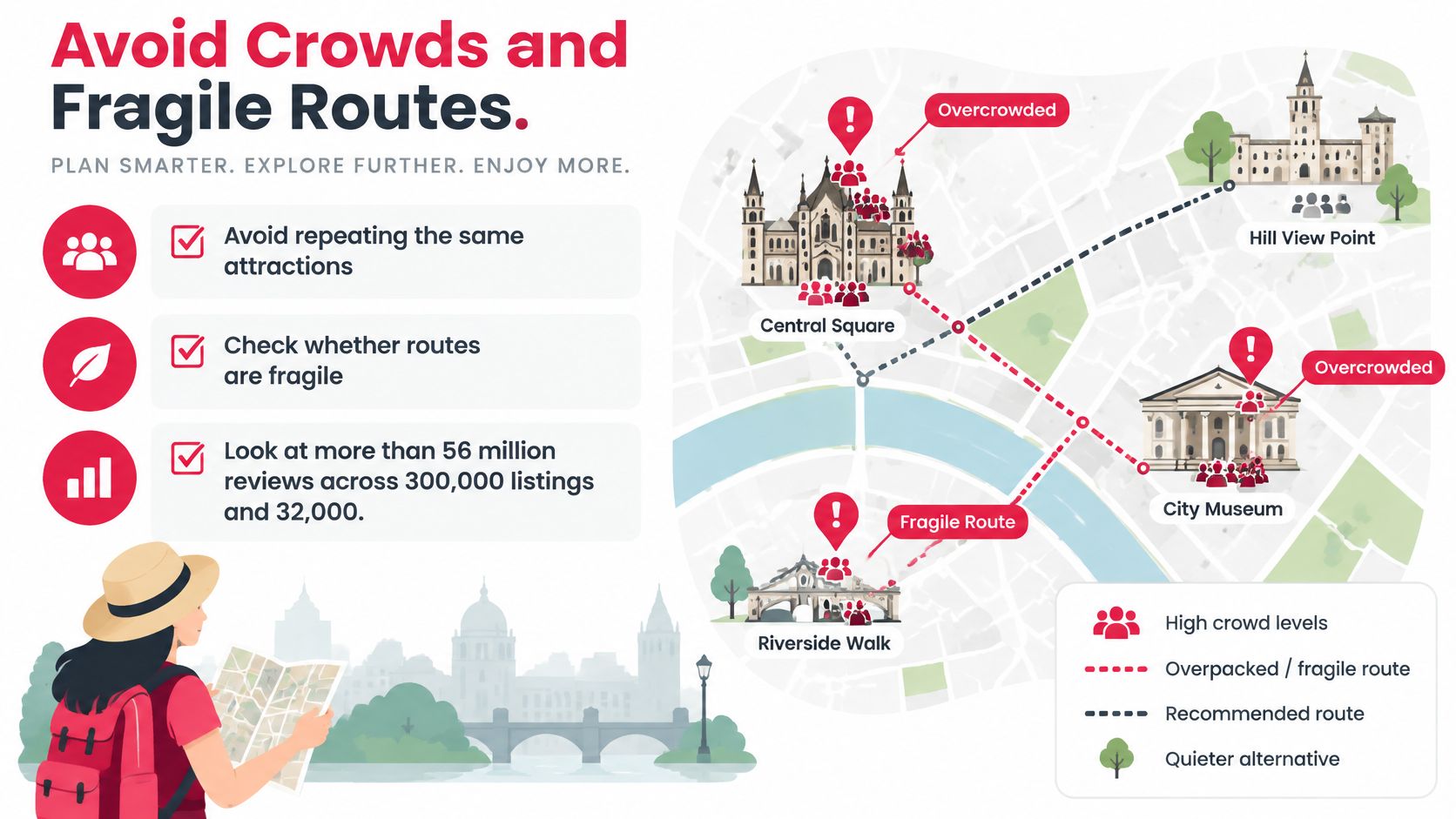
Stop treating a dense cluster of famous attractions as proof of a good itinerary. The group needs worthwhile time together, not a route that looks impressive until everyone reaches the same queue.
An analysis of concentrated experience demand examined more than 56 million reviews across 300,000 experience listings and 32,000 destinations, finding that 50 European cities, under 0.2% of destinations, accounted for nearly half of tour, activity, and attraction reviews; the same report discusses a 2025 study of 1,859 tourists in London, Paris, and Rome in which crowding reduced attractiveness and satisfaction in London and Paris, with differences by city and transport mode, alongside a €2,080 average European holiday budget, €162 above 2023, 47% planning an increase, and city trips representing 28% of preferred holiday types.
Those aren't local queue forecasts or recommended weekend budgets. They provide a reason to scrutinize value instead of assuming that higher spending and more famous stops produce a better trip.
Use this review before declaring the draft finished.
Compare crowding with value
Ask what the group gains from paying more for timed entry. Does the ticket reduce waiting, or merely assign an entry window? Could the proposed visit consume a half-day once transfers and entry procedures are included?
Then compare it with an alternative. A quieter neighborhood in Lisbon or Vienna, or a carefully chosen Marrakech side street, might suit the group's preferences better than another landmark. Don't assume those alternatives will be quiet; check conditions and keep the choice reversible.
Choose the experience, not the famous name. An attraction belongs in the plan because the group values it enough to accept its cost, movement, and crowd exposure.
Check the entire route for access
A venue's accessibility statement doesn't verify the journey there. Check the complete chain from accommodation door to entrance, including the return after travelers are tired.
- Step-free continuity: Verify entrances, station exits, crossings, and any lift-dependent connection.
- Practical facilities: Locate suitable toilets, seating, and rest points.
- Surface and congestion: Check uneven ground, narrow passages, and likely pinch points.
- Sensory load: Ask about quieter periods and provide a lower-stimulation alternative.
- Transfer realism: Allow for the route the traveler can use, not the shortest route displayed.
For journeys involving station changes, Waymap's material on planning accessible journeys through rail interchanges provides relevant context for examining the connection rather than just the destination.
A walkable old town isn't automatically an accessible route, especially when crowds remove the space someone needs to move or rest.
Mark access details as verified, unverified, or unresolved. Assign someone to check unresolved points, keep a rest-heavy backup available, and don't call a route confirmed while a critical connection remains unknown.
Lock the Plan and Book Together
Once the choices are settled, stop inviting fresh inspiration. The organizer's job is now to turn agreement into reservations that match the shared plan.
Open the trip workspace and send the participation link to anyone whose answers are missing. Keep the response deadline visible, close the vote when it arrives, and move the selected experiences into the daily itinerary without reopening rejected suggestions.
Make approval mean something
Review the match scores together, but use the completed cost and access checks as the final filter. Remove anything that failed those checks, even if it attracted enthusiastic votes.
Before payment, ask participants to confirm the details that matter:
- Correct participants: Check who is joining each activity rather than assuming the whole group is attending.
- Correct booking details: Confirm dates, ticket categories, meeting points, and any named-traveler requirements.
- Understood terms: Make cancellation conditions and payment responsibilities visible.
- Visible sequence: Ensure the shared itinerary shows the booked order and the relevant instructions.
For families, this avoids leaving practical information with a single relative. For friend groups and corporate offsites, it gives participants a place to check arrangements without interrupting the organizer.
Locking the plan means agreeing which changes need renewed consent. A corrected meeting-point note isn't the same as replacing an approved activity with a more expensive alternative.
Book from the agreed itinerary
Where the catalog covers the winning experiences, book for the group in one click and use instant confirmations sent to participants instead of forwarding screenshots. Check those confirmations against the itinerary while corrections are still manageable.
Starting doesn't require an account or app download. Full iOS and Android apps are available for managing changes on the move, so travelers who want mobile access can use them without making installation a condition of initial participation.
Hospitality teams can use this same approval moment to attach bookable experiences to a stay in Paris or Dubai. Travel creators planning Barcelona or Marrakech itineraries can also connect recommendations to bookable choices, while keeping optional purchases distinct from the group's agreed commitments.
Don't let a booking tool decide whether an experience is suitable. The organizer remains responsible for checking that the selected listing, departure, participant requirements, and terms match what everyone approved.
Start the survey today and give the group a decision deadline. Once reservations are confirmed, keep the chat for exceptions: a delayed arrival, a changed meeting point, or someone opting out. The itinerary should hold the plan.
MyPerfectStay brings private preference surveys, activity voting, a shared daily itinerary, and group experience bookings into the same planning process. Visit MyPerfectStay, open your city-break trip, and send the survey with a clear deadline before the group chat starts another round of maybes.