Family Vacations in Spain: Planning Guide
October 21, 2026·MyPerfectStay
Planning a family trip to Spain often starts with too many opinions: one person wants a beach week, another wants historic cities, and the children want a pool they can reach without a complicated transfer. Add grandparents with different walking speeds, and the tempting answer is to squeeze everything into one itinerary. Don't. The better move is to choose the right part of Spain for your group, then build a trip around its weather, pace, and transport.
Spain rewards that approach. A coast-and-city break, a cooler Atlantic holiday, and an inland rail trip can feel like entirely different vacations. Match the region to your group before you book flights, and you'll spend less time negotiating logistics once you arrive.
Table of Contents
- Why Spain Works for Every Kind of Family Trip
- Top Family-Friendly Destinations and What Makes Them Work
- Sample Itineraries from 3 to 14 Days
- Activities and Experiences by Age Group
- Accommodation and Getting Around Without the Friction
- Budgeting, Seasonality, and the Heat Question
- Accessibility and Safety Checks Families Often Skip
- Your Pre-Booking Checklist and Group-Planning Workflow
Why Spain Works for Every Kind of Family Trip
The usual family-planning argument is predictable: beach or city, sightseeing or pool, early start or leisurely breakfast. With several generations, these aren't small preferences. They determine whether a day feels manageable or like a relay race between one person's plans and everyone else's energy levels.
Use a four-climate framework to narrow the options. The Mediterranean coast is the classic choice for swimming, beach time, and cities such as Barcelona and Valencia. The Atlantic north, including Galicia and Asturias, is a cooler alternative for families who prefer green scenery and brisk coastal walks to baking afternoons. Inland Spain, including Madrid and Castile, suits museum visits, historic towns, and rail-based trips, but it calls for a different approach to midday sightseeing in hot weather. The Balearic and Canary Islands each offer their own island rhythm, with resorts and beach days playing a bigger role than a city-hopping itinerary.
These aren't interchangeable settings. A toddler who needs regular shade, a teenager eager to explore, and a grandparent who prefers short walks may all do well on one trip, but only if the daily plan fits their different needs. Start with the least flexible traveler, whether that's the youngest child, a relative with limited mobility, or the person who can't tolerate heat. Then choose activities and accommodation around that person's practical limits.
Spain's visitor mix also makes it a natural fit for family travel. The country received 93.8 million international tourists in 2024, up 10.1% from the previous year; visitors from the United Kingdom, France, and Germany accounted for around 46% of arrivals, according to Spain's 2024 international tourism figures. In established tourist areas, families can often manage common travel needs in English, while transport connections make it practical to combine a city stay with a different region.
Choose the climate and pace first. Flight prices and hotel searches come later.
Top Family-Friendly Destinations and What Makes Them Work
Choose destinations by the kind of week your family wants, not by how many famous places you can fit into a map. Catalonia is a strong city-plus-coast option: Barcelona gives adults architecture and museums, while a coastal stay can shift the pace toward swimming and relaxed meals. Families combining city and beach should be deliberate about where they stay, so they aren't spending each day crossing the region.
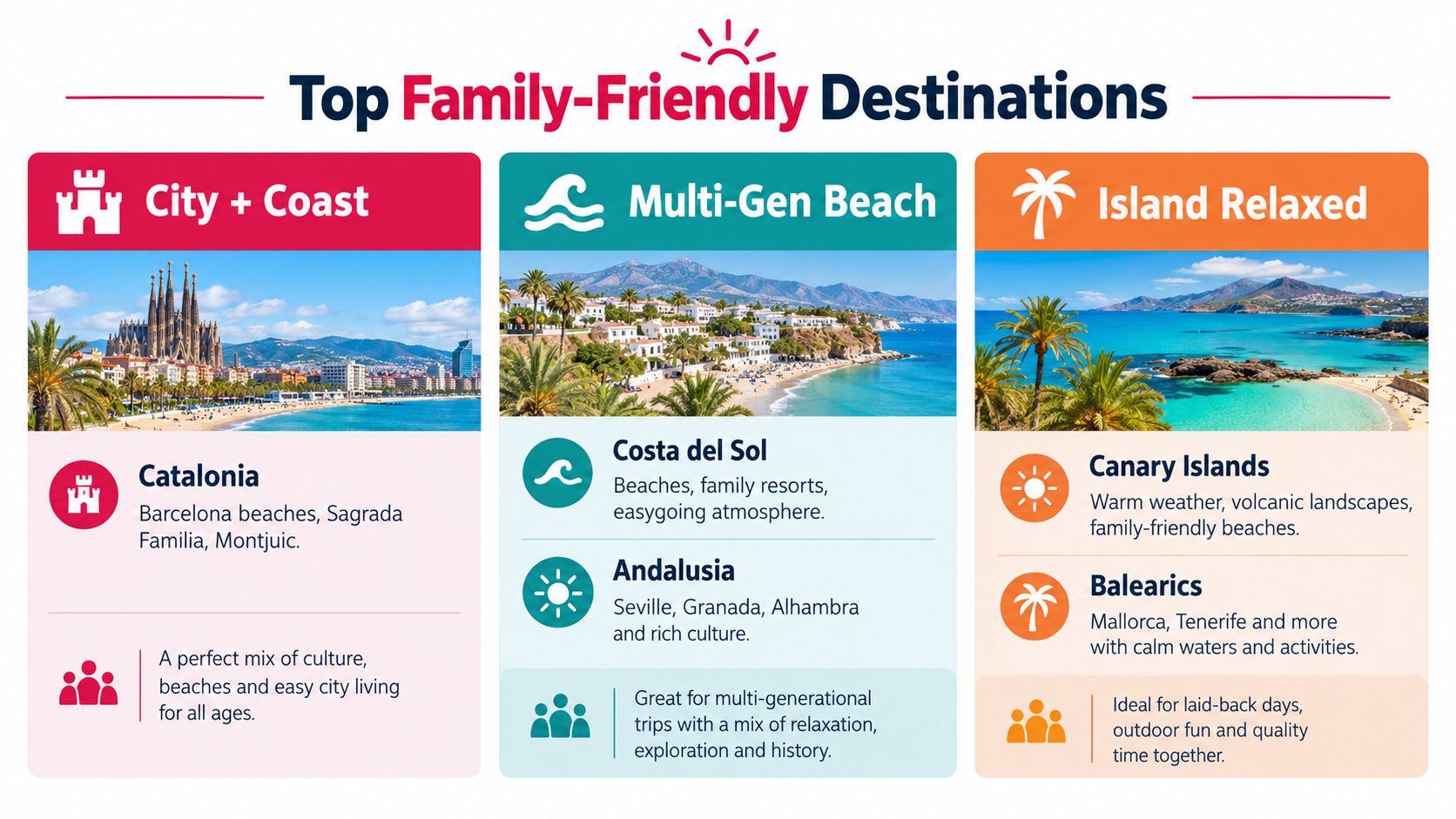
Costa del Sol and Andalusia suit multigenerational groups who want a dependable beach base with cultural outings as options, not obligations. Keep the coastal town as home base and choose one inland excursion, rather than moving hotels to cover Seville, Granada, and the coast. For resort-style logistics, the Balearic Islands can simplify the daily routine: settle into one island base, check the beach access and pool setup, and avoid turning every day into a transfer.
The Canary Islands are worth considering when warm beach weather matters outside the familiar Mediterranean summer window. Galicia and Asturias are the counter-choice for families seeking a cooler-feeling coastal trip; expect a different balance of beach days and weather-flexible outings. Madrid and inland Castile work well as a city-break anchor, particularly for families who want museums, plazas, and a possible day trip without changing hotels repeatedly. Valencia offers a useful city-and-coast mix; look for lodging that makes both the center and seaside practical for your group.
Spain's national parks are appealing nature stops, but don't assume the most popular places will be quiet during school holidays. The parks network recorded about 16 million visits in 2024, with July through September the peak period, according to the national-park visitor report. Go early, check access arrangements, and keep a less crowded alternative in reserve.
| Region | Best For | Peak Months | Signature Activity |
|---|---|---|---|
| Catalonia | City-and-coast combinations | Summer | Barcelona sightseeing followed by a beach stay |
| Costa del Sol and Andalusia | Multigenerational beach weeks | Summer | A coastal base with one cultural day trip |
| Balearic Islands | Resort-based routines | Summer | Beach and pool days from one island base |
| Canary Islands | Island stays beyond the classic summer window | Varies by island and school break | A resort-led beach holiday |
| Galicia and Asturias | Cooler coastal scenery | Summer holidays | Coastal walks and flexible outdoor days |
| Madrid and inland Castile | City breaks and historic towns | Spring and autumn are practical choices | Museums and a day trip |
| Valencia | City-and-beach balance | Summer | A seaside day paired with city time |
Sample Itineraries from 3 to 14 Days
A short trip works best when you choose one base and resist the urge to add another. For a three-day Madrid and Toledo break, stay in Madrid and take the train to Toledo for a day trip. Keep the arrival and departure days light, with a nearby park, café, or easy neighborhood walk instead of a timed attraction. If the group includes very young children, skip the day trip and enjoy Madrid at a slower pace.
For a seven-day Catalonia loop, give Barcelona a few nights, then head by train toward Girona and continue to the Costa Brava. Use Barcelona for city activities, Girona for a slower historic stop, and the coast for swimming and downtime. Keep a rest day at the seaside rather than trying to tour a different town every morning. With younger children, cut the extra stop and spend longer in one coastal base.
A 14-day multigenerational route can connect Madrid, Seville, the Costa del Sol, and Granada. Use trains for the city-to-city legs where the schedule works for your family, then decide whether a rental car is worth the convenience for your coastal and smaller-town plans. Give the group a no-transfer day after several days of moving, and don't book a major attraction for every morning. If your group has less time or small children who struggle with long travel days, leave out one region rather than shortening every stay.
Spanish residents made 155.7 million domestic trips in 2024, roughly 66% more than international arrivals, according to Spain's Tourism Strategy 2030. That scale of domestic travel is useful context: families can plan around established routes and services, but should still verify their own train times, transfers, and lodging location before locking in a multi-stop itinerary.
Practical rule: A rest day is part of the itinerary, not a gap to fill. Put it where the group would otherwise have to pack, check out, and move on.
Activities and Experiences by Age Group
Spain's family appeal isn't limited to the beach. In 2025, international family visitors numbered 26.9 million, or 27.8% of all international visitors, and spent €35.676 billion. Beaches were part of 69.6% of family visits and cities part of 67.6%, according to Spain's family tourism figures. Those figures point to a useful planning principle: many family trips combine outdoor time with urban sightseeing, so plan for both rather than treating them as competing choices.

For toddlers and preschoolers, choose simple pleasures with easy exits: a beach with nearby facilities, a shaded park, or an aquarium visit. Check beach conditions and access before you go, and don't assume every shoreline has calm water or a convenient place to change. School-age children usually do well with a mix of active and hands-on outings, such as a cooking class, a short guided visit to a historic site, or a theme park day. Confirm age requirements, session times, and advance-booking rules directly with each operator.
Teenagers can handle longer city walks and deeper cultural visits, but they'll enjoy them more if they get a say in the day's focus. Pair an architectural visit with free time for food or shopping, or book a flamenco performance that suits the group's schedule. Grandparents may appreciate the same outing if there's seating, shade, and an easy route back to the hotel.
A reliable mixed-age day has three acts: outdoors early, an indoor break around midday, and a short evening outing when the family has rested. For example, swim in the morning, visit a museum or return to the hotel during the hottest part of the day, then take a leisurely evening walk for dinner. Browse more options for experiences in Spain, then book the activities that fit your group rather than filling every open slot.
Accommodation and Getting Around Without the Friction
Book the apartment over the resort room. That one decision removes half the daily friction of a Spain trip with children: breakfast happens when your family wakes up rather than when the buffet opens, and a washing machine cuts the luggage you need to haul. Whatever you book, prioritize the details that shape every day over the ones that photograph well: an elevator that fits your stroller, real shade at the pool, and a layout where a napping toddler doesn't silence the whole group. Ask about pool depth, pharmacy distance, and grocery access before you commit.
Location priorities should also match which Spain you've chosen. On the Mediterranean coast, walking distance to the water earns its price premium. In inland cities like Madrid or Seville, reliable air conditioning and a short route back for the midday break matter more than a rooftop view. In the Atlantic north, secure parking and flexible cancellation count for more, since plans there bend with the weather.
For transport, compare the full door-to-door plan, not only the ticket price. Renfe's child rules vary by service: children under 14 get a 40% discount on AVE, long-distance, Avant, and Spain–France international trains when they occupy their own seat. Children aged 0–3 can travel free without a seat, though a free child ticket may still be required on some services. Check Renfe's child-fare conditions before booking.
| Service | Under 4 | Ages 4–13 | Group Offer | Notes |
|---|---|---|---|---|
| AVE, long-distance, Avant, Spain–France international | Free without a seat, subject to ticket requirements | 40% discount with own seat | Covered in the pre-booking checklist below | Check service-specific conditions |
| Madrid Cercanías | Free for children under six, with limits | Check current service rules | Not specified here | Confirm conditions before travel |
| Catalonia Rodalies | Free for children under four | Check current service rules | Not specified here | Confirm conditions before travel |
| Avlo | €5 child fare under stated conditions | €5 under 14 with a qualifying adult Basic Fare ticket | Separate scheme; see checklist below | Limited to two qualifying child tickets per adult Basic Fare ticket |
Avlo's child fare carries one booking condition first-timers regularly miss: the €5 fare for a child under 14 requires an accompanying adult with a Basic Fare ticket and is capped at two qualifying child tickets per such adult. Check the Avlo fare terms before comparing a rail itinerary with driving. Traveling as a bigger party? Group fare options for parties of four to nine are covered in the pre-booking checklist below.
Budgeting, Seasonality, and the Heat Question
Spain isn't one uniform summer destination. The Mediterranean coast, Atlantic north, inland plateau, and islands each call for different timing, and the right month depends on your tolerance for heat, your children's school calendar, and how much beach time matters. Don't assume a northern coastal holiday will feel like a Mediterranean resort week, or that a city itinerary will be comfortable at the same hours as a day by the sea.
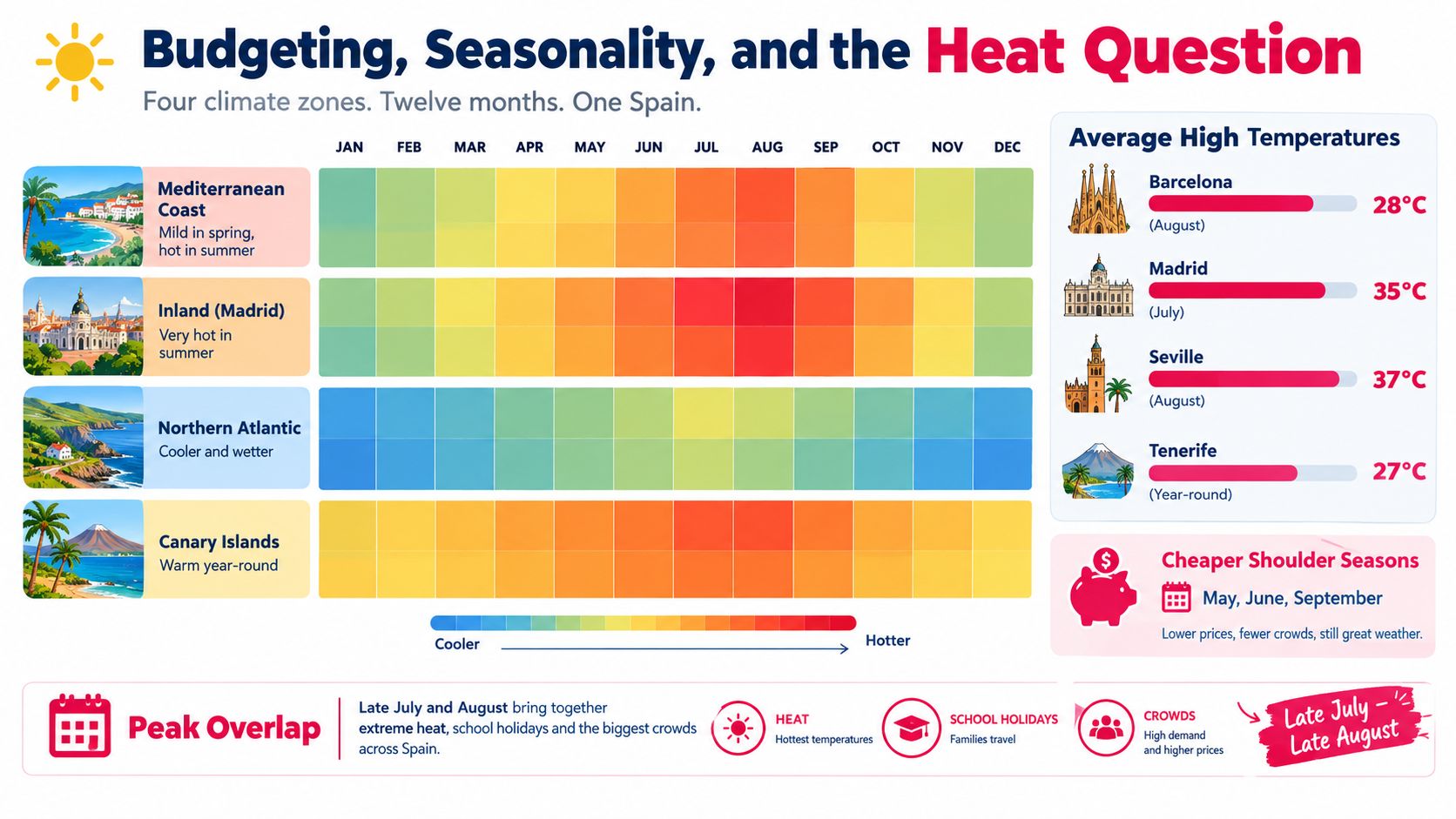
| When to Go | Mediterranean Coast | Atlantic North | Inland Cities | Islands |
|---|---|---|---|---|
| Spring | Good for sightseeing with time outdoors | A cooler option; plan for changeable weather | Build in indoor breaks | Consider for a beach-focused stay |
| June | Often a useful compromise for beach and city time | Suits families looking for coastal walks | Keep midday plans light | Check local conditions for your exact island |
| July and August | Beach appeal comes with peak-season pressure | Can suit families avoiding intense inland heat | Schedule around the hottest part of the day | Expect demand around school holidays |
| September and October | Consider for a quieter-feeling coastal break | A flexible option if your family accepts variable weather | Better suited to walking and sightseeing than midsummer | Check swimming and service availability |
Late July and August can bring the most difficult overlap for families: school holidays, heat, and busy attractions. Choose early beach time, reserve indoor activities for the middle of the day, and keep the evening plan simple. For national parks, treat the summer peak as a reason to start early or choose a less-visited alternative, not as a guarantee that every trail will be crowded.
Don't budget from a national average that doesn't reflect your family's travel style. Spain's international tourist expenditure reached €126.282 billion in 2024, but that total isn't a per-person family budget; it can't tell you what your accommodation, meals, or transport will cost. Set a daily target from actual lodging and transport quotes, then add meals, tickets, and a reserve for changes. For a practical planning framework, use this family vacation budgeting guide.
Accessibility and Safety Checks Families Often Skip
A hotel can describe itself as accessible and still leave your family facing an impractical route to dinner. Historic streets may have uneven surfaces, narrow sidewalks, or steep sections, and small towns can offer fewer accessible transport options. U.S. travel guidance says Spanish law prohibits disability discrimination and notes broad accessibility across public infrastructure, while also flagging these route-level and small-town limitations in its Spain accessibility and travel guidance.
Before you pay a deposit, work through this checklist:
- Confirm the room route. Ask whether the entrance, room, bathroom, and breakfast area are step-free, and request elevator dimensions if a mobility aid or large stroller must fit.
- Map the walk. Check the actual pavement, gradients, and crossings between your lodging and the places you expect to visit.
- Arrange transport. If you need an accessible taxi, book ahead rather than assuming one will be available when you arrive.
- Plan for heat and rest. Schedule water breaks and shaded stops, especially for children and older relatives.
- Check local support. Before staying in a smaller town, identify where you'll seek medical help and whether you can communicate your needs there.
For a group split across several locations, agree on a simple check-in plan so nobody has to guess whether a relative has reached the next stop. A family can compare live location family monitoring picks while deciding what suits its privacy needs and travel routine.
Your Pre-Booking Checklist and Group-Planning Workflow
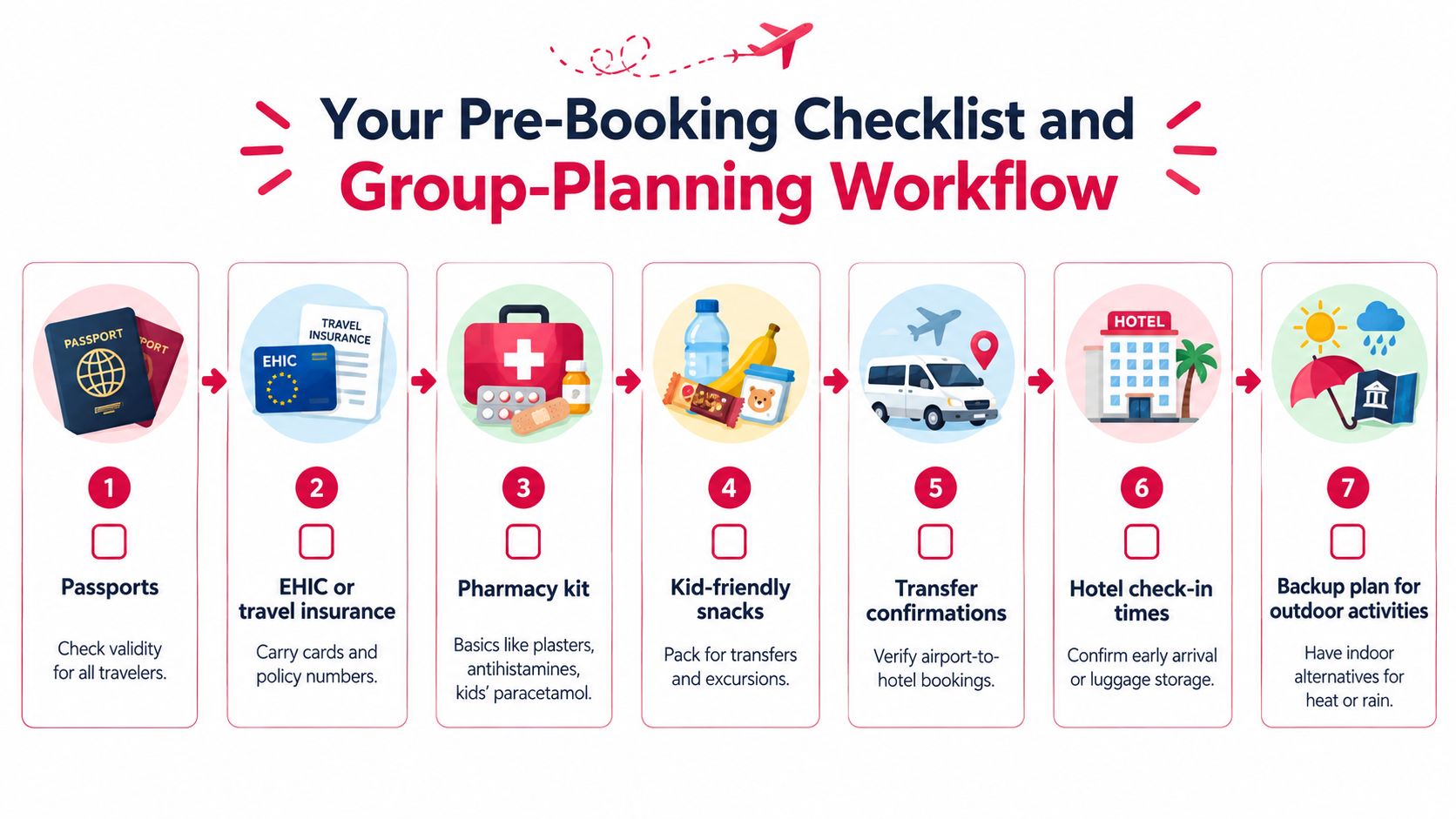
One family I worked with lost an entire afternoon in Seville because nobody confirmed the apartment's check-in window closed at 8 p.m. The details that wreck trips are rarely the dramatic ones. Handle the boring items first: passports, travel insurance or EHIC cards, any medication you would struggle to replace abroad, and transfer confirmations. Pack familiar snacks for travel days, verify hotel check-in times, and ask about luggage storage if you land before your room opens. For every outdoor day, name an indoor alternative before the weather forces a last-minute scramble.
Then settle the decisions that shape everything else. Spain is four climates in one country, so choose your month and region as a pair rather than picking a city first: the green north in July, the Mediterranean coast in June or September, Andalusia in the mild spring weeks. Decide whose needs set the pace, and whether one base or several suits your group. If you are booking rail tickets for a larger party, look at the group fare options covered in the transport section before buying seats individually.
Finally, retire the endless group chat. A shared shortlist lets relatives weigh Toledo against Segovia before anyone commits to a day trip, and this family group decision-making guide lays out a clean way to structure that conversation. Lock the month first. Once the season and region are fixed, flights and accommodation practically choose themselves.
MyPerfectStay helps families collect private preferences, vote on activities, and organize agreed plans into a shared itinerary. Use MyPerfectStay to compare ideas for your Spain trip and make the first group decision together.