Food Tasting Tours: The Group Travel Guide
September 29, 2026·MyPerfectStay
You're in the group chat again. One person wants a long dinner, another wants street food, someone needs gluten-free options, and two people are checking prices before agreeing to anything. The itinerary is ready to book, but the restaurant decision has stalled the entire trip.
Food tasting tours can remove that bottleneck when you treat them as group-planning infrastructure, not just a fun afternoon activity. A well-designed route gives everyone several smaller decisions instead of one high-stakes dinner choice, while a guide manages the bookings, timing, venue changes, and local context. The result is often easier to coordinate and more socially balanced, provided the format matches the group.
Table of Contents
- Why Food Tasting Tours Solve Group Travel Friction
- Choosing the Right Tour Format for Your Group
- The Hidden Mechanics of a Memorable Tasting Route
- Aligning Group Preferences and Dietary Needs
- Top European and MENA Destinations for Culinary Walks
- Packaging Tasting Routes for Hotels and Creators
- Your Action Plan for Booking the Perfect Group Tour
Why Food Tasting Tours Solve Group Travel Friction
A group dinner looks simple until you try to book one. Large tables need advance planning, restaurants may offer limited substitutions, and the person coordinating the reservation ends up negotiating price, cuisine, location, and timing in one conversation. Even after the booking is made, a fixed menu can leave one guest hungry, another uncomfortable, and a third wondering why the meal consumed the evening.
A tasting route spreads that pressure across several stops. One bakery, market counter, family-run café, cheese shop, or traditional restaurant can each contribute a small part of the experience. Guests get variety without committing the whole group to one menu, and the guide handles the movement between venues.
Practical rule: Choose a route that gives the group variety without forcing every guest to eat every item.
That structure also creates a natural social anchor. People walk, compare flavors, ask questions, and regroup between tastings. The activity keeps conversation moving more easily than a long table where the same few people dominate discussion. For friend groups, that matters as much as the food. For families, it lets guests pause without making the entire party wait through a formal meal.
The planning advantage is strongest when the organizer separates shared experiences from individual consumption. Ask the operator whether guests can skip a sample, receive an alternative, or purchase additional portions independently. Confirm how the route handles allergies, religious dietary requirements, mobility needs, and non-drinkers before anyone pays.
For the group itself, replace open-ended chat with a defined decision process. A short guide to group decision-making can help the organizer establish who votes, which preferences are essential, and when the decision closes. Once those rules are clear, a food tour becomes a reliable itinerary block instead of another debate.
Choosing the Right Tour Format for Your Group
The wrong format can make a good destination feel exhausting. A fast street-food walk may delight energetic friends and frustrate grandparents, while a seated multi-course tasting may suit a reunion but bore a corporate team that wants interaction. Start with the group's physical pace, meal expectations, and appetite for participation.
| Tour Format | Best For | Pacing & Accessibility | Budget Tier |
|---|---|---|---|
| Street-food walk | Energetic friends, city-break groups, adventurous couples | Fast movement, standing, uneven streets, limited seating | Usually lower to mid-range |
| Multi-course tasting | Families, celebrations, groups seeking a structured meal | Slower, more seated, easier to plan around dietary substitutions | Mid to premium |
| Market tour | Curious travelers, photographers, mixed-interest groups | Flexible pace, crowded aisles, variable seating | Lower to mid-range |
| Cooking-and-tasting class | Corporate teams, reunions, groups that enjoy collaboration | Station-based activity, usually less walking, check accessibility of the kitchen | Mid to premium |
Match the route to the group's energy
For a high-energy weekend in Barcelona, a street-food route through several neighborhoods can work well if guests are comfortable walking and snacking rather than eating a conventional lunch. Build in water breaks and avoid scheduling another demanding activity immediately afterward. A route that starts near the hotel also reduces the risk of late arrivals disrupting the first stop.
Multi-generational families generally need more control. Look for shorter walking distances, guaranteed seating, nearby toilets, and a clear plan for guests who want to rest. A structured tasting with fewer venue changes often works better than a route that promises a long list of stops. Ask whether the guide can keep the party together without making older or younger guests feel hurried.
Think about the social objective
A market visit is ideal when the group wants freedom. Guests can browse, photograph ingredients, and choose which conversations to join, but the organizer should confirm where the group will regroup. Markets can become chaotic when the guide has no visible meeting point or when vendors serve at different speeds.
Cooking classes create a different kind of connection. Corporate groups and startup teams often benefit from assigned stations, shared tasks, and a meal they assemble together. The trade-off is that the experience depends heavily on the instructor, kitchen layout, translation quality, and hygiene practices. It's less suitable for guests who want to relax without handling food.
Check what the price actually includes
A low headline price may exclude drinks, premium samples, transport, or a full meal. A premium package may be worthwhile if it reserves seating and removes coordination work, but don't pay for extras that divide the group. Ask for the exact inclusions, cancellation terms, walking distance, maximum party size, and substitution policy before comparing offers.
The Hidden Mechanics of a Memorable Tasting Route
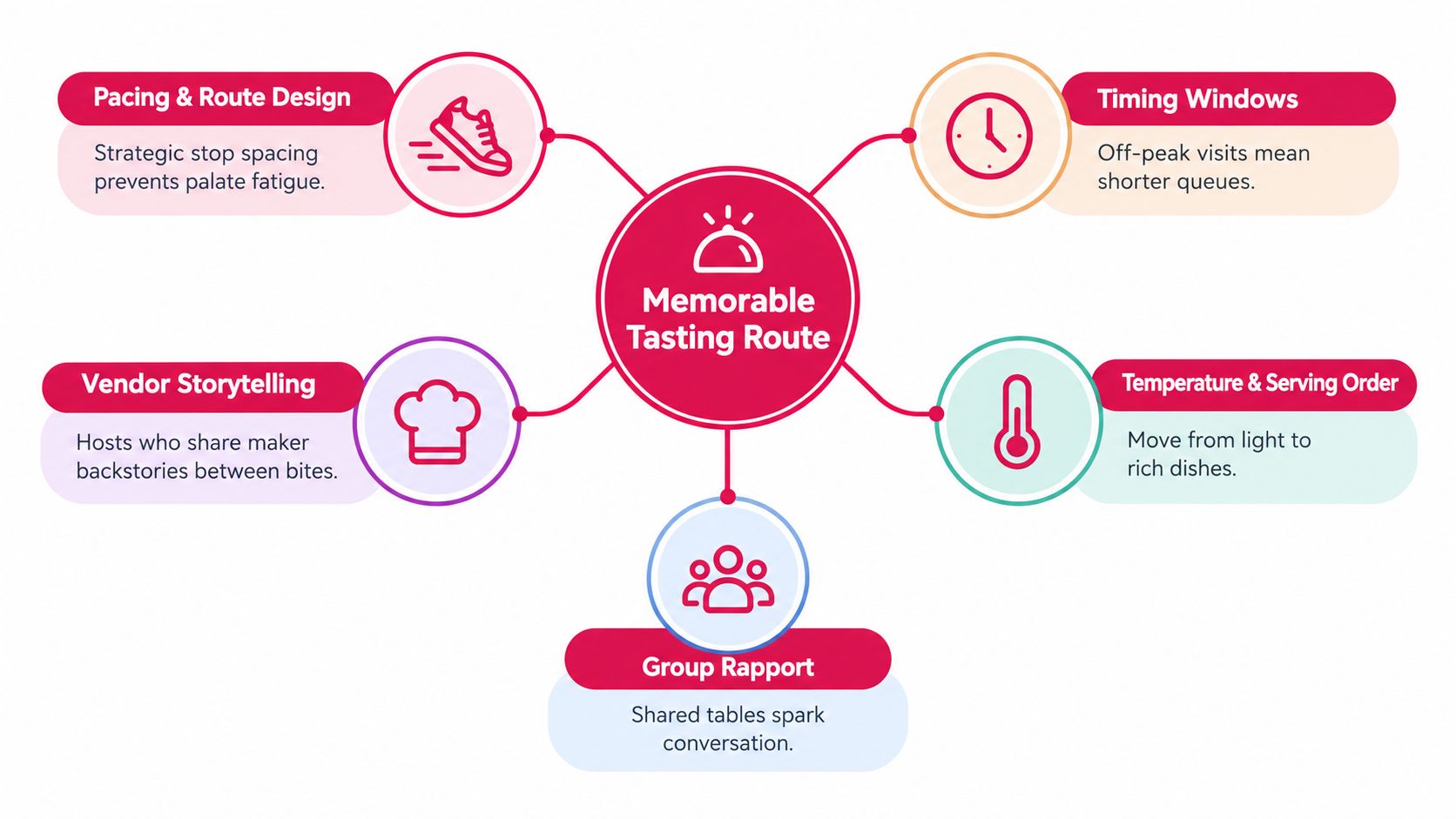
A memorable route is engineered around attention, comfort, and anticipation. The best operators don't just move guests from one popular venue to another. They sequence flavors, vary the setting, introduce makers or vendors, and leave enough time for people to talk.
A 2026 PLOS One study of food sensory experience, based on 447 food tourists in Zibo, China, found significant positive effects on tourist engagement across sight, smell, taste, and touch. Its strongest reported relationships were with feedback intention, β = 0.480, p < 0.001, and revisit intention, β = 0.411, p < 0.001 (study on multisensory food experiences). The study also identified food memory and mental imagery as parallel mediators.
That finding has a practical implication for group coordinators. A tasting should give guests something to see, smell, handle, and remember, not just a succession of anonymous bites. In Lisbon, for example, a guide might connect a pastry to neighborhood history, show an ingredient at a market stall, and explain how a family business prepares it. The story becomes a shared reference point long after the stop ends.
Audit the environment, not just the menu
The service setting can decide whether a route feels generous or chaotic. Cleanliness, noise levels, and room temperature shape how guests judge each stop, and the quality of service often matters as much as the food itself.
Before booking, ask the operator:
- Noise: Can the guide be heard clearly, and are any stops likely to be crowded?
- Pacing: How long does the group spend walking, standing, and waiting between tastings?
- Serving order: Does the route move from lighter flavors to richer dishes?
- Seating: Is there enough seating for guests who need regular breaks?
- Vendor contact: Will guests meet the maker, or only receive food at a counter?
- Contingencies: What happens if a vendor closes or the weather changes?
Temperature, queue length, and serving order can subtly change the experience. A hot dish served after a long wait may feel disappointing, while a rich item too early can dull interest in later tastings. Off-peak scheduling often gives guides more room to explain ingredients and keeps the group from blocking a narrow counter.
A route earns its place in the itinerary when the group remembers the people, place, and sequence, not only the quantity of food.
Aligning Group Preferences and Dietary Needs
Dietary planning should happen before you compare tour operators. Asking “Does everyone eat everything?” in a group chat produces incomplete answers, especially when guests feel awkward describing allergies, religious requirements, budget limits, or foods they naturally dislike.
Use a private survey tool, shared form, or structured spreadsheet. MyPerfectStay is one option that lets travelers submit private preferences covering budget, interests, energy level, and must-see ideas, then uses match scores to surface overlapping choices. The same process can work with other planning tools, as long as the organizer captures individual requirements rather than relying on public chat replies.
Follow a five-step preference process
-
Collect private information. Ask each guest about allergies, vegan or vegetarian diets, gluten-free needs, halal requirements, alcohol preferences, walking tolerance, and maximum spend. Include a free-text field for concerns people may not want to post publicly.
-
Separate hard requirements from preferences. A severe allergy is not equivalent to avoiding an ingredient by choice. Mark safety-related needs as absolute and treat favorite cuisines, preferred neighborhoods, or drink options as flexible.
-
Cluster the group. You may find that several guests share a low-spend preference, while others prioritize premium venues. Grouping similar requirements helps you evaluate tours without pretending that every traveler has identical priorities.
-
Score each option against the profiles. Review the menu, route, timing, accessibility, and price. A tour with fewer tastings may score higher because it offers dependable substitutions and a comfortable pace.
-
Confirm directly with vendors. Written confirmation matters. Ask who prepares the alternative, whether cross-contact is possible, and whether the substitution changes the serving sequence. Don't rely on a generic “we can accommodate dietary needs” statement.
Make the compromise visible
A fair decision doesn't mean every guest gets a perfect menu. It means everyone understands which requirements shaped the booking and which preferences were traded off. Share the final route, included tastings, exclusions, meeting point, walking expectations, and backup meal options before the cancellation deadline.
In Marrakech, a group may prioritize a souk route with halal-friendly dishes and manageable crowd exposure. In Paris, another group may accept a pastry-focused itinerary but need a separate savory meal later. The right answer depends on the overlap, not on the destination's reputation alone.
Top European and MENA Destinations for Culinary Walks
The most famous food cities aren't automatically the strongest choice for a group. A central route may offer iconic dishes but also crowded pavements, long queues, and prices shaped by visitor demand. A neighborhood-focused itinerary can provide better conversation, more personal vendor contact, and a clearer sense of local identity.
Europe deserves particular attention. One market estimate places Europe at 28.4% of global food-tour operator revenue, second only to Asia Pacific, with Italy, France, Spain, and Portugal as its major markets (food-tour operator market overview). That makes destination-led planning around cities such as Paris, Barcelona, Rome, and Lisbon especially relevant.
Match the destination to the route concept
Barcelona works well for groups that want a market-and-neighborhood structure. Pair a market visit with small savory bites, regional sweets, and a slower stop where the guide can explain Catalan food traditions. Avoid packing the route with distant neighborhoods. The best group route usually protects time for conversation rather than chasing every famous address.
Rome suits groups that prefer recognizable food with plenty of cultural context. A route can combine bread, pasta, cheese, cured products, and a final sweet stop, but organizers should ask how much walking takes place on cobbled streets. Smaller venues may create a better experience than a checklist of city-center landmarks.
Lisbon offers strong variety within a relatively compact culinary story. A group might explore Mouraria, sample cod preparations, taste local cheese and wine, and finish with pastel de nata. A neighborhood route can also expose travelers to food traditions that aren't limited to the most photographed squares.
Paris is a natural fit for pastry, cheese, bread, and market-led experiences. It's less suitable for a group that expects a full replacement for lunch unless the operator clearly includes savory portions. Confirm seating and the number of standing tastings for older guests.
Dubai gives planners a broad menu of market, Emirati, Levantine, South Asian, and premium dining experiences. The heat makes indoor routes and carefully timed transfers more practical than long outdoor walks. For groups with mixed budgets, compare cultural tasting routes with high-end food-and-beverage packages rather than assuming luxury is the only option.
Amman works for groups interested in shared plates and regional context. A route can combine traditional dishes with bakeries, coffee, and market stops, but organizers should check walking surfaces, vehicle access, and how the operator handles dietary substitutions.
For a destination with a particularly layered street-food identity, use a focused guide to food tours in Istanbul when comparing neighborhoods, formats, and booking options. Istanbul can reward groups that choose one area and explore it thoroughly instead of attempting to cover the whole city in one afternoon.
Treat compliance as part of the product
EU food hygiene rules apply broadly to food businesses under Regulation (EC) No 852/2004, while destinations can add local requirements. Spain may require a food-handler certificate, and Italy may require an SAB certificate for food service, so operators should align tastings and vendor stops with destination-specific obligations (food-tour compliance overview).
Don't ask only whether a tour is “authentic.” Ask how vendors are selected, how food is transported or served, and what happens when a stop can't accommodate an allergy. For groups, operational credibility is part of value.
Packaging Tasting Routes for Hotels and Creators
Hotels often treat food tours as concierge suggestions. That leaves revenue, differentiation, and guest convenience outside the property's bookable experience. A better approach is to package a vetted route as an optional add-on tied to the guest's arrival date, neighborhood, room type, celebration, or group itinerary.
The product doesn't need to be complicated. A hotel might offer a market walk for families, a pastry route for couples, or a private neighborhood tasting for a corporate retreat. Each package should state the duration, meeting point, walking level, dietary process, inclusions, cancellation terms, and whether the tour replaces a meal.
Build a dependable operating layer
The hotel needs a direct contact at the operator, a backup plan for closures, and a clear responsibility split. Decide who confirms guest numbers, who collects dietary information, who handles refunds, and who answers late arrival questions. Front-desk staff should have a one-page reference rather than a collection of informal recommendations.
The commercial opportunity is easier to manage when the experience is treated as inventory. European tourists often use online travel agents to book food experiences (CBI market-entry guidance for food tourism), while one market estimate reports that direct bookings still held 62.96% of culinary-tourism revenue in 2025 (Grand View Research culinary tourism report). Both channels matter, and the practical lesson is the same: travelers expect culinary experiences to be discoverable and bookable wherever they plan.
Creators can apply the same principle through destination guides, itinerary pages, newsletters, and affiliate deep links. The content should solve a planning problem, not merely display attractive dishes. Compare routes by neighborhood, accessibility, dietary fit, group size, and meal replacement value, then send readers to a booking path that preserves those details.
For partner-focused distribution and experience packaging, hospitality businesses and creators can review MyPerfectStay's partner information. The important test is whether the booking flow gives guests clear confirmation, reliable payment handling, and an itinerary they can easily follow.
Your Action Plan for Booking the Perfect Group Tour
Start with the group, not the destination page. Collect private preferences, separate hard dietary requirements from casual dislikes, and set a deadline for responses. Without a cutoff, one undecided guest can keep reopening the discussion.
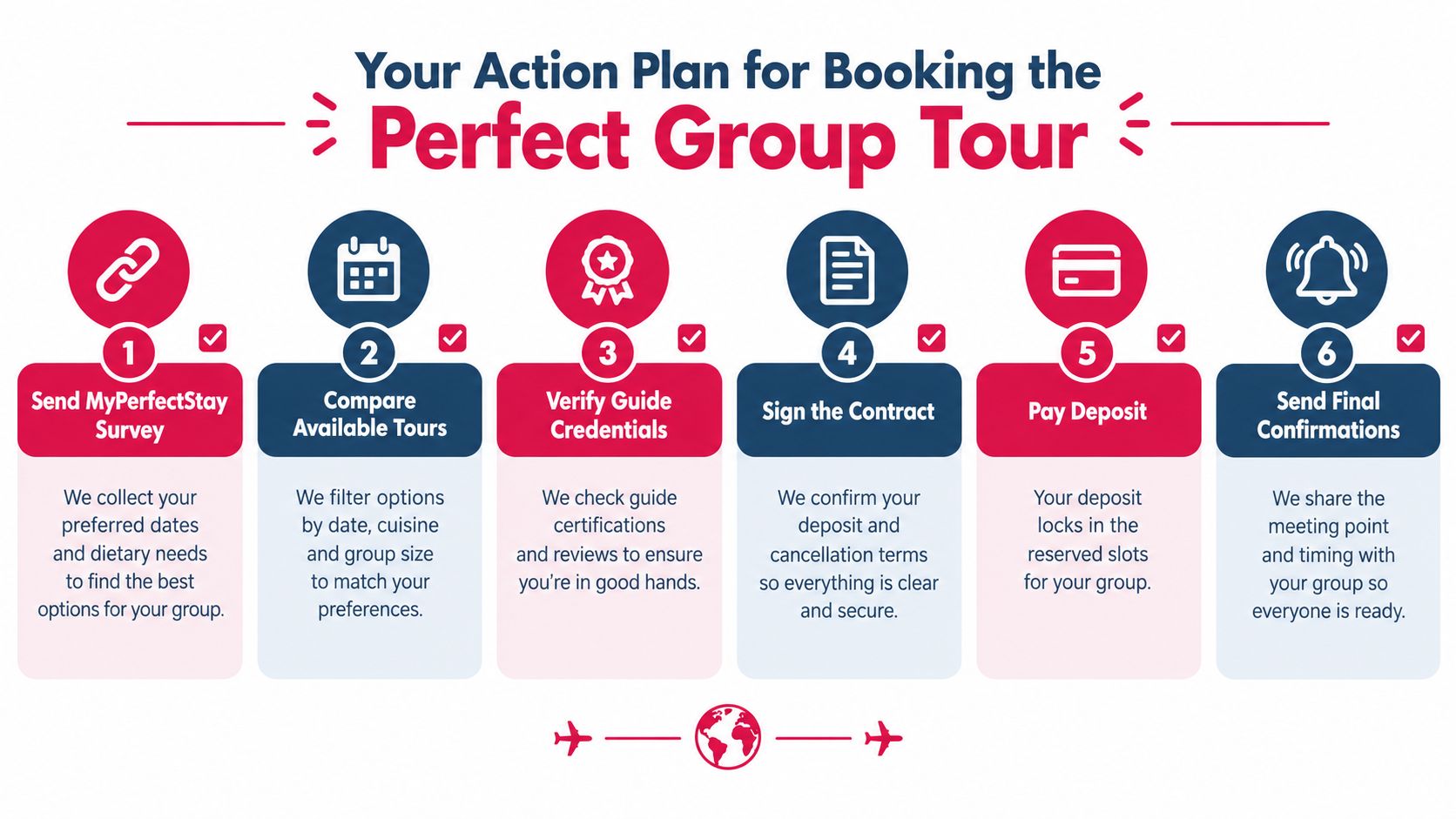
- Send the survey: Gather dates, budget, energy level, interests, and dietary needs.
- Compare formats: Filter street-food walks, market tours, seated tastings, and classes by fit.
- Verify the operator: Check guide credentials, reviews, accessibility, substitutions, and hygiene practices.
- Confirm terms: Record deposits, cancellation rules, meeting points, and vendor responsibilities.
- Reserve the places: Pay the required deposit only after the group understands the commitment.
- Distribute the plan: Share timing, clothing guidance, included tastings, transport details, and a late-change contact.
Use organizer nudges for missing responses and keep one backup option for weather or vendor changes. A shared itinerary prevents guests from relying on different chat messages.
MyPerfectStay helps groups collect private preferences, compare bookable food experiences, vote on the options that fit, and keep the final route in a shared itinerary. Visit MyPerfectStay to start organizing your next group food tour without another endless restaurant debate.