Group Booking Cruise: A Practical Planner's Playbook
October 9, 2026·MyPerfectStay

You've got the family thread open, the cabin options are half-decided, and someone has just asked whether the Rome sailing should start in Barcelona or Civitavecchia. That's usually the moment a group booking cruise stops being a fun idea and turns into an operating problem, because a group cruise compresses a lot of moving parts into one embarkation date, one name list, one payment calendar, and one shared expectation of what everyone thinks was promised.
The market is big enough to justify that level of discipline. CLIA says global cruise lines carried 34.64 million passengers in 2024, up from 31.69 million in 2023 and 29.67 million in 2019. Europe alone contributed 8.44 million passengers in 2024, and CLIA projects 37.7 million global cruise passengers for 2025, so the supply of people trying to travel together isn't the problem, coordination is. CLIA's 2025 State of the Cruise Industry report and CLIA Europe's annual report show why group sailings keep coming back.
The people who succeed with these bookings treat them like a project with four moving parts, not a social chat. First comes the contract, then the cabin block, then the cash-flow plan, then the excursion design. Miss any one of those and the result is usually the same, someone is chasing a passport scan, a missed deposit, or a cabin hold that never existed.
Table of Contents
- The Group Cruise Operating Reality
- Choosing Between Self-Management and a Group Specialist
- Comparing Individual Rates With a Written Group Agreement
- Sizing the Cabin Block Without Overcommitting
- Running the Money and the Manifest
- Picking the Mediterranean Embarkation and Port Pattern
- Pre-Signing Checklist and the Sail-Away Handoff
The Group Cruise Operating Reality
A Mediterranean family reunion can fail before anyone reaches the port. The family may want to sail from Barcelona, cousins may request adjoining cabins, and grandparents may prefer a quieter pace. Meanwhile, the volunteer who promised to “sort the cruise” discovers that the ship responds to deadlines, inventory, deposits, and travel-document names, not group sentiment.
A group booking cruise therefore needs one accountable organiser and a process the travellers agree to follow. The sailing date, embarkation port, itinerary, cabins, transfers, budgets, and shore excursions all create linked decisions. Families, friends, wedding parties, and corporate teams can enjoy the same trip, but only if they confirm those decisions before the cabin block starts shrinking. The scale of the cruise market reinforces the commercial reality: group inventory is managed as a limited operational resource, not an informal promise.
Practical rule: if nobody owns the booking, the booking is already exposed.
The terminology keeps negotiations precise. The cabin block is the rooms held for the group. Attrition defines how much of that block can be released before penalties apply. The name list is the controlled manifest checked against passports, payments, and cabin assignments. These terms matter even for a relaxed group of friends, because the cruise line still requires matching documents, deposits, deadlines, and final names.
The operating sequence is straightforward: secure the inventory, read the group agreement, set a payment calendar, and maintain one current manifest. A discount can look attractive while the release date, deposit terms, or attrition clause strip away flexibility. The cash-flow plan decides whether the sailing survives when one family delays payment or a corporate attendee drops out.
For a basic explanation of how group travel differs from ordinary trip planning, the organiser can consult MyPerfectStay's overview of group travel. The practical conclusion is direct: a group cruise is a chain of commitments, and each one needs an owner, a deadline, and a written record.
Choosing Between Self-Management and a Group Specialist
A small, disciplined group can self-manage. A larger or more complicated sailing usually can't, especially when the organiser is also the one collecting deposits, tracking rooming preferences, and answering the same ten questions in three different chats. The right choice depends less on ego and more on whether the group can tolerate administration without letting the booking drift.
Where each option fits
If the group is tight, price-sensitive, and comfortable with spreadsheets, self-management can work. If the sailing involves multiple cabin types, split payments, accessibility requests, or a mix of relatives and friends who don't all pay at the same pace, a specialist or host advisor usually saves the booking from becoming a mess. Cruise-line group desks can handle the basic framework, but they won't chase every traveller the way a dedicated planner will.
A useful decision rule is simple.
- Self-manage when the group is small, the payment pattern is straightforward, and one person can enforce deadlines without drama.
- Use a specialist when the organiser wants help comparing written group space with individual rates, or when the payment load is likely to become a problem.
- Use a formal block even for informal groups when friends-of-friends are involved, because casual enthusiasm doesn't protect inventory.
A good planner reduces social friction before it becomes a cancellation problem.
The best reason to bring in help is not that the cruise line is mysterious. It's that the group's internal behaviour is usually harder to manage than the sailing itself. The MyPerfectStay travel agent explainer is useful here only as a reference for the kind of coordination role a planner can play, but the true test is whether someone is willing to own the moving parts from first hold to final manifest.
Comparing Individual Rates With a Written Group Agreement
The biggest mistake I see is people celebrating a “group rate” before they've read the agreement. A good group booking cruise contract is less about the headline fare and more about the clauses that control inventory, deadlines, and what happens when somebody changes their mind.
Read the contract like a project brief
Cruise Lines International Association says policies and group benefits vary by cruise line, and the written agreement needs to carry the whole deal. That means the contract should specify cabin inventory, rates, deposits, payment milestones, name-submission deadlines, cancellation rules, and any onboard amenities that were promised. If a benefit is only mentioned in email or during a call, it isn't safe until it appears in writing. CLIA's FAQ on cruise vacationer group policies is useful precisely because it underscores that these terms aren't universal.
The practical comparison is straightforward. An individual booking gives you flexibility, but usually with less bargaining power. A group agreement can open up coordinated space and amenities, but it also introduces attrition rules, contract cutoffs, and the risk that a provisional hold isn't guaranteed inventory. The organiser has to know exactly which promises are contractual and which are just assumed.
| Clause | Verbal assumption | What the contract must say |
|---|---|---|
| Cabin inventory | “We've got the rooms” | Exact held cabin count and categories |
| Rate protection | “The price should stay the same” | Rate basis and what changes it |
| Deposits | “We can sort payments later” | Deposit amount, timing, and refund status |
| Name submission | “We'll send names when ready” | Deadline and replacement mechanics |
| Cancellation | “We should be fine if someone drops out” | Attrition and cancellation terms |
| Amenities | “There'll probably be onboard credit” | Every promised perk in writing |
A contract that looks generous on the surface can still be rigid in practice. That's why the organiser should read it like an SOW, not like a brochure. The only wording that matters is the wording that survives a disagreement.
Sizing the Cabin Block Without Overcommitting
The cleanest group booking cruise failures are the ones that looked profitable until the hold was too big for the actual turnout. Cruise guidance commonly uses about 8 cabins or 16 travellers as a working benchmark for a group, but the threshold varies by line, sailing, and season. CruiseBite's group booking guidance is useful because it reflects the operational mindset, not just the sales pitch.
Build the forecast in three layers
Use three scenarios: committed, probable, and upside. The contracted block should sit near the committed case, not the total pool of interest, because interest is cheap and cancellations are expensive. A block that is too ambitious can force the organiser into penalty territory long before the ship leaves port.
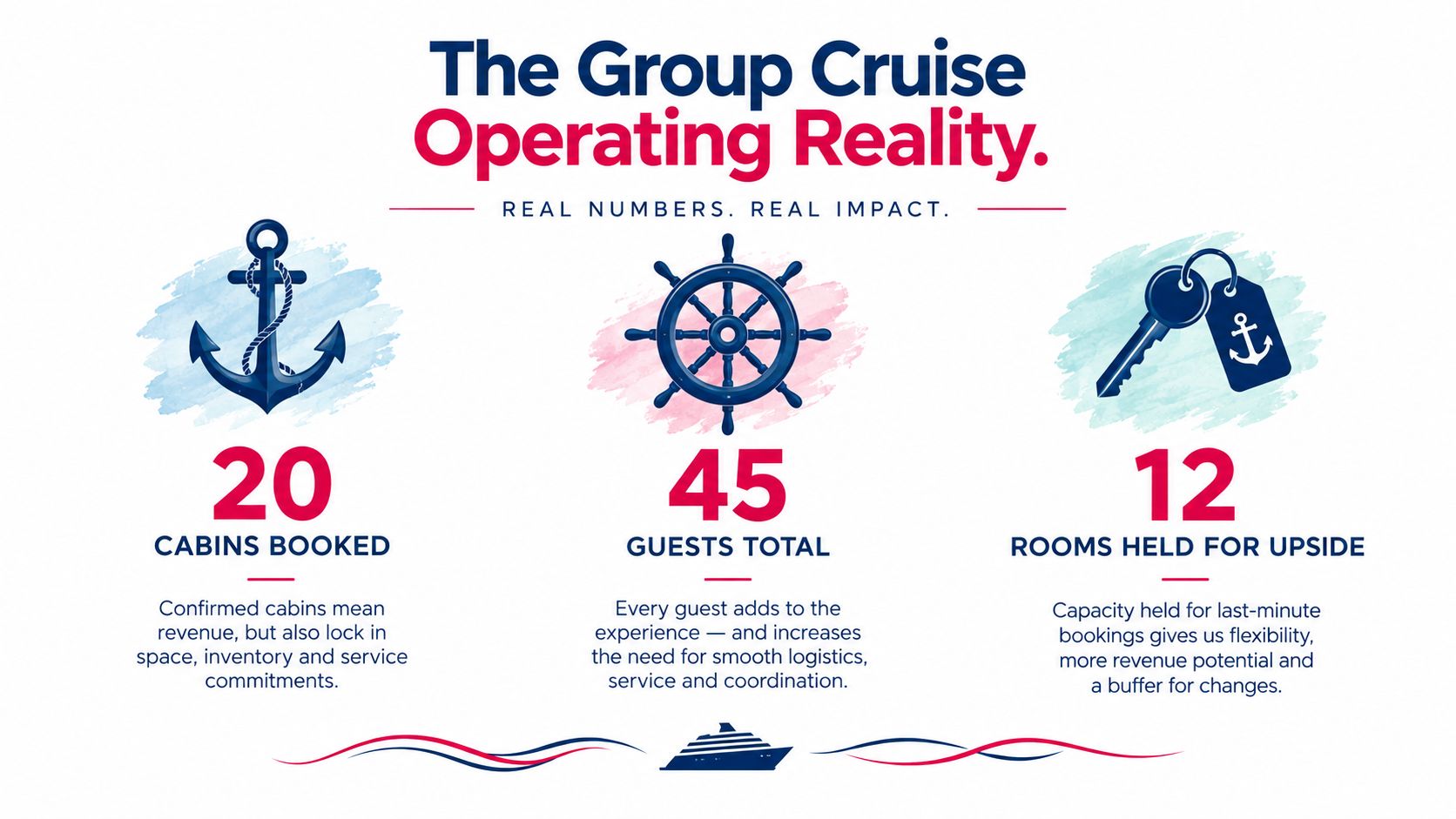
Take the worked example that matters most. A 20-cabin block with an 85% retention requirement leaves very little room for cancellation or softness. If five cabins cancel or remain unsold, the group may breach the contract and incur charges. That's why the upside rooms should be treated as optional, not as a promise to the cruise line or to the people who are “probably in.”
Track four dates per cabin.
- Deposit due, because that is the first real commitment.
- Name deadline, because passenger data has to line up with documents.
- Final payment, because missed money can trigger loss of the booking.
- Release or attrition cutoff, because unsold cabins can vanish before sailing.
A weekly dashboard should show booked cabins, paid deposits, outstanding balances, cancellation exposure, and days to cutoff. The point isn't to create reporting theatre, it's to catch the moment when the block is still fixable. A group booking cruise that is monitored weekly is far easier to rescue than one that gets reviewed only when someone notices a payment is missing.
Running the Money and the Manifest
A group can have enough money overall and still lose cabins because payments arrive on different schedules. One traveller assumes the deposit is optional, another misses the balance date, and the organiser discovers the problem after the cruise line has tightened its terms. Treat the booking as a cash-flow operation, not a shared promise.
Translate the deadline into a private cash map
Royal Caribbean lists final-payment deadlines of 75, 90, or 120 days for individual bookings, depending on voyage length. Its policy also says group terms differ and applies only to the United States, Canada, and Puerto Rico. Royal Caribbean's final payment schedule policy shows why organisers must verify the agreement for the relevant market. European and MENA groups should keep cruise-line deadlines separate from local payment expectations and consumer rules.
Maintain a commitment map for every cabin. Record deposit status, balance due, currency, payer, refund exposure, and the person responsible for chasing payment. A family vacation budget planner can provide a useful structure for tracking these milestones. The main risk is often timing rather than affordability. One missed payment can jeopardise the cabin, and a cabin problem can affect the group's contracted block.
Read the cancellation schedule at group level as carefully as the headline price. Katarina Line treats reservations of five or more cabins as small-group bookings, requires a non-refundable deposit, and applies a 100% cancellation fee from 41 days through departure. Katarina Line's terms of service demonstrates how quickly late changes can become expensive once the payment calendar tightens.
Practical rule: never promise that a replacement is possible until the contract explains name changes, deadlines, and any fee.
Run one reconciliation routine each week. The organiser checks the payment sheet, the travel desk verifies the manifest, and the ship-ready list is matched line by line with passports, names, and paid balances. Keep one controlled master list that mirrors the cruise line's final records. MyPerfectStay can help collect preferences and keep the human side of the booking visible, but it should support, not replace, that controlled manifest.
Picking the Mediterranean Embarkation and Port Pattern
A wedding party can lose half its embarkation morning to one late airport transfer. A family reunion can spend its first hours moving luggage between hotels, coaches, and terminals. Choosing the Mediterranean port pattern is therefore an operating decision, not a beauty contest. Spain, Italy, and Greece remain central to European cruise planning, and Porteconomics Management's Mediterranean cruise passenger analysis identifies Barcelona, Civitavecchia, and the Balearic Islands among the region's busiest cruise locations. Their value lies in the workflows they support.
Barcelona versus Rome changes the whole workflow
Barcelona often suits a turnaround because a dispersed group can gather there before sailing, with hotels, airport access, and the terminal forming a manageable pre-cruise plan. Civitavecchia serves as the Rome gateway, so the organiser must decide whether the itinerary is marketed around “Rome cruise” or built around the simpler logistics of boarding in a dedicated cruise city. For a corporate group or wedding party, that choice can matter more than the destination wording in the brochure.
The Balearic Islands can support either turnaround operations or port-of-call planning. That makes them useful for a beach stay before sailing or a quieter night after disembarkation. Santorini and Dubrovnik serve a different purpose. They can produce memorable shared days, but tendering, steep or lengthy walks, and strict timing create added exposure for older guests, children, and anyone with limited mobility.
Choose the pattern that makes transfers, luggage handling, and late arrivals easier to control. A port with fewer moving parts may serve a multi-generational group better than a more famous option.
Design the day for different energy levels
CLIA reports that nearly one-third of cruise guests sail with three or more generations. CLIA's Europe annual report and the 2025 global report also describe groups that combine age ranges and repeat travellers. An itinerary should therefore allow people to share the sailing without requiring identical days ashore.
Assess every excursion against practical conditions:
- Walking intensity: Offer lower-friction routes for older travellers and young children.
- Duration: Long days can exhaust groups with different energy levels.
- Bathroom access: Long transfers make facilities a serious planning concern.
- Heat exposure: Mediterranean temperatures can turn poor timing into a health and comfort problem.
- Child suitability: An adult-focused tour may not work for families.
- Cancellation flexibility: Weather or health changes require a workable exit option.
A shared ship does not produce a shared holiday automatically. Set up low-energy, family-friendly, and adventurous subgroups on the same sailing, then reunite them for dinner or a planned group event. Group amenities or onboard credit can support a shared upgrade, private gathering, or coordinated excursion, while allowing guests to choose the day that fits them.
Pre-Signing Checklist and the Sail-Away Handoff
The final week is not the time to discover that the dietary notes are in one email thread, the accessibility request is in another, and nobody has confirmed the transfer time from the port hotel. By then, the job is no longer booking, it's damage control.
Lock the last details before departure
The organiser should verify that contracts are signed, deposits are cleared, the manifest is reconciled, cabin preferences are submitted, and accessibility and dietary needs are logged. Excursion tracks should already be chosen, and embarkation-day logistics should be confirmed with whoever is handling the transfers. A clean sail-away handoff is less about ceremony and more about eliminating the avoidable last-minute scramble.
The best group leaders print less, confirm more, and never trust a memory over a manifest.
The handoff itself should be simple. The organiser turns the dashboard into a printed rooming list, a final contact sheet, and a single WhatsApp channel for on-trip coordination. That keeps the shipboard version of the group from becoming a repeat of the planning chaos.
After the sailing, the debrief should be short and honest. Keep what made decisions easier, change what caused friction, and drop anything that only added noise. The next group booking cruise is smoother when the organiser saves the right templates, the right cabin logic, and the right payment rhythm instead of trying to start from scratch again.
MyPerfectStay helps groups turn scattered preferences into one private voting flow, one shared itinerary, and one cleaner decision trail. If you're planning a cruise group with mixed budgets, energy levels, and activity tastes, visit MyPerfectStay to see how the platform can help your group agree faster and keep the booking organised.