What Is Group Travel Today
September 28, 2026·MyPerfectStay

You've probably seen it happen in a group chat. Someone suggests Barcelona, another person asks about the budget, a third sends a list of restaurants, and then two travelers disappear while everyone else debates whether the trip should include museums, nightlife, or a quiet afternoon. By the time somebody proposes booking flights, the conversation has become too complicated to finish.
That tension explains what is group travel today. It isn't just several people buying tickets to the same destination. It's the organized coordination of travelers who share a destination, a purpose, and at least part of an itinerary, while still bringing different budgets, interests, schedules, and energy levels. A successful group trip turns those differences into workable choices instead of letting them stall the plan. For practical inspiration, compare your needs with these group vacation ideas, then build the decision process around the people actually traveling.
Table of Contents
- The Modern Reality of Traveling Together
- Defining Group Travel Beyond the Tour Bus
- Key Types of Group Travel and Their Unique Needs
- Benefits and Operational Challenges of Group Trips
- Group Travel Market Trends Across Europe and MENA
- Streamlining Decisions with Smart Planning Platforms
- Executing a Flawless Group Travel Experience
The Modern Reality of Traveling Together
The old image of group travel is easy to recognize: a full coach, a fixed route, a guide holding a sign, and everyone following the same timetable. That format still exists, but it no longer defines the whole market. A group might now be three generations sharing a villa near Lisbon, friends arranging a birthday weekend in Prague, colleagues planning an offsite in Dubai, or couples joining a food-focused stay in Marrakech.
The shared destination is only the visible part. Behind it sits a coordination problem. One traveler wants an early walking tour in Rome, another needs a slower morning, someone else has a firm spending limit, and a parent wants an activity suitable for children. If the organizer handles every decision personally, even a promising trip can become exhausting before anyone leaves home.
Practical rule: A group trip works best when the group agrees on the decision process before it debates individual activities.
Modern group travel is therefore closer to consensus-building than simple bulk booking. The organizer needs to identify what everyone must share, such as transport, accommodation, and key dates, and what can remain flexible, such as free time, dining choices, or optional excursions. That distinction protects both the itinerary and the relationships within the group.
The desire to travel together remains strong because people value shared memories, practical support, and the chance to celebrate in one place. The friction comes from trying to achieve that experience through unstructured messages. A better definition starts with coordination, not headcount.
Defining Group Travel Beyond the Tour Bus
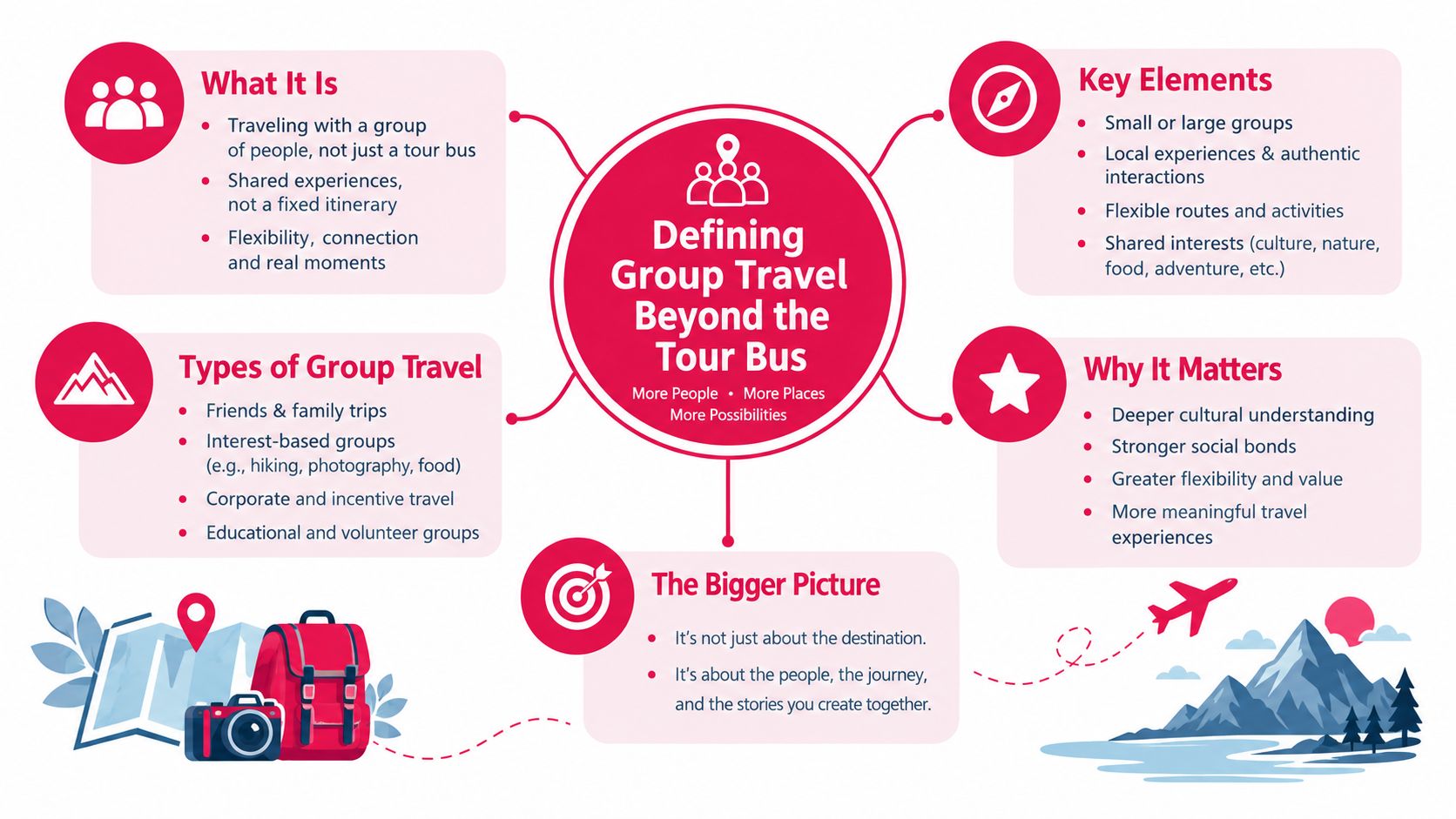
Group travel is travel in which several people are coordinated as a unit around a shared destination, schedule, and purpose. Market researchers split it by trip type; SkyQuest's group travel market report, for example, segments it into leisure, corporate, educational, religious, and adventure group travel. The important phrase is “as a unit.” Ten people who happen to book hotels in Paris independently aren't necessarily a group. Ten people sharing a reservation plan, transfers, activities, and timing are.
A useful definition in practice
The segment usually includes four broad purposes:
- Leisure travel: Friends, couples, families, and informal communities may share a holiday, celebration, city break, or special-interest experience.
- Corporate travel: Teams coordinate accommodation, meeting spaces, transport, meals, and activities around an offsite, retreat, or business event.
- Educational travel: Students and teachers require supervision, age-appropriate schedules, safeguarding, transport planning, and clear responsibility.
- Event and religious travel: Weddings, reunions, pilgrimages, and other organized gatherings often depend on a common date, venue, and arrival plan.
Each subtype changes the booking logic. A family visiting Istanbul may prioritize connected rooms and flexible days. A corporate group heading to Amsterdam may need a reliable transfer plan and an agenda that fits work commitments. A wedding party in Dubrovnik may coordinate flights, ceremony-related events, and separate preferences for sightseeing.
The commercial history of group tourism reaches back well before online booking. Thomas Cook is widely acknowledged as the first travel agent and a pioneer of group tourism. One widely cited milestone is the July 5, 1841 rail excursion from Leicester to Loughborough, which carried more than 570 people to a temperance meeting for a shilling each, return, and is often described as the first organized group excursion, according to historical reporting on the evolution of tourism.
From mass movement to intentional coordination
That early excursion had a single leader, shared transport, and a preplanned itinerary. Those elements still appear in modern trips, but travelers now expect more choice. A group can share the core plan while allowing people to opt out, select different activity levels, or spend within different limits.
This is why “group” no longer automatically means “large.” It means the travelers are connected by a coordinated plan. The organizer's job is to create enough structure for the group to move together, without forcing every person to experience the destination in exactly the same way.
Key Types of Group Travel and Their Unique Needs
A group of friends, a multigenerational family, and a corporate team may all visit the same city, yet their planning problems will look nothing alike. Treating them as one category leads to poor choices, especially when the itinerary, payment process, and activity mix need to serve different priorities.
Friend groups and celebration trips
Friends often want a memorable shared experience, but agreement can become difficult when the trip combines nightlife, sightseeing, food, and rest. A bachelor party in Budapest might include a central apartment, a restaurant reservation, a thermal bath visit, and evening plans. The group may share the main schedule while allowing individuals to skip an activity or join later.
The organizer should settle the basics early:
- Purpose: Is the trip for a birthday, reunion, celebration, or simple time together?
- Spending boundaries: Which costs are shared, and which belong only to participants who opt in?
- Pace: Does the group prefer a packed weekend or a slower city break?
- Participation: Which activities are essential, and which should remain optional?
A clear distinction between “everyone” and “whoever wants to join” prevents resentment. It also makes the final itinerary more realistic.
Multigenerational families
Family travel adds emotional weight and practical variation. Grandparents may need accessible routes and regular breaks, teenagers may want independence, younger children may need predictable meal times, and adults may disagree about whether to prioritize culture, beaches, or relaxation. A reunion in Tuscany can work well when the shared plan includes meals and a few anchor activities, while free periods let each age group choose its own pace.
The 2025 U.S. Family Travel Survey, which polled nearly 1,600 parents and grandparents, found that 57% of parents were planning a multigenerational trip (up from 55% in 2023) and 71% of grandparents had recently taken one, according to NYU SPS's summary of the survey.
For more ideas suited to different ages and travel styles, review these large-group vacation ideas, then filter them through mobility, budget, and downtime requirements rather than choosing activities by popularity alone.
Corporate teams and retreats
Corporate travel has a different standard of success. An offsite in Dubai may require rooming information, airport transfers, meeting facilities, meal arrangements, reimbursement rules, and a schedule that protects working time. Participants may enjoy a desert experience or a guided neighborhood tour, but the organizer must still account for approvals, accessibility, punctuality, and company policy.
A corporate itinerary should separate business-critical commitments from optional social activities. That structure allows a traveler to miss a leisure experience without missing a workshop, while the finance team can see which costs apply to everyone and which are elective.
Educational and event groups require their own controls, including attendance tracking, responsibility assignments, and contingency plans. The common lesson is simple: the group type determines the operating model.
Benefits and Operational Challenges of Group Trips
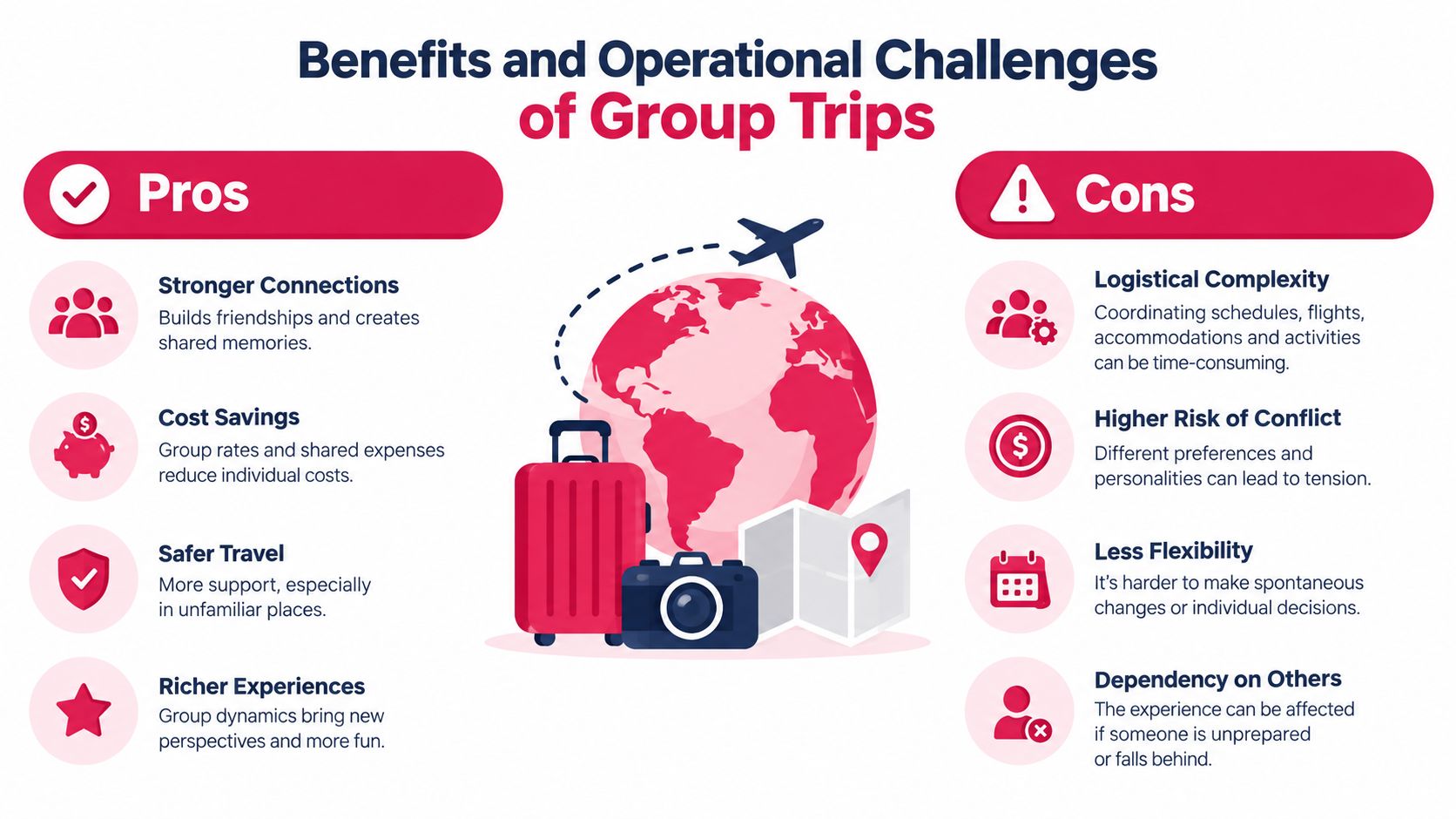
Traveling together creates value that solo planning can't reproduce. Friends share stories in real time, families turn a destination into a collective memory, and colleagues can build relationships outside the workplace. A larger booking may also make it easier to coordinate transport, accommodation, and activities through one plan rather than many disconnected reservations.
Shared costs can make certain arrangements more practical, especially when the group uses a villa, private transfer, guide, or shared excursion. The benefit isn't automatic, though. The organizer must explain what the group is sharing, how optional expenses work, and when each traveler needs to pay.
Why people choose group travel
The strongest benefits usually fall into three areas:
- Connection: A shared trip gives friends and relatives time that ordinary routines often interrupt.
- Practical support: Travelers can divide responsibilities for bookings, navigation, meals, and reminders.
- Access: A coordinated group may be able to consider accommodation, transfers, or experiences that are less convenient to arrange individually.
These advantages become meaningful only when the plan respects personal limits. A traveler who can't afford every excursion shouldn't feel pressured to join. Someone who prefers quiet evenings shouldn't be treated as difficult for skipping nightlife.
Where planning breaks down
The most common failures happen before departure. Travelers respond at different speeds, describe budgets differently, and use the same words to mean different things. “Affordable” might mean a simple hotel to one person and a private room in a central property to another. “Relaxed itinerary” might still include two scheduled activities for one traveler, while another wants only one anchor plan per day.
The same survey shows groups widening beyond the immediate family: trips with extended family rose to 48% (from 41% in 2023) and trips with friends or other families to 42% (from 40%). Parents also named the frictions that come with a bigger party, including the difficulty and added cost of being seated together on flights and the scarcity of family or connected hotel rooms, according to the Family Travel Association survey report.
A group chat makes this worse because decisions become buried. The organizer then repeats questions, tracks replies manually, and absorbs the blame when the final choice disappoints someone.
The problem isn't that groups have different preferences. The problem is asking an unstructured conversation to resolve them.
The solution isn't to eliminate disagreement. It's to make trade-offs visible, record preferences before booking, and distinguish a majority choice from a firm requirement. That approach turns planning from personal persuasion into a shared process.
Group Travel Market Trends Across Europe and MENA
Europe and MENA show why modern group travel needs flexible planning. Paris, Rome, Lisbon, Istanbul, and Dubrovnik offer dense cultural and culinary options, but their best experiences may involve different booking conditions, walking demands, and time commitments. Dubai, Marrakech, Amman, Muscat, and Doha add another mix of desert activities, historic sites, coastal experiences, and hotel-based hospitality.
The supply side has had to respond to travelers who want more than a standard sightseeing circuit. Hotels increasingly need to think in terms of room combinations, shared spaces, transport coordination, and add-on experiences. Local operators also need products that work for a small circle of friends or a family with mixed interests, not only for a large coach party.
A group visiting Rome might split one day between a guided archaeological visit and independent shopping. In Marrakech, some travelers may choose a cooking experience while others prefer a hammam or a slower afternoon in the medina. In Dubai, a group could combine a shared dinner with optional desert activities, rather than requiring every participant to follow one identical schedule.
The scale of demand is significant. The global group travel market was valued at about $639.9 billion in 2023 and is projected to grow at a 5.2% CAGR through 2030, while 85% of group tours have 10 to 50 participants, according to one group travel industry statistics roundup. That profile supports the shift toward small-to-mid-sized trips where one booking still represents several travelers, shared expenses, and a substantial itinerary.
What this means for travelers
Destinations are becoming easier to use for groups, but choice can also create more coordination work. More hotels, guides, restaurants, and experience providers mean more possible combinations. Without a way to compare them against the group's actual preferences, abundance just produces more debate.
The practical advantage belongs to groups that define their travel style early. A cultural weekend, a family celebration, and a corporate retreat should search for different accommodation layouts and activity rhythms, even when they share the same destination.
Streamlining Decisions with Smart Planning Platforms
A group doesn't need unanimous enthusiasm for every activity. It needs a fair method for identifying the choices that satisfy the most important needs without ignoring minority requirements. Structured planning platforms replace scattered opinions with comparable inputs, which makes the final decision easier to explain.
Start with private preferences
Ask each traveler to complete a short survey before the group starts debating specific bookings. Useful questions cover:
- Budget: What is comfortable for accommodation, transport, and optional activities?
- Interests: Which categories matter most, such as food, history, beaches, shopping, or nightlife?
- Energy level: Does the traveler prefer early starts, a moderate pace, or unstructured downtime?
- Must-see ideas: Which experiences would make the trip feel worthwhile?
- Limits: Are there mobility, dietary, scheduling, or participation constraints?
A structured group-trip survey lets organizers compare preferences before they lock the plan, reducing misunderstandings by collecting responses in one place, as explained in this group trip planning survey template.
Use voting to reveal overlap
A smart voting algorithm can compare responses across several dimensions instead of counting a simple yes or no. For example, an activity in Barcelona may appeal to travelers who value food, prefer a moderate pace, and accept an established budget. A desert safari in Dubai may match the group's interest in outdoor experiences but require a different energy level and price tolerance.
The useful output is not a mysterious recommendation. It's a visible comparison. Match scores can show why an activity surfaced, while private answers protect travelers who might hesitate to state a preference in a group chat.
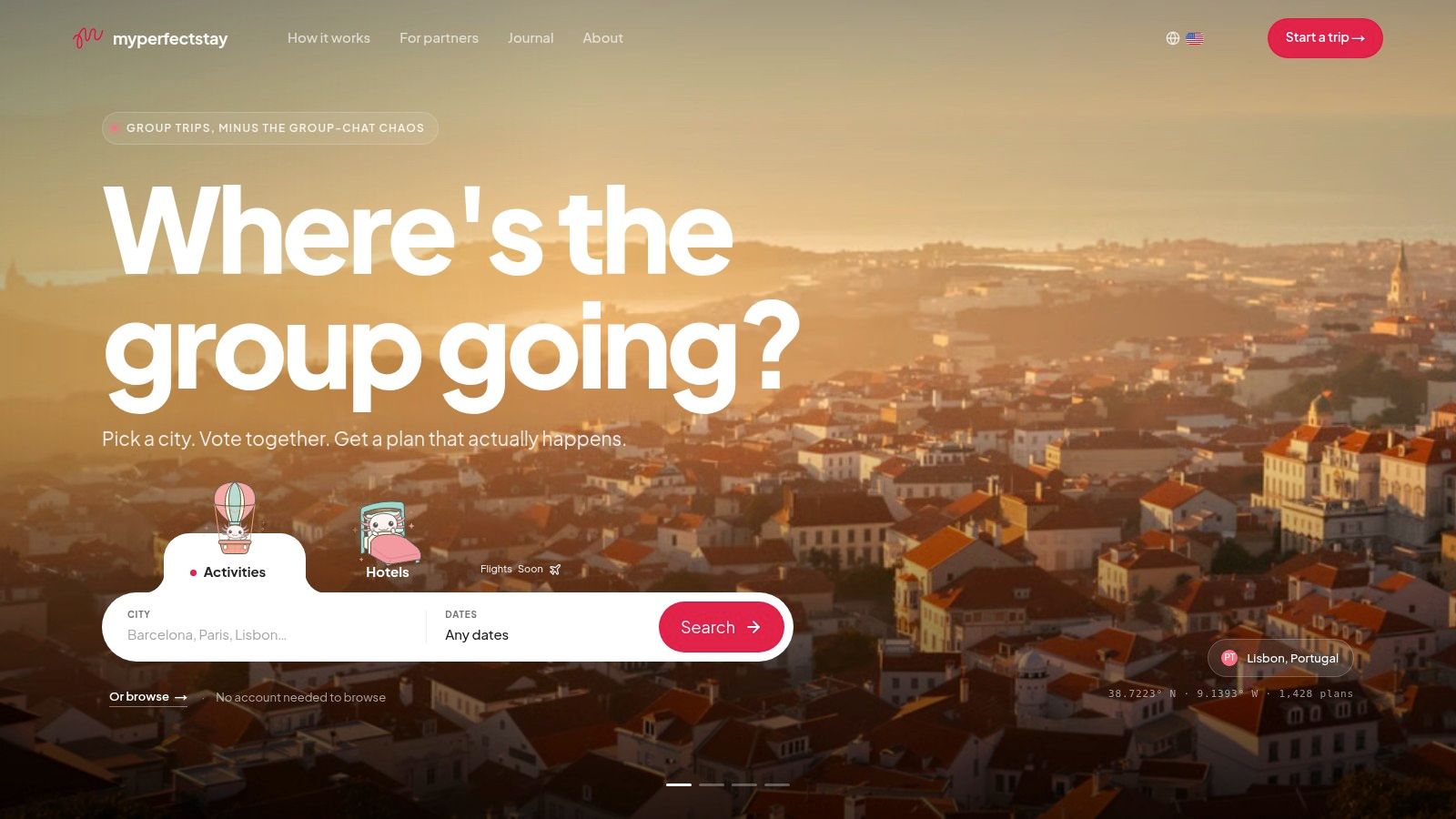
MyPerfectStay is one example of this model. It lets travelers complete a private survey covering budget, interests, energy level, and must-see ideas, then compares those inputs to surface activities with match scores. The platform includes bookable experiences across destinations, shared itinerary generation, and organizer features such as deadlines, nudges, and invitation links. You can also review how a group travel planning website can organize these decisions before reservations are made.
Lock the plan in shared form
Once the group votes, the organizer should convert the result into a practical daily schedule. A good itinerary shows the date, time, address, booking status, participants, meeting point, and any preparation required. It should also identify optional items clearly, so nobody mistakes a suggestion for a commitment.
Deadlines matter because an open decision stays open forever. Set a response date, send one reminder, and record the final choice. That small amount of structure gives the group room to participate without making the organizer chase every reply.
Executing a Flawless Group Travel Experience
A smooth group trip begins before anyone compares hotels. First, define the purpose. A family reunion in Amman, a corporate retreat in Amsterdam, and a friends' weekend in Santorini may all involve shared travel, but they need different schedules, accommodation layouts, and decision rules.
Then establish the essentials. Confirm the dates, approximate headcount, shared budget, accessibility requirements, and activities that matter most. After that, let travelers express preferences privately and use the results to build a plan with a clear balance between shared time and personal flexibility.

A coordinator's working checklist
- Name the decision owner: Choose one organizer, or two coordinators who can divide flights, accommodation, and activity tasks. A travel guide recommends designating one or two coordinators for groups of 5+, as described in this group travel booking guide.
- Collect preferences early: Use one survey rather than relying on scattered replies.
- Separate shared and optional plans: Make the cost and participation rules visible.
- Set deadlines: Close each decision before the next one begins.
- Share the live itinerary: Keep times, addresses, notes, and booking details in one updated place.
- Add contingency options: Identify a backup restaurant, route, or indoor activity where weather or energy could disrupt the plan.
Shared itineraries are a core part of group planning because everyone can see the same updated times, addresses, notes, and booking details, as explained by this shared group itinerary planning resource.
The modern answer to “what is group travel” is intentional coordination. Travelers don't need identical tastes, identical budgets, or identical energy levels. They need a transparent way to find enough overlap, protect essential needs, and keep the final plan accessible to everyone. Start that process before the group chat becomes a negotiation nobody wants to finish.
MyPerfectStay helps groups collect private preferences, compare activity match scores, vote on shared experiences, and turn the result into a bookable itinerary. Visit MyPerfectStay to start organizing your next European or MENA group trip with less debate and clearer decisions.