Hotel Ancillary Revenue: Sources and How to Grow It
November 26, 2026·MyPerfectStay
Only 7% of hotel websites let guests book a stand-alone experience directly, even though approximately 90% promote things to do, according to Destination Commerce's hospitality report. That gap reframes hotel ancillary revenue: the opportunity isn't to recommend more activities. It's to make suitable experiences bookable, retain a defensible share of the sale, and resolve problems without turning the front desk into an unpaid support centre.
For hotels in Europe and MENA, the commercial question is therefore operational. Which experiences deserve placement, who handles a cancelled departure, and does the hotel still earn money after refunds and staff time? A useful strategy answers those questions before expanding the catalogue.
Table of Contents
- What Hotel Ancillary Revenue Includes
- Metrics That Show Real Ancillary Value
- Channels Where Guests Buy Extras
- Experiences Guests Book During a Stay
- Measuring Ancillary Revenue for Groups
- Protecting Margin and Trust with Partner Experiences
- Start a Pilot Experience Layer Before Scaling
What Hotel Ancillary Revenue Includes
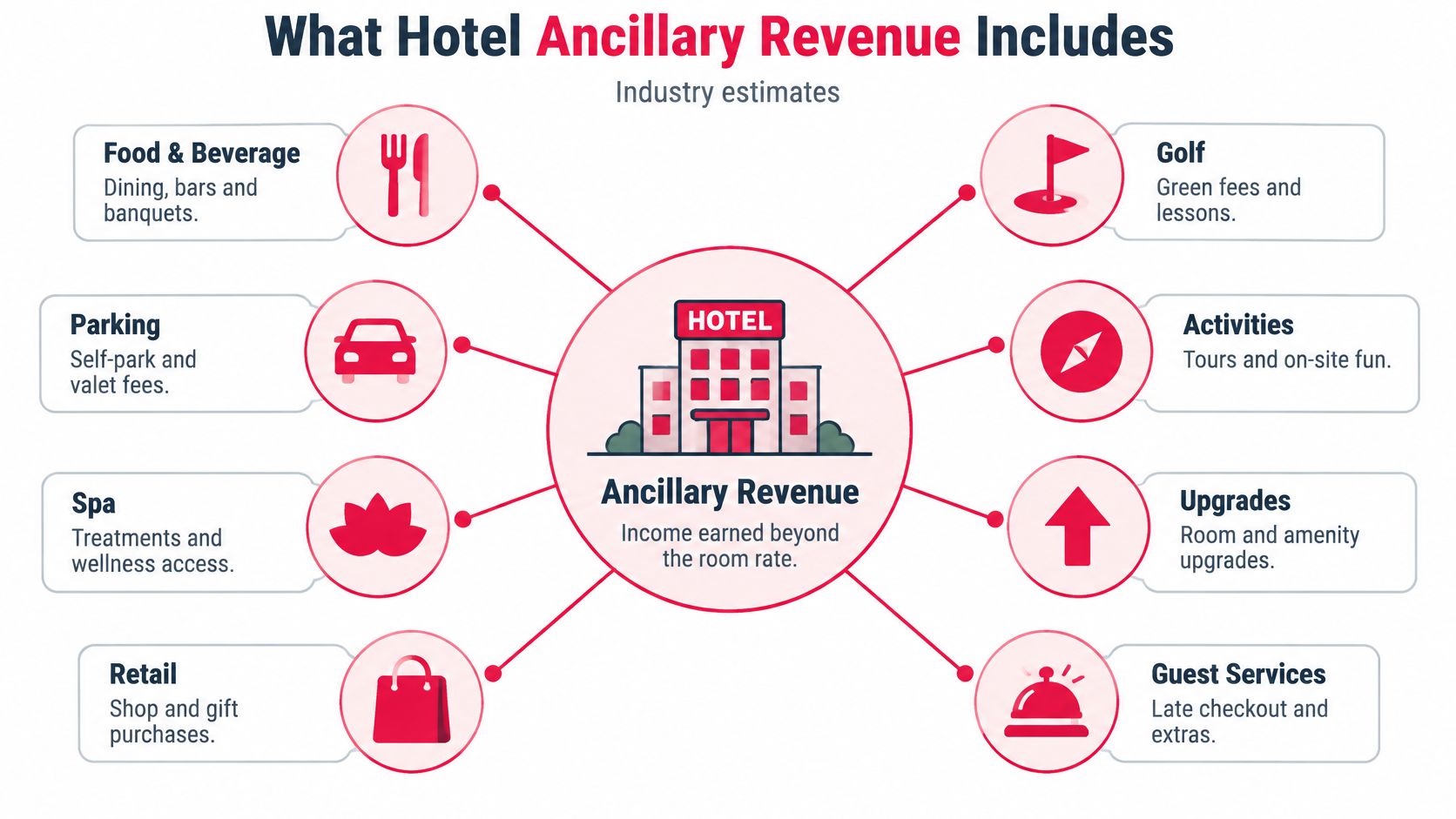
Hotel ancillary revenue is income earned beyond the room rate, including food and beverage, parking, spa and wellness, retail, golf, activities, upgrades and guest services. Industry estimates presented by White Sky Hospitality put broad ancillary or non-core revenue at approximately 32% of hotel revenue on average, heavily influenced by food and beverage, while the narrower definition covering fees and add-on services sits closer to 10%–15%.
Those aren't competing estimates of the same thing. They describe different revenue boundaries. A resort counting restaurants, treatments and recreation will report a different ancillary share from a city hotel counting paid late checkout, upgrades and tour commissions.
Separate departmental income from add-on sales
Use the following working classification to organise the offer catalogue, then reconcile it with the property's chart of accounts. A sales label shouldn't override the accounting treatment of an operated department.
Ancillary revenue sources and how they are usually classified
| Source | Typical examples | How it is usually classified |
|---|---|---|
| Food and beverage | Restaurant, room service, minibar | Departmental, often excluded from ancillary totals |
| Spa and wellness | Treatments, fitness classes, pool access | Departmental at resorts, ancillary at city hotels |
| Parking | Valet, garage, car park permits | Ancillary fee |
| Retail, golf and activities | Shop items, tee times, guided tours | Ancillary sale |
| Upgrades and late checkout | Room upgrade, paid late checkout | Ancillary fee |
| Transfers and bookable experiences | Airport transfer, city tour tickets | Ancillary sale |
The distinction becomes especially important when an external supplier fulfils the purchase. A hotel-operated excursion and a commissionable referral may look identical to the guest, but the hotel shouldn't automatically record their sales values the same way. Finance should establish whether the property recognises the full transaction or only its earned commission.
Use other sectors as context, not targets
White Sky Hospitality also characterises hotels as less mature in ancillary monetisation than airlines, where ancillary revenue can represent 52%–62% of revenue, or cruise lines, at approximately 31%. Those comparisons indicate different commercial models, not a percentage every hotel should try to reach.
A hotel shouldn't chase a larger ancillary share by adding inconvenient fees or pushing unsuitable products. The better question is which services improve the stay while producing worthwhile contribution.
For a full-service hotel or resort, that can mean making dining, wellness and recreation easier to purchase throughout the visit. For a city property, it may mean helping guests arrange a transfer or a well-timed local tour. Both approaches increase total guest value without depending exclusively on higher room rates.
Metrics That Show Real Ancillary Value
Room-only RevPAR can conceal a substantial part of a property's business. In a hypothetical full-service resort example presented by Stayntouch, 100 rooms generate $426 in TRevPAR against $297 in room-only RevPAR, a $129 per-available-room difference, equivalent to $12,900 in daily non-room revenue before considering occupancy changes.
That difference is additional to room revenue, not proof that a new upselling initiative created incremental demand. Restaurants and other existing departments may already account for it. Revenue managers need to distinguish the property's revenue mix from the gain attributable to a particular experience offer.
Build a report that separates sales from earnings
TRevPAR, or total revenue per available room, includes rooms, food and beverage, retail, fees, upgrades and other hotel income. It shows the property-wide picture, but it doesn't explain whether a particular partner experience deserves more promotion.
Ancillary revenue metrics, formulas and the decisions they support
| Metric | Formula | Question it answers |
|---|---|---|
| TRevPAR | Total revenue divided by available rooms | Is non-room income lifting the whole property? |
| Ancillary revenue per occupied room | Ancillary revenue divided by occupied rooms | Which properties or segments earn more per occupied room? |
| Attachment rate | Orders divided by eligible offers | Does the offer reach guests at the right moment? |
| Average order value | Ancillary revenue divided by number of orders | Is this offer worth prime placement? |
| Contribution margin | Net ancillary revenue minus supplier commission, payment cost and staff time | Is the experience actually profitable? |
Define the denominator before using attachment rate. An eligible offer should mean a genuine opportunity to buy, excluding guests who can't participate because of dates, capacity or other restrictions. Otherwise, differences in eligibility can masquerade as differences in sales performance.
The contribution formula above produces a monetary contribution, not a margin percentage. Finance should also specify which costs are already deducted from net revenue, so the team doesn't subtract them again.
Practical rule: For an agency-style experience sale, start with the commission the hotel retains, not the full amount the guest pays.
Read margins alongside revenue
The same Stayntouch benchmark reports that U.S. hotel parking revenue reached $11.53 per occupied room in 2023, up 23.1% from 2019, with a 61.3% departmental profit margin. That is a useful illustration of ancillary economics, not a forecast for a European or MENA property's parking operation.
The broader lesson is to investigate each revenue line separately. A high-value tour booking may produce less hotel profit than a smaller sale once the supplier, payment processor and support team have been paid.
Avoid the common reporting errors: treating gross booking value as hotel revenue, leaving cancelled orders in the sales total, and ignoring commission, payment and staff costs. Ownership needs a reconciled contribution report, not a growing transaction counter.
Channels Where Guests Buy Extras
Average upsell value is about €45 through the booking engine versus €9 at the front desk, according to benchmarking reported by Revfine; online check-in averages about €33, kiosks about €29, while 87% of upsell volume still occurs at the front desk.
That's a distribution imbalance worth testing, not proof that moving an identical product online will automatically increase its value. The channels may carry different products and reach different guests. Timing, product mix and eligibility all need to be considered before attributing the difference to the channel itself.
Average upsell value and best-suited products by channel
| Channel | Average upsell value | Best-suited products |
|---|---|---|
| Booking engine | About €45 | Pre-bookable tours, transfers, dining, wellness |
| Online check-in | About €33 | Transfers, dining, group activities |
| Kiosk | About €29 | Parking, late checkout, room upgrades |
| Front desk | About €9 | Complex or high-intent sales, last-minute upgrades |
The values above are channel benchmarks. The product pairings are practical starting points for a property-level test, not measured category rankings.
Match the offer to the decision window
Booking-stage offers reach guests while they're allocating time and budget. Check-in offers benefit from better knowledge of arrival conditions, but guests may already have made their plans.
Say a guest books a city stay in Istanbul or Rome. Put a half-day tour and airport transfer in the confirmation journey, with departure times, meeting arrangements and cancellation terms visible before checkout. Don't make the guest discover the transfer after they've arranged their own transport.
Use front-desk staff where conversation adds value: explaining accessibility, resolving a complicated itinerary or helping a guest choose between suitable alternatives. Automate the straightforward purchases, not the judgement required to sell responsibly.
When assessing implementation, our guide to tour booking software provides a starting point for reviewing the booking workflow. An operator-facing resource such as the Kona Honu Divers booking guide can also be assessed for how clearly it answers pre-purchase questions, without treating its destination as a recommendation for this hotel portfolio.
Test contribution rather than clicks
Run a four-week channel test as an initial operating experiment. Keep product, eligibility and pricing comparable, record exposure by channel, and prevent repeat messages from being counted as independent buyers.
Compare cancellation-adjusted net profit per occupied room, alongside conversion and support demand. If guests buy earlier but staff spend longer correcting unsuitable purchases, the channel hasn't necessarily improved the economics.
Experiences Guests Book During a Stay
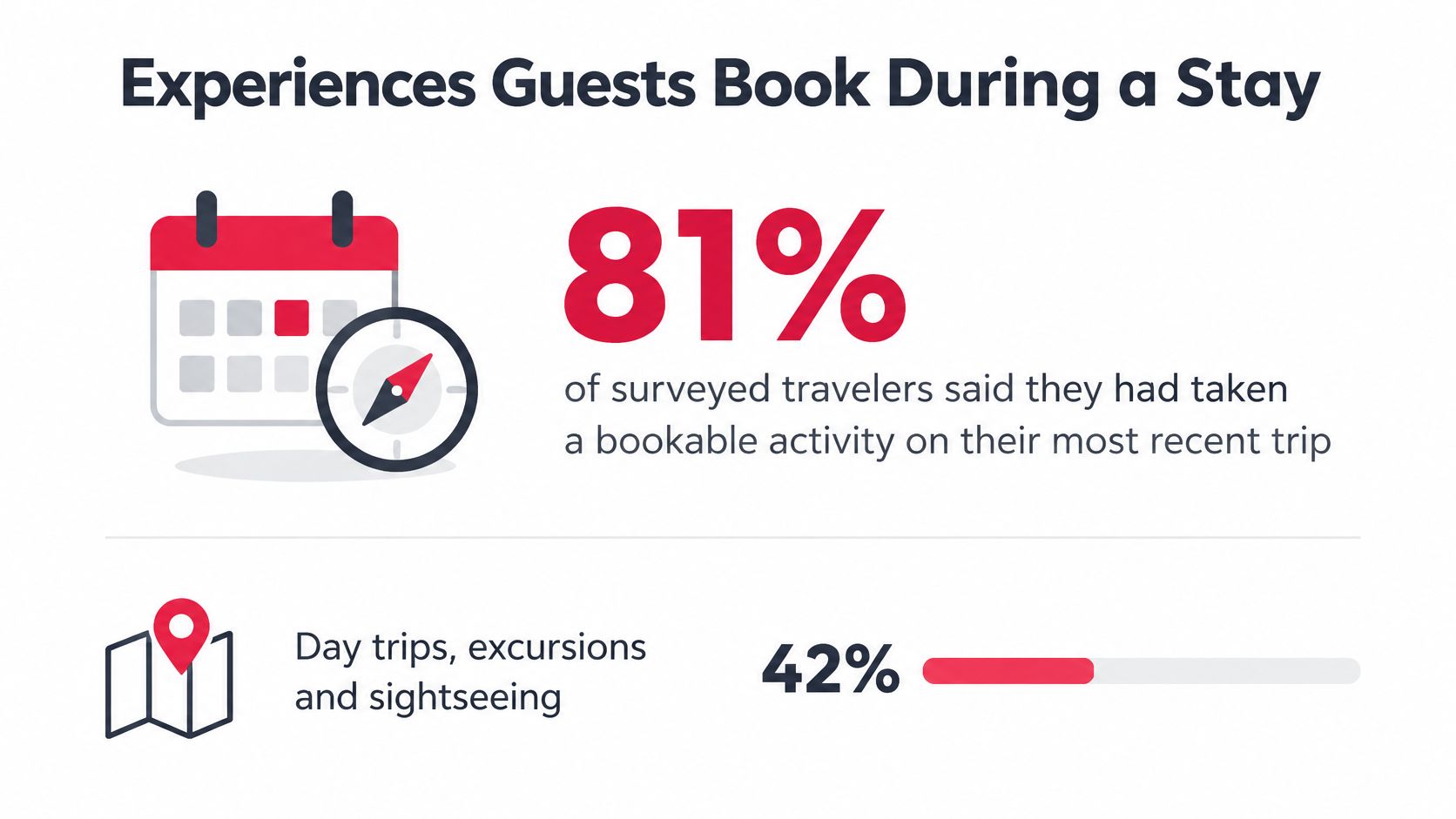
81% of surveyed travellers participated in a bookable activity during their most recent trip, according to the hotel ancillary-revenue industry report hosted by Wishpond, which identifies day trips, excursions and sightseeing at 42%, and museums, galleries and cultural attractions at 30%, alongside outdoor activities.
That establishes a demand signal, not the share of hotel guests who will buy through their accommodation. Hotels still have to offer a relevant product, make the transaction straightforward and give guests a reason to trust the recommendation.
Curate around a usable itinerary
Build the initial assortment around recognisable categories, then evaluate individual suppliers. These European and MENA examples illustrate possible combinations, not endorsements of particular departures:
- Paris or Rome: Pair a museum visit with a guided walk, checking that entry and meeting times leave a realistic connection.
- Istanbul: Offer a Bosphorus excursion or an old-city tour, with the return location clearly stated.
- Barcelona: Consider a food tasting with dietary information available before purchase.
- Dubai: Evaluate a desert safari against transport arrangements, activity intensity and return time.
- Marrakech: Present a medina guide with an explicit meeting point and clear inclusions.
- Santorini: Assess a sunset cruise for boarding access, weather exposure and cancellation arrangements.
A destination label alone isn't enough. The sellable product is the complete proposition: date, duration, access requirements, inclusions, price and fulfilment arrangements.
Treat guest segments as hypotheses
For couples, start by testing dining and wellness offers. For families, consider outdoor activities and attraction tickets, with age and accessibility restrictions visible. For business guests, test transfers and short city tours with flexible timing.
These are merchandising hypotheses, not universal preferences. Ask what guests want and retain alternatives for travellers whose needs don't match the segment label.
Transport deserves particular attention because the journey can determine whether an otherwise suitable experience is practical. For a comparative example of a pickup-led product format, examine Comedy On Deck's hotel pickup tours to Hoover Dam. The useful operational question is whether a guest can understand pickup, departure and return arrangements before committing.
A hotel's destination page should therefore lead to a specific, available booking rather than end at inspiration. Reject an offer if its duration, travel time or uncertain return makes it incompatible with the guest's stay or checkout window.
Measuring Ancillary Revenue for Groups
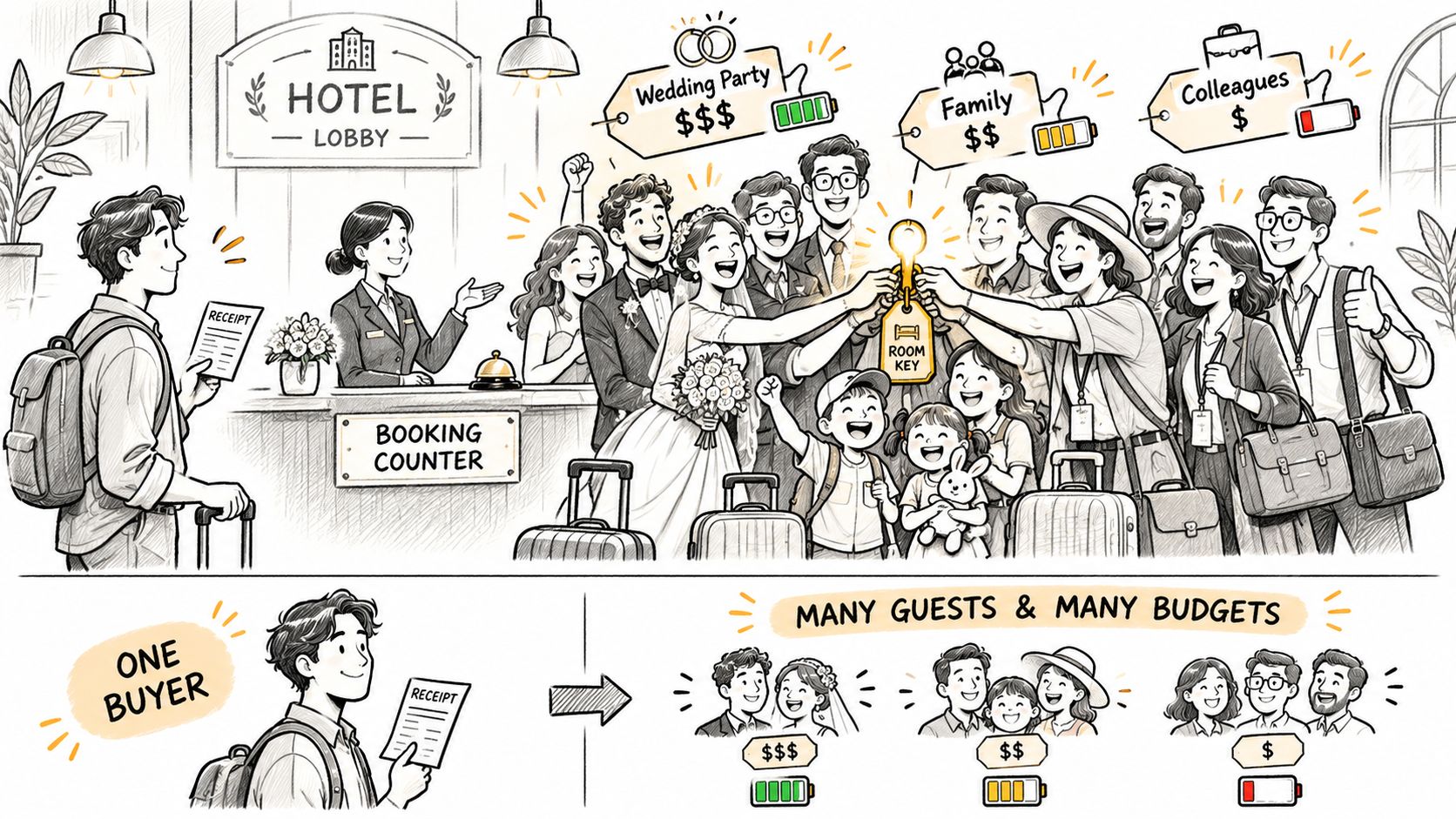
A room-based metric can describe hotel performance without explaining a group's decision. Families, friend groups, wedding parties and corporate retreats contain travellers with different budgets, interests, mobility requirements and energy levels. The organiser who pays isn't necessarily representative of everyone attending.
The category opportunity is material: Cloudbeds' Market Pulse reports that Europe generated approximately $56.31 in food-and-beverage revenue per available room and $7.79 in health-club and spa revenue per available room in 2025. These departmental benchmarks establish context, but they don't reveal who participated or whose preferences went unmet.
Add a group decision record
RevPAG, or revenue per available guest, broadens attention beyond the room to food, wellness, workspace, parking, retail and entertainment. For group experiences, use an additional internal framework, RevPAG-plus, to connect commercial results with participation and decision quality.
This is a proposed management framework, not a standard accounting measure. Record:
- Group-level revenue and contribution: Connect each activity to the travelling party, not only to the payer's room.
- Participation rate: Compare confirmed participants with eligible group members, noting voluntary opt-outs separately.
- Decision time: Track the interval between presenting suitable options and confirming the purchase.
- Cancellations: Separate supplier failures from changes initiated by the group.
- Satisfaction and repeat intent: Ask participants whether the activity suited them and whether they would book through the hotel again.
Set the group identifier when the organiser first engages. Otherwise, purchases made by different members can appear unrelated, while a single large payment can hide low participation.
Don't confuse agreement with fairness
A group dinner order works only when the menu covers the table, not just the loudest voice. Activity selection needs the same discipline: establish budget ceilings and access needs before inviting preferences.
For a practical comparison of group-oriented presentation, Tiki Time Bay Tours' San Diego boat tours for groups is a resource to assess for group-fit questions, rather than a destination recommendation. Apply that assessment to a cruise in Istanbul or Santorini: capacity alone doesn't establish suitability.
A winning vote isn't enough if the selected activity excludes someone who wanted to participate.
Offer a shorter alternative, a parallel activity or an explicit opt-out where appropriate. The objective isn't compulsory participation. It's a purchase enough people accept without pressuring the minority into a spend, pace or activity they can't comfortably manage.
Protecting Margin and Trust with Partner Experiences
More experience inventory doesn't automatically mean more profitable hotel ancillary revenue. Ambition is rising: Oracle's hospitality industry trends report states that 18% of surveyed hoteliers expect more than half of revenue to come from non-room sources, up from just over 11% the prior year. That expectation makes supplier governance more important, not less.
A poorly matched activity can leave the hotel handling complaints even when the external operator collected the payment. Treat the supplier relationship as an extension of the guest-service operation, with commercial terms attached.
Resolve the uncomfortable questions first
Before adding an experience, require written answers to the questions that determine who bears the work and risk:
- Guest suitability: Which segments should receive this offer, and which restrictions make it unsuitable?
- Support ownership: Who contacts the guest when a supplier cancels, changes the meeting point or fails to appear?
- Commercial allocation: How are commissions, refunds, payment costs and disputed transactions handled?
- Liability and recovery: Which party is responsible for the service, what insurance is documented, and who may authorise a replacement or goodwill remedy?
Don't assume a supplier's terms transfer every obligation away from the hotel. Have qualified legal counsel review the booking relationship, disclosures and applicable obligations in each operating market.
For Europe and MENA, a defensible starting model is a tightly curated pre-arrival experience layer. Verify local partners, show the full price before confirmation, identify the booking counterparty and retain products suitable for groups. Our discussion of authentic travel experiences offers a useful editorial lens for relevance, but local appeal doesn't replace operational checks.
Make service recovery executable
Give the duty manager a recovery playbook containing the supplier's escalation contact, the guest message to send, replacement options and spending authority. Test it against a cancelled excursion before selling that excursion to guests.
Keep a partner-level ledger of retained earnings, support minutes, cancellations, payment costs and recovery spending. Review guest-satisfaction outcomes alongside contribution rather than assigning an invented monetary value to every complaint.
Before signing a supplier, confirm:
- Documents: Verify business identity, relevant permissions and insurance evidence.
- Fulfilment: Test availability, confirmations, meeting instructions and guest contact routes.
- Refunds: Agree who approves, funds and communicates them.
- Escalation: Name an accountable contact on each side.
- Exit rights: Preserve a practical way to pause sales when service deteriorates.
A catalogue should earn expansion through reliable delivery. A supplier that generates bookings but repeatedly consumes management attention may be a poor commercial partner even before a serious complaint occurs.
Start a Pilot Experience Layer Before Scaling
Run a 90-day pilot before committing to a broad experience catalogue. This is a proposed operating period, not an industry performance benchmark. Its purpose is to test demand, attribution and fulfilment together under conditions the hotel can control.
Assign an owner to every decision
-
Revenue manager, define the cohort. Choose one guest segment and one stay length, such as families on a city break. Document eligibility so the team knows who should receive the offers and who belongs outside the test.
-
Concierge manager, select the assortment. Choose three to five experiences matched to that cohort's time, budget and access needs. Keep a replacement option available, but don't expand the live catalogue merely because another supplier offers commission.
-
Digital marketing manager, place the offers. Use one pre-arrival channel and one booking-engine placement. Tag the journey by property, campaign and booking stage, and check that a completed purchase can be reconciled to its originating placement.
-
Financial controller, establish the scorecard. Track attachment rate, net contribution per occupied room and cancellation rate. Define cancellations against confirmed bookings, and distinguish a still-refundable booking from earnings the property can recognise.
-
General manager, approve supplier terms. Sign off support ownership, refunds, liability allocation and service recovery before launch. Require the team to complete a test booking and a cancellation rehearsal.
-
Commercial director, make the day-90 decision. Scale only experiences that clear the pre-agreed margin and satisfaction thresholds. Pause products with unresolved fulfilment problems, even if their initial booking totals look attractive.
Choose commercial terms that can be reconciled
Our partner program is offered to hotels and authors, including content creators. Guests plan their whole trip in the partner's branded app, and the partner earns a share every time they book, for the life of the relationship. We publish commission rates on the partner page and pay partners monthly.
Evaluate that model against the hotel's own acquisition and support costs rather than assuming recurring attribution guarantees profit. Give finance responsibility for reconciling earned amounts with payments received.
Write down the margin and satisfaction thresholds before day one, including the conditions that trigger a pause. The review should produce a decision based on agreed criteria, not a debate about whether a busy booking report looks successful.
MyPerfectStay helps hotels and creators turn group travel decisions into bookable plans through a partner-branded app, with a share earned when guests book. Visit MyPerfectStay to assess the partner model for a focused experience pilot, and bring your guest segment, supplier requirements and contribution targets to the decision.