How to Make a Group for Travel: A Step-by-Step Guide
October 3, 2026·MyPerfectStay
You're in the group chat again. One person wants museums, another wants nightlife, someone else keeps asking about the budget, and the quietest traveler has stopped replying altogether. After several days of contradictory suggestions, nobody knows what's happening, yet everyone assumes somebody else is handling it.
That's why learning how to make a group for travel takes more than choosing a destination and sending an invite. You need a process that captures private preferences, exposes genuine overlap, handles money before it becomes personal, and gives the organizer a clear way to resolve the final disagreements.
Table of Contents
- Why Group Travel Planning Feels Like a Nightmare
- Setting Up Your Travel Planning Group with MyPerfectStay
- How the Matching Algorithm Finds Common Ground
- Balancing Diverse Interests and Budgets
- Finalizing the Itinerary and Managing Conflicts
- Your Next Steps for Stress-Free Group Trips
Why Group Travel Planning Feels Like a Nightmare
The familiar version starts innocently. A friend suggests Paris, a sibling proposes London, and somebody drops a Barcelona food tour into the chat. Then the conversation fragments. One traveler argues for a packed itinerary, another wants slow mornings, and a parent worries that the proposed activities won't work for the children or grandparents.
The loudest person often becomes the unofficial decision-maker, not because their idea fits the group, but because they respond fastest and most often. Traditional group chats reward persistence, confidence, and availability. They don't reliably capture the preferences of people who are busy, conflict-averse, or unsure whether their opinion will matter.

Why chat-based planning breaks down
The problem isn't only too many messages. It's that the group is trying to solve several different problems at once:
- Preference discovery: What does each person really want, rather than what sounds acceptable in public?
- Constraint checking: Who has a firm budget, mobility limitation, dietary need, or schedule restriction?
- Option comparison: Which activities suit the largest overlap?
- Commitment: Who is ready to book, and who is still undecided?
Human groups naturally form much smaller working units than the famous Dunbar figure suggests. A review of the evidence found that estimates for average group size varied widely, with approximations ranging from 69 to 109 under one method and 16 to 42 under another, while the confidence intervals were broad enough that one precise number wasn't defensible (review of Dunbar's number). The practical lesson is more useful than the headline: shared memory and repeated contact help small groups coordinate, but scale makes informal coordination harder.
For online communities, the same principle applies. Before inviting travelers, it's useful to review practical steps for an engaged online group, especially around participation and expectations. A travel group needs those basics, plus a firm process for dates, money, activities, and decisions.
Practical rule: Don't ask a group chat to discover preferences, debate options, and finalize a booking in the same stream.
Start by separating those jobs. Give every traveler a private way to state what matters, then bring the group together only after the common ground is visible.
Setting Up Your Travel Planning Group with MyPerfectStay
A family trip can stall before anyone books a room. One person proposes Rome, another wants Dubai, and the group chat fills with reactions instead of decisions. Set up a clear trip workspace before that happens, with a destination, dates, travel style, and a short list of decisions the group must make.
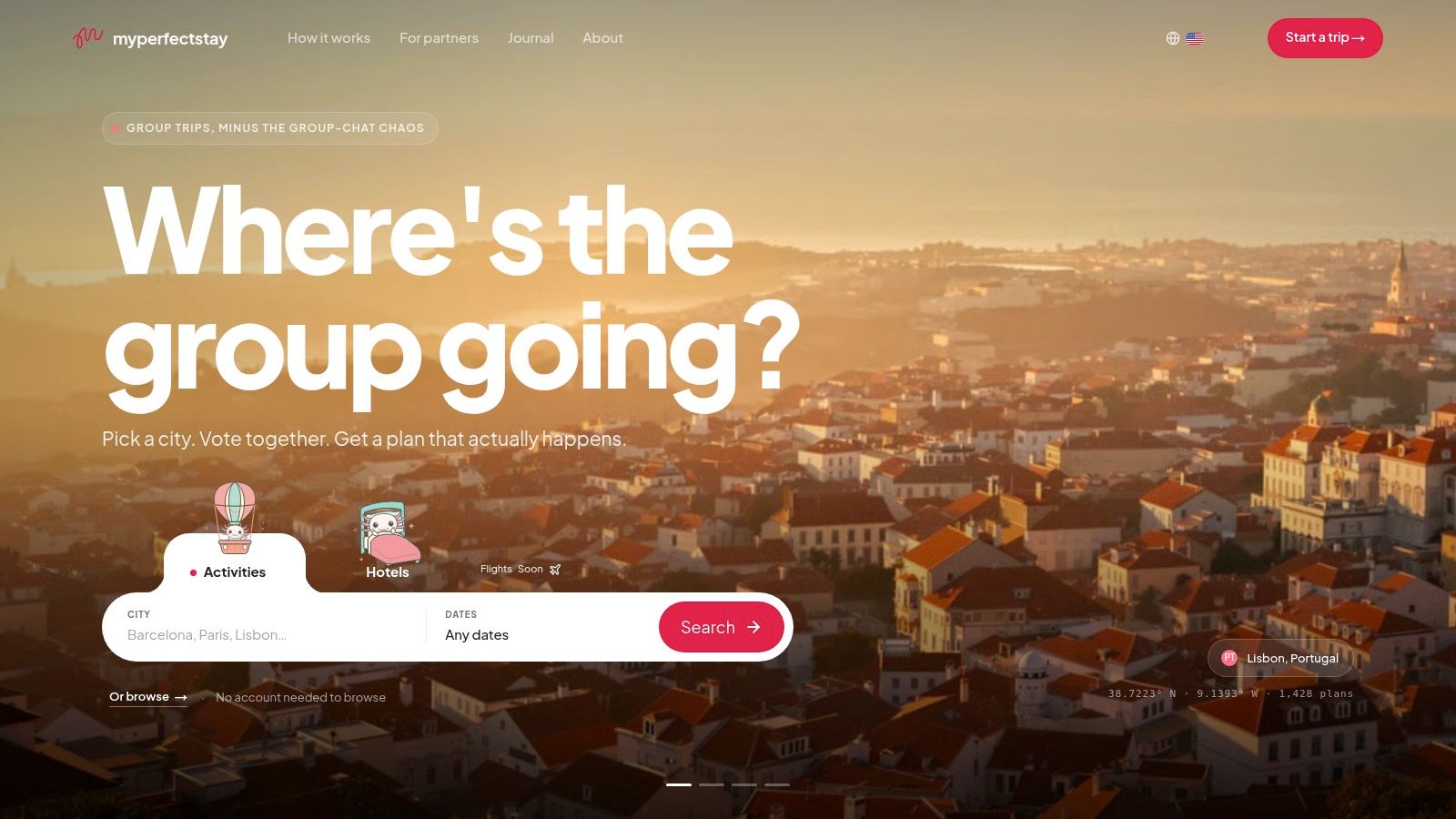
MyPerfectStay lets you open a workspace and invite travelers through a shareable link. Participants can respond without creating an account or downloading an app. Travelers who prefer mobile access can use the iOS or Android apps later. That combination keeps access simple while giving the organizer one place to collect responses.
Set the planning rules before adding activities. Define:
- Destination and dates: Name a city or region, rather than opening an unlimited “where should we go?” debate.
- Trip purpose: Identify a city break, family holiday, celebration, retreat, or another clear format.
- Response deadline: Give travelers a firm date for submitting preferences.
- Budget method: Record spending ranges and agree how shared costs, deposits, and optional activities will be handled.
- Required inputs: Ask about activity interests, energy level, must-see ideas, and firm constraints.
Money needs its own decision rule. A low-cost base plan can include everyone, while upgrades or optional excursions remain personal expenses. Recording that distinction before booking prevents one traveler from inadvertently subsidizing the group or paying first and chasing reimbursements later. A private survey also gives each person space to state their budget before confident voices shape the discussion.
Use a destination library with bookable experiences to turn broad preferences into a workable shortlist. European and MENA choices might include Paris, London, Barcelona, Rome, Istanbul, Amsterdam, Dubai, Marrakech, or Muscat. Paris and London remain among Europe's most visited city destinations in recent rankings, with Barcelona also a high-demand example (European city tourism overview). Dubai gives groups options spanning food, architecture, desert activities, and warm-weather city breaks (Dubai tourism reporting).
Keep social plans separate from booking decisions. Travelers meeting new people can use advice on making friends while pub crawling in Amsterdam without letting that discussion take over the itinerary.
For help inviting collaborators, follow the platform's instructions for adding friends. Put invitations, private responses, shortlist decisions, and cost agreements in the same workspace instead of tracking them across scattered chats.
How the Matching Algorithm Finds Common Ground
A family trip can stall before anyone books a room. One person proposes museums, another pushes for nightlife, and a third stays silent because the discussion has already settled around the loudest preference. A matching algorithm gives the group a clearer starting point by collecting individual choices before the conversation shapes them.
Each traveler should complete a private survey first. Ask them to rank activity types, choose a preferred pace, mark must-see ideas, and describe their tolerance for demanding schedules. Include practical constraints such as accessibility, children's needs, dietary requirements, and whether they would split from the group for part of the day.
The survey creates comparable inputs instead of a long chat history. It also separates genuine preferences from polite agreement.
From private preferences to a workable shortlist
Research on group holiday planning describes a progression from gathering information to sharing it, transferring knowledge, and making decisions. The research links common interest with stronger collaboration, preparation, and flexibility (group holiday planning research).
Use a four-stage workflow:
- Collect: Travelers submit preferences independently.
- Compare: The system identifies shared interests and conflicting requirements.
- Review: The group examines a short list, rather than debating every suggestion.
- Decide: The organizer applies the decision rule the group agreed to use.
A match score does not determine who is right. It shows how many preferences an activity meets, where compromises appear, and which choices deserve discussion. A museum tour may suit most travelers' cultural interests while conflicting with a tight schedule. A lower-scoring option may still win if it meets a specific requirement, such as accessibility or a child-friendly time.
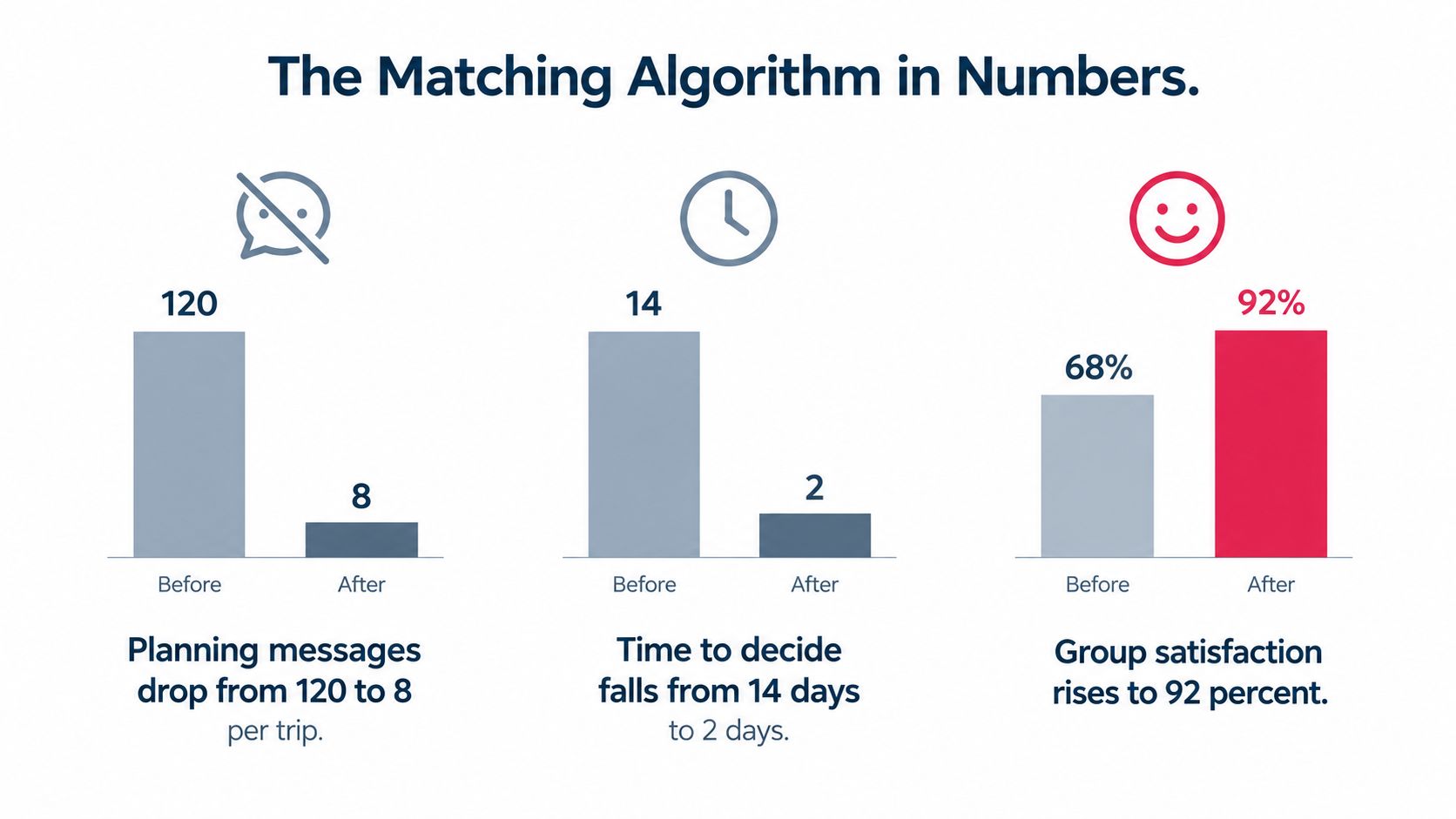
The visualization offers an illustrative comparison of message volume, decision time, and satisfaction. Treat it as a product explanation, not independently verified evidence of performance. The operating rule is straightforward: show the trade-offs clearly, then let people decide how to handle them.
For the decision logic behind this process, read the platform's consensus algorithm overview.
Structured coordination improves contribution without guaranteeing the strongest possible result. Team-formation experiments found that coordinated teams increased contribution levels while still falling short of the best outcome. Other consensus research found that unanimous rules can require more communication than majority-style rules (coordination and consensus research). Use the score to focus the discussion, then make the trade-off explicit and choose.
Balancing Diverse Interests and Budgets
Budget disagreements become dangerous when nobody names them. One traveler assumes shared dinners are included, another expects low-cost meals, and a third agrees to an expensive activity because they don't want to be the person who blocks the group. By the time the bill arrives, the argument is no longer about money. It feels like a question of fairness and consideration.
Ask for financial preferences privately before anyone votes on activities. Don't ask only, “What's your budget?” Capture the decisions that affect the final cost:
- Spending comfort: Which activities feel comfortable, borderline, or unacceptable?
- Shared costs: Who pays deposits, transport, or group reservations upfront?
- Unequal participation: Can travelers skip an activity without penalizing the people who attend?
- Payment timing: When must each person transfer their share?
- Fallback choice: What happens if the preferred option exceeds someone's limit?
Recent travel research found that 82% of group travelers are willing to pay more than their fair share to avoid financial conflict (group-trip questionnaire research). That isn't permission to spend freely. It shows why reimbursement and deposits need to be discussed before the group becomes emotionally attached to an itinerary.
Use rotation instead of winner-takes-all
Consider a Rome city break where one traveler wants galleries, another wants food, and a grandparent needs a slower pace. The fairest plan might pair a central cultural visit with an accessible lunch and leave one evening open, rather than filling every day with the preference of the largest subgroup. Rome is a useful example because it offers museums, historic sites, food experiences, and slower neighborhood exploration in the same destination (European city destination examples).
Dubai creates a different trade-off. A desert safari may appeal to adventurous travelers but not to someone who dislikes long transfers or intense heat. Offer a parallel choice, such as a food experience or cultural visit, and make the split explicit rather than treating non-participation as a failure.

Multi-generational groups need this flexibility. The 2025 US Family Travel Survey reported that 57% of parents planned to travel with grandparents and children, compared with 55% in 2023 (2025 Family Travel Survey). A group isn't homogeneous just because everyone shares a surname or booking.
Use the platform's group decision-making methods to compare options, then label the compromise clearly. People accept an imperfect plan more readily when they can see whose needs it serves, what it costs, and where they still have freedom to choose.
Finalizing the Itinerary and Managing Conflicts
Once the group has voted, stop reopening settled questions. Pick the activity that fits the widest overlap, note why the compromise won, and set a booking deadline. Without that cut-off, every new message turns into a fresh argument.
One shared itinerary should carry the confirmed activities, meeting points, travel time, payment status, and free periods. If people are working from old screenshots or different links, the plan falls apart fast. Send confirmations to every participant, not only the person who made the booking.
The harder problem is not the schedule. It is the money and fairness question that sits under it.
Private surveys help here more than another round of group debate. Ask people for budget limits, must-do activities, pace, and any health or accessibility constraints before the group discussion starts. That gives the organizer real input to compare, and it keeps quieter travelers from being talked over by the loudest voice in the room.
A simple decision ladder keeps conflicts from turning personal:
- Check the constraint. Is someone dealing with a real budget, safety, health, or accessibility issue?
- Check the overlap. Does another option satisfy most of the same interests?
- Offer a split. Can the group divide for part of the day without creating transport or supervision problems?
- Apply the rule. If no option works for everyone, use the rule agreed before voting, such as organizer tie-break, rotation, or consensus.
- Close the decision. Record the outcome and move to booking.
Majority voting too early can hide useful information. Consensus will not appear just because everyone is polite. The group needs a communication protocol, a deadline, and one person responsible for closing the loop.
Organizer tools such as nudges and deadlines solve the practical problem of non-response. Use one reminder with a clear consequence, such as “no response means no preference recorded,” instead of repeated emotional appeals. People respond better when the request is specific and the next action is obvious.
Conflict can still show up after booking. Handle it by separating the person from the decision. “The group chose this because it met the budget and accessibility constraints” works better than “You lost the vote.” If a traveler changes their mind, review cancellation terms, identify who bears the cost, and do not push that expense onto the most accommodating person.
Your Next Steps for Stress-Free Group Trips
The most reliable answer to how to make a group for travel is a sequence, not a personality trait. You don't need to become a full-time coordinator or persuade everyone to communicate perfectly. You need to collect the right information before the group starts negotiating.
Use this final checklist:
- Name the trip: Confirm the destination, dates, purpose, and decision deadline.
- Invite everyone: Use one link and make participation possible without unnecessary setup.
- Ask privately: Capture budget, interests, pace, must-see ideas, and constraints.
- Shortlist intelligently: Start with destinations and activities that match the group's actual overlap.
- Discuss the trade-offs: Show what each option satisfies and what it compromises.
- Set the money rules: Decide deposits, reimbursements, skipped activities, and payment timing before booking.
- Choose a resolution rule: Use consensus where practical, then apply a defined tie-breaker when needed.
- Lock the plan: Book confirmed activities, send confirmations, and publish one shared itinerary.
- Keep flexibility: Leave room for rest, independent time, and changes that don't undermine the whole trip.
Small groups still need structure. Evidence briefs summarizing observational research across 15,486 groups found that 65.5% were single-person groups, 25.5% were dyads, 6.9% were triads, and only 2.1% had four or more people (evidence brief on gathering size). The same brief notes that discussion groups are often considered ideally sized at four to six members, because that range allows variety without making participation unmanageable. Larger travel groups aren't impossible, but they need more deliberate information flow and clearer ownership.
Don't wait until the chat becomes hostile. Create the trip, invite the travelers, collect private preferences, and set the first deadline while everyone is still excited.
MyPerfectStay gives travel groups a shared space to collect private preferences, compare activities with match scores, book plans together, and keep an auto-organized itinerary in one place. Visit MyPerfectStay to start your next group trip with a clearer process and fewer exhausting chat debates.