How to Plan a Multi City Trip: Routes, Pacing and Budget
October 26, 2026·MyPerfectStay

You've got Paris, London and Amsterdam open in separate tabs, a cheap flight saved, and a group chat full of hotel suggestions. The trip looks manageable until you try to fit checkout, airport transfers, luggage and a museum reservation into the same afternoon.
The practical answer to how to plan a multi city trip is to settle the route before choosing hotels or attractions. Then judge every move by total door-to-door time and the cost of failure, not just the fare displayed in search results.
Table of Contents
- Choose Your Cities and Route Order First
- Set Nights per City and Transfer Days
- Compare Door-to-Door Transport for Each Leg
- Pick an Accommodation Strategy for Each Stop
- Budget Each Leg Before You Commit
- Pack and Carry Luggage Across Stops
- Plan Fallbacks for Missed Connections and Late Check-Ins
- Lock the Plan with Your Group Before Booking
Choose Your Cities and Route Order First
Start with geographic clusters, not attractions. Milan, Florence and Rome make a coherent north-to-south journey; adding an unrelated destination because someone found a cheap flight creates another transfer problem.
Europe is a useful starting point for neighboring-city itineraries: 92.2% of all overnight trips by EU residents remained within the European Union in 2024, according to Eurostat's tourism statistics. That measures where trips stayed, not how many cities travelers visited, but it reinforces the value of planning within a connected region.
Build an open route
- List the must-see cities. Separate genuine priorities from places that would merely be nice to include.
- Drop cities that force a return journey. Compare arriving in one city and flying home from another before accepting a round-trip airfare.
- Check every leg door to door. Use Google Maps for local access and the transport operator's website for actual departures, terminals and ticket conditions.
A Paris–London–Amsterdam loop that returns to Paris can consume a full day once packing, station access and check-in are included. An open line ending near your departure airport avoids that final repositioning journey.
Use this route-first sequence before opening hotel searches.
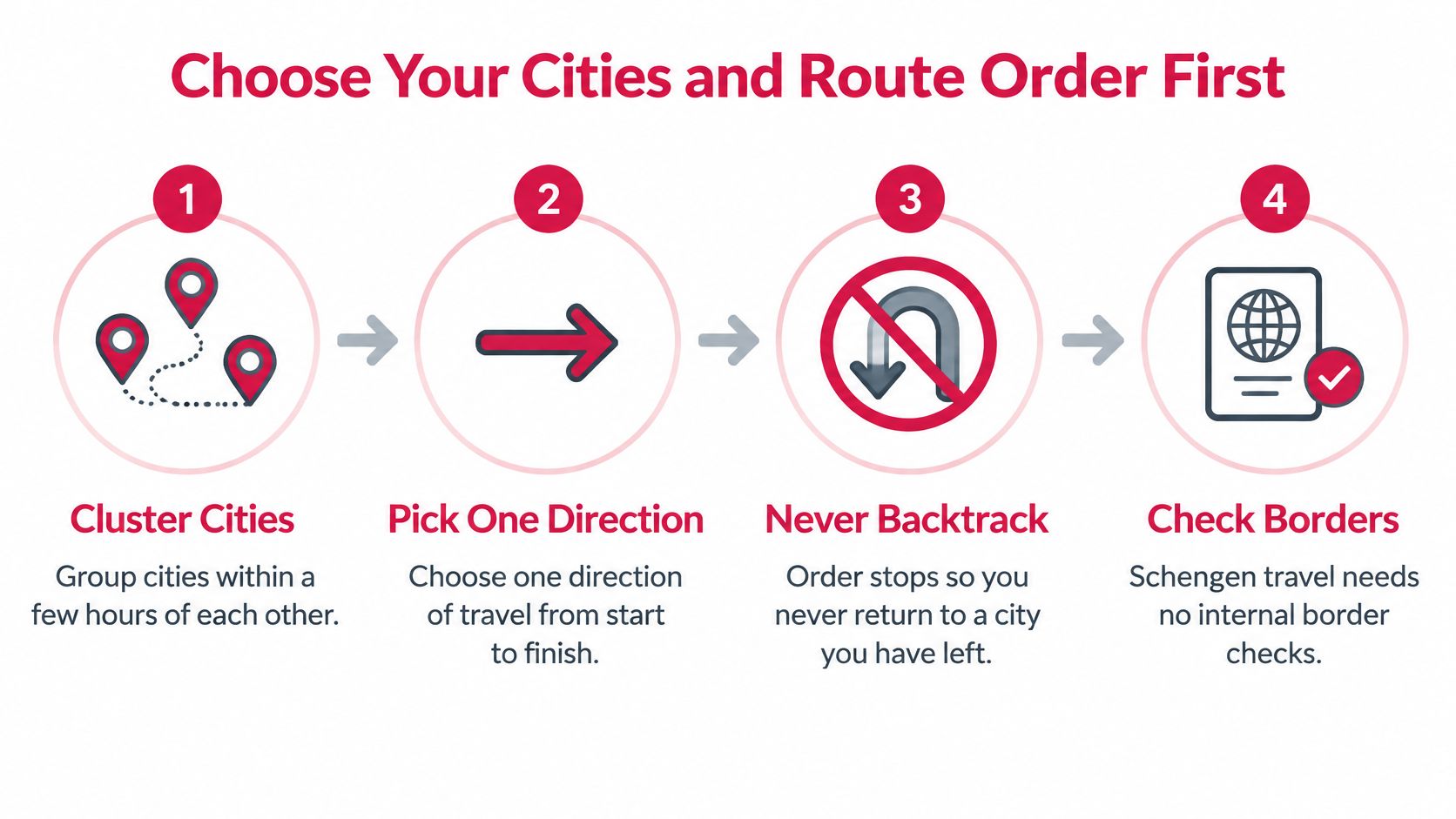
Check passport, visa and border requirements separately. Don't assume that traveling within Schengen guarantees the absence of document checks, or that London follows the same entry arrangements.
Sample multi-city routes and their main legs
These are planning approximations and recommended stays, not confirmed timetables. Check the exact service before booking.
| Route | Sequence logic | Main leg | Approx. travel time | Nights per city |
|---|---|---|---|---|
| Paris – London – Amsterdam | Open rail line | Eurostar Paris to London | About 2 h 20 min | 3–4 each |
| Milan – Florence – Rome | North-to-south line | High-speed rail per leg | About 1 h 35 min and 1 h 30 min | 2–3 each |
| Barcelona – Rome – Vienna | Flight-linked; no practical short direct rail link | Flights between legs | Allow about 2 h 30 min by air per leg for initial planning | 3–4 each |
| Lisbon – Madrid – Paris | Long open line | Flight or long rail journey | Lisbon to Madrid about 1 h 30 min by air | 2–4 each |
| Dubai – Abu Dhabi | Short road or bus hop | Road transfer | About 1 h 30 min by car | 2–3 each |
| Cairo – Luxor – Aswan | Upriver line | Flight or overnight train | Cairo to Luxor about 1 h by air, 10–12 h by overnight train | 2–3 each |
Dubai–Abu Dhabi works as a road pairing, while Cairo–Luxor offers a flight-versus-overnight-train decision. Neither comparison is complete until you include access and arrival arrangements.
For a more compact Spanish alternative, Northern Spain Travel's guide to where to go in northern Spain can help you build a regional shortlist rather than stretching a route across Europe.
Route readiness test: Every leg has a confirmed transport option, and no leg requires a same-day onward connection to make the itinerary work.
Set Nights per City and Transfer Days
For Paris and London, I'd start with three to four nights in each and leave a flexible half-day. That gives you room to arrive, settle in and rearrange activities without turning every delay into a cancellation.
In 2024, Paris and the surrounding Île-de-France region welcomed more than 20 million inbound visitors, while London accounted for nearly half of international tourist arrivals to the United Kingdom, according to Statista's city-tourism overview. For popular attractions, check timed-entry availability before assigning a sightseeing day.
Match city count to usable time
Nights and transfer days by trip length
These are pacing recommendations. Choose a distribution that adds up to your actual nights rather than treating every range as interchangeable.
| Trip length | Cities | Nights per city | Transfer days |
|---|---|---|---|
| 4–5 nights | 2 | 2–3 each | 1 |
| 7–8 nights | 2–3 | 2–4 each | One per move |
| 10–12 nights | 3–4 | About 3 each | 2–3 |
| 14 nights or more | 4–5 | At least 3 where possible; distribute remaining nights by priorities | One per move, plus one rest day per week |
A transfer day isn't necessarily a lost day, but it shouldn't carry an essential sightseeing commitment. You may have time for dinner and a neighborhood walk; you may instead spend the afternoon waiting for your room.
For groups, use a more conservative rule: move no more than once every three nights. Families, mixed-energy groups and travelers with mobility needs benefit more from a settled base than from another destination ticked off the list.
Count moves before attractions
Put travel days into a calendar first, including arrival and departure days. Then allocate the remaining time to full days in each city.
Next, check whether anyone has an immovable priority, such as a performance or guided visit. A practical guide to creating a trip itinerary can help turn those fixed commitments into a usable daily schedule.
Finally, remove any stop receiving fewer than two nights. If the group wants a slower pace, reduce the city count rather than borrowing time from sleep or assuming everyone will leave the hotel at dawn.
Compare Door-to-Door Transport for Each Leg
A cheap Paris–London flight can lose its advantage once you add travel to a distant airport, departure procedures and the journey into central London. Eurostar may cost more at checkout yet leave you with more usable time in both cities.
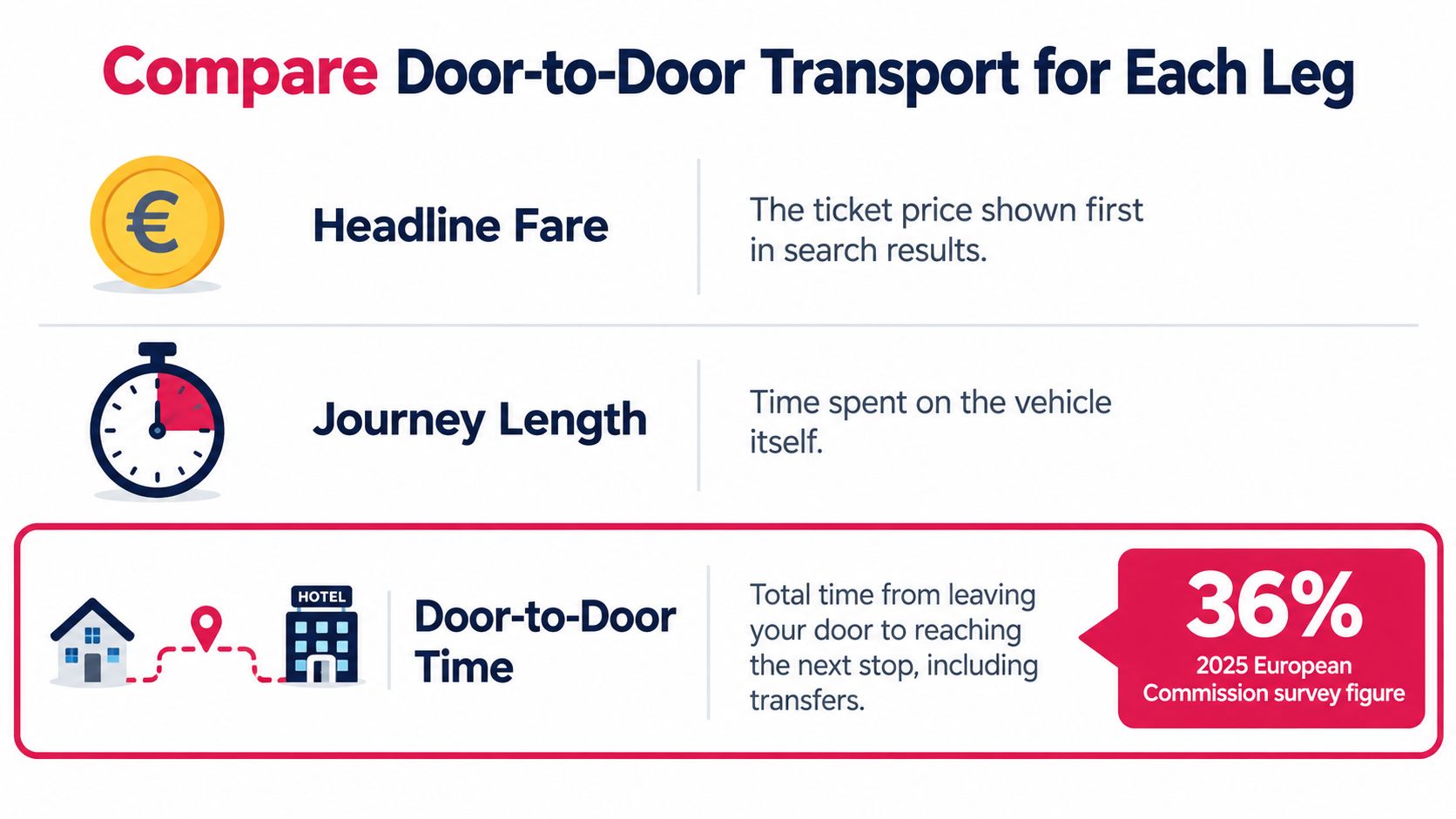
Multimodal booking adds its own friction on top of the fares. A 2025 European Commission survey found that 36% of Europeans struggle to book journeys combining transport modes, and 31% avoided booking them because the process was too complex, according to the European Commission's transport survey announcement. That is one more reason to compare legs on total door-to-door time and the cost of failure, not headline prices.
Keep these comparison metrics separate when searching.
Rail, flight and road compared door to door
The buffers below are starting allowances, not universal boarding rules. International trains can require substantially earlier arrival.
| Factor | Train (centre to centre) | Flight (airport to airport) | Road (coach or car) |
|---|---|---|---|
| Door-to-door time | Often competitive with central stations | Add airport access, security and arrival transit | Add traffic and pickup margin |
| Check-in and boarding | Often 10–30 minutes for domestic services; check international requirements | Start with around two hours before international flights; follow airline guidance | Often 10–15 minutes for coaches; check operator |
| Luggage | Often generous, but size, storage and handling rules apply | Check weight, dimensions and bag fees | Check coach allowance or vehicle capacity |
| Cross-border booking | Multiple operators may require separate tickets | Through bookings can simplify connections; self-transfers add risk | Check operator and border arrangements |
| Missed-connection risk | Ticket conditions determine rebooking rights | Tight or separate-ticket connections can be expensive to replace | Traffic and infrequent services increase exposure |
| Best fit | Roughly four-hour-or-shorter legs between central cities | Long distances or impractical rail routes | Short regional hops without useful rail |
Calculate the complete leg
- Add access at both ends. Use the actual hotel district, station entrance or airport terminal, not a generic city-center pin.
- Add realistic buffers. Start with about 30 minutes for a straightforward rail connection and about two hours before an international flight. Increase these for station changes, accessibility needs or operator requirements.
- Price the luggage you'll end up carrying. Include reservations, checked bags and the practical difficulty of lifting cases onto trains.
- Read connection protection explicitly. A single checkout doesn't necessarily mean a protected through-ticket. Separate tickets normally leave you responsible for reaching the next departure.
The four-hour line in the table is a rule of thumb, not a wall. Once the scheduled rail time climbs past that, airport overhead starts looking less painful. Below it, the station-to-station journey usually wins on usable hours even when the flight itself is shorter, because city-center arrival beats a 40-minute shuttle from an outlying terminal.
For a worked regional example, the Cork-to-Killarney planning guide walks through station access and onward travel on a short hop. If your route includes the United States and the group wants rail chosen for comfort and manageable pacing, Prime Journal's guide to senior train trips compares scenic US journeys on those criteria.
Use the video as another planning aid, then verify your chosen service directly.
With a group, assess the slowest traveler's realistic transfer pace. A theoretically achievable connection isn't useful if someone can't manage the stairs with their luggage, and a missed departure on separate tickets lands the rebooking cost on you.
Choose the shortest practical door-to-door journey with the strongest connection protection, not merely the shortest scheduled segment.
Pick an Accommodation Strategy for Each Stop
Choose your accommodation model before comparing individual properties. Hold the first and last nights on refundable rates until transport is locked, then check availability across the whole route before committing to restrictive bookings.
International demand makes that availability check worthwhile: UN Tourism reported approximately 1.4 billion international tourist arrivals worldwide in 2024, according to its World Tourism Barometer. That global total doesn't predict a particular hotel's availability, so search your actual dates rather than assuming rooms will remain open.
Choose the base model
| Model | When it works | Main trade-off |
|---|---|---|
| Single base with day trips | Nearby destinations have straightforward return transport | Less packing, but repeated journeys can consume time |
| Split stay | Each city deserves its own full days | Better local access, more checkouts and luggage handling |
| Moving hub | A short trip uses an arrival gateway and a different final base | Efficient departure positioning, but little room for disruption |
For a moving-hub trip under five nights, avoid changing hotels just to sleep closer to an attraction. The move should solve an arrival or departure problem, not create another task.
A split stay works better when the hotel is convenient for both the incoming leg and the activities you'll really do. A cheaper room on the outskirts can become poor value after repeated taxis and difficult evening returns.
Check the handover between hotels
Say your train arrives before a property's 3 pm check-in. Confirm whether staff will store luggage, whether that service costs extra and whether you can access it before reception opens.
For groups of six or more, request a room block and ask about deposits, rooming-list deadlines and the release date for unused rooms. Don't assume the cancellation terms match those offered to individual guests.
- Search constrained stops first. Check busy dates in Paris and London before committing to easier accommodation elsewhere.
- Compare equivalent stays. In Dubai and Abu Dhabi, compare the same dates, room occupancy, meal inclusions and cancellation terms.
- Record deadlines together. Put cancellation cutoffs, payment dates and room-block release dates in one calendar.
Work backward from the next non-refundable payment. Each stop's cancellation window should end before that next booking deadline, leaving time to review the route while changes are still affordable.
Budget Each Leg Before You Commit
Budget shares are planning heuristics, not measured averages or targets you must hit. Price the actual nights and legs first, then use the percentages to spot an itinerary that spends too much on moving and too little on staying.
Typical budget split for a multi-city trip
The ranges below are independent warning bands. They won't necessarily add up to a workable total at their upper limits.
| Cost line | Typical share | What drives it | Common mistake |
|---|---|---|---|
| Accommodation | 40–50% | Nights, district and room type | Choosing a hotel far from the station |
| Transport between cities | 15–20% | Number of legs and rail or flight choice | Ignoring bag fees and seat reservations |
| Local transport and transfers | 5–8% | Metro use, taxis and airport transfers | Forgetting the airport-to-centre leg |
| Timed tickets and activities | 10–15% | Must-see count and group size | Booking non-refundable slots before the route is set |
| Food | 15–20% | City price level and group habits | Budgeting only for restaurant meals |
| Buffer for changes | 10% | Connections and disruption exposure | Skipping the buffer entirely |
Build the total from actual choices
- Estimate accommodation by city and night. Record the full room total, taxes and occupancy before dividing shared costs.
- Add each intercity leg, including bags, seats, reservation charges and station or airport transfers.
- Price essential experiences. Separate must-see admission from optional activities so cuts are straightforward.
- Set a daily food range that includes breakfast, snacks, drinks and meals during transfers.
- Add a change buffer. Keep it separate from discretionary spending.
- Divide shared expenses by the travelers using them, add individual purchases, and convert currencies consistently.
Use Google Sheets or Excel with columns for city, currency, payer, cancellation terms and remaining balance. Don't divide every expense equally if room types, attendance or arrival dates differ.
For longer stays that include working days, Mazurly's guide to choosing a base for remote work can help frame recurring living costs separately from holiday spending.
Cut a stop before cutting resilience
Say four people plan a six-night, three-city trip. After pricing two flights with bags and airport transfers, transport takes far more than the group intended.
The sensible fix is to remove a city, not spend the emergency reserve before departure. Compare actual accommodation quotes too: don't assume a Lisbon or Cairo stay offsets every expensive Paris or London booking.
The costly mistakes are committing to a non-refundable fare before the route is settled and forgetting the outer-airport transfer. Hold about 10% unassigned until the last leg is booked, then retain whatever remains for changes during the trip.
Pack and Carry Luggage Across Stops
Pack for the most restrictive transport leg and the hardest luggage transfer, not the nicest hotel. A suitcase that rolls easily through an airport may still be awkward on stairs, cobblestones and crowded trains.
Pack in transfer order
- Check and weigh the bag first. Compare its packed weight and dimensions with every flight's allowance, including the return journey. Check rail and coach restrictions too.
- Build a capsule wardrobe around roughly one set of clothes per two nights, with layers that work across cities and an outfit suitable for dinner. Plan laundry rather than adding a fresh outfit for every day.
- Keep essentials with you. Medication, chargers, travel documents, passport copies and a change of clothes belong in your carry-on. Keep copies secure rather than loose in an outside pocket.
- Add a foldable daypack. Leave the main case at the hotel whenever possible instead of carrying it through sightseeing stops.
- Confirm storage arrangements. Match luggage storage access to checkout and departure times, and reserve it before the transfer day if the property allows.
- For groups, distribute shared supplies across two people. First-aid basics, adapters and printed confirmations shouldn't all disappear with one delayed bag.
Test what you can carry
Lift the packed case onto a raised surface and carry it up stairs. If that's difficult at home, it won't become easier while navigating an unfamiliar platform.
Keep liquids and items needed during departure procedures accessible. Put tickets and the next property's address somewhere you can reach without opening the whole suitcase.
Finally, weigh the complete load again, including the daypack and anything attached to the case. Compare it with each flight's specific allowance, not just the allowance on your longest flight.
Plan Fallbacks for Missed Connections and Late Check-Ins
Say your Milan–Florence train is delayed by 40 minutes and your Uffizi entry slot is suddenly doubtful. Check whether the attraction permits a change before rearranging the hotel or buying replacement transport; moving the activity, where permitted, may be the least expensive response.
A fallback needs an operator, departure point, usable timing and booking conditions. A vague intention to find another train won't help when everyone is standing on the platform.
Keep the next departure and the next property's contact details accessible.
Match the response to the failure
| Problem | Named fallback to record | What to verify |
|---|---|---|
| Missed connection | Later departure on the same line | Ticket validity, seat availability and last departure |
| Cancelled flight | Feasible rail service or replacement flight | Station access, journey length and new arrival time |
| Rail strike or closure | Coach or alternate rail routing | Whether the alternative uses the affected infrastructure |
| Late hotel arrival | Agreed late check-in or late hold | Reception hours, access instructions and contact method |
| Delayed luggage | Airline baggage report and essentials kit | Reporting process, delivery address and claim documentation |
Choose legs with a later same-day departure when possible. For the final service of the day, identify where you could stay if onward travel becomes impossible.
Decide what the group does
- Wait together when a vulnerable traveler needs support or the booking requires everyone to arrive together.
- Split deliberately when part of the group can continue safely and someone has agreed to accompany the delayed traveler.
- Move the activity when doing so costs less than replacing transport or accommodation, subject to the activity's terms.
For late check-in, message the property as soon as the likely arrival changes. Get acknowledgment of access arrangements rather than assuming a message alone prevents a no-show cancellation.
For delayed baggage, retain the reporting reference and purchase receipts. Follow the airline's process before leaving the airport, and give an address where you'll be when delivery is possible.
Before departure, agree whether the group waits, splits or changes the activity. Every vulnerable leg needs a named fallback you could reach within two hours; if none exists, allow an overnight recovery.
Lock the Plan with Your Group Before Booking
Use a survey-to-vote-to-book sequence instead of asking everyone to approve an unfinished itinerary in a chat. MyPerfectStay is one option for collecting private preferences, comparing activity match scores and turning agreed choices into a shared daily plan; a shared spreadsheet remains useful for transport conditions and fallback details.
The group needs to agree on what it's buying before anyone becomes responsible for everyone else's non-refundable costs. Separate approval of the route from approval of optional experiences.
Turn preferences into decisions
- Create the trip and share the invite link. Travelers can join without an account or app download. Put the agreed dates and city sequence in place so everyone responds to the same proposal.
- Ask each traveler to complete the two-minute private survey covering budget, interests, energy level and must-see ideas. Private answers help avoid a vocal traveler setting everyone else's spending level.
- Review overlap and match scores. Look for experiences that appeal across the group, but also notice when people want different pacing. An optional afternoon can work better than forcing unanimous participation.
- Set a voting deadline and send nudges through the organizer tools. Assign a named person to resolve unanswered logistics questions rather than letting them remain in the chat.
- Vote on activities once each stop's nights are fixed. Lock the agreed experiences, check attendance and booking terms, then book for the group in one click, with confirmations sent to participants.
- Review the auto-organized daily itinerary against actual transport times, property access and fallbacks. Adjust the day order wherever an activity depends on a fragile arrival.
Use these group travel tips to settle practical responsibilities, including who manages bookings and how shared decisions get approved.
A visible plan makes those decisions easier to discuss.

Check the commitments before payment
Confirm the exact participants for each experience, not merely the overall group size. Someone skipping a tour shouldn't accidentally be included in a non-refundable group purchase.
Save confirmations and access instructions offline, and give another traveler access to essential booking details. The organizer's phone shouldn't be the only place the itinerary exists.
Pre-booking checklist: The route order is fixed, nights match the agreed pace, every connection has a protected option or explicit recovery allowance, and each vulnerable leg has a named fallback. Everyone has approved their own cost before payment.
MyPerfectStay brings private preference surveys, activity voting and a shared daily itinerary into one group-planning process. Visit MyPerfectStay to turn your agreed multi-city route into experiences your group can choose and book together.