How to Plan a Trip Without Losing Your Mind
October 2, 2026·MyPerfectStay

You're in the group chat right now. Someone has suggested Paris, another person wants a beach weekend in Santorini, a third has found cheap flights to Marrakech, and one determined friend is still campaigning for a road trip. Twelve messages cover destinations, three mention budget, one introduces an entirely different transport plan, and nobody has answered the basic question: when can everyone go?
That's how trips become exhausting before anyone leaves home. Learning how to plan a trip isn't mainly about finding attractions. It's about compressing a messy negotiation into a sequence of decisions that people can finish.
Table of Contents
- The Group Chat Problem Nobody Talks About
- Locking Dates Before Anything Else
- Setting a Budget That Holds Up
- Matching Activities to Real Traveler Profiles
- Booking in the Right Order
- Replacing Endless Debate With Organizer Tools
- Your Pre-Departure Checklist and Common Traps
The Group Chat Problem Nobody Talks About
Most travel guides assume one person is choosing the destination, paying the deposits, checking availability, and deciding what everyone will do each day. Groups don't work that way. One traveler has limited annual leave, another won't spend beyond a firm ceiling, someone needs slower mornings, and a fourth person has a museum or football match that's a must on the list.
The group chat hides these differences instead of resolving them. People react to the latest suggestion, forget earlier objections, and treat silence as agreement. After a week, the loudest person may appear to have won, while the quieter travelers decide not to join.
Practical rule: Don't ask a group to choose from an unlimited list. Ask them to make one decision at a time, with a deadline and a clearly defined fallback.
The cost isn't just wasted planning time. It produces compromise destinations, abandoned bookings, and resentment when somebody discovers that the “relaxed city break” includes an early train, three hours of walking, and a dinner reservation nobody wanted. A practical guide to group travel tips from Approved Experiences Traveler is useful for the logistics, but the core problem comes earlier. The group needs a fair way to decide what deserves discussion in the first place.
Start by separating preferences, constraints, and vetoes. “I'd like to see the Louvre” is a preference. “I can't travel before Thursday” is a constraint. “I won't share a room” is a veto. Put each into a shared record, then move through dates, budget, destination, transport, accommodation, and activities in that order.
The organizer shouldn't become a full-time diplomat. Use a defined decision process, such as the one outlined in group decision-making methods, and assign an owner to each stage. The aim isn't to make everyone equally enthusiastic about every choice. It's to make the trade-offs visible, acceptable, and finished.
Locking Dates Before Anything Else
Dates come first because every later decision depends on them. A destination without dates is just a mood board. Once the window is fixed, the group can compare actual transport, accommodation, opening days, weather, and activity availability instead of arguing over imaginary versions of a trip.
Collect availability before you mention destinations. Ask every traveler to submit their workable windows, not their preferred single weekend. Include arrival and departure flexibility, work commitments, school schedules, and any date that is impossible. Put the responses into a poll and choose the window with the strongest overlap.
Use a decision gate
After the poll closes, publish one proposed date range and a response deadline. Don't reopen the question because somebody finds a more attractive hotel on different dates. If the window has enough participants and doesn't violate a stated constraint, lock it.
Date changes create cascading rework:
- Transport: Flight, rail, and ferry options change with the travel window.
- Accommodation: Larger rooms and connected properties disappear at different speeds.
- Activities: Timed-entry attractions, small-group tours, and restaurants may not operate every day.
- Leave and payments: Travelers need certainty before requesting time off or paying deposits.
For an international group trip, work backward over a nine-to-twelve-month planning horizon. At the earliest stage, collect availability and agree on the date window. After that, set a budget ceiling and shortlist destinations. Once the group chooses a destination, compare transport and accommodation, then reserve high-variance experiences as their availability becomes clear. Closer to departure, confirm documents, transfers, and the daily plan.
For shorter regional trips, a three-to-six-month timeline usually gives the group enough room to settle dates, compare destinations, book accommodation, and reserve activities without rushing. The exact booking window depends on the destination and season, but the order shouldn't change. Dates first, then the decisions that those dates make possible.
A 2024 Priceline survey of 3,024 U.S. adults found that the average traveler spends the equivalent of two full workdays, or 16 hours, planning and booking a trip, while 22% said creating the itinerary was one of the most frustrating parts of the process (Priceline research). Locking dates early won't remove every disagreement, but it stops the group from repeating the same comparisons after every new suggestion.
Setting a Budget That Holds Up
A group budget shouldn't be one attractive number copied from the most optimistic traveler. Build it in layers so people can see what is shared, what is personal, and where the trip can flex.
First, collect each person's private spending ceiling. Ask for a real maximum, not the amount they hope the trip might cost. Then separate shared costs, such as accommodation, airport transfers, group transport, and joint activities, from personal costs, such as shopping, upgraded rooms, extra drinks, and solo excursions.
Build three budget layers
- Fixed ceiling: The highest amount each person can responsibly spend.
- Shared kitty: A contribution for agreed joint expenses, tracked item by item.
- Personal allowance: Money each traveler controls without needing group approval.
The shared kitty should never become a mystery pot. Record who paid, what the expense covered, and who benefited. A splitwise-style tracker works well, especially when one person pays for a booking and the group reimburses them later. For solo travel, a simpler category split is enough: accommodation, transport, food, activities, and contingency.
Don't pretend Europe and MENA have one universal daily price. Paris, Dubrovnik, Dubai, Marrakech, Cairo, and Muscat have different accommodation markets, transport patterns, and activity prices. Use the table as a comparison framework, then fill it with live quotes for the exact dates and traveler profile.
Average Daily Travel Costs Europe vs MENA
| Expense Category | Western Europe per day | MENA per day |
|---|---|---|
| Accommodation | Compare current room or apartment quotes for the fixed dates | Compare current room, apartment, or resort quotes for the fixed dates |
| Food | Price breakfast, lunch, dinner, and drinks separately | Price local meals, hotel meals, drinks, and dietary requirements separately |
| Local transport | Check metro, rail, taxi, and airport-transfer needs | Check metro, taxi, private driver, and airport-transfer needs |
| One paid activity | Check attraction entry, guided tours, or timed experiences | Check museum entry, desert activities, guided tours, or private transfers |
This approach is more honest than invented regional averages. A group can also use a family vacation budget planner to expose the categories that families often forget, such as child-specific activities, room arrangements, and food preferences.
The friend who always upgrades is part of the budget, not an exception to it. Decide in advance whether upgrades are personal, shared only when everyone agrees, or excluded. If someone wants a premium hotel, private transfer, or expensive tasting menu, they shouldn't push the entire group into paying for it.
A budget survives when people know what they can decline without defending themselves.
Matching Activities to Real Traveler Profiles
“I like culture” tells you almost nothing. It doesn't reveal whether someone wants a dawn walking tour, a long museum visit, a café stop between landmarks, or a single historic site followed by a slow lunch.
Use three hard variables instead: daily energy, pace tolerance, and must-see priorities. An early-riser hiker may happily start the day before breakfast but struggle with a late dinner. A museum marathoner may tolerate slow movement indoors but dislike a packed schedule of transfers. A café-and-photo traveler may care less about checking off landmarks and more about having unhurried time in attractive neighborhoods.
Score the real trade-offs
Ask each traveler to score activities privately against those three variables. Weight must-see items more heavily than optional interests, then remove ideas that fail a basic constraint, such as mobility, heat tolerance, opening hours, or travel time.
| Activity | Early Riser Energy | Steady Pacer Pace | Slow Explorer Must-See |
|---|---|---|---|
| Sunrise viewpoint | High fit | Moderate fit | Low fit unless essential |
| Major museum | Moderate fit | High fit | High fit if chosen as a must-see |
| Long walking route | High fit | Moderate fit | Low fit |
| Café and neighborhood wander | Moderate fit | High fit | High fit |
| Timed group tour | Moderate fit | High fit if transfer is short | Moderate fit |
A group of six doesn't need twenty activity ideas. It needs a shortlist that survives the matrix. Rank the options, keep the strongest matches, and allow one personal-choice block where people can split up without treating the separation as a failure.
For a five-day European itinerary, a sensible structure might include one major anchor activity per day, one flexible neighborhood block, and at least one deliberately light morning. Paris, Rome, Barcelona, and Lisbon all reward this approach because the interesting parts of the city aren't limited to the headline attraction. Put a museum or landmark on the day when the group has the energy for it, then leave space for food, wandering, or a change of plan.
The same framework changes in MENA. In Marrakech, Cairo, Amman, Muscat, or Dubai, heat, prayer times, Friday schedules, driving distances, and indoor versus outdoor timing can reshape the day. Put walking and outdoor sightseeing where conditions are more comfortable, protect breaks, and check operating schedules before you build a tightly timed route.
If the group chooses island activities in Santorini, transport deserves its own score. Comparing parking, transfers, and driving confidence matters before exploring World Auto Hire Santorini deals, because the cheapest activity can become a poor choice if nobody wants to manage the journey.
Build the day around the lowest-energy traveler, then add optional layers for everyone else. That person shouldn't dictate the entire trip, but their limits should define the shared schedule. The early riser can take a sunrise walk. The museum enthusiast can add a second gallery. The slow explorer gets a day that doesn't feel like a punishment.
Booking in the Right Order
“Book early” is incomplete advice. The useful question is, what becomes hardest or most expensive to replace if the group waits?
The classic order is flights, hotels, then attractions. That works for a simple trip, but it can fail for groups. A flight may have several workable alternatives. A small-group food tour, limited train, Colosseum underground visit, or dinner reservation for a large party may not.
A variance-first strategy ranks bookings by the cost of being wrong and the number of alternatives available. Reserve the items with narrow availability first, especially when the group has already locked dates and the activity is central to the trip.
A ten-week countdown
For a European trip, use the following gates:
- Week 10: Lock the dates, shortlist transport, reserve scarce attractions, and check accommodation cancellation terms.
- Week 6: Confirm accommodation, book limited rail routes or small-group tours, and reserve restaurants that matter to the group.
- Week 3: Recheck transport times, transfer requirements, opening hours, and every booking name.
- Week 1: Download confirmations, distribute the final itinerary, and leave flexible blocks untouched.
For a MENA trip, the same countdown needs more attention to private transfers, drivers, heat-sensitive activities, prayer schedules, and route length. At week 10, identify any desert, diving, guided, or intercity elements that depend on limited operators. At week 6, confirm the driver or transfer plan. At week 3, verify meeting points and local operating conditions. During the final week, keep copies of confirmations and make sure the group knows how to reach the organizer.
Independent itinerary data indicates that activity planning rises between 90 and 180 days before departure, peaks around 56 days out, and drops sharply inside the final two weeks (itinerary-planning analysis). The same report says lunch is searched and planned 50% more often than dinner within itineraries. That suggests a practical correction: groups often over-plan routine meal slots while leaving the middle of the trip under-specified.
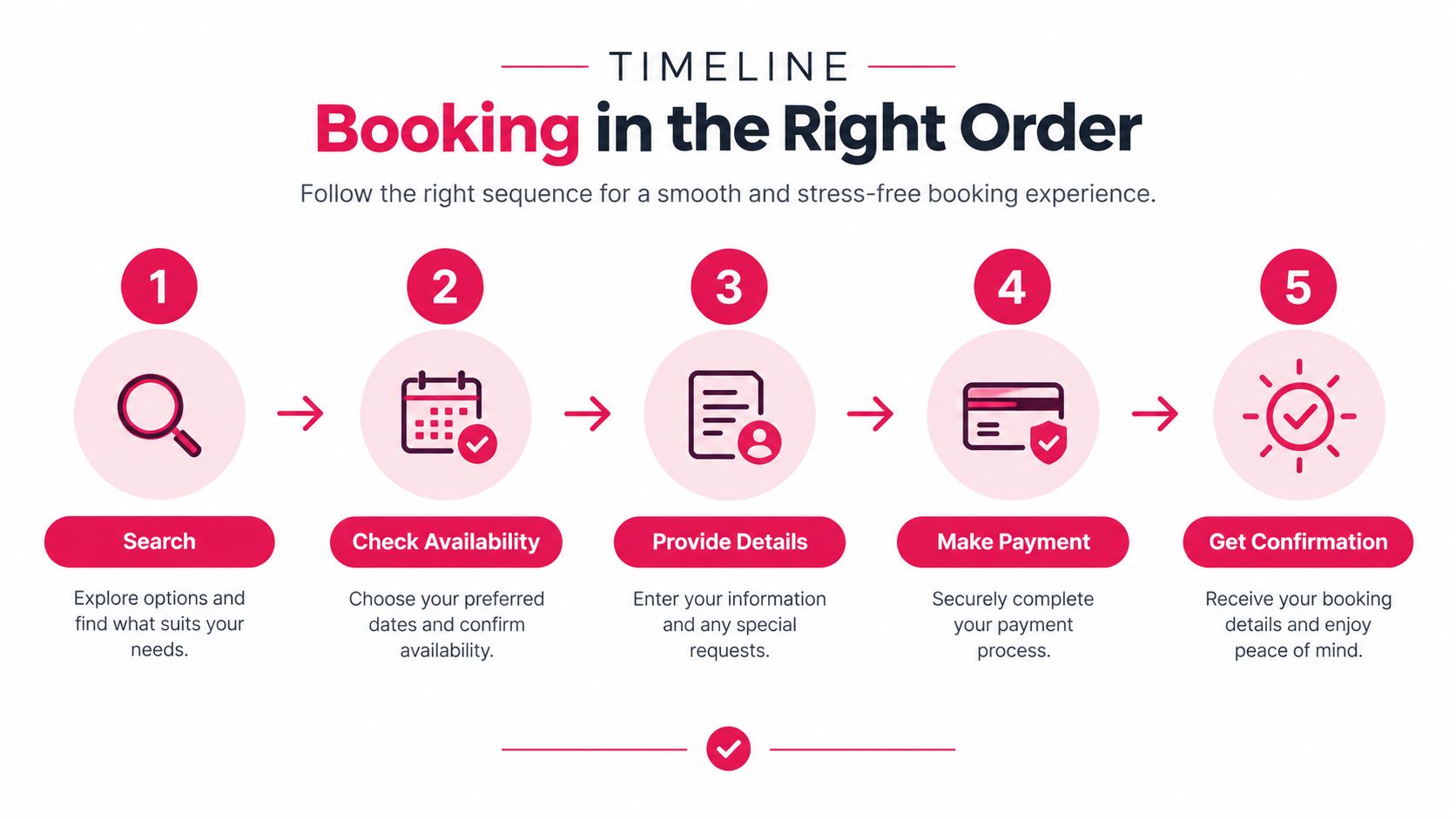
Reserve high-variance items first, then fill low-variance blocks. A refundable booking is usually worth considering for a large group because one cancellation can disrupt rooms, transport, and activities. A smaller group may accept a non-refundable rate when the saving and certainty justify it, but that should follow a clear risk decision, not personal habit.
Here's a visual walkthrough of the booking sequence:
Replacing Endless Debate With Organizer Tools
The group chat is excellent for jokes, urgency, and finding out who has lost their passport. It's a terrible database. Important decisions disappear under restaurant photos, unread reactions, and messages from people who were asleep when the question was posted.
Create one source of truth in Notion, Google Docs, or a similar workspace. The page should show the destination, dates, travelers, budget rules, confirmed bookings, open decisions, and firm requirements. Every open decision needs an owner, a deadline, and a default answer if nobody responds.
Give every decision a status
Use simple labels:
- Open: The group still needs to provide information.
- Voting: The options are fixed and responses are being collected.
- Locked: The deadline passed and the choice won't be reopened without a serious reason.
- Booked: Payment or confirmation is complete.
A WhatsApp version of the discussion might look like this:
“Should we do the museum on Tuesday? Anyone? What about Wednesday? I think Tuesday is better. Does everyone agree?”
The shared-document version is cleaner:
Museum visit, voting: Tuesday or Wednesday.
Owner: Sam. Deadline: Friday evening.
Default: Tuesday, unless a traveler has a documented schedule conflict.
Use binary vote buttons for choices such as train or taxi. Use weighted voting when budget matters, giving travelers a way to indicate that a premium option is acceptable but not essential. Keep a pinned fixed requirements section at the top so the group doesn't reopen the same argument every few days.
The same page should include medical and access needs without exposing private details unnecessarily. If somebody needs medication planning, mobility support, or a specific food arrangement, record the practical requirement and the responsible action. A resource on preparing for a hike with diabetes illustrates why health considerations belong in the plan rather than being treated as an afterthought.
The organizer can also use a deadline calendar, automatic reminders, link invites, and an expense tracker. A dedicated group planning app can reduce the number of separate tools, but the principle stays the same: each traveler sees what has been decided, what remains open, and what happens if they don't vote.

Don't ask for endless consensus. Ask for informed participation by a deadline. Fairness comes from showing the options and the trade-offs, not from keeping every decision open forever.
Your Pre-Departure Checklist and Common Traps
A good plan should become shorter as departure approaches. If the document keeps growing, you're probably collecting inspiration instead of making decisions.
Eight to six weeks before departure
- Documents: Check passport validity, entry rules, visas, and required permits for every traveler.
- Insurance: Confirm medical, cancellation, baggage, and activity coverage.
- Health: Review prescriptions, destination health advice, and any support needed for mobility or chronic conditions.
- Core bookings: Check that names, dates, room types, and cancellation terms match the final plan.
Four to two weeks before departure
- Bookings: Reconfirm transport, accommodation, tours, restaurant reservations, and transfers.
- Shared itinerary: Send one current version with addresses, confirmation details, meeting points, and free blocks.
- Emergency contacts: Add accommodation contacts, transport providers, travel companions, and a trusted contact at home.
- Payments: Record who paid, what the payment covers, and which reimbursements remain open.
One week before departure
- Packing: Split clothing and equipment by climate, planned activity, and cultural requirements.
- Money: Arrange the currencies and payment methods needed for the destinations, without relying on one card.
- Offline access: Download maps, confirmations, translation tools, and essential addresses.
- Home preparation: Arrange care for pets and plants, secure the property, and share the final emergency details.
A ten-day Spain itinerary may require advance train planning when the route covers several cities. That plan still needs unscheduled time, because a full calendar turns every delay into a group crisis. A Jordan route may need driver coordination, longer transfer checks, and careful attention to how Petra, Wadi Rum, Amman, and other stops fit together. The checklist stays the same, but the transport questions change.
The traps are predictable. Groups over-optimize until breakfast has a departure time and every viewpoint has a maximum photo allowance. They ignore the friction between cities, split hotel costs unfairly when rooms differ, and skip cancellation policies until someone drops out. They also confuse “everyone approved the destination” with “everyone can manage the itinerary.”
Europe remains a strong testing ground for this method. The region recorded 747 million international arrivals in 2024, reported at 1% above 2019 levels and 5% above 2023 (European destination overview). Paris, London, Istanbul, Rome, and Barcelona are useful examples because they combine major sights with real transport and energy trade-offs. London recorded 20,715,900 international visitors, Paris 16,863,500, Istanbul 12,121,100, Rome 9,703,200, and Barcelona 6,726,000 in one 2026 city ranking (European city visitor ranking).
The final test is simple: can every traveler find their budget limit, must-see item, energy requirement, booking, and next deadline without searching the chat? If not, the plan isn't finished.
Stop asking your group to vote across scattered messages. MyPerfectStay lets travelers privately share budgets, interests, energy levels, and must-see ideas, then surfaces matched experiences, shared votes, and an organized daily itinerary. Start a trip there, invite the group, and turn the next debate into a decision you can book.