Maximum Impact Travel: Guide to Sustainable Tourism
October 4, 2026·MyPerfectStay
Travel has become one of the world's largest coordinated movements of people, money, and attention. That scale changes the question travelers should ask. “How can I reduce harm?” matters, but a stronger question is, how can each decision create the greatest practical benefit for local communities, the environment, and the people taking the trip?
Maximum impact travel treats sustainability as a decision-quality problem. It helps travelers compare destinations, experiences, transport, and spending patterns instead of applying a simple green label to an entire holiday.
Table of Contents
- Why Travel Impact Matters Now
- Understanding Maximum Impact Travel
- The Economics of Conscious Travel
- Measuring Impact Across Destinations
- How Travelers Can Plan for Maximum Impact
- Strategies for Hotels and Hospitality Brands
- Guidance for Travel Creators and Influencers
- Building Your Maximum Impact Itinerary
Why Travel Impact Matters Now
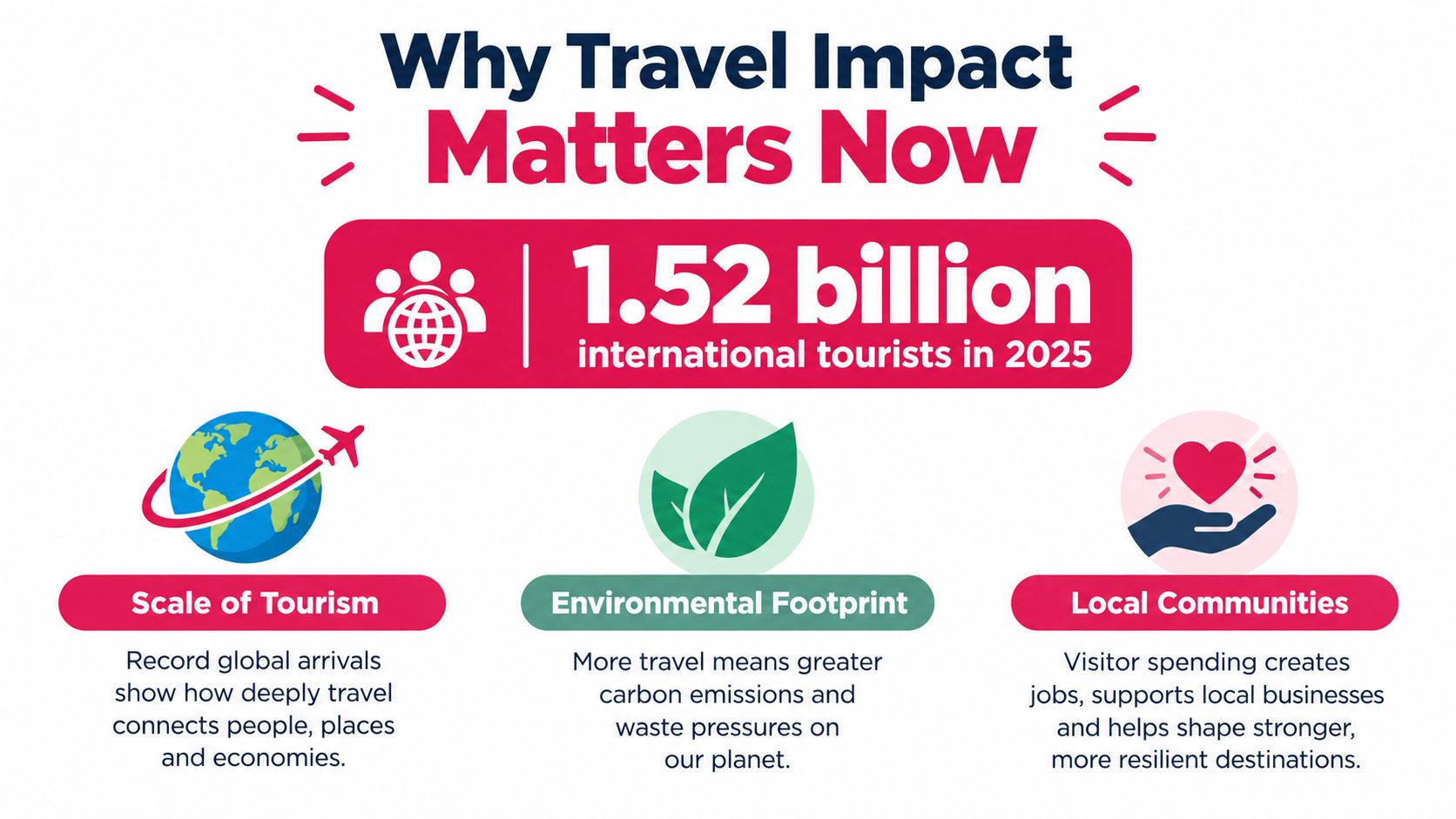
In 2025, global tourism reached an estimated 1.52 billion international tourists, according to UN Tourism's World Tourism Barometer data. A city such as Paris, London, Rome, Istanbul, or Barcelona isn't receiving visitors in isolation. Hotels, restaurants, guides, transport operators, attractions, and residents all experience the consequences of those choices.
Consider two visitors arriving in Istanbul. Both may book similar accommodation and visit the same historic district. One spends most of the trip through an international chain, takes only pre-packaged excursions, and follows the same congested route as every other visitor. The other chooses a locally operated food walk, uses public transport where practical, visits a less pressured neighborhood, and pays directly for a craft workshop led by residents.
Neither traveler needs to be perfect. The difference lies in where money goes, how visitor pressure is distributed, and whether the experience strengthens local livelihoods. Repeated across millions of trips, those decisions influence which businesses survive and which places become overcrowded.
From avoiding harm to creating value
Traditional sustainable tourism often asks travelers to reduce waste, emissions, or resource consumption. Those goals remain important, but they don't answer every practical question. A low-impact activity may still provide little value to residents, while a slightly more resource-intensive choice could support local employment, protect cultural knowledge, or keep spending in the destination.
Practical rule: Don't judge a trip by one label. Judge the combined result of its transport, accommodation, activities, spending, and effect on local life.
Maximum impact travel therefore favors informed trade-offs. A traveler might choose a rail-connected European city, book a locally owned experience in Marrakech, or replace an overcrowded attraction time slot with a community-led activity nearby. The strongest itinerary isn't always the cheapest or the most visibly “green.” It's the one that aligns experience quality, affordability, local benefit, and manageable pressure.
Understanding Maximum Impact Travel
Maximum impact travel is a proactive approach to tourism that seeks to increase positive economic, social, and environmental outcomes. It doesn't mean chasing an idealized, impact-free holiday. Travel always uses resources and affects places. The practical aim is to allocate limited time and money more thoughtfully.
The framework has three connected questions:
- What does the traveler need? Consider budget, interests, mobility, energy level, dietary requirements, and preferred pace.
- What does the destination need? Look at seasonality, congestion, local ownership, cultural sensitivity, and the capacity of communities to absorb visitors.
- Which choice produces the strongest combined result? Compare the experience, local benefit, environmental pressure, convenience, and price before booking.
This is different from passive sustainability. Passive sustainability says, “Choose the option with the smallest negative footprint.” Maximum impact travel asks, “Among realistic options, which one creates the most useful overall outcome?”
A decision framework, not a moral test
Sustainability remains influential for around half of international travelers choosing travel service providers and roughly two-thirds choosing a destination, according to VisitBritain's sustainable and regenerative tourism research. Yet travelers still need help turning those preferences into itinerary decisions.
A traveler who cares about local benefit might compare a large bus tour with a small, resident-led walking experience. A family concerned about convenience might select a centrally located hotel that reduces daily transfers, then spend its activity budget with neighborhood businesses. A group with different priorities might accept one higher-value excursion while choosing simpler, lower-cost activities elsewhere.
The framework also prevents sustainability from becoming a binary filter. A hotel without an impressive label isn't automatically irresponsible, and a certified property isn't automatically the best fit for every trip. Travelers should ask who owns the business, who receives the spending, what the activity requires from the destination, and whether the experience respects local life.
The impact triangle
Use three points to test any option:
- Traveler value: Does it deliver a meaningful, enjoyable experience at an acceptable price?
- Local value: Does spending reach residents, independent operators, producers, guides, or cultural organizations?
- Planetary value: Does the choice avoid unnecessary transport, waste, resource use, or pressure on fragile places?
The best decision balances all three. That balance makes maximum impact travel practical rather than aspirational.
The Economics of Conscious Travel
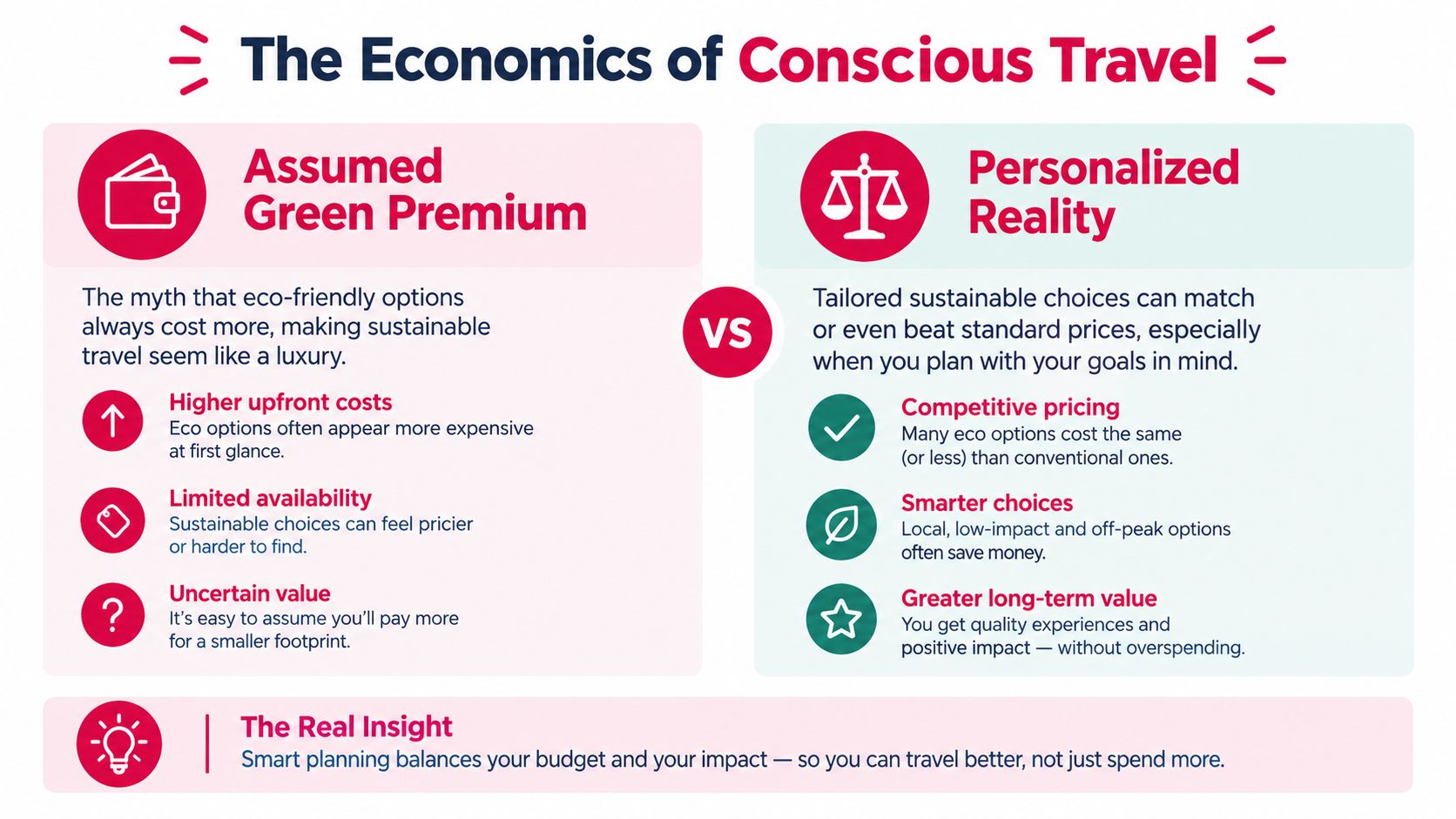
Sustainable travel is often presented as a premium product. In practice, the cost depends on timing, personalization, coordination, and the alternatives being compared. A locally operated walking tour may cost less than a private excursion. A central hotel may reduce repeated transfers. A carefully chosen regional activity may replace several poorly matched purchases that leave travelers dissatisfied.
Personalization creates the commercial bridge between impact and profitability. Medallia reports that 61% of consumers are willing to spend more for a customized experience, while only 23% of hotel guests said they had experienced high levels of personalization after recent stays. The gap suggests that many businesses still offer generic products even when travelers are open to paying for something more relevant.
The impact triangle in financial terms
Think of the economics through three questions:
| Question | What to examine |
|---|---|
| Fit | Does the experience match the traveler's interests and energy? |
| Fair value | Does the price reflect quality and produce a visible local benefit? |
| Timing | Is the recommendation offered while the traveler can still make a decision? |
The timing point matters because relevant recommendations lose value once the traveler has committed the budget elsewhere. A hotel that offers a preference-matched food tour after booking has a clearer opportunity than one that presents a long, generic list at checkout.
APAC travel research cited by Hotels Magazine found that 68% of travelers would increase hotel spending for personalized experiences. The same research reported that 73% would pay up to 30% more for room upgrades offered after booking, and 73% would be more likely to rebook when hotel experiences were customized. These findings support a practical conclusion: travelers don't necessarily resist spending more. They resist spending more on options that feel irrelevant, unclear, or poorly timed.
Making conscious choices affordable
Maximum impact doesn't mean selecting the most expensive local product. It means matching the right option to the right traveler. A budget-conscious visitor to Lisbon might choose a public-market food experience and a self-guided neighborhood route. A couple in Muscat might spend more on a small-group nature activity because the experience offers stronger personal value and direct local participation.
For hotels and travelers alike, the strongest offer combines clear benefit, credible local value, and transparent pricing. That approach can support communities without turning sustainability into a luxury category.
Measuring Impact Across Destinations
Destination popularity creates both opportunity and pressure. Visa's 2024 to 2025 travel insight lists Paris at about 34 million arrivals, followed by London, Barcelona, Istanbul, and Palma among Europe's leading destination cities. These places deserve attention not because every traveler should visit them, but because decisions in high-volume destinations affect a large network of residents and businesses.
Eurostat's platform-booking data lists Paris with 26.3 million guest nights, Rome with 18.8 million, Barcelona with 13.2 million, Madrid with 12.3 million, and Lisbon with 11.6 million. Those figures support a Europe-first approach to destination planning, while also showing why travelers should think beyond the most concentrated landmarks.
Traditional planning versus impact-led planning
| Traditional approach | Maximum impact approach |
|---|---|
| Selects the most famous attraction | Compares famous sites with less pressured alternatives |
| Books the first convenient operator | Checks ownership, group size, and local participation |
| Treats sustainability as a label | Evaluates transport, spending, culture, and visitor pressure together |
| Optimizes the organizer's preferences | Finds overlap across the whole group |
| Measures success by how much was seen | Measures success by fit, satisfaction, and destination benefit |
High-friction, high-intent travel becomes useful here. A little effort before booking can reveal whether a group truly wants a museum, a food market, a long hike, or a relaxed neighborhood afternoon. The extra planning reduces unsuitable bookings and can distribute spending more intentionally.
A beach comparison can make the principle clearer. Someone researching a local coastal experience may encounter a guide to Starfish Beach in Panama, but the same evaluation method applies closer to Europe and MENA. Ask how visitors reach the site, whether local operators participate, how fragile the environment is, and whether the experience supports residents rather than just increasing footfall.
What to measure
Travelers and businesses can score each option qualitatively across four areas:
- Local ownership: Who runs the accommodation, tour, restaurant, or activity?
- Distribution of pressure: Does the choice concentrate visitors in a fragile hotspot or spread demand?
- Cultural respect: Does it give residents control over how their culture is presented?
- Experience fit: Will the option satisfy the actual people taking the trip?
A popular destination isn't automatically a poor choice. The better question is whether the itinerary adds pressure without adding value, or whether it connects visitor spending with a well-managed local experience.
How Travelers Can Plan for Maximum Impact
Start before anyone searches for activities. Ask each traveler to record a private view of budget, interests, energy level, and must-see ideas. Private responses help people state their true preferences, especially when one person usually dominates the group conversation.

Build the shortlist around overlap
A group visiting Rome might include one person who wants ancient history, another who prefers food, and a third who can't manage a full day of walking. Instead of voting on dozens of disconnected ideas, create a shortlist that meets more than one need. A food-focused route near historic sites, a shorter guided visit, or a neighborhood market can create more overlap than separate specialist activities.
Research on group travel identifies a growing coordination problem. Simon-Kucher's global travel trends research describes the rise of high-friction, high-intent planning, where people want fast shared decisions but still disagree over budgets, energy, and preferences.
Use a simple scoring method:
- Record individual priorities privately.
- Remove activities that conflict with essential constraints, such as mobility needs or a firm budget.
- Rank the remaining choices by preference overlap.
- Check local value and operating practices before confirming.
- Book one or two shared anchors, then leave space for independent time.
A group-planning platform such as MyPerfectStay can collect private surveys, analyze shared preferences, surface activities with match scores, organize a daily itinerary, and support group booking. Travelers looking for ideas can also use a resource on authentic travel experiences to evaluate activities by depth and local connection rather than appearance alone.
Put local benefit into the booking checklist
Before choosing an experience in Paris, Marrakech, Athens, Istanbul, or Dubai, check whether the operator names its guides, producers, artisans, or community partners. Look for clear meeting instructions, realistic group sizes, and descriptions that explain what guests will do rather than relying only on attractive imagery.
Don't try to optimize every minute. A maximum impact itinerary should leave room for rest, unplanned spending, and respectful interaction. The aim is a trip that works for the group and contributes to the destination, not a schedule so dense that everyone defaults to the most convenient chain.
Strategies for Hotels and Hospitality Brands
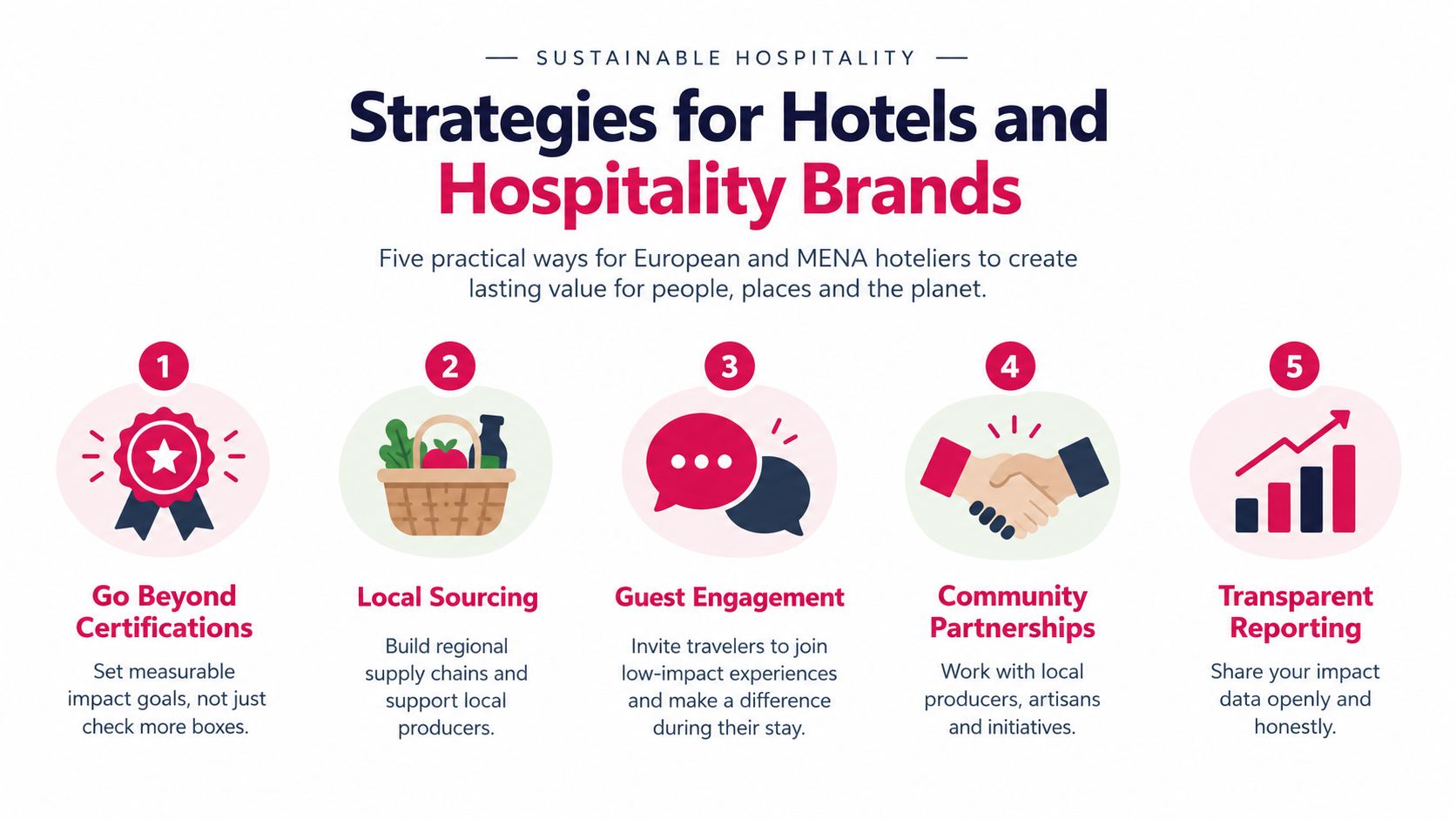
Hotels can turn maximum impact travel into a concrete guest experience by connecting local partnerships with useful personalization. A sustainability certificate may reassure guests, but it doesn't replace a carefully designed activity, a transparent supply chain, or a recommendation that fits the individual traveler.
Build a local experience portfolio
Start with a small, credible set of partners in the surrounding destination. A hotel in Lisbon could work with a neighborhood food producer, an independent guide, and a cultural venue. A property in Amman might connect guests with a local cooking experience or a guide who can explain the cultural context of Petra without reducing the destination to a photo stop.
Each listing should explain the host, the activity, the duration, the level of physical effort, the meeting point, and the reason the experience matters locally. Guests can then make informed choices instead of receiving a vague “things to do” brochure.
Use preference data responsibly
Capture useful information at the right moments. Pre-arrival questions can identify interests and mobility needs. Booking data can reveal trip purpose. Post-booking messages can present a small number of relevant options rather than a long catalogue.
BCG reports that brands using personalized experiences with advanced digital technologies and proprietary data see revenue increases of 6% to 10%. The same source cites Adobe and Forrester research showing that the top 25% of travel brands operating as experience-based businesses achieved 2x revenue versus competitors. Personalization works best when the data is accurate, the recommendation is relevant, and the offer reaches the guest before plans are fixed.
Make impact visible without exaggeration
Hotels should report practical information. Name local partners, explain purchasing decisions, show how guests can participate in low-impact activities, and avoid broad claims that can't be verified.
For hospitality teams that want to list properties or connect with experience-led guest planning, MyPerfectStay's partner information provides a relevant starting point. The commercial opportunity lies in creating ancillary offers that improve the stay while directing spending toward responsible local operators.
Guidance for Travel Creators and Influencers
Travel creators shape demand long before a viewer opens a booking page. A short video can turn a quiet neighborhood into a crowded route, while a thoughtful guide can distribute attention toward local businesses and experiences that visitors might otherwise miss.
The market is large enough to make this responsibility commercially important. McKinsey estimates the worldwide experiences economy at roughly $1.1 trillion to $1.3 trillion, establishing experiences as a core travel category rather than a minor add-on.
Show the full decision
Don't present a destination only through its most photogenic moment. Explain when to visit, how to behave, what the experience requires physically, and whether the operator is locally based. If a site is fragile or crowded, provide an alternative rather than turning the warning into another reason to visit immediately.
Creators should also separate personal preference from universal advice. “This suited my walking-heavy trip” is more useful than presenting one itinerary as ideal for everyone. Include options for different budgets, energy levels, and group types, especially for families and multi-generational travelers.
Choose partnerships carefully
Before accepting a campaign, ask:
- Who operates the experience?
- What does the audience's spending support?
- Does the partnership encourage concentration in an already pressured area?
- Can the brand substantiate its environmental or community claims?
- Will the content help viewers make a better decision?
Track outcomes beyond views. Creators can use DTC brand influencer measurement to evaluate audience quality, engagement, and conversion patterns, then compare whether campaigns attract people who take a relevant action.
Give audiences a practical next step
A responsible post should help viewers move from inspiration to planning. Offer a local operator, a quieter time window, a public transport route, or a way to compare activities by group fit. Clear disclosure also protects trust. Audiences are more likely to follow recommendations when creators explain commercial relationships and avoid inflated claims.
Building Your Maximum Impact Itinerary
A maximum impact itinerary doesn't require perfect choices. It requires a visible chain of reasoning from preference to purchase.
Use this final checklist:
- Define the trip: Record budget, interests, energy, accessibility needs, and must-see priorities.
- Compare destinations: Start with European and MENA cities such as Paris, Lisbon, Rome, Marrakech, Istanbul, Muscat, or Amman, then examine visitor pressure and local options.
- Shortlist experiences: Prefer activities with clear hosts, transparent descriptions, and a credible connection to the local community.
- Test the trade-offs: Consider price, convenience, environmental pressure, cultural respect, and likely group satisfaction together.
- Coordinate fairly: Let every traveler contribute privately before the group commits.
- Leave capacity: Build in rest, flexibility, and room for local recommendations.
The goal isn't to consume more experiences. It's to choose experiences with better fit and stronger consequences. When travelers, hotels, and creators make those decisions consistently, sustainability becomes an active practice rather than a label.
MyPerfectStay helps groups compare destinations and experiences, collect private preferences, vote on shared options, and organize a bookable itinerary around clear match scores. Visit MyPerfectStay to plan your next Europe or MENA group trip with faster, fairer decisions and more thoughtful local experiences.