Open Budget Survey: How to Plan a Group Trip Budget
November 4, 2026·MyPerfectStay
The group chat is full of restaurant links, hotel screenshots, and enthusiastic reactions. You're trying to turn them into a trip, but nobody's quite said what they can comfortably afford. Asking everyone to post their budget publicly feels awkward, and booking first would be worse.
A group-trip open budget survey gives people a private way to share their limits before you make shared decisions. Here, “open” means the planning process is clear, not that everyone's finances are public. It's distinct from the International Budget Partnership's Open Budget Survey, which assesses government budget accountability.
Table of Contents
- Why Group Trips Need a Budget Range, Not One Number
- How to Build Your Open Budget Survey Step by Step
- Question Formats That Surface Real Limits
- Protecting Privacy and Participation
- Turning Answers Into a Budget Range
- Choosing a Plan When Ceilings Clash
- Confirm the Shared Budget Before You Book
Why Group Trips Need a Budget Range, Not One Number
Say six friends are planning a three-night Paris city break. One can spend €400 per person for the trip, two can spend €900, and the others haven't answered. Someone suggests an apartment, but nobody knows whether the figure in the chat covers accommodation alone or the entire group's stay.
Even after you settle the units, a single ceiling hides important choices. A traveler who wants simple accommodation and memorable meals may have the same overall budget as someone who wants a comfortable room and inexpensive food.
According to Euronews' coverage of European travel spending, accommodation accounts for about 32% of trip spending, while food and drink account for 24%. The same coverage reports that 62% of Europeans planned to keep travel spending unchanged through November 2025, while 22% expected to spend more. Those intentions don't tell you what your friends can afford, but they show why economizing in every category isn't the only useful approach.
Ask about trade-offs, not just affordability
A useful survey collects:
- A private ceiling: The maximum each traveler can comfortably commit.
- Preferred spend bands: What feels reasonable, rather than merely possible.
- Category priorities: Where someone would welcome an upgrade.
- Hard-no thresholds: Costs or conditions that would make an option unacceptable.
For a family trip, use the Stay Norwich Apartments family holiday guide as a conversation prompt while identifying the needs your budget must accommodate. Decide what the family needs before comparing attractive properties.
Practical rule: Ask what each person can pay, where they'd spend more, and what they won't accept.
Before building the form, settle trip length, currency, and budget unit. Every amount should say whether it means per person, per night, or the group total.
How to Build Your Open Budget Survey Step by Step
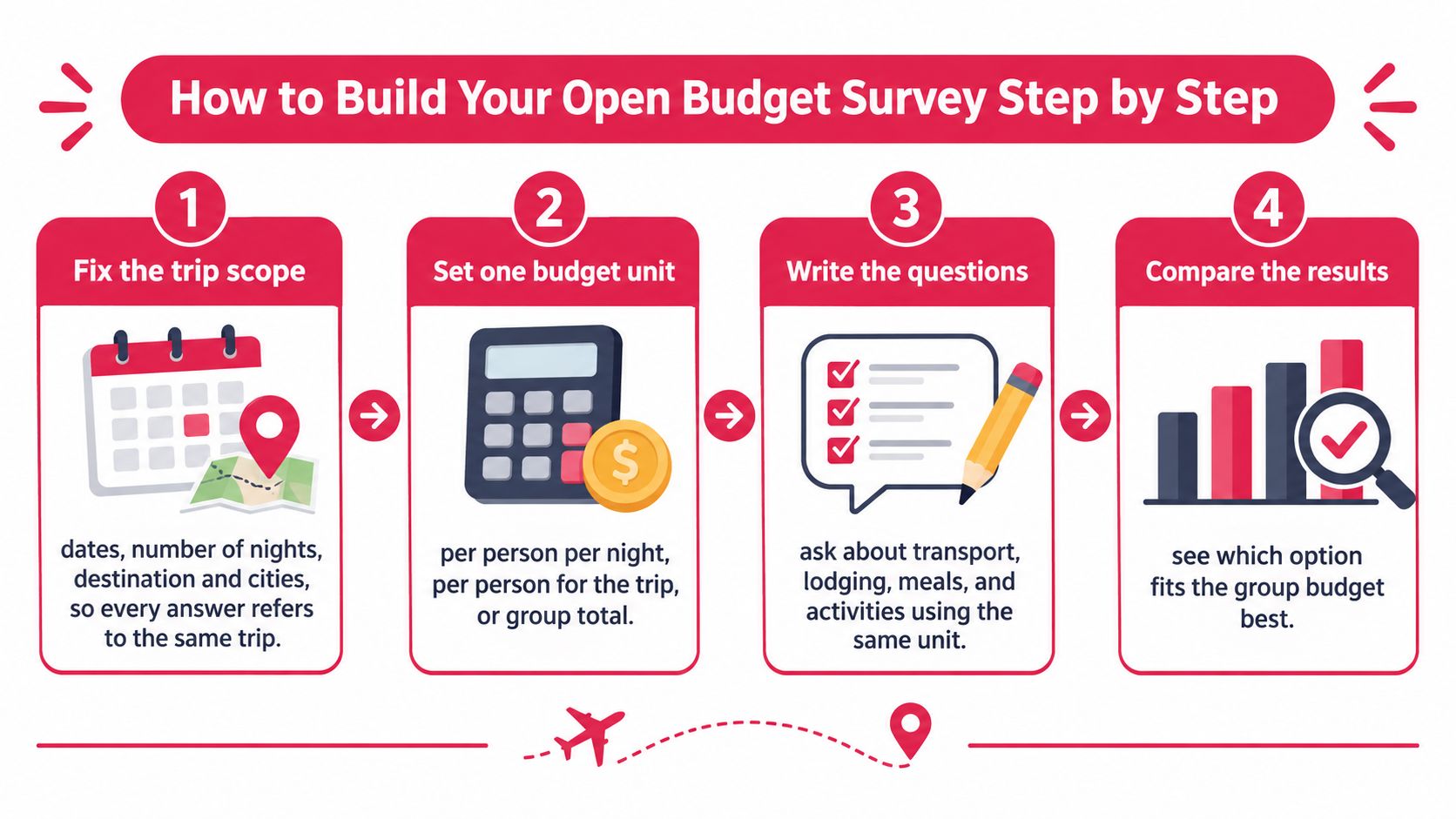
Build the survey in Google Forms, Microsoft Forms, or another form builder that lets you restrict access to responses. Start with the trip definition, not the questions. Otherwise, people may answer accurately about completely different versions of the holiday.
The workflow should stay simple enough that the organizer can explain it without a separate instruction sheet.
Build a form people can answer independently
-
Fix the trip scope. Put the proposed dates, number of nights, destination, and any additional cities in the description. If dates remain flexible, name the specific option people should price mentally rather than asking them to imagine their own itinerary.
-
Choose one budget unit. A sample title could be “Paris trip budget, EUR per person for the whole trip.” Mixing per-night answers with whole-trip answers makes comparison meaningless, even when every respondent has entered a valid number.
-
Select the cost categories. For a compact draft, use accommodation, food and drink, activities, transport, nightlife, and shopping, keeping to six or fewer categories. Aim for a form someone can finish in under two minutes, but test that target rather than promising it.
-
Add the private ceiling. Use a numeric field paired with a currency selector such as EUR, GBP, or USD, and provide a separate “rather not say” choice. A bare answer of 600 isn't usable until you know its currency and what it includes.
-
Ask for preferred bands and priorities. Separate what someone would like to spend from their absolute maximum, then let them rank spending categories. Don't treat a high ceiling as permission to choose the most expensive version of everything.
-
Collect boundaries and must-haves. Ask about unacceptable costs, accommodation conditions, and experiences someone considers essential. Keep required accessibility needs separate from optional preferences so they aren't accidentally traded away.
-
Set a deadline and distribute one link. A practical starting point is a deadline five to seven days after sending, adjusted for the group's availability. If you're putting a custom form on a public page, consider how to add spam protection to survey forms so irrelevant submissions don't contaminate the responses.
-
Test with one friend. Ask them to complete the form without your help and time the attempt. Any question they need you to explain should be rewritten before the group receives it.
Define what the ceiling includes
State whether the budget covers travel to the destination, local transport, accommodation, meals, and activities. Explain how you'll handle personal purchases and optional extras, too.
A traveler shouldn't have to guess whether flights belong in their answer. Include a short scope statement above the numeric field, where they'll see it while responding.
The form is ready when every question can be answered without messaging the organizer for clarification.
Question Formats That Surface Real Limits
An open budget survey needs several question formats because affordability, enthusiasm, and practical constraints are different planning questions. A single free-text box makes people do the work of deciding what information you need.
Question formats for an open budget survey
| Question format | Example wording | What it reveals | Best use |
|---|---|---|---|
| Numeric private ceiling | What is the most you can spend on this trip, in EUR? You may choose rather not say. | Maximum a person can pay | Core budget input for the range |
| Single-choice spend band | For accommodation, which band fits your preferred EUR spend per person per night? Choose one of the non-overlapping bands below. | Preferred level per category | Accommodation and dining |
| Category priority ranking | Rank these 1 to 5: food, activities, nightlife, transport, shopping. | Where extra money would go | Mixed-income groups |
| Hard-no threshold | Above what price in EUR would you refuse a single activity? Enter a threshold or choose none. | Deal breakers | Filtering activity options |
| Multi-select must-haves | Pick any experiences you must do on this trip. | Non-negotiable experiences | Matching itineraries |
| Open note | Anything that affects your budget or access, such as diet, mobility, or observance? | Constraints a number cannot capture | Final review before booking |
Start with limits, then add preferences
The numeric ceiling establishes the outer boundary, but it shouldn't become a spending target. Always offer “rather not say” because forcing a financial disclosure may produce a guess or cause someone to abandon the form.
Next, use single-choice bands to identify comfortable spending. Make them mutually exclusive and cover the full range, including a lower-cost choice and an open-ended upper choice. Don't create adjacent bands that both include the same boundary amount.
A ranking question helps distinguish categories when someone likes everything. Make clear which end of the ranking means highest priority, and allow someone to mark nightlife or shopping as irrelevant instead of inventing enthusiasm.
Separate refusal from mild disappointment
A hard-no threshold is stronger than a preference. In a hypothetical answer, someone might reject any single activity above €200 even though their total trip ceiling is generous.
The must-have list identifies experiences that matter enough to influence the itinerary. Ask travelers to distinguish essential experiences from things they'd merely enjoy, or every attractive suggestion may become a supposed requirement.
Finally, leave an open note for needs that predefined choices miss. Avoid leading wording such as “Would you like something cheaper?” Ask neutrally what works, what doesn't, and what the organizer needs to accommodate.
Protecting Privacy and Participation
A visible budget chat can turn an ordinary planning question into a public comparison of incomes. Once someone posts a generous amount, another traveler may feel pressure to match it or explain why they can't.
Independent planning doesn't remove this problem. TGM Research's European travel trends reports that 62% of Europeans arrange trips themselves, rising to 67% among those aged 18–34. Organizing your own travel and having equal influence within a group are different things.
Keep individual answers out of the negotiation
Tell participants who can see their responses before they submit. The planner may need identifiable answers to check affordability, but the group discussion should use an anonymized summary rather than a spreadsheet of personal ceilings.
Even summary counts need care in a small group. If everyone can infer whose answer is lowest, publishing the distribution may expose nearly as much as publishing names.
- Keep money out of the chat: Never ask people to announce their budgets publicly.
- Restrict raw answers: Store individual responses where only the designated planner can access them.
- Share the final range: Publish the agreed planning range, not each person's financial limit.
Send reminders individually without announcing who hasn't responded. A group update can say the survey is still open and report response progress, provided that count won't identify the remaining participant.
Give quieter travelers a usable route in
Fast replies aren't more important than thoughtful ones. Leave room for abstention, “no preference,” and accessibility requirements, without making travelers explain personal circumstances publicly.
Someone may skip nightlife because it doesn't interest them, because they're observing religious practices, or because their energy is limited. You need the planning constraint, not a justification.
Use a group scheduling tool to coordinate availability separately from financial disclosures. A person's ability to attend on a particular date shouldn't reveal or imply anything about what they can spend.
Privacy check: Before sharing any summary, ask whether another traveler could use it to identify someone's private answer.
Turning Answers Into a Budget Range
Consider a hypothetical five-person, three-night Barcelona trip. The private ceilings are €600, €750, €800, €900, and €1,200 per person for the whole trip, all covering the same cost categories.
The lowest ceiling protects affordability for everyone, but it leaves the higher-spending preferences of the other four travelers unfulfilled within the shared plan. The median describes the middle answer. Neither tells you, by itself, which itinerary everyone has agreed to buy.
Compare the summaries without treating them as permission
Budget range methods for a five-person example
| Method | Use when | Watch for |
|---|---|---|
| Lowest ceiling, €600 per person | One person is clearly tight and the shared trip must remain affordable for them | Excludes four people's higher-spending preferences from the shared plan |
| 25th percentile, €750 per person | Most people can stretch slightly and the lowest response must still be accommodated | Needs a fallback plan for the lowest responses, not an assumption they'll stretch |
| Median ceiling, €800 per person | Choosing a standard descriptive planning figure for a mixed group | Ignores how far the outlier sits and isn't universal consent |
| Mean ceiling, €850 per person | Estimating an indicative total while comparing accommodation deposits | The highest ceiling pulls the average upward; ceilings aren't committed contributions |
For this example, using the inclusive percentile convention available in spreadsheets, the middle band runs from the 25th percentile of €750 to the 75th percentile of €900. Other percentile conventions can produce different boundaries in a small sample, so record which calculation you use.
In Google Sheets or Excel, MEDIAN calculates the middle value, AVERAGE calculates the mean, and PERCENTILE.INC calculates those inclusive percentile boundaries. Keep the underlying answers in a restricted sheet rather than sharing the workbook with the group.
Make the range useful without abandoning anyone
Convert answers into one currency before calculating, recording the exchange-rate date and method. Don't mix converted amounts with unconverted entries, and don't mistake a converted ceiling for a guaranteed final card charge.
Multiplying the hypothetical median by headcount gives €4,000 for the group, but that total isn't a pooled fund the group has authorized. It also doesn't solve the mismatch between a proposed €800 contribution and someone's €600 ceiling.
Flag the €1,200 response for a private scope check rather than deleting it as an outlier. That traveler may have included different costs, or may have more flexibility.
Use a family vacation budget planner to separate shared essentials from optional spending when contributions or needs differ. Keep any subsidy voluntary, explicit, and privately agreed.
A usable organizer message would be:
The provisional planning band is €750 to €900 per person, in EUR, for the whole three-night Barcelona trip, subject to an affordable shared arrangement for every traveler.
That final qualification matters. A descriptive range is not an agreed contribution, and the lowest-budget traveler hasn't consented merely because most answers fall above theirs.
Choosing a Plan When Ceilings Clash
Suppose five travelers can afford a €180-per-person flamenco dinner, while another has ruled out any single activity above €100. An enthusiastic majority doesn't make that dinner an acceptable mandatory group expense.
The better shared choice is the one everyone can accept, not necessarily the one with the highest average enthusiasm. Acceptable consensus means nobody has to cross a firm boundary to remain part of the group.

Filter before you vote
- Remove incompatible shared activities: Exclude options that breach an individual hard-no or an essential access requirement.
- Check the must-haves: Match each essential experience against both the itinerary and the affordable shared allocation.
- Rank acceptable options: Compare how many people can accept each remaining choice, then use enthusiasm to distinguish them.
If there's still a conflict, change the structure rather than pressuring the person. Offer a shared dinner within everyone's limits, plus two optional excursions that participants pay for individually.
Optional must mean optional. Don't attach essential transport or the only substantial meal to an upgrade that some travelers can't afford.
Resolve the remaining disagreement narrowly
Send a short second survey containing only the conflicting items and a clear closing date. Use group decision-making methods that distinguish preferences from objections, rather than reopening every settled detail.
Clarify who pays for supporting costs before accepting an option. For a celebration involving guest transport, Hamptons Leisure Limo's guide to who pays for guest shuttles is a useful prompt for discussing host-paid versus participant-paid arrangements, though a casual trip needs its own explicit agreement.
Record the chosen option, the constraints it satisfies, and why alternatives were rejected. Keep sensitive explanations private; the decision record needs the reason for the choice, not someone's financial history.
Confirm the Shared Budget Before You Book
Use a confirmation checklist, not another open-ended discussion. Silence isn't agreement, and a positive reaction to a photo isn't permission to charge someone.
Get explicit approval
- Post the complete proposal: For the hypothetical Barcelona plan, state “Per person, in EUR, for the three-night trip: €750 to €900,” alongside the agreed arrangement that keeps the lower-ceiling traveler included.
- Request a direct answer: Ask each traveler to confirm yes or no within a proposed 48-hour window, with no public explanation required. Follow up privately if someone declines.
- Recheck the actual itinerary: Remove any activity that breaches a hard-no and make sure the confirmed plan still covers essential experiences.
- Show the payable total: List the inclusions, applicable taxes and fees, and any separately paid optional items before requesting approval.
Finish with one agreed booking
- Compare the final amount: If the hypothetical total exceeds €900 per person, revise the choice rather than asking everyone to top up. A changed price needs fresh approval.
- Check the payment currency: Our activities are priced in USD, so keep the survey's EUR planning amounts distinct from the checkout amount. Our activity-page prices include applicable taxes and fees, and the full total appears before confirmation.
- Book together: With us, friends vote on activities and book the winning option together with a single payment for everyone. Agree privately who will make that payment before proceeding.
- Keep the record: Log the confirmation date, final total, inclusions, and agreed contribution arrangements alongside the decision.
Send the survey today, choose a response deadline five to seven days out, and confirm an affordable range once everyone's answers are in. Don't commit money until the group has approved the actual booking.
MyPerfectStay helps your group turn private preferences into activity choices, vote on the options, and book the winner together. Visit MyPerfectStay to start a shared plan that respects individual budgets and gives everyone a clear say before checkout.