What Is Consensus Decision Making? a Practical Guide
November 12, 2026·MyPerfectStay
Consensus decision making is a way for a group to adopt a proposal without a formal vote, once discussion has addressed objections and no one is actively blocking it.
Your group chat may already be stuck on exactly this problem: someone suggests a trip, someone else objects to the cost, and everyone starts proposing alternatives. The challenge isn't finding the most enthusiastic response. It's finding a plan people can accept, with clear rules for what happens when they can't.
Table of Contents
- Consensus Decision Making Explained Simply
- How Consensus Works, Step by Step
- Consensus Models Compared at a Glance
- Pros and Cons of Consensus Decision Making
- Using Consensus for Group Travel and Offsites
- Choose Your Decision Rule Before the Group Debate
Consensus Decision Making Explained Simply
Consensus decision making means adopting a proposal after participants have discussed it, addressed objections, and established that no one will stand in its way.
Say your friends are choosing a restaurant. Instead of counting raised hands for everyone's favorite, you ask whether there's somewhere everyone would be willing to eat.
Someone prefers Italian food but can accept the proposed Lebanese restaurant. Someone else needs a suitable vegetarian option. You check the menu, resolve that concern, and agree to go. The group hasn't discovered a restaurant everyone loves equally. It has found an acceptable shared plan.
What the group actually agrees to
The process has distinct parts:
- A proposal: A concrete suggestion people can evaluate, rather than an open-ended discussion.
- Discussion and amendment: Participants explain concerns, and the proposal changes where necessary.
- A test for objections: The facilitator checks whether anyone will prevent the proposal from proceeding.
Consensus isn't the same as unanimity of preference. Someone can prefer another option and still accept the decision. Supporting implementation doesn't require pretending the outcome was your first choice.
The distinction also matters at a much larger scale. According to the United Nations explanation of consensus, UN membership grew from 51 founding states in 1945 to 193 today, and approximately 80% of General Assembly resolutions are now adopted by consensus.
That doesn't mean representatives arrive with identical positions. Diplomats negotiate wording in advance so members can allow a resolution to proceed without a recorded vote. Consensus operates alongside the General Assembly's formal voting framework, not as a replacement for every voting procedure.
Acceptance must be explicit
Back at the restaurant, silence isn't enough. A friend may be distracted, embarrassed about the price, or unsure whether disagreement is welcome.
Ask each person whether they can accept the actual proposal, including its cost and practical details. The useful test is whether everyone can accept the outcome and move forward, not whether everyone received their favorite option.
How Consensus Works, Step by Step
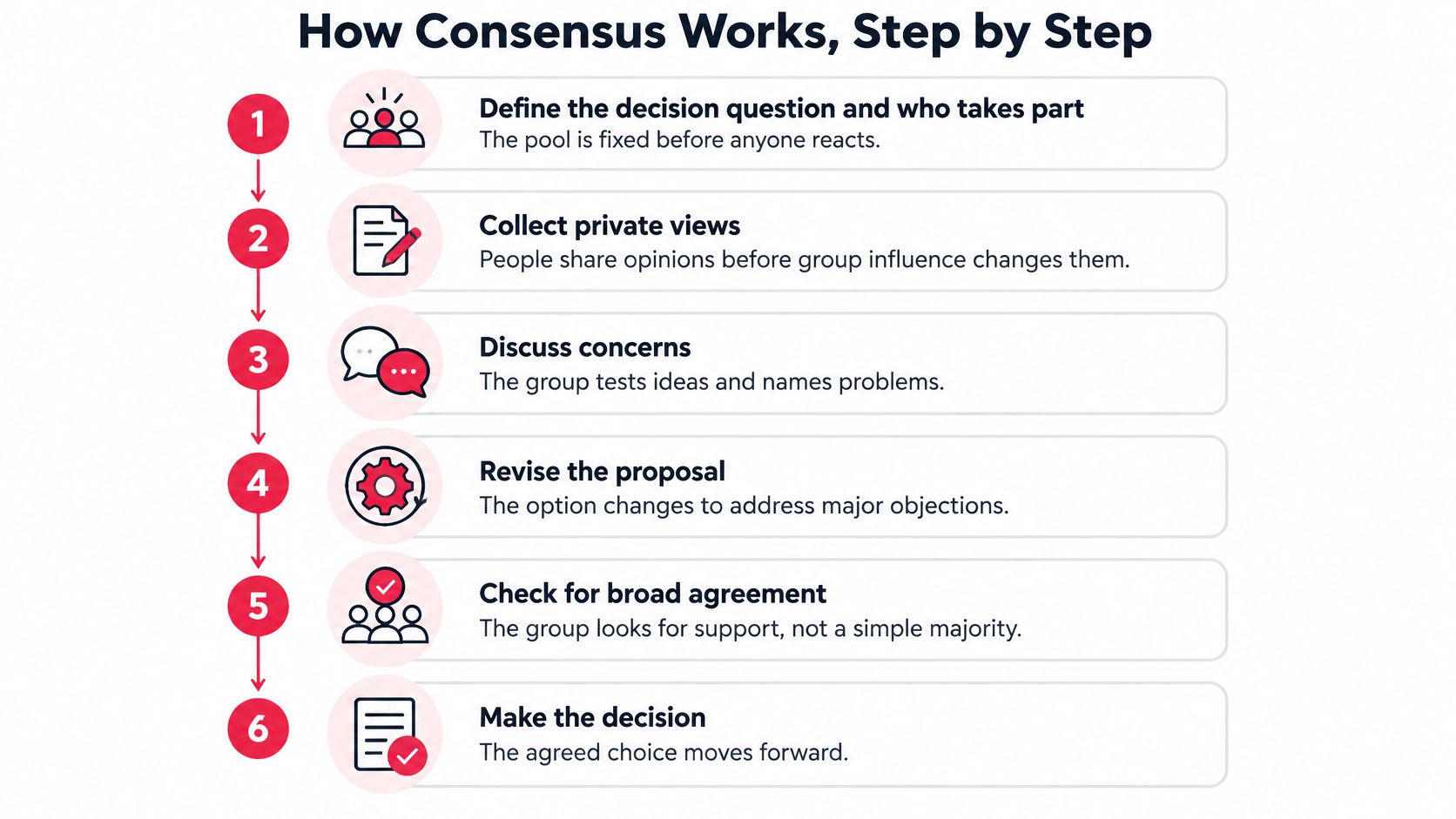
A facilitator's job is to give disagreement somewhere useful to go. Follow a sequence that separates discovering preferences from negotiating a shared decision.
-
Define the question and participants. Fix the scope before anyone reacts, so people know what they're deciding and whose acceptance matters. For a friends' day trip from Lisbon, specify whether the group is choosing the destination alone or also agreeing transport and activities.
-
Collect private views first. Independent answers help prevent the earliest or loudest opinion from shaping everyone else's response. Ask each traveler about interests, spending limits, walking tolerance, and anything they're uncertain about.
-
Share a proposal and the combined preferences. People need to understand why an option is being considered, not just see an unexplained winner. In a hypothetical Lisbon trip, most friends favor a coastal day, while others want hills and walking.
-
Discuss concerns and amend the plan. Turn objections into changes the group can assess. A Cascais proposal might gain an optional short walk for friends who wanted hills, provided the route is checked rather than assumed suitable.
-
Test objections against the agreed rule. Ask whether the revised proposal meets the group's adoption threshold, not whether people are tired of discussing it. Distinguish a remaining preference for another destination from an unresolved practical barrier.
-
Adopt and record the decision. Name who will arrange transport, what remains unconfirmed, and when the group will review the plan. Closure should produce an actionable record, not another ambiguous chat message.
The visual below summarizes the movement from individual views to a shared choice.
The structured methods behind the process
Delphi uses anonymous rating rounds, with summarized group feedback between rounds. Nominal Group Technique, or NGT, asks people to generate ideas privately, share them without immediate debate, discuss them, and then rank or rate independently.
A comparison of consensus methods published in PMC describes these procedures and reports a 420-participant study in which Delphi and NGT produced more ideas and greater participant satisfaction than unstructured group processes. These are useful structures, but they don't prove that a group's eventual choice is objectively best.
For travel planning, a group voting app can provide a common place to collect responses. The facilitator still needs to explain what the responses mean and how they'll be used.
A finished decision includes the outcome, resolved concerns, remaining exceptions, an owner, and a review date.
Consensus Models Compared at a Glance
Consensus and voting rules compared
| Model | Adoption rule | Blocking power | Best fit |
|---|---|---|---|
| Majority vote | More than 50% of votes cast | A bloc of more than half can win | Large groups facing time pressure |
| Two-thirds majority | Two-thirds of votes cast when a quorum is present | A bloc of more than one third can block | Boards with formal bylaws |
| Pure consensus | No participant objects | One objection stops the proposal | Small, high-trust teams |
| Consensus-minus-one | Proceed unless more than one person objects | Two objections are needed to block | Groups wanting to avoid a lone veto |
| Consent-based | Proceed unless a reasoned, paramount objection exists | Only harm-based objections block | Teams testing decisions as experiments |
The majority row describes the conventional voting rule. The Queen's University Planetary Health Subcommittee terms of reference describes consensus-minus-one, where one dissenting voice is workable but more than one prompts reconsideration, and contrasts that procedure with a two-thirds majority when a quorum is present.
The Unitarian Universalist Association's overview describes pure consensus, under which a single blocking objection can prevent adoption. The consent-based rule follows the narrower test described in Oxford Academic's discussion of circular organizing: whether a reasoned, paramount objection remains.
The threshold changes the conversation
The table's most important distinction is how much power an objection carries.
With pure consensus, the group must resolve or accommodate every blocking objection before proceeding. With consensus-minus-one, the group may proceed despite an isolated dissent, but it shouldn't erase that person's position from the record.
The Queen's procedure also expects dissenters to suggest alternatives. That's a useful facilitation habit: ask what amendment would make the proposal workable, rather than allowing discussion to stop at rejection.
Consent-based decision making asks a different question. A participant needs to identify a serious concern about harm, risk, or feasibility, rather than just prefer another option. Terminology differs between organizations, so write down the actual adoption test instead of relying on the word consensus alone.
Choose a rule that fits the decision
- Use pure consensus when a small, high-trust team needs everyone's acceptance and can spend time resolving objections.
- Choose consensus-minus-one when the group wants substantial agreement without allowing a lone participant to block indefinitely.
- Try consent-based decisions when the group can act provisionally, examine consequences, and revise its approach.
- Keep voting available when the decision is bounded, alternatives are clear, and the group accepts the voting procedure.
A rehearsal using decision-making activities can expose different assumptions about blocking before a consequential choice arises.
Don't change the rule after seeing which option it favors. That turns a procedural agreement into another argument about the outcome.
Pros and Cons of Consensus Decision Making
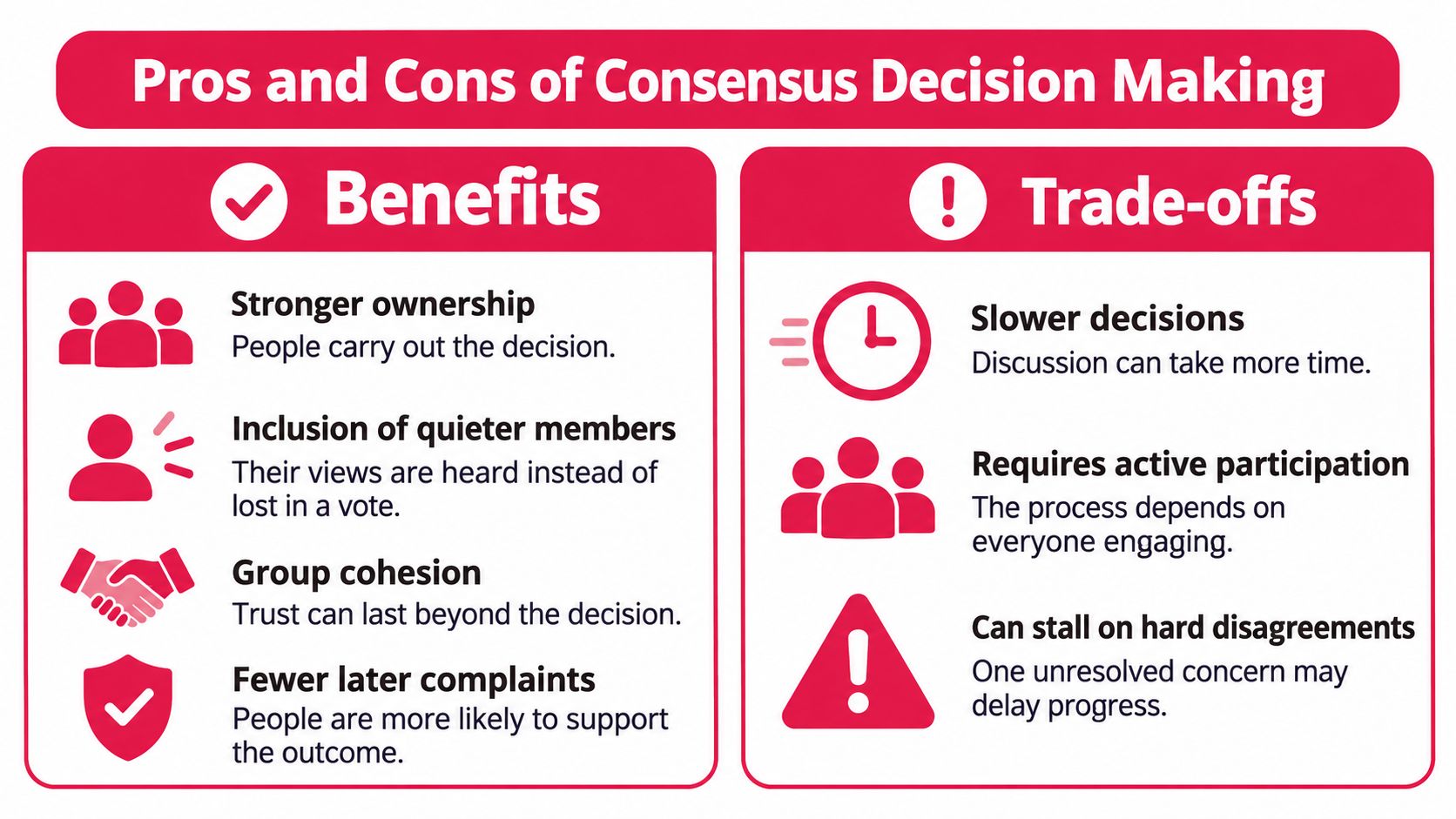
The benefits depend on how the facilitator handles participation. They aren't automatic rewards for avoiding a vote.
- Stronger ownership: People who help shape a workable proposal have a clearer basis for carrying it out.
- Inclusion of quieter members: Structured participation gives concerns space that a quick show of hands might miss.
- Group cohesion: Respectful disagreement can preserve working relationships beyond the immediate choice.
- Fewer resentful losers: Participants can influence the final proposal rather than lose to a larger bloc.
- A useful decision record: The group can see which objections led to changes.
The trade-offs deserve equal attention.
- Slower decisions: Discussion and revision take time, particularly when interests conflict.
- Diluted proposals: Repeated compromise can remove the features that made an option worthwhile.
- Stalled progress: A determined participant can hold up adoption under a strict blocking rule.
- Pressure to conform: A strong leader can produce apparent agreement without genuine acceptance.
- Participation demands: Members need enough information and attention to evaluate the proposal responsibly.
Check who paid the price of agreement
The hidden risk is agreement achieved through unequal sacrifice. A high match score may conceal that someone accepted an unaffordable activity or stopped mentioning an accessibility requirement.
An ACM paper on consensus and adjustment willingness identifies adjustment costs, unequal influence, and differing willingness to change as important variables. Treat acceptance as something to verify, not infer from a smooth meeting.
Ask whose requirements were met, which preferences were traded away, and whether anyone abstained or lacked the information to participate. Give members a private route to flag concerns before the decision becomes a commitment.
Fairness check: A fast agreement isn't a fair agreement if someone had to hide the reason they couldn't accept it.
For low-stakes, reversible choices, majority voting is often sufficient. When fairness matters and people must live with the outcome, consensus can justify the additional time.
Using Consensus for Group Travel and Offsites
Lock the protocol before collecting responses. Specify who participates, the question, the response scale, the feedback format, the deadline, and the adoption rule.
A review of formal consensus methods emphasizes the importance of explicit procedures while cautioning that group opinion isn't a gold standard. For trip planning, an attractive average score shouldn't override an individual's hard constraint.
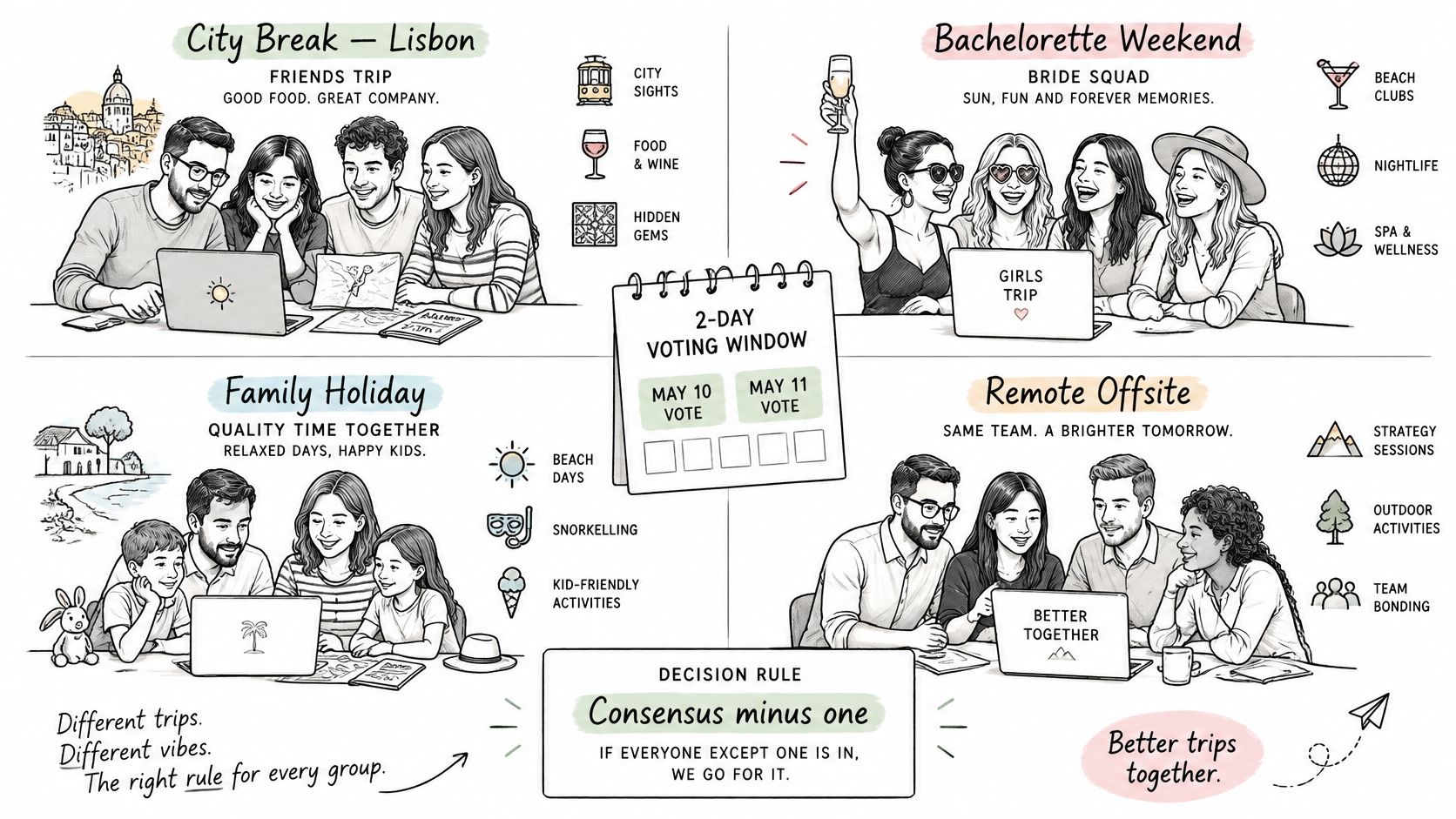
The following diagram illustrates how different trip types can use a structured decision process.
Match the process to the people
These are illustrative planning protocols, not measured best-performing deadlines.
Consensus rules for common group trips and offsites
| Group | Example destination | Recommended rule | Decision window |
|---|---|---|---|
| Friends' city break | Lisbon or Barcelona | Consensus-minus-one on activities | Two days of voting |
| Bachelorette weekend | Barcelona | Private hard limits, open soft preferences | Organizer-set deadline before commitments |
| Multi-generational reunion | Marrakech or Amman and Petra | Consent-based, accessibility as paramount objection | One week, two rounds |
| Corporate offsite | Dubai or Doha | Pure consensus on must-haves, majority tie-break | Three rounds before booking |
For a friends' city break in Lisbon, use consensus-minus-one for optional shared activities. Make clear that proceeding doesn't oblige the dissenting traveler to purchase an activity they can't afford or don't wish to join.
For a bachelorette weekend in Barcelona, collect budget ceilings privately and let people mark soft preferences as open to alternatives. Practical accommodation choices also affect what remains available for activities, so St Christopher's booking tips for group city breaks are useful alongside the decision process.
For a multi-generational reunion in Marrakech or Amman and Petra, treat an accessibility barrier as a substantive objection, not a preference to average away. Use the feedback stage to replace unsuitable transport or activities with workable alternatives.
For a corporate offsite in Dubai or Doha, settle essential requirements before ranking optional sessions. Build the company retreat itinerary around those requirements, and define the majority tie-break in advance so seniority doesn't become the unofficial rule.
The video below provides an additional visual resource for considering the group decision process.
Build a shortlist that exposes trade-offs
The basic planning flow is straightforward: someone picks a city, the group is invited, and everyone votes so a plan appears. Making that plan acceptable requires more than sorting options by popularity.
- Separate constraints from preferences: Record budget ceilings, accessibility needs, and agreed must-see items separately from desirable extras.
- Collect private surveys: Let people answer before seeing everyone else's choices.
- Show the overlap: Explain which interests the shortlisted options satisfy.
- Check each hard constraint: Flag any option that fails a requirement, even if its overall rating is strong.
- Display unresolved trade-offs: Show what would need to change rather than presenting an unconditional winner.
A useful shortlist tells the organizer where the group agrees and where a compromise is still needed. It shouldn't conceal an unresolved barrier behind a favorable score.
Choose Your Decision Rule Before the Group Debate
Before another destination suggestion lands in the chat, settle the process. People can disagree productively when they know what their input can change and when the discussion will end.
Use this checklist to make the agreement concrete:
- The rule: Choose pure consensus, consensus-minus-one, or consent-based adoption, and identify any decisions that will use voting instead.
- The objection threshold: State what stops adoption and what happens next when that threshold is reached.
- The deadline: Say when responses close and how the organizer will follow up with missing participants.
- The review point: Identify when the group will check whether the decision remains workable.
Don't treat a missed deadline as proof of consent. Contact the person, establish whether they had a fair opportunity to respond, and follow the absence procedure the group agreed.
Make revision possible without restarting everything
Treat a provisional decision as an experiment with explicit failure conditions. The Columbia-hosted discussion of consensus and consent describes an empirical approach in which groups define what evidence would justify reassessment.
Borrow the sociocratic aim of being good enough for now and safe enough to try. Applied to a trip, that means specifying which changes matter: a price increase that breaches a budget ceiling, unavailable accessible transport, or a key participant who can no longer attend.
Revisit the affected part of the plan, not every settled preference. If transport becomes unsuitable, the immediate question is how to restore accessibility, not whether someone now prefers a different city.
A review point is permission to respond to new information, not an invitation to repeat the same debate.
Some commitments aren't easily reversible. Before payment, check cancellation terms and confirm that participants understand what the group is committing to.
Turn the agreement into action
- Collect private preferences first. Include uncertainty and willingness to consider alternatives, not just favorites.
- Confirm hard limits individually. Resolve ambiguous answers before treating an option as acceptable.
- Vote or check objections in one place. Apply the procedure already agreed, without changing it to favor the leading proposal.
- Record the outcome and review date. Include unresolved objections, responsibilities, and the conditions that would reopen the decision.
The record can be short. It needs to tell an absent participant what was decided, why the option passed, and what happens next.
When group decisions become bookings, friends vote on activities and book the winning option together with a single payment for everyone. That makes the final acceptance check important: a planning preference and authorization to spend money aren't interchangeable.
Your next step is simple: write the decision rule into the group chat before anyone proposes a destination.
MyPerfectStay helps friends vote on activities and turn their chosen option into a group booking with a single payment for everyone. Visit MyPerfectStay to bring your group's activity choices into one place, then use an agreed decision rule to move from discussion to a shared plan.