Group Voting App Guide for Fairer Trips
October 30, 2026·MyPerfectStay
A group voting app collects each traveler's private preferences and turns the overlap into a shared shortlist or booking, instead of a public chat poll. In 2024, mobile devices generated 70.5% of global online travel traffic, so the decision already happens on a phone, not around a conference table.
You're in the thread right now. Three restaurant links, a “maybe,” and a budget complaint sit under the same joke. Nobody can say what was agreed, and the person who pays first is about to resent the rest.
A popular winner can still be a bad plan. If two people can't manage the hill, or the deposit isn't refundable, the vote only moved the fight to checkout. Ask for private must-haves and budgets before any score, then show who a plan leaves out.
Table of Contents
- What a Group Voting App Is
- Features That Separate a Real Vote From Chat
- How Scores Stay Fair When Tastes Clash
- City Breaks Hotels and Partner Trips
- How to Judge a Group Voting App
- Send the Link Before the Thread Grows
What a Group Voting App Is
Six friends are trying to lock a long weekend. The chat holds restaurant links, one soft maybe, and a complaint about price that nobody scrolls back to find. By Thursday the plan is whoever answered last.
A group voting app is shared decision software. Each person files preferences in private, and the group receives one result it can book or reject. Picture a ballot box. Everyone drops in a note, and the room sees the tally rather than who shouted.
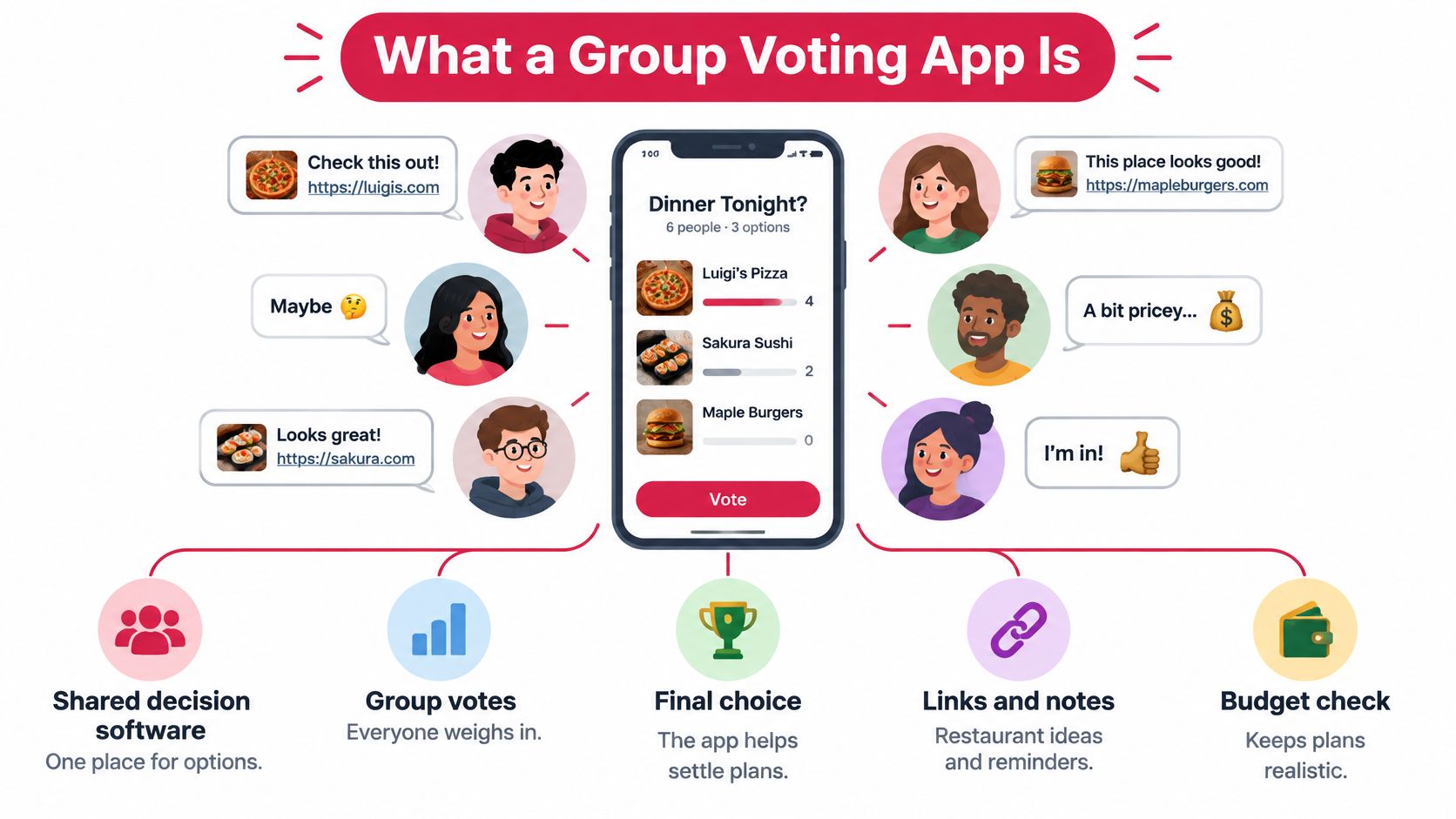
Three jobs a poll mashes together
Structured inputs. A budget ceiling, interests, energy, and deal-breakers are fields. They aren't a paragraph someone can skim past.
A voting rule. Ballots become a collective result. Plurality, approval, a ranking, or a score each means something different, so the rule is part of the product, not a hidden setting.
An explanation people can question. The group should see support and blocks, not only a crown.
A yes-no chat poll, and a meeting icebreaker that only warms the room, stop once they name a winner. Travel has to survive unequal money, mobility, diet, and time. The friend who can't do stairs, or who is paying for two children, is still in the decision if they type less.
A tally that ignores constraints is just a louder chat.
The practical form is a phone link. According to Navan's compilation of online travel data, in 2024 mobile devices generated 70.5% of global online travel traffic. People will not install a conference-room system for a weekend.
When the thread is the only record, the plan disappears with the scroll. Organizers who need a sturdier trail than replies can use email communication for community organizers so decisions aren't trapped in whoever answered last. Start where the phones already are, and keep names off the answers.
Features That Separate a Real Vote From Chat
Check the behavior, not the branding. If a chat thread is the alternative, this is the pass you can make in one sitting.
| Feature | Chat poll | Group voting app |
|---|---|---|
| Private preferences | Names sit next to replies | Inputs stay private; only aggregates show |
| Hard constraints | Easy to skip in the thread | Budget, access, diet, or pace can remove options first |
| Voting rule | Usually one vote, highest count wins | Plurality, approval, ranked, or score-based rules |
| Explainable result | A winner and a vote count | Score plus how many people support or are blocked |
| Compare cost | One person guesses a total | Per-person cost without exposing exact budgets |
| Commitment timing | Winner often treated as booked | Shortlist first, reserve or pay later |
| Shared payment | One person pays and chases others | Group can book and pay the winner together |
| Deadlines and nudges | Manual reminders | Invite links, deadlines, and participation nudges |
| Join friction | App or account often required | Link join without a download to start |
| Time to a plan | Days of debate across time zones | A short private pass per person |
| Record of the trip | Buried in chat | Links and choices kept with the trip |
Constraints before scores
Say the group is in Paris. One person marks a hard ceiling. Another marks no late nights because of an early train. Those inputs should drop a midnight cruise before anyone is scored. What's left might be a museum morning and a food walk. The cruise can be wonderful and still be the wrong plan.
Money is the test most polls skip. European travel research from Generali reports that 53% of European travelers say they plan to gather with family or friends, while 28% prefer city trips, a figure that has risen 12 percentage points over a decade. The same travelers are also shortening trips or trading down on price.
Each person should enter a comfortable range in private and mark whether price is a hard limit. The screen compares per-person cost with transport and fees. It should not show anyone's exact budget. Currencies, unequal incomes, deposits, and cancellation deadlines belong in that comparison. Otherwise one organizer fronts the money and spends the weekend chasing transfers.
Shortlist first. Reserve later. Treat a non-refundable term as a fact, not a footnote.
When the thread is enough
Chat works well for two people choosing dinner in Prague tonight. An app earns its place with four or more people, mixed budgets, or an activity that can be booked. A bad rule can hide a veto. A pretty catalog with no live availability sends everyone back to links.
We learned that the hard way. Our two co-founders spent five days planning a friends' reunion across three time zones on WhatsApp. There was no plan, and about 47 votes that were not really votes. A heart is not a ballot, and a spreadsheet doesn't survive the weekend.
How Scores Stay Fair When Tastes Clash
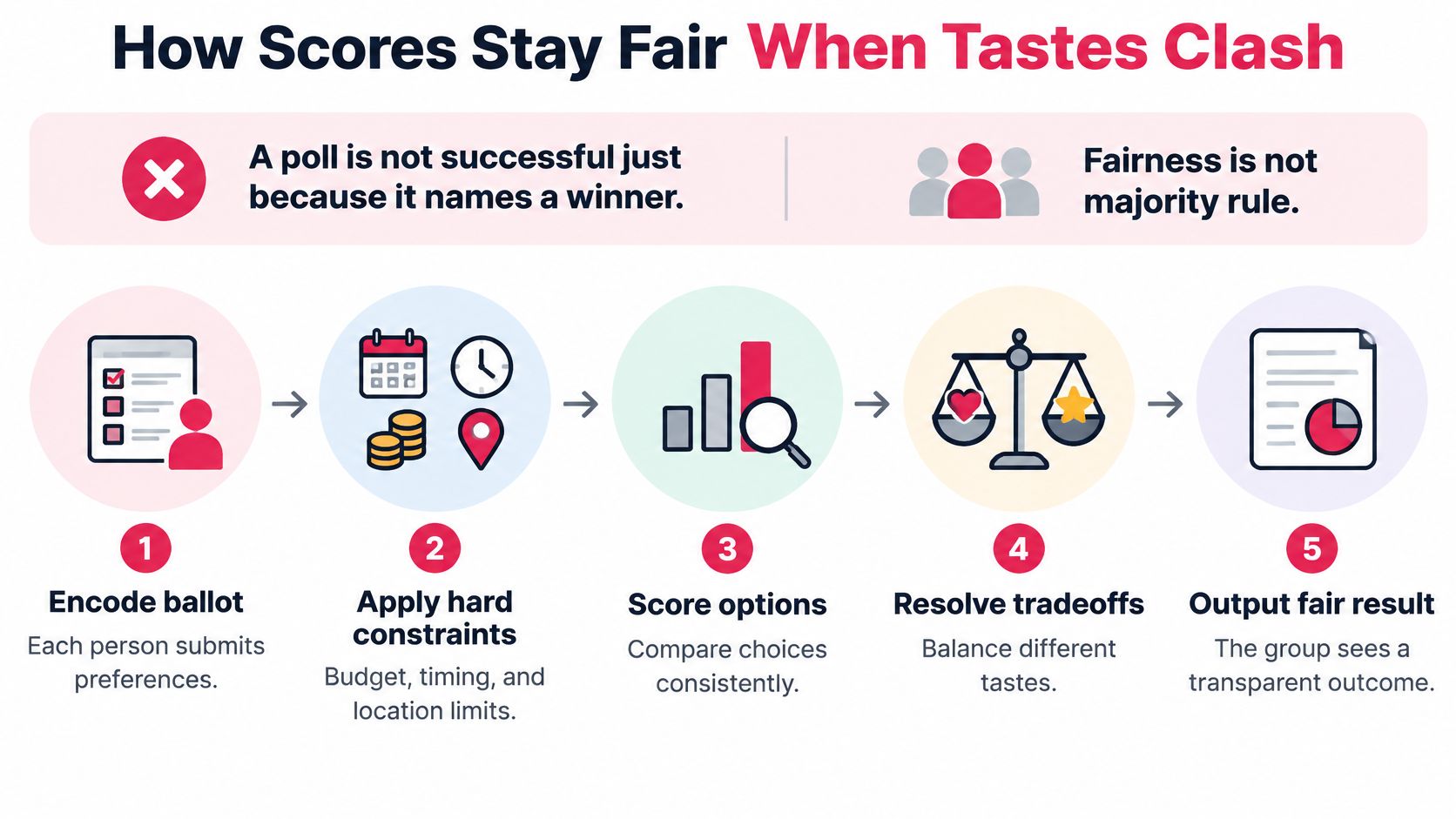
A poll isn't successful just because it names a winner. Fairness isn't majority rule. The activity with the most votes can still exclude someone with a strict budget, a mobility limit, a dietary need, or a caregiving schedule.
Walk the pipeline in order. Each person encodes a ballot. Hard constraints eliminate options that break a veto. Soft preferences are scored only on what remains. The honest question is which options people can live with, and where the trade-offs sit.
A Rome day that looks like a win
Ten people are choosing a day in Rome. Eight want a long walking food tour. Two mark it too expensive or too far for a knee injury. The honest line is that 8 of 10 support it and 2 are blocked. It did not “win.”
Families hit this pattern often. If you find family adventure travel ideas that assume everyone can hike, run the same check before you lock the day. The least vocal person often pays the highest cost of a bad match. The same logic sits behind clearer group decision-making methods when a reunion mixes ages and energy.
| Rule | What it counts | Trip meaning |
|---|---|---|
| Plurality | One favorite per person | A single top pick can win while others cannot live with it |
| Approval | Options people can accept | Surfaces plans the group can live with |
| Ranked choice | Ordered preferences | Shows second choices when the first choice splits |
| Score-based | Intensity of preference | A strong block and a mild like are not the same vote |
Plurality crowns a single favorite. Approval counts what people can accept. Ranked choice orders tastes and surfaces second choices when the first choice splits. A score measures intensity, so a hard block and a mild like aren't the same vote. The rule changes the meaning of the result. Test these four on realistic groups before you trust a match score.
Privacy, pressure, and four checks
Hiding names isn't enough. Keep identity separate from preference records, and publish only aggregates. A paper in the U.S. National Science Foundation archive concludes that maximal economic efficiency, high fairness, and high privacy can't always be achieved at once. You pick which one you'll give up a little of.
Live counts can speed replies and also raise conformity. A University College Cork paper on technology-mediated group decisions points to anonymity, blind voting, and hiding interim results as ways minority information can surface. Private first-round input, then a transparent explanation, is the better default for families and mixed-energy friends.
Four production checks keep the claim honest: participation rate, the share of groups that decide before the deadline, score gaps between constraint groups, and how often a minority must-have is violated.
City Breaks Hotels and Partner Trips
Europe is the stage where these groups already gather. France 24's report on UN Tourism figures records about 747 million international arrivals in Europe in 2024, a 5% increase from 2023 and 1% above 2019. The UN Tourism January 2025 assessment puts the Middle East 32% above its 2019 level. Friend groups, families, offsites, and hotel guests are deciding inside that demand, not in a generic stock photo.
A World Atlas comparison of European cities puts estimated annual international visitors at about 20.7 million for London, 16.9 million for Paris, 12.1 million for Istanbul, 9.7 million for Rome, and 6.7 million for Barcelona. Methods can vary between cities. Dubai, Marrakech, and Cairo are the MENA counterparts with the same planning problem: too many good options, unequal constraints.

Four scenes, four different blocks
Lisbon friends. Half the group wants trams and miradouros. Half wants late fado. Private energy and budget ranges should surface an afternoon walk everyone can afford, not a midnight winner that empties two wallets.
A Barcelona family. Grandparents need step-free time in the Gothic Quarter. Teens want a beach window. The vote fails if it only ranks “top sights” and never asks who can climb.
A Dubai offsite. The startup wants a desert morning that still ends before meetings. One invoice beats six expense claims. Pace and a shared payment matter more than another poll about dune photos.
A partner in Marrakech or Santorini. In-house guests pick a riad cooking class or a caldera cruise. Empty ancillary inventory becomes a booked slot. The same guest path works for a riad as for a cave suite.
Enthusiasm doesn't pay the deposit. The vote has to carry per-person cost, cancellation deadlines, and who is blocked.
Moving people between those stops is its own constraint. Operators who plan smoother group journeys already treat timing and headcount as part of the booking, not an afterthought. A city break itinerary planner only helps if the chosen slots are ones the whole group can still reach. Doing this by hand means one person holds the spreadsheet, the currencies, and the blame.
How to Judge a Group Voting App
Score the product on a trial group before you look at the homepage. Pass means you can see the behavior. Fail means the claim is only a sentence on the site.
| Criterion | Pass | Fail |
|---|---|---|
| Constraints | Must-haves remove options before ranking | Only a popularity winner |
| Explainability | Support and blocks are visible | Opaque score with no reason |
| Privacy | Aggregates only | Names attached to each vote |
| Commitment | Shortlist, then book | Instant non-refundable charge |
| Participation | Link invite plus a deadline | Account or install wall for every guest |
| Inventory | Bookable experiences in the chosen city | Ideas with no availability |
| Hospitality fit | Guest or partner flow for on-site experiences | Consumer poll with nowhere to book |
Run the tests in order
- Constraints. Enter a must-have that should kill an option. If it still ranks first, stop.
- Explainability. You should see who supports a plan and who is blocked. A mystery match score is a fail.
- Privacy. Aggregates only. Named ballots send people back to polite lies.
- Commitment. A shortlist must exist before payment. An instant non-refundable charge is not a decision.
- Participation. A link and a deadline. People on different phones will not all install software first.
- Inventory. The winner has to be bookable in the city you already chose.
- Hospitality fit. Hotels need a guest or partner path, not only a consumer poll with nowhere to book.
What you can verify with us
On MyPerfectStay, planning is three steps. Someone picks a city, the group is invited, and votes produce a plan. People join by link and don't need to download an app to be added, though iOS and Android apps exist. Voting uses swipes, about 15 per person. The catalog is over 450,000 bookable experiences in more than 150 countries, which covers European and MENA city breaks rather than a single-country list. The same vote can become one booking and one payment for the winning activity.
Group voting was in closed beta in 2025 with friends, family, and selected users. Improvements ship weekly, covering UX, destinations, booking depth, and the decision process. Commission rates for partners are on the partner page, not in this guide. If a trial group can't see constraints, blocks, and a bookable shortlist, the brand line doesn't matter.
Send the Link Before the Thread Grows
Pick one city the group can already reach, such as Amsterdam, Vienna, Dubrovnik, or Dubai, and one date window. Send a join link and set a reply deadline before anyone pastes more options into chat. If you're unsure how the invite works, this note on how to add friends matches a link that doesn't require a download.
Ask each person for a budget ceiling, an energy level, and one deal-breaker. Keep those answers private. Read the result for blocks, not only for the top score, and drop anything that violates a must-have.
Shortlist two bookable activities. Then use one shared checkout if the product supports it, so nobody floats the deposit alone. On MyPerfectStay, friends vote, the group books the winning activity together, and the whole group can pay in one checkout, including one tap from the group voting feature. The first version of the app is live as of 2026.
If the group is a hotel or a creator, use the same flow for one ancillary experience rather than a whole itinerary. A cooking class or a short cruise is enough.
Stop if people won't answer. A vote can't invent agreement. The success check is simple. Every participant had a private say, the plan names who would be excluded, and the booking deadline is visible before money moves.
MyPerfectStay turns a private group vote into one shared booking, so a city break doesn't stall between a winning activity and someone chasing deposits. You pick a city, invite the group by link, and the winning plan can be paid in a single checkout. Visit MyPerfectStay and send that link before the thread grows another day.