Dead Sea Tour Guide with Real Itineraries
November 22, 2026·MyPerfectStay

You are in a group chat at 11 p.m., and half the people want a photo of themselves floating. Someone else has a fresh shave and zero interest in stinging water. A third person pasted a beach pin from a blog written years ago. Nobody has agreed whether tomorrow is a swim, a spa hour, or just a look at the water from a high terrace.
That argument is the Dead Sea tour. The lake is not a pool you can treat like a Mediterranean dip, and the shore you remember from an old write-up may not be the shore you can use now. The useful decision is a short, supervised stop, matched to who will get in.
Table of Contents
- What a Dead Sea Tour Includes
- Why You Float Without Swimming
- How to Choose a Beach That Still Works
- Sample Days from Amman and a Resort
- Who Should Float and Who Should Not
- How a Falling Shoreline Changes the Visit
- Lock a Plan the Whole Group Can Share
What a Dead Sea Tour Includes
Most visitors buy the same morning. You leave Amman, drive the desert highway, and reach a managed beach on the Jordan shore in under an hour, often around the hotel strip at Sweimeh. The day they paid for is simple. A short float, a smear of mineral mud if skin is intact, a freshwater rinse, then time in the shade with a cold drink.
A Dead Sea tour is a controlled bathing stop plus a lookout, not an open-water swim. You are not crossing the lake, racing anyone, or staying in until you are bored. The water does the odd part. Your job is to pick a format that fits the group, then stop.
Four ways the day is sold
| Format | Typical length | Best for | Usual stops | Time in the lake |
|---|---|---|---|---|
| Resort half day | 3-4 hours | Hotel guests at Sweimeh or the north shore | Resort beach, mud, spa or pool | About 10-20 minutes |
| Amman day trip | 8-10 hours | First visits based in the city | Managed beach plus Madaba or Mount Nebo | About 10-20 minutes |
| Petra and Dead Sea same day | 12 hours or more | Only if the group accepts a very long day | Petra, then a late managed beach | About 10-15 minutes if energy remains |
| Viewpoint or spa, no float | 1-3 hours | Children, non-swimmers, heat-sensitive guests | Panorama, museum, pool or treatment | None |
A resort half day is the easy row if you already slept at a north-shore hotel. Breakfast, beach, mud or a treatment, lunch, done. You are not burning the drive.
An Amman day trip is what first-time groups usually mean. You spend the water part early, then use the ride back for one cultural stop. Madaba and its mosaics, or the Mount Nebo viewpoint, sit on a sensible return toward the city. Trying to stack both plus a long float turns a calm day into a rush.
Petra on the same day only works when everyone has already said yes to twelve hours or more. Petra lies well to the south. By the time you reach a managed beach, energy is gone, and a tired group makes sloppy entries. Give Petra its own day. Use the lake as its own short stop.
The no-float row is not a consolation prize. It is the right product for young children, non-swimmers who do not want help in the water, and anyone who overheats fast. A panorama, a small museum, a pool, or a spa hour still counts as the visit.
Practical rule: Circle one format before you read about salt, beaches, or who should skip the water. A group that has not picked a row will keep arguing in the car.
Float time on every water row stays near 10 to 20 minutes, in the morning or late afternoon during hot months. If your group is splitting tastes, it helps to look at group activity ideas the same way you would for a city weekend. Vote the float, the mud or spa hour, and the viewpoint as separate choices, not one mandatory swim.
Why You Float Without Swimming
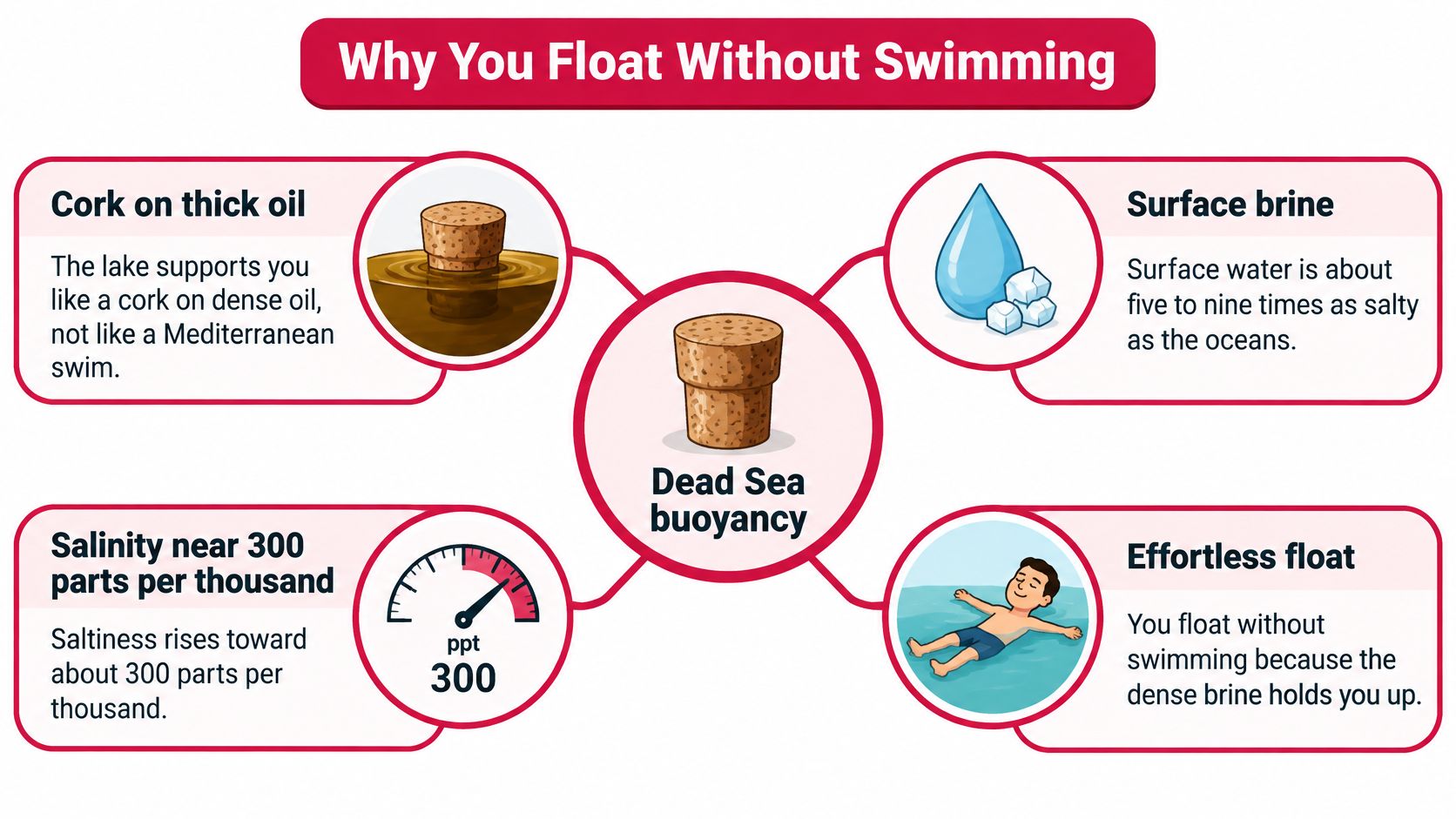
Think of a cork on thick oil, not a swim off a Mediterranean beach. In ordinary seawater you kick, you glide, and if you tip forward you roll back up. Here the liquid is heavy enough that your body sits on it. Fighting that support is what dumps first-timers onto their faces.
What the brine actually does
The NOAA JetStream explainer on the Dead Sea puts surface brine salinity at about five to nine times that of the oceans. Saltiness rises toward about 300 parts per thousand at roughly 40 meters, and below about 100 meters it approaches 332 parts per thousand, where the water is saturated. That density produces a much stronger buoyant force than ordinary seawater, so the working posture is on your back.
The minerals people name on the shore, magnesium, sodium, potassium, and bromine, are chloride salts in that same brine. The Jordan Tourism Board lists them as the chemistry behind the float. They are also why the water stings eyes, lips, and any fresh shave. That is a comfort and safety fact, not a promise that a ten-minute float treats a medical condition.
The entry a guide should show
A good guide demonstrates the entry before anyone is wet.
- Step in slowly. No running start, no jump from a ledge.
- Sit back and let the legs rise. Do not try to stand and "swim out."
- Keep the face and mouth clear. A laugh that throws water is enough to ruin the next half hour.
- Never dive, and do not splash neighbors. The person beside you may have a cut you cannot see.
High buoyancy is the fun and the hazard in the same minute. If your face goes under, rolling back up is harder than in a normal sea, because the water keeps pushing your body toward the surface in the wrong orientation. A strong swimmer is not exempt. Skill at a front crawl does not cancel a liquid that will not let you swim the usual way.
Confident swimmers are the people most likely to skip the briefing, and they are the ones who end up face-down.
Every water format from the opening table uses the same shore sequence. Supervised entry, a 10-to-20-minute float, an immediate freshwater rinse, then shade and drinking water. Leave beach shopping and personal medical screening for the decisions that come next. The physics does not change because the resort has a nicer lounger.
How to Choose a Beach That Still Works
Choosing a stop is logistics, not a postcard. The Ynet travel report on the shrinking lake notes that the Dead Sea has fallen about 40 to 45 metres over roughly five decades and still declines by nearly a metre a year. The retreating edge has fed sinkholes, lost beaches, and broken access. Industrial mineral extraction may account for as much as a quarter of the shrinkage, so the problem is larger than tourists standing in the shallows.
An old blog can name a beach that has moved, closed, or lost its road. A pin that worked for the writer may land you on a longer walk, a shuttered ramp, or ground that looks flat and is not.
Three stops, not one postcard
| Stop type | Access | Lifeguard and showers | Best for | Main risk |
|---|---|---|---|---|
| Managed resort beach | Hotel stay or day pass from Amman | Usually both, plus shade | First visits and mixed groups | Confirm the named beach is still open |
| Unmanaged shoreline | Informal or lower-cost access | Often neither | Confident adults who accept sparse facilities | Poor footing, no rinse, sinkhole ground |
| Viewpoint only | Short stop or ticketed lookout | Not a swim site | Children, non-swimmers, anyone avoiding brine | Disappointment if the group expected to float |
A managed resort beach is the default from Amman or a Sweimeh hotel. You want a lifeguard, showers, shade, and a clear boundary between "in" and "out." Day passes at north-shore properties are how city guests buy that setup without sleeping there.
An unmanaged shoreline can look empty and cheaper. It often has no rinse, unstable footing, and nobody watching the water. Salt crust cuts feet. If someone gets brine in their eyes, the car is not a shower. Wet, salty ground is also where a beach wheelchair or a walking frame fails unless the path is built for it. Operators who lay beach access mats and pathway panels are solving a real gap. Ask whether the named beach has a firm path from the drop-off to the water, not only a photo of a ramp.
A viewpoint is the correct row when the group wants the below-sea-level panorama and does not want brine. Sell it that way in the chat. If people arrive expecting to float, the lookout feels like a letdown even when the view is excellent.
What to confirm before you pay
Before money moves, write five answers into the booking note.
- Exact venue name: "Dead Sea" is not a beach. Get the resort or public site.
- Showers and a lifeguard that day: "Usually" is not the same as "open on Friday."
- Transport time from Amman: Plan on under an hour to the north shore, then add Friday traffic.
- What the ticket includes: Mud, towel, lunch, and pool access are not automatic.
- Whether the booking can move: If the access road or the ramp is closed, you need a different managed beach, not a scramble down the bank.
A western-shore add-on, such as a resort beach near the southern Israeli hotels, is a separate trip. It is not a stop you bolt onto an Amman day. Passports, border time, and a second set of opening hours will eat the float window.
Match the beach back to one format you already circled. Hotel guests take the resort half day at a managed beach. City first-timers take the Amman day at that same kind of beach, plus Madaba or Mount Nebo. Anyone skipping the brine takes the viewpoint or spa row, even if the rest of the group buys a day pass.
Sample Days from Amman and a Resort
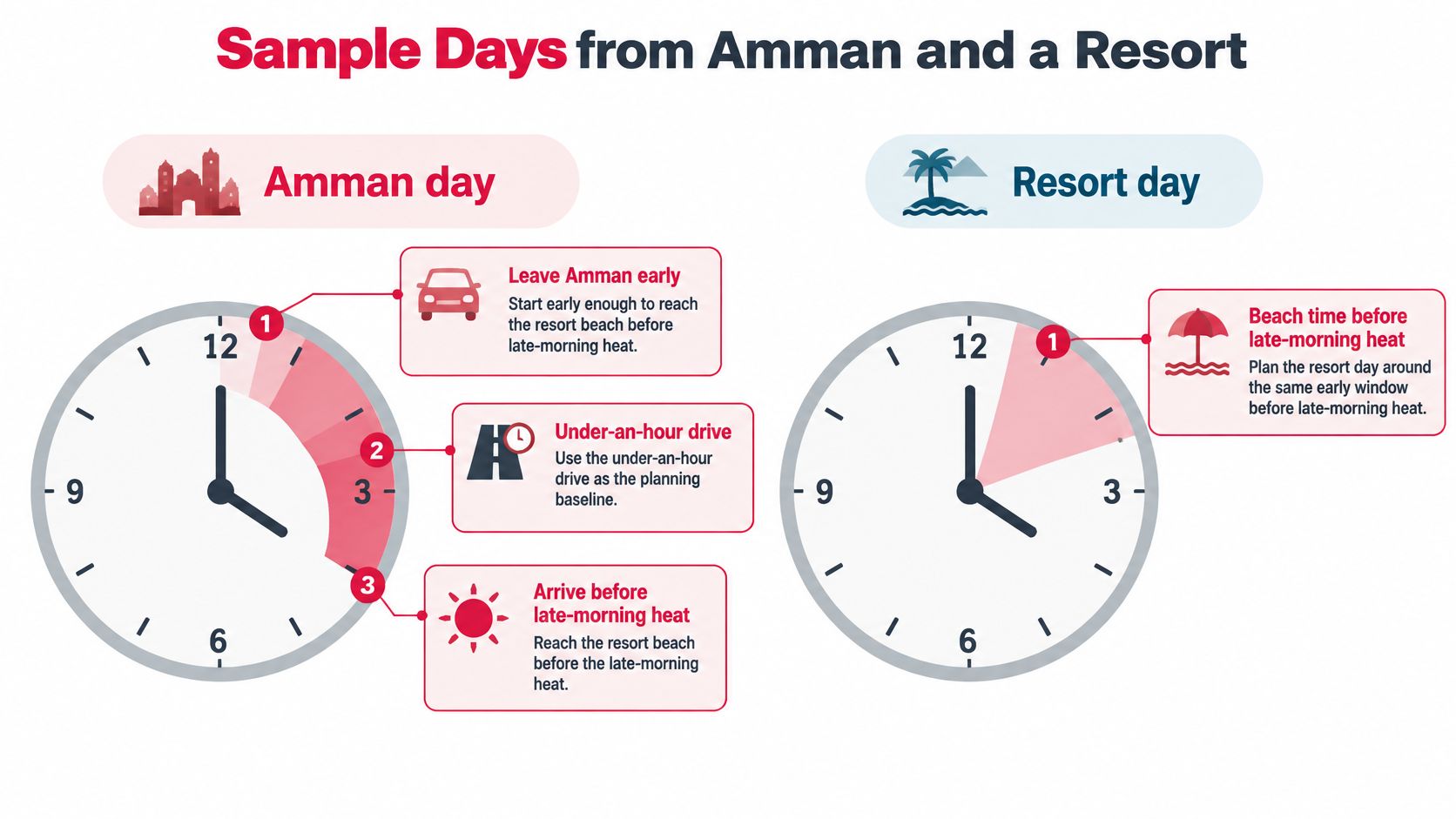
Two clocks cover almost every group. One starts in the city. One starts at the hotel. Both put water, if there is any, before the worst heat.
The Amman clock
- Leave early enough to be on a named resort beach before late-morning heat. Use the under-an-hour drive as the baseline, not as a promise once Friday traffic or a hotel pickup queue appears. If the operator's number is saved wrong, you lose the cool hour. It is worth knowing how to dial Jordan from abroad before you rely on a local mobile for a pickup change.
- Float first, about 10 to 20 minutes. Mud comes only if skin is intact. Shower in fresh water before anyone poses in salty clothes. Salt dries into a white film and stains light fabric.
- Move to shade, drinking water, and lunch at the resort. Lingering on the open shore is how a short float becomes a heat problem. The low, dry basin does not feel like a coastal breeze.
- Add one cultural stop on the way back. Madaba's mosaics or Mount Nebo, not both, unless the group is fresh and the light is still good. Aim to be in Amman for the evening.
- Keep Petra off this day unless everyone already accepted a twelve-hour-plus trip. A "quick look" at Petra is not quick.
Friday crowds and summer midday heat are the two reasons to move the float earlier. A weekday morning at a managed beach is a different visit from a packed Friday at noon.
If you are already at the hotel
Guests at a Sweimeh or north-shore hotel should use the resort beach after breakfast or in the late afternoon, still inside that 10-to-20-minute cap. Book a spa or pool block for anyone not floating, at the same hour, so the group splits and meets for lunch. Treat a second day as optional rest. Another long float is rarely what sore eyes and tight skin want.
Shared packing for both clocks stays short. Water shoes, a towel, drinking water, high-SPF sunscreen, a hat, and a change of clothes. Skip jewelry. Do not shave the morning of the swim. Old, dark swimwear beats a new light suit that will carry mud home.
If you are building this into a wider Jordan route, a group tour itinerary should show the lake as its own block with a return time, not as filler between Petra and the airport. The next decision is who joins the water at all.
Who Should Float and Who Should Not
Everyone does not float "easily," and easy is the wrong word even when the body stays up. The main harm is chemical, not only drowning.
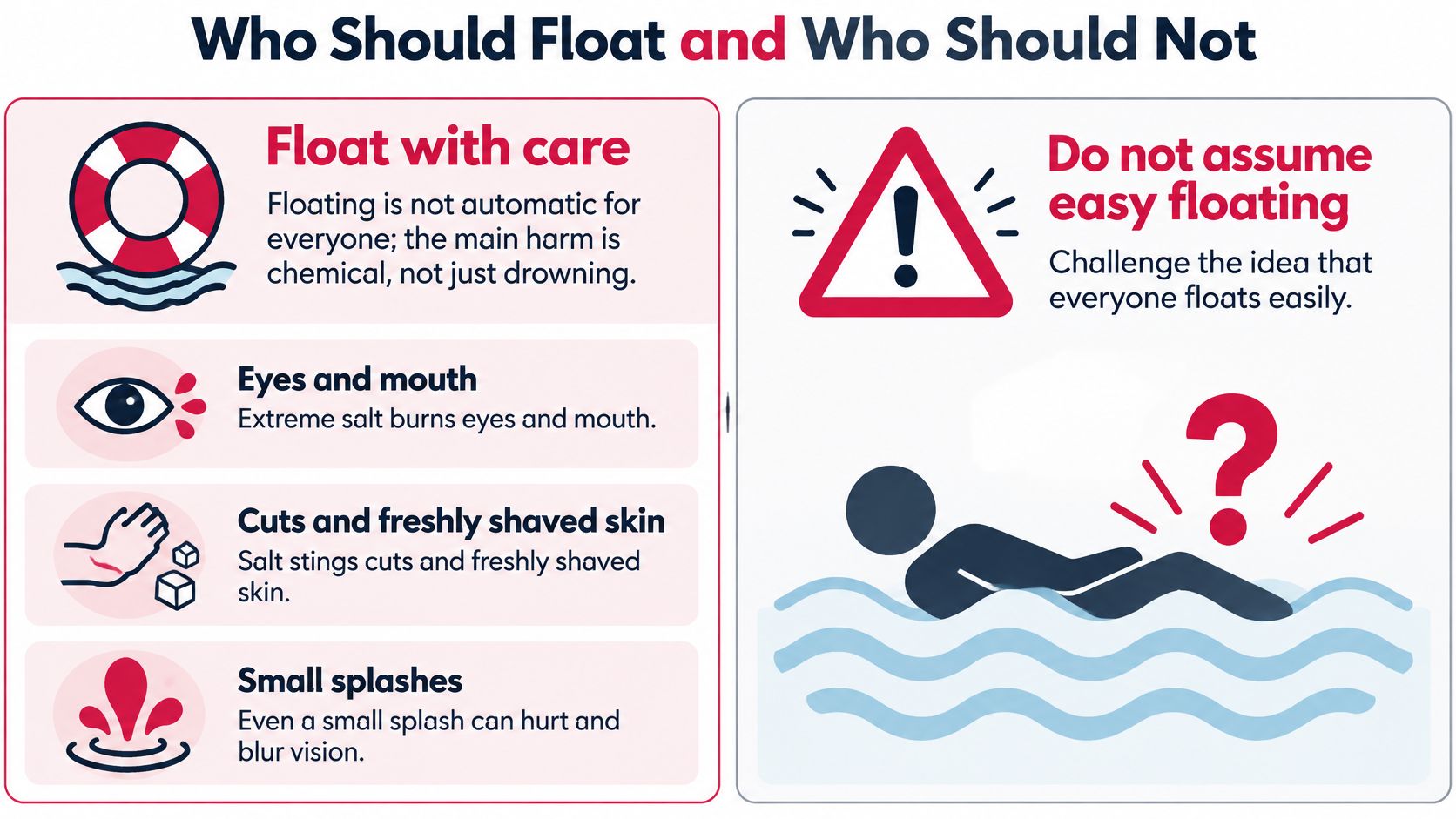
The Dead Sea tourism guidance on why you float is direct. Extreme salt causes intense irritation on eyes, mucous membranes, cuts, and recently shaved skin. Even a minor splash can hurt and blur vision for a while. The same density that holds you up makes a face-down position hard to correct, so buoyancy does not remove drowning risk.
A chat checklist before anyone pays
Run this in the group chat, not at the water's edge.
- Young children: A supervised freshwater pool is usually the better plan. The lake is a poor place to practice "don't splash."
- Open wounds, a recent shave, very sensitive skin: Take the spa, a mud-only stop if the operator allows it on dry skin, or the viewpoint. A long float will find every nick.
- Low heat tolerance: Shorten the shore time or skip it. The basin is hot and bright, and shade after the water is part of the activity, not a luxury.
- Non-swimmers: They can still float on their backs at a lifeguarded beach if they accept a short, assisted entry and will not try to swim. Say that out loud. "I'll just paddle" is the wrong plan.
- Mobility limits: Wet, salty steps are slick. Ask about handrails and the distance from the car to the water before you promise the float to someone using a cane or wheelchair.
An unmanaged shore fails this test when it has no shower, no lifeguard, and no clear edge.
Rules for the people who do go in
Anyone who enters follows the same short list. Supervised zone only. Face up. No diving. No splashing. No rubbing eyes with wet hands. Rinse in fresh water at once, then shade, drinking water, and a cover-up. Guides should know where the rinse is before the first person steps in, and the safety talk belongs in the car or the lobby, not after someone is already blinded and panicking.
One group can book two outcomes. A short float for the people who passed the check, and a pool or lookout for everyone else. Forcing one activity onto every age and ability is how a pleasant half day becomes an argument in the parking lot.
How a Falling Shoreline Changes the Visit
The decline is a trip fact, not a side essay you read after you book. USGS Earthshots reports that the lake level fell by about 45 meters over the preceding 50 years. A 2018 Israeli Ministry of Environmental Protection report cited by USGS put the pace at about 1.2 meters per year. Upstream irrigation and other water uses cut the inflow. As the edge retreats, a salt layer on the bottom has been growing by about 10 centimeters a year, and sinkholes open in the exposed salty bed.
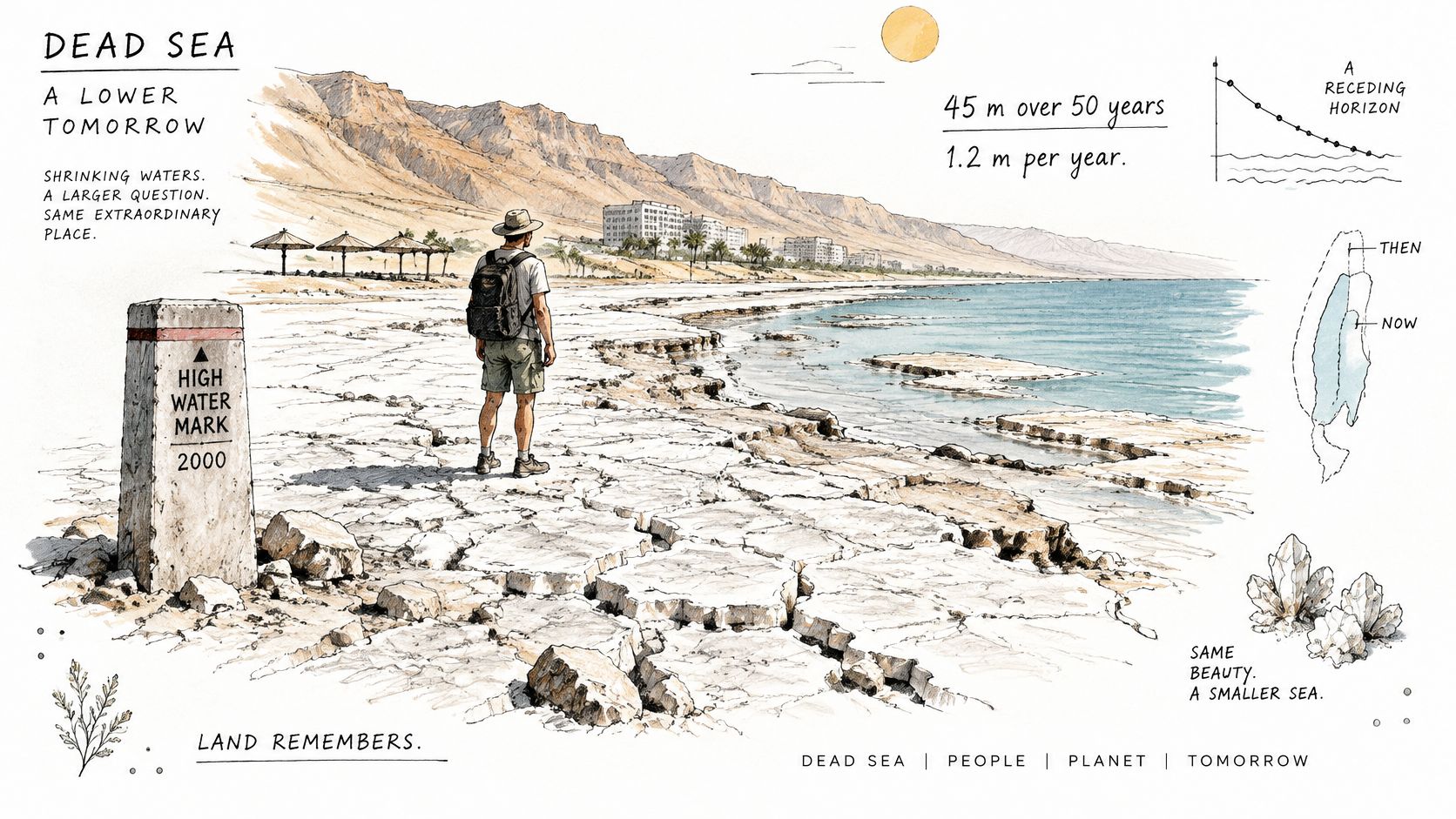
Picture a bathtub. The Dead Sea is a terminal lake. Water comes in and does not flow on to another sea. Turn the tap down, and the ring on the tub moves. The steps that once met the water now stop on dry, crusted ground. You are looking at a smaller lake than the one in a decade-old photo, even if the mountains in the background match.
What a stale pin gets wrong
A GPS pin from a blog can land on a closed ramp, a longer walk, or unsafe ground. Flat, empty land near the old shore can still be geologically risky. Areas that look buildable are not automatically places to park, picnic, or scramble for a better angle.
Rain in the surrounding hills can nudge the level for a short time. It does not put the old beaches back. Do not plan the day around a rumor that "it rained, so the shore is fixed."
This video shows how fast a familiar shoreline can stop matching the map in your head.
Tourism is not the sole cause, and scolding visitors does not refill the lake. The action on the day is narrow. Use a designated, maintained bathing area. Ask the hotel or operator what is open that week. Do not climb an unmarked bank for a photo. Current local guidance beats a timeless beach description every time.
Lock a Plan the Whole Group Can Share
Write down three choices you have already made. The format row, whether that is an Amman day, a resort half day, or a viewpoint. The exact managed beach or spa. Who floats, and who uses the pool or the lookout.
Send those options. Do not reopen them as a forty-message thread. Groups that try to coordinate travel dates and logistics in one endless chat lose the cool morning to indecision, then arrive when the shore is hottest.
Before MyPerfectStay, our co-founders Basel and Salih's own group spent weeks debating where to go. They say that now they pick a city, send the link, and a plan appears. To start, the organiser enters a destination, a rough date, and who is coming. That maps cleanly onto Amman plus a Dead Sea day, or a Sweimeh resort base. Friends vote on activities, and the group books the winning activity together with a single payment for everyone. The float, the mud or spa hour, and the viewpoint can be separate votes. Nobody has to enter the lake for the day to count.
If you want the sequence for setting that up without a spreadsheet war, see how to organize a trip once the three choices are on paper. Then do the last practical step. Confirm the venue, the showers, and the lifeguard with the operator. Lock the winning option and the return time to Amman before anyone buys add-ons.
MyPerfectStay helps a group turn a Dead Sea day into a shared vote, so the float, the spa hour, and the viewpoint are chosen together instead of argued in a late-night chat. You can set the destination, the date, and who is coming, then book the option that wins with one payment for the group. When you are ready to lock the plan, visit MyPerfectStay.