How to Organize a Trip: Timeline, Budget and Group Plan
November 16, 2026·MyPerfectStay
Your group chat has hotel screenshots, competing restaurant lists and someone asking whether the dates are confirmed. Nobody wants to commit money until everyone agrees, but nobody agrees because the costs and constraints are still unclear. To organize a trip, start by coordinating people, not collecting more destination ideas.
A workable plan needs an owner, decision deadlines and a fair way to handle different budgets and energy levels. Whether you're arranging a Paris weekend, a Rome family holiday or a Marrakech offsite, the useful question isn't how much you can fit in. It's what everyone can commit to, and what still works when something changes.
Table of Contents
- Build the Timeline and Start This Week
- Set a Budget That Stays Fair for Everyone
- How to Make a Group Decision Stick
- Build an Itinerary That Survives a Bad Day
- Adjust the Plan for Solo, Family and Corporate Trips
Build the Timeline and Start This Week
Planning milestones by weeks before departure
Use this as a working schedule, not a claim about the cheapest booking window.
| Weeks before departure | Core task | Who owns it | Done when |
|---|---|---|---|
| 12+ weeks | Choose dates, destination shortlist and budget ceiling | Organiser | Dates and ceiling agreed by the group |
| 8-10 weeks | Send invitation and private survey | Organiser | Every traveler has responded or the deadline has passed |
| 6-8 weeks | Run group vote on activities | Whole group | Winning activities locked |
| 4-6 weeks | Book flights, stays and group activities | Organiser, with deposits from members | Bookings confirmed and shared |
| 2-3 weeks | Publish master itinerary and optional tracks | Organiser | Everyone has the plan and their own private access notes |
| 1 week | Insurance, offline bookings and check-in windows | Each traveler | Documents saved on each phone |
| During and after | Shared expenses and photos in one place | Organiser | Balances settled within a week of return |
Get agreement before collecting reservations
At the opening stage, establish which dates work, which destinations are realistic and the maximum financial commitment everyone accepts. A shortlist of Paris, Rome and Barcelona is useful only if travelers can reach them within their available leave and spending limits. Check arrival and departure times, not just the headline airfare.
For peak-month trips to Paris, Rome, Barcelona or Lisbon, I'd move every planning window two weeks earlier as a precaution against narrowing accommodation choices. That's an organising recommendation, not a guarantee of availability or lower prices. For European and MENA dates, also check public holidays and religious observances such as Ramadan against the services and activities you intend to use.
Send the invitation and private survey before debating individual attractions. Ask about budget range, interests, energy level and access needs, with a response deadline and quorum rule visible in the invitation. Keep sensitive responses out of the public chat.
Once the activity vote closes, check that the accommodation, transport and chosen experiences work together. Coordinate booking in a single session where practical, so nobody buys a flight while the proposed stay disappears. Collect deposits before the organiser takes on non-refundable commitments, and record who owns each reservation.
Turn the schedule into assigned work
Publish the master itinerary before departure pressure makes every change urgent. Include fixed reservations, open blocks, optional tracks and meeting points, while checking access arrangements privately with the relevant traveler. A collaborative to-do list helps distinguish a task someone has accepted from a suggestion everyone assumes someone else is handling.
For specialist excursions, add a preparation task before payment. Manta Ray Night Snorkel Hawaii's Big Island manta ray trip planning is a destination-specific resource to consult when that experience is already part of a traveler's plans. Use the same approach for any activity with participation requirements or conditions that could affect the wider schedule.
Before departure, each traveler should save insurance details, booking confirmations and check-in windows offline. The organiser's phone shouldn't be the group's only way into the hotel or onto a booked activity. Afterward, close the expense ledger rather than leaving small balances unresolved.
This week's checklist is deliberately short:
- Agree the boundaries: Confirm dates and the group's budget ceiling.
- Draft the choices: Write minimum, expected and premium tiers with per-person totals.
- Send one invitation: Include the survey, response deadline and quorum rule.
- Assign the next action: Name the person responsible for checking each shortlisted option.
To test the process on a real city, start a trip in MyPerfectStay by entering a destination, a rough date and who's coming. Our destination list includes European and MENA options such as Rome, Paris, London, Dubai, Cairo, Barcelona and Marrakech.
Schedule test: If fundamental questions remain open at week six, treat the schedule as slipping. Set a hard decision date rather than adding another round of suggestions.
Set a Budget That Stays Fair for Everyone
A friend books the cheaper hotel because the nightly rate looks kind. The group then spends two hours each way on transfers, pays for extra taxis, and loses an afternoon that was supposed to be free. That gap is a fairness problem, not a taste problem.
Separate shared commitments from personal choices before anyone talks about how much to contribute. Accommodation, agreed transfers and voted activities belong in the shared plan. Shopping, extra excursions and individual upgrades stay with the person who wants them.
Affordability belongs in a private conversation, not a public test of enthusiasm. Financial pressure was the main travel barrier for 58% of European non-travelers in the 2025 Europ Assistance Holiday Barometer.
Typical budget split for a multi-day city trip
Choose shares that add up to the full budget, then swap each share for a real quote before anyone pays. If one category comes in higher, cut another shared line or move the extra into an opt-in upgrade.
| Cost category | Typical share of total | Shared or personal | Planning note |
|---|---|---|---|
| Flights or long-distance transport | Remainder after other allocations | Personal, paid per person | Show the per-person price before anyone books |
| Accommodation | 30-40% | Shared | Split by room if room sizes differ |
| Food | 15-20% | Mixed | Group dinners shared, breakfasts and extras personal |
| Activities and tickets | 10-15% | Shared once the vote locks | Price each of the three tiers separately |
| Local transport | 5-8% | Shared | Compare city transit passes in Paris, Rome or Barcelona |
| Contingency | 5-10% | Shared | Covers price moves between the vote and payment |
Decide the split before anyone pays
Collect budget ranges anonymously where possible. An open budget survey lets the organiser see what is workable without asking someone to explain their income to friends or colleagues.
Publish per-person totals for minimum, expected and premium versions. Each version should be a complete, usable trip, not a low headline that leaves out transfers or meals. Keep premium additions opt-in so declining an upgrade does not mean missing the group's main experience.
Agree whether accommodation is divided by room, occupant or family branch. Name who covers a child, partner or colleague, and whether a larger room costs more. Record cancellation responsibility too: a deposit collected from the group is not automatically refundable because one person's circumstances change.
For Europe-MENA groups, show totals in one common currency and record the exchange rate and the date used. Keep the supplier's original currency beside each quote so travelers can see where conversion charges or later price moves may appear.
Count what the cheap option takes away
Price the time, not only the room. An option with a two-hour transfer should be set against a closer stay, the group's free hours and the work of moving everyone together. A lower hotel rate can still cost more once taxis and lost working time are on the same line.
Optional extras need the same check. For a separate Caribbean sailing extension, Little Blue Door's guide to compare Aruba yacht charter formats can frame the format comparison before you request quotes. Compare inclusions, passenger arrangements and who pays for extras. Two boats with similar day rates can leave very different bills.
A fair itinerary prices the transfer, the lost afternoon and the upgrade that only some people wanted. A group saving that becomes one traveler's extra taxi fare is not a saving.
How to Make a Group Decision Stick
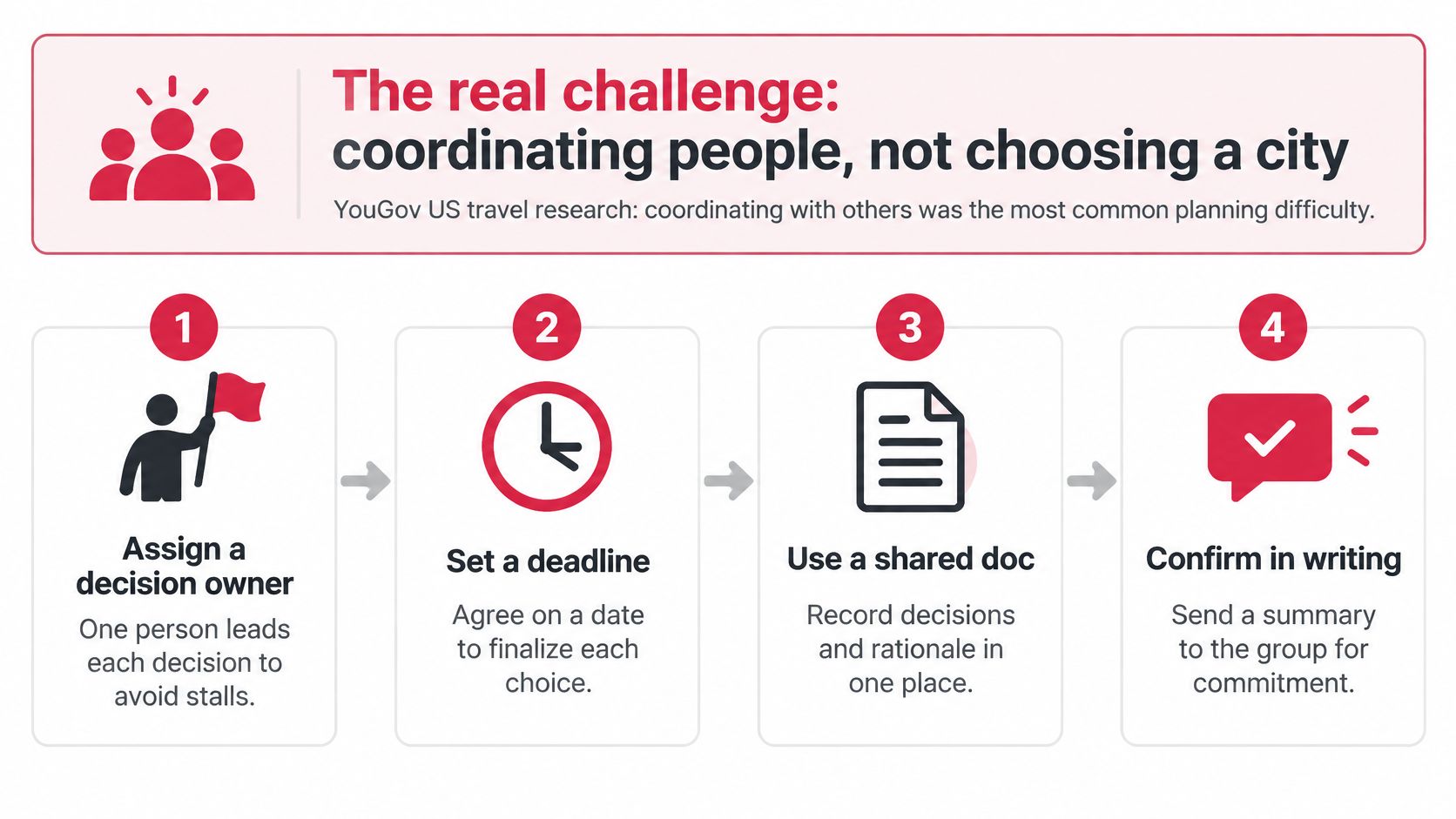
Coordinating people is the constraint that deserves attention first. In YouGov's US travel-decision research, coordinating with other people was the most common planning difficulty, cited by 20% of trip planners.
Assign responsibility before asking for more opinions. The practical coordination habits below help prevent a discussion from becoming an indefinite conversation.
Use a decision process people can trust
-
Collect private constraints. Ask each traveler for dates, budget ceiling, interests, mobility requirements, energy level, dietary needs and must-haves. The organiser needs enough information to rule out unsuitable options, not anyone's medical or financial history.
-
Separate hard constraints from preferences. A required step-free route is a constraint; preferring a rooftop restaurant is a preference. Treating them as equivalent voting inputs can produce a popular but unusable result.
-
Remove options that fail a hard constraint. Don't put an inaccessible venue or unaffordable mandatory excursion on the ballot and hope the vote solves the problem. Where participation is optional, make that distinction explicit before voting.
-
Rank the remaining choices transparently. For example, a hypothetical score could weight interest at 40%, energy fit at 30% and cost at 30%. Agree the weighting before showing results, and explain that a match score ranks suitable options rather than overriding someone's essential needs.
-
Set a response deadline and quorum. A sample invitation might allow 72 hours, requiring either every traveler's response or a defined majority for optional activities. Silence isn't consent to a financial commitment, and a majority cannot waive another traveler's access requirement.
-
Turn the result into a booking action. For example, give members one week after the vote to pay their deposit, with the booking date stated alongside it. If availability or price changes materially before payment, return the changed decision to the group.
Different choices need different methods. A group decision-making framework can help distinguish an activity poll from a decision requiring unanimous financial agreement.
Give every decision one home
Use a shared poll for preferences, a master sheet for deadlines and booking references, and a shared expense ledger for money. Google Sheets can hold the booking register, while Splitwise can track who paid and who owes whom. Don't collect fresh votes in chat once the official poll has closed.
A planning app can simplify the sequence: someone picks a city, the group is invited, and everyone votes so a plan appears. The organiser still needs to confirm which decisions are final and which remain provisional.
Start with an invitation people can act on:
Invitation template: Please complete the private survey by the stated deadline. Optional activities will be decided by the announced quorum; mandatory spending requires each payer's agreement. Review the minimum, expected and premium totals before responding.
For another planning reference, use the video alongside your written decision record.
After the result, send a written summary naming the selected activity, payer, booking owner and next deadline. That message turns a preference into a commitment.
An activity everyone accepts often beats one that thrills a minority and excludes the rest. Don't mistake the loudest enthusiasm for a workable group decision.
Build an Itinerary That Survives a Bad Day
A packed itinerary can look efficient while being impossible to run. If a delayed arrival, tired child or missed connection makes every later reservation uncertain, you haven't organised the day well. You've scheduled it too tightly.
Build for reliability and recovery, not the largest attraction count. RBAN Tours' flexible-tour guidance offers useful design targets: leave 20-30% of trip time unplanned, allow two-to-four-hour open blocks around anchors and include approximately one rest day per five travel days. Treat those as adjustable benchmarks, not universal rules.
Place anchors, then check the actual journey
Put immovable commitments on the calendar first: flights, accommodation check-in, timed-entry tickets and agreed group dinners. Avoid placing the trip's most important event immediately after arrival or on departure day. Those are poor places to absorb a disruption.
Next, cluster activities by neighbourhood. In Rome, don't assume a Vatican visit and an evening in Trastevere form a continuous sightseeing block because they're on the same day. Give each area its own time, and show the transfer and recovery period between them.
Assign every activity an energy rating and a realistic door-to-door duration. Count the walk from the hotel, transport waiting, ticket checks, queues, restroom stops and the time needed to gather the group afterward. A venue's advertised visit duration isn't the time the excursion takes out of your day.
Use these checks before confirming adjacent bookings:
- Actual starting point: Calculate the journey from where the previous activity ends, not from the hotel.
- Group departure: Allow for collecting bags, finding the exit and checking everyone is ready.
- Reservation conditions: Record arrival instructions and any entry cutoff.
- Recovery margin: Keep enough room to pause without sacrificing the next essential commitment.
Make the fallback usable
Say you're planning a Lisbon walk from Alfama to Bairro Alto. Don't treat the map's shortest route as a promise: inspect the gradients and route conditions, then decide whether walking, a transfer or a shorter outing suits the group. Put the alternative in the itinerary before someone needs it.
For a Marrakech summer itinerary, a medina morning could switch to an indoor visit or a rest period when heat makes the outdoor plan unsuitable. Choose the fallback in advance, check its opening arrangements and avoid replacing one strenuous outing with another.
Give weather-sensitive or capacity-limited activities a realistic alternative, not just a note saying “free time if cancelled.” Include where people can go, how they'll get there and whether the alternative needs booking. Otherwise, the organiser has to solve the day while everyone waits.
For families and corporate groups, publish a master itinerary with optional tracks. A traveler should be able to skip a demanding block and rejoin at a clearly stated meeting point without requiring everyone else to change course.
Finish with a schedule test: count each day's commitments and inspect every transition between them. If the day only works when nobody queues, rests or runs late, remove a commitment before buying another ticket.
Adjust the Plan for Solo, Family and Corporate Trips
A solo traveler can change direction without consulting anyone. A friends' city break needs a fair voting method, a family reunion needs room for different generations, and a corporate offsite needs clear authority over work and spending. Don't apply the same decision rules to all of them.
Planning setup by trip type
| Trip type | Decision style | Budget model | Itinerary format | Access and pacing check |
|---|---|---|---|---|
| Solo traveler | One person decides | One personal budget with a tier | Flexible, with loose anchors | Own pacing, stairs and transfer time |
| Friends' city break | Majority vote with a quorum | Shared accommodation, personal extras | Master plan with optional tracks | Private check of mobility and stamina |
| Multi-generational family | Older members and children can veto high-intensity blocks | Split by room or by branch | Master plan with a rest block every day | Walking distance, seating, restroom access and heat |
| Corporate offsite | Manager sign-off plus an anonymous preference poll | Company budget with a per-person cap | Agenda with fixed working sessions | Venue access, transfer time, dietary and sensory needs |
A corporate team may need a fixed working session before the afternoon outing, with an explicit distinction between required attendance and optional social time. A family needs a daily rest block that isn't filled with another excursion. Friends can separate for personal interests without treating that as a failure of the trip.
Plan access as part of participation
Accessibility isn't a final venue-compliance check. In a 2025 survey of 3,473 European travelers with mobility or long-term health conditions, 46% traveled at least once a year, while more than six in ten identified transport to the destination as an important accommodation or planning consideration.
Accessible bathrooms, wide doorways and assistive devices matter. So do pacing, recovery time, reliable transfers and the needs of a companion who may be providing support throughout the day. A technically accessible attraction can still be a poor choice if reaching it exhausts the traveler.
Use a practical access workflow:
- Collect requirements privately: Ask what arrangements someone needs, not for a diagnosis. Get permission before sharing any detail with a venue or fellow traveler.
- Describe the activity: Record walking distance, stairs, available seating, heat exposure, restroom access and transfer time.
- Confirm the whole route: Check the journey between accommodation, vehicle, entrance and activity space rather than relying on a broad accessibility label.
- Offer an equivalent alternative: Provide a parallel option when the main activity cannot suit everyone, with a clear reunion point and no pressure to justify opting out.
Keep operational notes useful and discreet. The group needs to know the meeting point has seating; it doesn't need to know which traveler requested it. Before locking the itinerary, ask each traveler privately: What would make a day hard for you?
MyPerfectStay helps groups turn activity preferences into a shared plan, then book the winning experiences together with a single payment. Visit MyPerfectStay with your destination, rough dates and traveler list to start organising a trip your group can agree on.