Dubrovnik vs Split: Which City Fits Your Group in 2026
November 18, 2026·MyPerfectStay
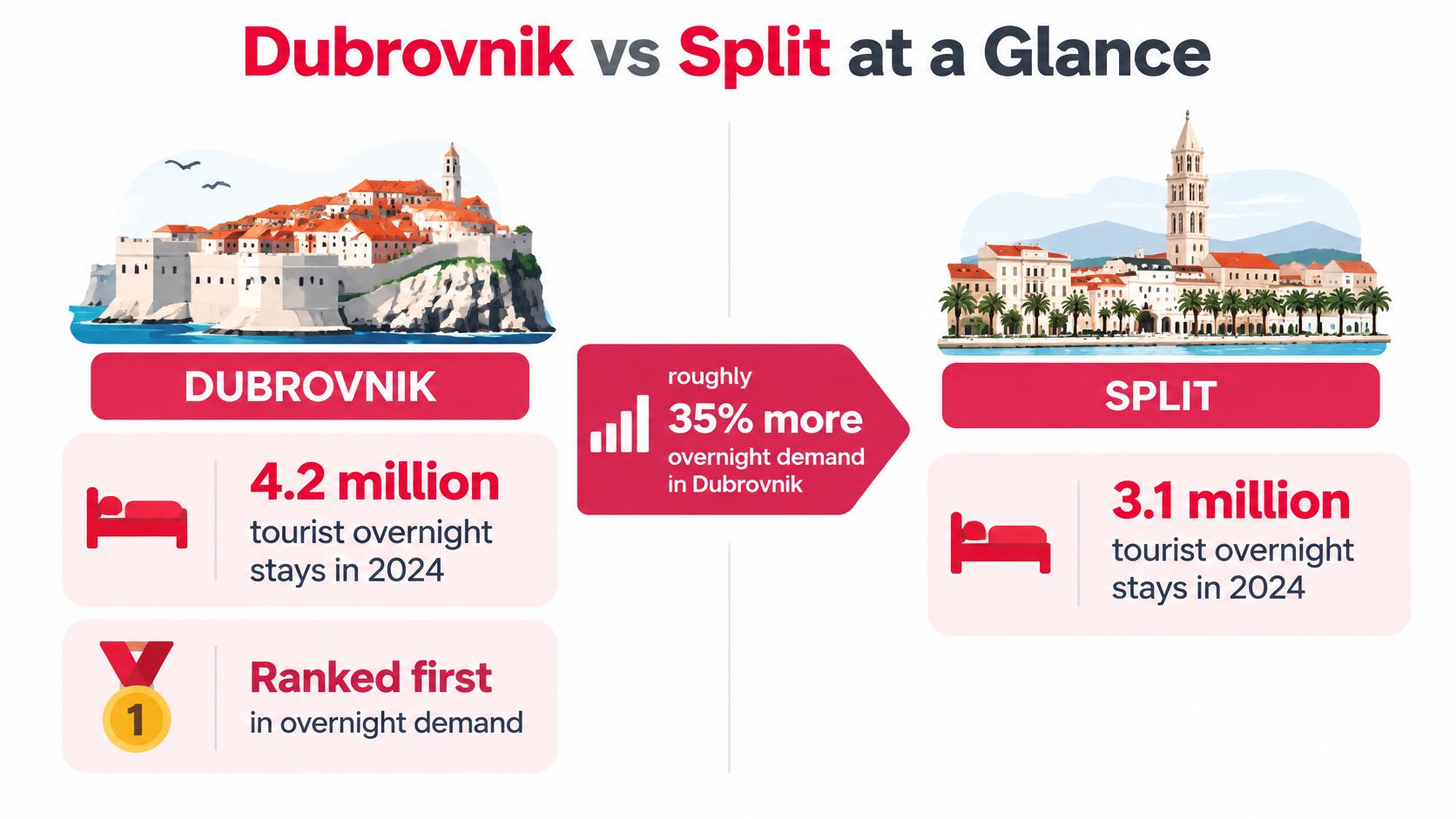
In 2024, Dubrovnik recorded approximately 4.2 million tourist overnight stays, compared with about 3.1 million in Split, according to the Institute of Economics, Zagreb sector analysis. That is roughly 1.1 million more nights and about 35% more overnight demand. Dubrovnik placed first among Croatian destinations, ahead of Rovinj at 4.1 million nights and Poreč at 3.2 million, while Split ranked fourth. Dubrovnik also logged roughly 3.1 overnight stays per arrival, a short, concentrated pattern. These are registered tourist nights, not unique travelers, so they measure beds filled rather than people who walked the streets.
That gap doesn't crown a winner. It tells a group where demand sits, then leaves the choice to timing, tickets, and how mixed your interests are.
Table of Contents
- Dubrovnik vs Split at a Glance
- What You Actually See in Each City
- Beaches in Dubrovnik and Split
- What Each City Costs a Group
- Crowds, Cruises and Timing Your Visit
- Getting In and Moving Between the Cities
- Which City Fits Your Group
Dubrovnik vs Split at a Glance
Choose Dubrovnik for one iconic heritage day with timed entry. Choose Split for mixed groups that want a flexible base with beaches, nightlife, and island day trips.
The official nights above are accommodation demand. A cruise passenger who never checks into a hotel doesn't appear in them, and one guest who stays three nights counts three times. Read the table as a picture of how each city is used, not as a popularity contest.
| Measure | Dubrovnik | Split |
|---|---|---|
| Tourist overnight stays, 2024 | 4.2 million | 3.1 million |
| National ranking by overnight stays, 2024 | First | Fourth |
| Core experience | Compact walled Old Town and heritage sights | Diocletian's Palace, waterfront and a living city |
| Role for travelers | Destination in itself | Base for city stays and island day trips |
| Best fit | Heritage-focused groups with a tight schedule | Mixed-interest groups wanting flexibility |
Dubrovnik is a concentrated walled heritage city. The visit is built around one Old Town, and most of the signature photos sit inside that boundary. Split is a living city: a waterfront, a palace that still functions as streets and homes, and a gateway to nearby islands. Hospitality demand follows that split. Dubrovnik pulls premium, heritage-led stays. Split holds a high-volume gateway role, with room for city breaks, events, and multi-stop itineraries.
Dubrovnik sells one intense heritage experience. Split sells a broader base for mixed itineraries.
The rest of this Dubrovnik vs Split comparison tests that distinction against what you pay, when the streets fill, how you arrive, and which kind of group you're traveling with.
What You Actually See in Each City
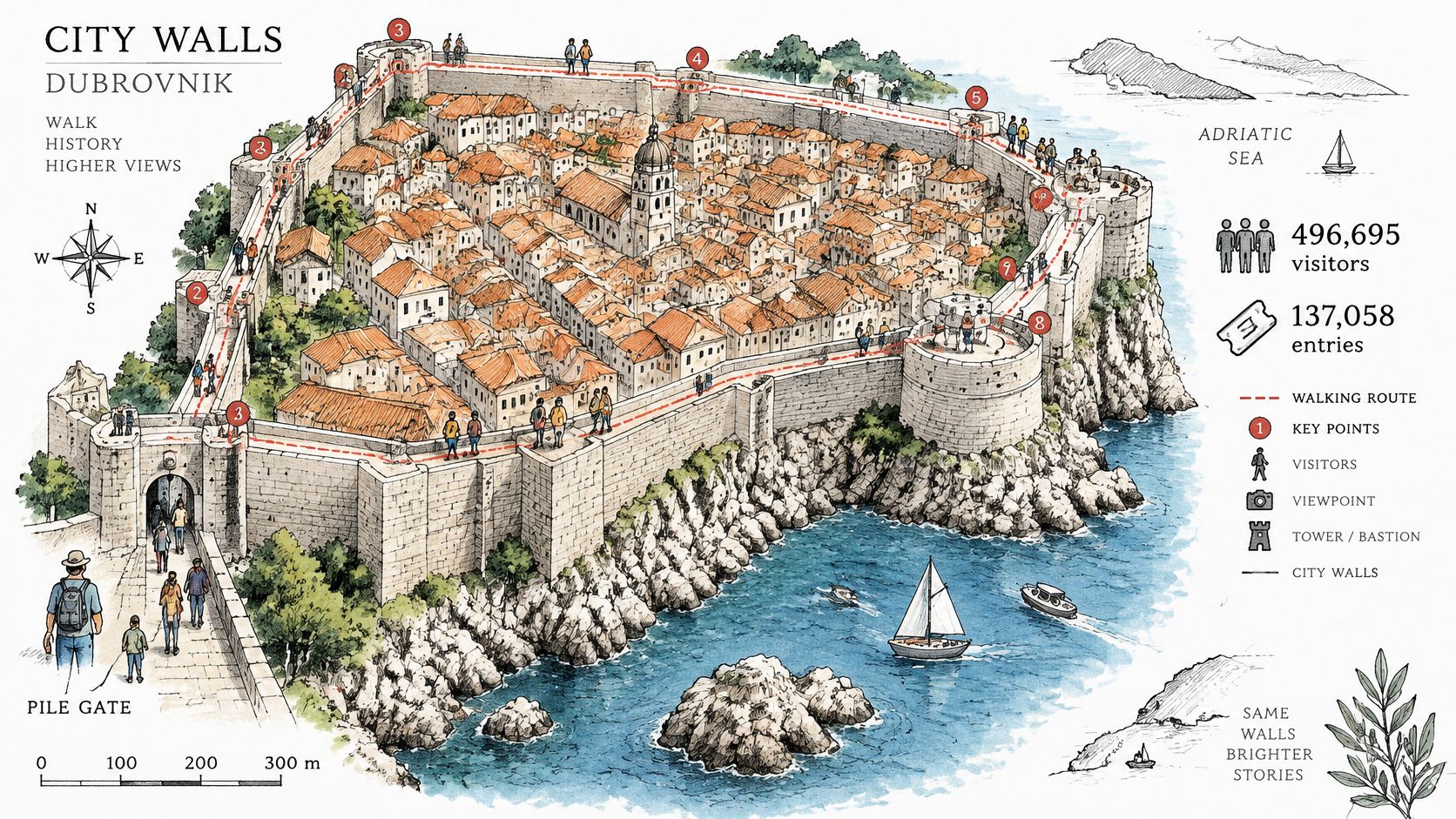
Between the start of 2025 and 19 August 2025, 496,695 people had already walked Dubrovnik's walls, July alone accounted for 137,058 entries, and the busiest recorded day, Monday 28 July, drew 6,059 visitors, according to The Dubrovnik Times. About half of those entries came through the Dubrovnik Pass. The rest used tickets from the Society of Friends of Dubrovnik Antiquities.
The fortifications form a roughly two-kilometre loop, sea on one side and terracotta roofs on the other. The same circuit reads differently by hour. A heritage pair on an early slot gets one set piece with room to stop. A large group that hits a cruise morning meets the same staircase as several thousand other tickets.
One heritage set piece
Inside the walls, the Old Town reads as one set. Fortifications, polished limestone lanes, and Game of Thrones filming locations sit within a short walk of each other. You enter the historic core, and the rest of the city drops away. A heritage-focused pair can feel they have seen the point of the trip in a single morning. A big group all wants that staircase at the same hour, so the walk gets tight even though the route itself is short.
Book the walls before you fly. Early slots and shoulder-season dates change the walk more than any restaurant booking will. The activity and the hour decide how crowded that two kilometres feels.
A palace that still has neighbors
Split spreads the sights across a street grid people still live in. Diocletian's Palace is not a museum you enter and exit. You can be in a Roman cellar, then on a lane with laundry and a café, then out on the Riva for an evening walk and dinner. Marjan gives you a viewpoint without a ticket. The Cathedral of Saint Domnius anchors the palace rather than sitting apart from it.
Dubrovnik is a bounded historic core, so the group's choice is mostly when to enter it. Split is a working city, with neighborhoods, a market rhythm, and nightlife wrapped around the heritage. The same group can split the day across those pieces without one master ticket holding the schedule together.
A short walk-through of both old towns makes the contrast easier to picture before you lock dates.
Plan Split around open air and evenings. Use the palace lanes in the morning, the Riva after dinner, and Marjan when someone in the group wants out of the stone. Morning stone, an evening waterfront, and a hill walk are three different loads on the same city. Crowding follows the activity the group picks, not a single gate.
Beaches in Dubrovnik and Split
The swim you get depends on which city you're sleeping in, and on whether the group wants a backdrop or an easy evening.
Small coves beside the walls
Dubrovnik's beaches are mostly small pebble coves and rocky bathing spots near the Old Town and on the Lapad peninsula. Banje sits just outside the walls, so it's the simplest swim if you're already in the historic core. Lapad's beaches are the quieter family option when the Old Town feels too tight for a towel and a toddler.
Lokrum is the half-day version. It's a nature-reserve island reached by a short boat from Dubrovnik's Old Port. The beach time only works if you treat the boat schedule as the plan, not as a backup. Miss the last return and the "quick swim" becomes the whole afternoon.
Sand, pebbles, and a walk home
Split's city beaches are sandier, and several sit within walking distance of the center. Bačvice is the lively sandy beach a short walk from the palace, the one groups use for an evening swim and casual beach games. Kašjuni, below Marjan, is pebbly and reached on foot from the hill's trails, which suits a group that already wanted the viewpoint. Trstenik is the calmer pick when ages and energy levels don't match.
Pick Dubrovnik for a swim-and-sightseeing day with a heritage backdrop. Pick Split when the group wants the beach close to the hotel and nightlife afterwards.
Pack water shoes either way. Plenty of shores in both cities are rock or pebble, and a group that planned a barefoot hour will stall at the waterline.
What Each City Costs a Group
Dubrovnik concentrates its signature experiences into paid, capacity-sensitive attractions. Split gives you a day of low-cost urban walking before anyone opens a wallet for a ticket.
| Item | Dubrovnik | Split |
|---|---|---|
| City Walls entry, main season | €40 | No equivalent admission |
| Cable car return ride | €30 | No equivalent cable car |
| Diocletian's Palace core area | Not applicable | No general admission fee |
| Marjan viewpoint | Not applicable | Free |
One comparison puts Dubrovnik's main-season City Walls ticket at €40 and the cable-car return at €30, while Split's palace core can be walked without an equivalent general admission and Marjan stays free, as noted by Travel And Tour World. The useful question isn't which city is cheaper on a headline. It's what the group receives for the money it does spend.
Dubrovnik's premium buys a concentrated visual hit: walls, a viewpoint over the roofs, and an iconic heritage day you can describe in one sentence. Split outperforms when budgets, interests, and stamina don't match, because free walking, nightlife, and a swapped plan don't each trigger another major admission.
A group of six, before food
Say six friends do the two paid Dubrovnik items. That's €70 per person, or €420 for the group, before food, taxis, or the boat to a beach. A Split day built on the palace, Marjan, and the waterfront adds no comparable admission line. The Split plan can still cost money, in ferries and dinners, but the surprise at the ticket window is smaller.
Agree the paid-sight line before anyone votes on activities. We turn that vote into one booking: friends pick the winning option, and the group pays with a single payment for everyone. A shared ceiling, written down in an open budget survey, stops the person who wanted the cable car from discovering the bill only at the turnstile.
Crowds, Cruises and Timing Your Visit
Crowding isn't a label that says "Dubrovnik is busier." In 2025, Dubrovnik recorded 557 foreign cruise ship visits against 315 for Split, and Dubrovnik-Neretva together with Split-Dalmatia accounted for 68.0% of Croatia's cruise journeys, according to MICE Travel Advisor. Croatia also recorded 466,000 cruise passengers disembarking in the second quarter of 2025, up 5.7% year over year. The pressure is current, and it arrives in pulses.
Dubrovnik's Old Town is small enough that those pulses sync. When a ship opens its gangway, the same lanes, walls, and cafés fill together. Split's visitors spread across the palace, the waterfront, the ferry terminal, and nearby islands, so a packed morning can be left behind by moving one neighborhood over.
| Measure | Dubrovnik | Split |
|---|---|---|
| Foreign cruise ship visits, 2025 | 557 | 315 |
| Daily cruise ship limit | Maximum two ships per day, down from about eight | No two-ship daily limit stated |
| Minimum cruise docking time | At least 8 hours | No eight-hour minimum stated |
| Old Town visitor cap | 11,200 people inside the walls | No equivalent walls cap |
| Where crowds gather | Compact walled Old Town during ship arrivals | Spread across palace, waterfront, ferry terminal and islands |
Rules that stretch the busy hours
Dubrovnik's management plan sets a maximum of 11,200 people inside the historic walls, and cruise arrivals are capped at two ships per day, down from a previous peak of about eight, as BBC Travel reports. Ships must stay docked at least eight hours, so the old quick stopover has become a longer stay in town. Before those controls, about 9,000 to 9,500 cruise passengers arrived daily in the 2019 peak season. The caps make the city plannable. They don't make a July afternoon empty, and the eight-hour stay means the surge lasts through lunch, not just a photo stop.
Time the day, don't just pick the city.
- Read the cruise calendar for your exact dates, not a generic "summer is busy" note.
- Book walls or museum slots outside the window when those ships are alongside.
- Shift to Split if the group has mixed energy and needs a backup neighborhood when one square fills.
A less crowded hour often comes from the arrival calendar and the clock, not from declaring one city the quiet one.
Getting In and Moving Between the Cities
Airports don't treat these cities as twins, and the gap moves with the month.
In September 2024, Split Airport processed approximately 533,000 passengers versus 421,000 at Dubrovnik Airport, about 26.6% more for Split, while Dubrovnik's year-over-year growth was 19.1% against Split's 5.1%, according to Croatia's official statistics release. June looked similar in volume and sharper in growth: Split handled 534,000 passengers and Dubrovnik 431,000, with Dubrovnik up 25.6% and Split up 10.4%.
| Measure | Dubrovnik | Split |
|---|---|---|
| Airport passengers, June 2024 | 431,000 | 534,000 |
| Airport passengers, September 2024 | 421,000 | 533,000 |
| Year-over-year growth, June 2024 | 25.6% | 10.4% |
| Year-over-year growth, September 2024 | 19.1% | 5.1% |
| Route 841 sailing time, 2025 | 5 h 20 min from Dubrovnik | 5 h 55 min from Split |
For a large summer group, Split is the higher-capacity arrival base. Stress-test hotel inventory and airport transfers around those peak waves. Dubrovnik's faster growth is the other operational problem: watch new flights, because airport-to-city transfer queues tighten when seats are added faster than coaches.
The boat is a day, not a hop
Jadrolinija Route 841 ran daily from 6 June through 21 September 2025, leaving Dubrovnik at 07:45 and reaching Split at 13:05, with stops at Korčula, Hvar, and Bol. The return left Split at 15:30 and reached Dubrovnik at 21:25. The Jadrolinija 2025 timetable therefore shows 5 hours 20 minutes northbound and 5 hours 55 minutes southbound, before you add the time you must be at the quay. Check the current timetable before you treat those clocks as this year's.
Use the sailing as an island-hopping day, not as a way to see both old towns before dinner. If the group wants both cities, base the nights where the flights are simpler and give the boat its own date. Our notes on how to plan a multi-city trip are built for that kind of handoff. Sort mobile data before you land, too. A prepaid eSIM for Croatian holidays from RedSim keeps maps and ferry alerts working when the group splits between the airport queue and the quay.
Which City Fits Your Group
Official counts still separate the two commercial models. In the first seven months of 2026, Dubrovnik recorded 305 foreign cruise vessel visits versus 184 for Split, about 66% more calls, while Split-Dalmatia County logged 20.7 million nights in 2024 against 9.1 million in Dubrovnik-Neretva County, about 2.3 times as many, in Croatia's official statistics. Cruise intensity sits with Dubrovnik. Booking capacity sits with the wider Split region.
- Friend groups, bachelor and bachelorette weekends. Choose Split when the point is nightlife, long dinners, and the right to change the plan at 4 p.m. The city has more beds in the wider county and more day-trip substitutes if one beach or one club is a miss.
- Heritage-minded couples and small groups with a fixed list. Dubrovnik fits if the list is the walls, the lanes, and a timed entry. The city is the sight. You don't need a second town to justify the trip, but you do need the ticket before the morning fills.
- Families with mixed ages. Walking distance, a free hill, and the option to skip a paid sight point to Split. A younger child can have a beach hour while someone else stays on the Riva, without everyone buying the same admission.
- Corporate offsites. The Split region absorbs a larger program: more rooms, island excursions, and activities that scale past one walled core. Dubrovnik works for a tight, premium half-day near the port, not for a team that needs parallel options.
The verdicts
Choose Dubrovnik when the group wants one iconic heritage experience, can plan around timed entry and cruise windows, and accepts paid sights as the core of the budget. Choose Split when budget, energy, and interests are mixed. If you want both, stay in Split and give Dubrovnik one ferry day, knowing the sailing takes the full day.
Don't expect Dubrovnik to be a cheap base for a large group on a tight budget. Don't expect Split to deliver a single concentrated heritage day with nothing else competing for attention.
Before you vote, confirm four things: the paid-sight budget, the cruise calendar on your dates, whether a day trip or an island hop fits, and which airport you're flying into. Write the preferences down, then vote the shortlist and book the winner together. Group decision methods only work if the choices are real. On MyPerfectStay, friends vote on activities, the group books the winner together, and everyone pays in one checkout. The city search uses a city field, a dates field that defaults to any dates, and a guests field that defaults to any guests, so you can start from the group you have rather than a guessed headcount.
MyPerfectStay turns a Dubrovnik versus Split argument into a private survey on budget, energy, and must-see sights, then surfaces activities the whole group can share. You vote, lock the plan, and book for everyone in one click, whether the winner is a walls slot, a palace walk, or an island day from Split. Start with your dates at MyPerfectStay.