Free Travel Planner Template: How to Adapt It for Groups
October 23, 2026·MyPerfectStay

You're three weeks from a Barcelona weekend, the group chat has sixty unread messages, and one person is quietly pasting everyone else's restaurant links into a spreadsheet nobody else opens. Nobody disagrees out loud, so the plan looks settled. It isn't. A good free travel planner template fixes that moment, not by storing more links, but by making choices visible before money and moods are committed.
Table of Contents
- Why Group Trips Need More Than a Blank Spreadsheet
- Building the Core Layout for Solo and Group Trips
- Running a Fair Preference Vote for Your Group
- Balancing Budgets, Access Needs, and Backup Plans
- Comparing Planning Approaches and Where MyPerfectStay Fits
- Turning Your Template Into a Booked Trip
Why Group Trips Need More Than a Blank Spreadsheet
A blank spreadsheet feels democratic. Anyone can add a row, so everyone supposedly has equal control. In practice, six friends planning Barcelona usually means one organized person builds the file, chases replies, and guesses what silence means. The loudest traveler proposes a late night, a quieter one wanted an early market, and the compromise only surfaces when someone's tired, hungry, or already booked onto the wrong thing.
That hidden labor is the true cost. The sheet records dates and bookings, but it doesn't tell you who truly wants each activity, who can't afford it, or who needs a slower pace. Control goes to whoever maintains the document, not to the group.
Europe makes this friction routine, not rare. City breaks, food trips, and multigenerational visits to Paris, Rome, Lisbon, and Amsterdam pack a lot of competing wishes into two or three days. UN Tourism reported approximately 747 million international tourist arrivals in Europe in 2024, a 5% increase from 2023 and 1% above 2019, so popular sights, timed tickets, and good tables reward early, shared decisions.
What a Coordination Layer Does Differently
Treat the template as a coordination layer. It should collect preferences privately, show where they overlap, and turn that overlap into a shortlist with deadlines. Bookings come last, not first.
- One owner, many voices: One person maintains structure, but everyone contributes preferences in the same format.
- Visible trade-offs: Cost, pace, and must-see priorities sit beside each option, not buried in chat.
- Decisions before deposits: Nothing moves to confirmed until the group has seen the overlap.
If your template only works after someone has done all the arguing elsewhere, it's a filing cabinet, not a planner.
Used that way, the document stops rewarding whoever types fastest. It gives a family in Vienna, friends in Prague, or colleagues in Istanbul the same thing: a fair record of what people wanted, what the group chose, and why.
Building the Core Layout for Solo and Group Trips
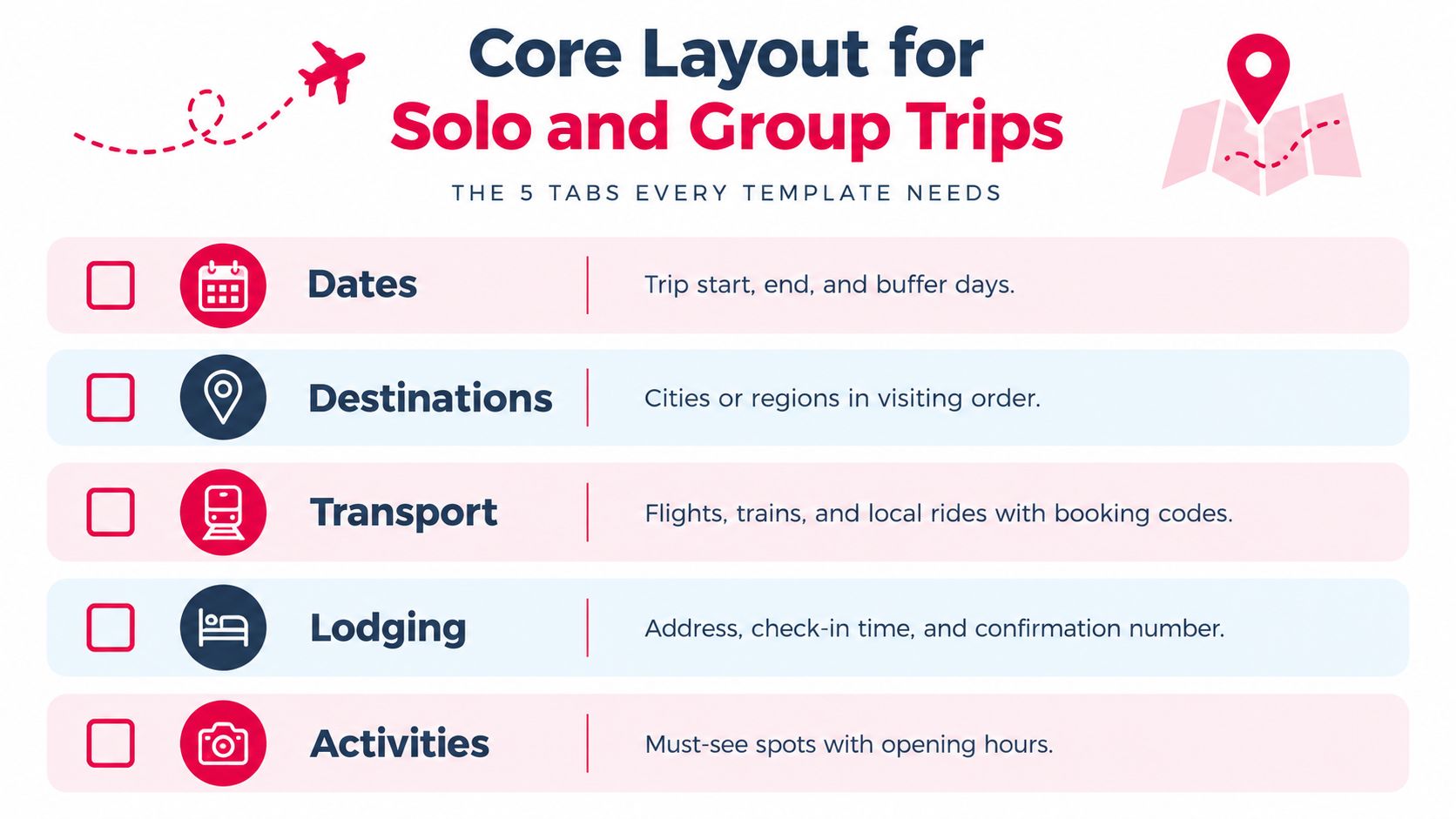
Start with five tabs, in this order: Dates, Destinations, Transport, Lodging, Activities. Order matters because logistics constrain choices. There's no point voting for a Lisbon day trip to Sintra before you know arrival times, or shortlisting Prague hotels before you've fixed how many nights you're staying.
The checklist below shows those five tabs and what belongs in each one.
Consolidation is the point. Accenture's study of 8,000 travelers found that 68% use up to 10 websites when planning a trip and 45% begin one to two months before departure. One readable layout replaces that sprawl if every row carries its source link with it.
Fields to Copy First
Add these columns to every booking or activity row:
- Status: Use idea, shortlisted, or confirmed so nobody mistakes a wish for a reservation.
- Booking reference: Paste the code beside the supplier link, not in a separate notes app.
- Cancellation terms: Note the deadline and whether it's refundable, in plain words.
- Owner: Name who's responsible for booking, paying, or checking times.
- Cost and paid status: Split these into two columns, because agreed and paid aren't the same thing.
If you want a spreadsheet-first starting point, this guide to building an Excel trip itinerary covers the basic grid before you add group fields.
Set Three Deadlines, Not One
For a Lisbon weekend you'd set an activity decision deadline first, then a payment deadline for deposits, then a final confirmation check a few days before departure. A longer Prague stay needs the same three dates, just spaced further apart. Solo travelers can drop the owner column and the voting fields that follow. Groups shouldn't. Without deadlines, your free travel planner template collects ideas beautifully and decides nothing.
Running a Fair Preference Vote for Your Group
Six friends, three candidate plans: a Prague food walk, a Dubrovnik boat day on a different trip, and, for their actual Barcelona weekend, a football match that one very enthusiastic person keeps pushing. In the chat, the match wins by volume. When everyone answered privately instead, three people ranked food first, two wanted a slow morning, and only the proposer called the match a must-see. The group kept the food walk, made the match optional, and nobody had to argue in public.
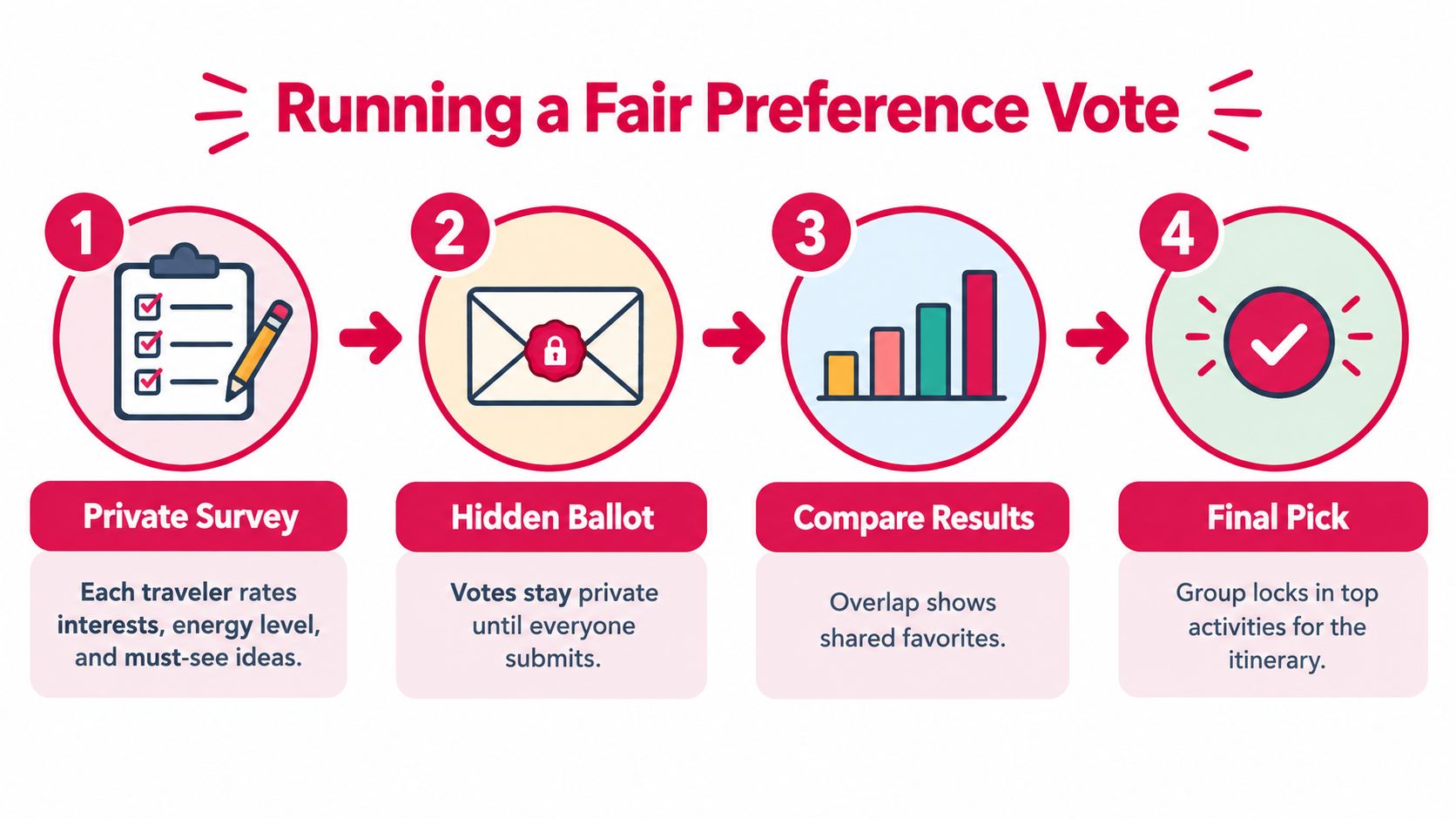
That's the pattern worth copying. The four steps below show how a private round becomes a final pick.
Shared decisions aren't an edge case. A 2025 survey of nearly 4,000 U.S. travelers found that more than 40% planned romantic or family trips and 21% planned trips with friends. Most groups are negotiating, whether they admit it or not.
The Private Round in Practice
Ask each traveler, separately, for interests, energy level, budget comfort, and one must-see. Keep answers hidden until everyone's in, then sort activities by overlap, not by who suggested them. These group decision making methods are useful if your group tends to defer to one planner.
Set a participation deadline and send one reminder, not daily nudges in chat. If someone misses it, their must-see from the survey still counts, which protects quieter travelers and anyone traveling with children or limited energy.
This short walkthrough shows the voting flow in action, from private survey to locked shortlist.
For families and corporate offsites, the fairness point matters even more. One parent or team lead shouldn't have to reconcile every preference from memory. Visible overlap does that work, and it leaves a record the group can point to when someone asks why an activity made the cut.
Balancing Budgets, Access Needs, and Backup Plans
Trip-level totals hide the decisions that cause tension. A single budget figure doesn't tell you that one traveler in Santorini can afford the sunset cruise, another can't, and a third needs step-free boarding. Your template needs per-person columns, or those facts arrive too late.
The pressure is mainstream. A 2025 travel survey found that 65% of respondents intended to spend less than $250 per night on accommodation, and budget management ranked among the leading planning concerns. Design for unequal budgets from the start, not as an awkward exception.
Budget Fields That Prevent Arguments
- Per-person estimate and actual: Show each traveler's share, not just the group total.
- Optional-cost flag: Mark activities people can skip without splitting the day apart.
- Low-cost alternative: Put a cheaper option beside every premium one, such as a free viewpoint beside the paid cruise.
- Payment deadline and refund status: Tie both to the specific booking row.
- Currency conversion: Add a converted column when your group is paying from different countries.
When one person can't afford an option, the flag and the alternative give you a graceful route. They join the shared morning, skip the paid add-on, and meet for dinner. Nobody has to announce their finances to the group.
Access as a Planning Variable
Add dietary tags, accessibility fields, and rest periods as columns, not footnotes. For a Marrakech day trip, that means noting step-free access, shade and seating, halal or vegetarian stops, and who pays which shared taxi fare before you leave. In Santorini, it means checking boat boarding for a mobility-limited guest while there's still time to pick a different operator.
Practical rule: Every outdoor plan gets a bad-weather or cancellation backup in the next column. If the backup cell is empty, the plan isn't finished.
Inclusivity in a free travel planner template isn't a notes field. It's the difference between an itinerary everyone can manage and one that leaves out the person who mentioned their needs last.
Comparing Planning Approaches and Where MyPerfectStay Fits
Four common approaches handle the same job very differently. Judge each on preference collection, fair voting, budget visibility, deadlines, and booking follow-through, because those are where group plans usually break.
| Approach | Best For | Preference Handling | Booking Follow-Through |
|---|---|---|---|
| Blank spreadsheet | Solo trips, detail lovers | Manual, whoever edits wins | Manual links and codes |
| Shared document | Two travelers, light plans | Comments, easy to lose track | Pasted links, no status tracking |
| Group chat with pinned notes | Quick weekend decisions | Loudest voice tends to dominate | Buried confirmations, repeated searching |
| Dedicated group planning platform | Groups choosing activities together | Private surveys and visible overlap | Shortlist connects to bookable options |
A spreadsheet gives you total control and total maintenance. A shared document reads nicely but can't sort votes or costs. Chat is fast for one question and terrible for twenty, because pinned notes don't show status, deadlines, or who's paid.
What the Dedicated Option Adds
MyPerfectStay fits in that fourth row. Each traveler completes a two-minute private survey on budget, interests, energy level, and must-see ideas. Its smart voting algorithm then surfaces activities with clear match scores, so the group sees overlap instead of debating in chat.
From there, travelers can lock plans and book from more than 300,000 experiences across 190+ countries in one click, with a shared, auto-organized daily itinerary for everyone. Organizer tools handle deadlines and nudges, and no account or app download is needed to start.
That's more machinery than a solo weekend in Vienna needs. For one or two travelers who already agree, a free travel planner template on its own is enough. The platform earns its place when preference collection, fair voting, and booking are the bottleneck, which is most groups of four or more.
Turning Your Template Into a Booked Trip
A finished template only helps if everyone sees the same version on their phone during the trip. Share it as a single link, check that it opens cleanly on mobile, and stop editing copies in parallel. One link, one plan.
That expectation is now normal. An industry survey of more than 1,000 U.S. consumers found that 49% consider centralized itinerary management an important digital capability, alongside mobile boarding passes at 63% and real-time alerts at 56%. Your shared link is the low-tech version of that central hub.
The photo below shows the end state you're aiming for, one plan the whole group can actually gather around.

The Final Review Routine
Run this check once, together, before departure:
- Status labels: Everything's marked confirmed, optional, or dropped, with nothing left ambiguous.
- Cancellation terms: Each deadline is visible beside its booking, not in someone's inbox.
- Payment deadlines: Every traveler can see what they owe and by when.
- One reminder: Set a single pre-departure nudge for documents, check-in, and meeting points.
If you're still comparing where to stay in Lisbon, Prague, or Dubrovnik, this roundup of top accommodation sites for 2026 is a handy reference to paste into your lodging tab. And if several people are booking rooms or activities under one reservation, this explainer on how group booking works clarifies who's responsible for what.
Start today with one trip and one private preference round. Build the five tabs, collect answers before anyone books, and measure success by asking two plain questions: did every traveler's must-see get considered, and can everyone open the same itinerary right now?
Turn your free travel planner template into a fair group decision by letting each traveler answer a private two-minute survey, then use match scores to lock and book the activities your group actually overlaps on. Visit MyPerfectStay to run your first vote today and share one auto-organized itinerary with everyone on the trip.