Group Schedule: How to Build One That Everyone Agrees On
October 17, 2026·MyPerfectStay
The group chat is active, but the trip still isn't booked. One person has suggested Lisbon, another wants a beach, and a third hasn't replied. Meanwhile, the first confident suggestion is becoming the default, even though nobody has agreed that it works for everyone.
A reliable group schedule doesn't depend on getting every person to debate every option in public. It separates private preferences from shared decisions, filters out plans that violate real constraints, and gives the group a clear deadline to confirm what remains.
Table of Contents
- Why Group Schedules Always Stall
- The Group Scheduling Workflow From Survey to Lock
- Adapting the Workflow to Friends, Families, and Corporate Teams
- Roles, Permissions, and How to Stop the Loudest Voice Winning
- Scoring Trade-offs That Matter Beyond Popularity
- Sample Itineraries for a Lisbon Weekend and a Dubai Retreat
- Locking the Plan and What to Do When Reality Changes
Why Group Schedules Always Stall
You're probably not short of ideas. You're short of a way to compare them without letting the first suggestion, the quickest reply, or the most persistent voice decide for everybody. In a chat thread, people often react to what they've already seen rather than state what they want. Others stay quiet because they don't want to seem difficult, then raise a serious objection after someone has started booking.
That silence creates a false impression of agreement. A thumbs-up to a destination isn't necessarily approval of the dates, pace, cost, or activities. The result is a plan that looks settled in the chat but keeps slipping whenever a new detail comes up.
Workplace scheduling offers a useful parallel: professionals spent an average of 14.8 hours per week in meetings in 2024, roughly 37% of the average work schedule, while informal coordination adds friction around those meetings, as summarized in WorkTime's time-management statistics. Trips aren't meetings, but the same pattern appears when a group spends more effort coordinating than deciding.
The fix is a repeatable sequence: collect preferences privately, score viable options together, then lock the choice with a deadline. That makes room for honest answers before anyone feels pressure to follow the crowd. If the group is comparing a cruise with a city-based trip, a cruise ship comparison can help people discuss what the experience involves before they vote.
Use the same method for a family reunion in Rome, a friends' weekend in Lisbon, or a corporate retreat in Marrakech. The destination changes. The decision design doesn't.
The Group Scheduling Workflow From Survey to Lock
Start with a short survey that asks for useful input, not a wish list. Collect each person's date availability, budget comfort, pace, interests, and any essential requirements privately. Ask participants to separate what they must have from what they'd enjoy. If everyone answers after seeing the early votes, the first popular option can anchor the rest of the group.
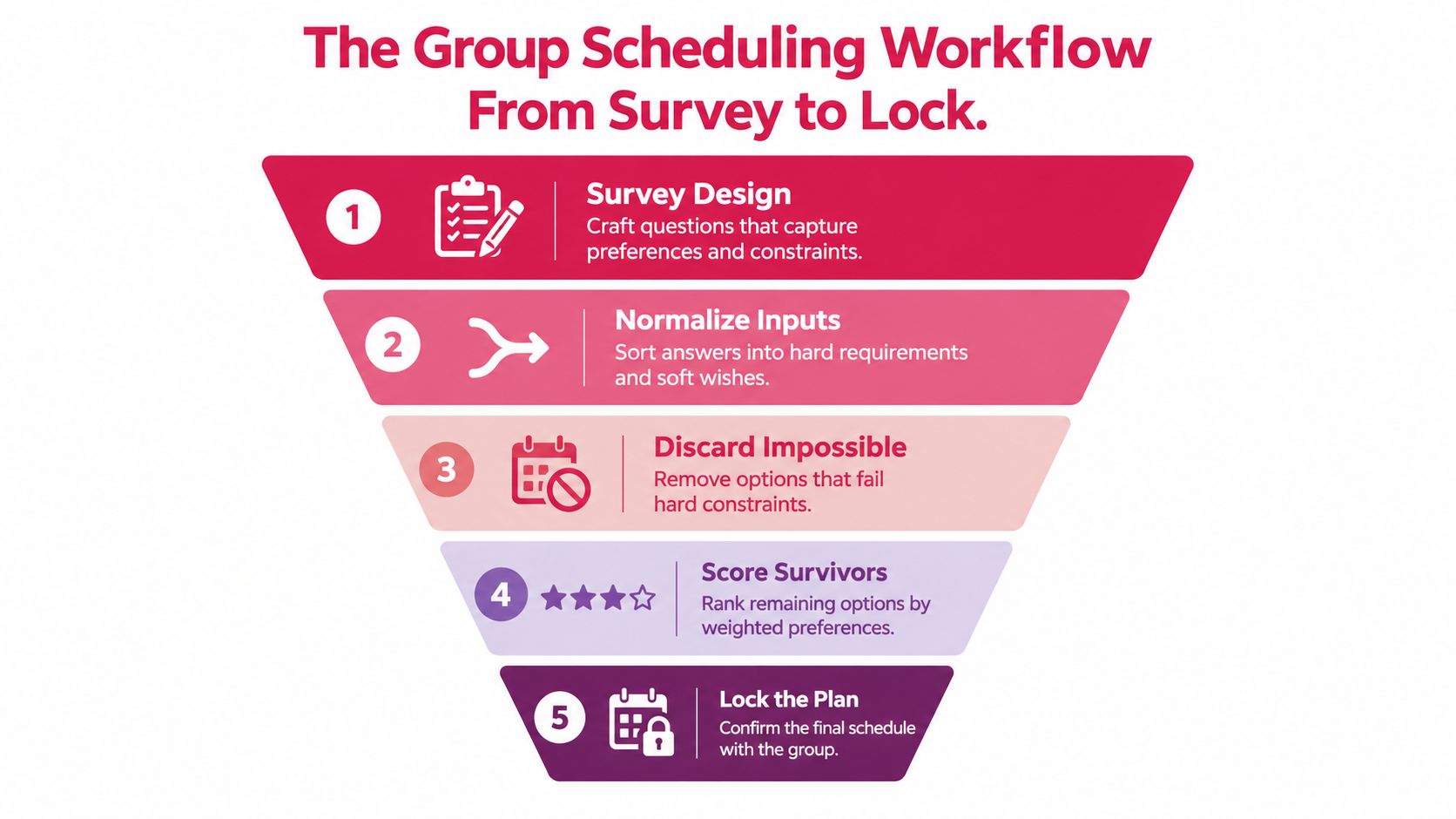
Once replies arrive, normalize them. “Not before Friday evening” is a hard constraint; “a lively dinner would be fun” is a preference. Remove any date or activity that conflicts with a firm requirement, then score the remaining choices using a transparent method such as weighted approval or a satisfaction threshold. Group-decision research supports collecting preferences privately and releasing results simultaneously to reduce anchoring and social pressure. It also cautions against treating a simple majority as consensus when many people dislike the winner, as discussed in research on group decision-making.
Give the group a deadline before sharing the survey. After it passes, show the leading options together and state what will happen next: confirm the best acceptable option, or run a specific tie-breaker. Party plans have their own logistics, so organizers can also consult Sunset Sail USA's party planning tips when a group is weighing activities and event details.
| Stage | Action | Metric to Track |
|---|---|---|
| Invite | Send the survey and state the deadline | Invitation-to-open rate |
| Collect | Gather private preferences and constraints | Survey completion rate |
| Filter | Remove options that fail hard requirements | Feasible-option rate |
| Score | Rank viable choices using a stated rule | Median time to decision |
| Lock | Confirm and share the final schedule | Confirmation rate |
These measures reveal where the process gets stuck. A low completion rate points to a confusing survey or unclear deadline; a long decision time suggests too many choices or no agreed tie-breaker. Once the group confirms, publish one shared version rather than letting several chat messages serve as competing schedules.
Adapting the Workflow to Friends, Families, and Corporate Teams
The workflow stays the same across groups, but the questions and scoring weights should change. Friends usually want a good mix of food, free time, and shared activities. A family reunion needs to account for pace and access needs before popularity. A corporate team needs a schedule that supports its working goals as well as time together.
| Group | Ask About | Give More Weight To |
|---|---|---|
| Friends | Food, nightlife, budget, and preferred pace | Shared enthusiasm and flexibility |
| Family | Walking tolerance, rest, mobility, and meal needs | Whole-group feasibility and comfort |
| Corporate team | Agenda goals, attendance, and work-session preferences | Purposeful use of time and clear logistics |
For a long weekend in Lisbon, a friend group can privately rank a food walk, a relaxed waterfront afternoon, and a late dinner. The organizer filters out options that don't fit the group's dates or budget, then scores what survives. The locked plan should preserve open time rather than turn every hour into a group activity.
A reunion in Rome needs a different lens. The 2025 U.S. Family Travel Survey reports that 71% of grandparents took a multigenerational trip during the previous three years, and 57% identified multigenerational travel as a relevant pattern, as detailed in the Family Travel Association's survey. Those figures underline why the organizer should ask about rest stops, walking pace, and access privately, not wait for someone to disclose a need in front of the group. For large outings, practical travel tips for large group excursions can help organizers think through transport and keeping participants together.
A product team planning an offsite in Marrakech can add agenda priorities and a post-event feedback question. The organizer might weight a focused work session and an accessible shared meal above optional activities, then publish the agenda and confirm who's attending each part. Teams planning the working portion can also use this company retreat itinerary guide as a reference for structuring the day.
Roles, Permissions, and How to Stop the Loudest Voice Winning
A fair process needs named responsibilities, but it doesn't need a boss. The organizer sets the deadline, writes neutral survey questions, removes options that breach stated constraints, and publishes the result. Voters answer by the deadline and flag mistakes in the summary rather than restarting the whole conversation.
Give someone else the challenger role. Their job is to ask whether a reasonable alternative is missing, not to argue until their personal choice wins. That simple permission helps groups catch gaps without turning every preference into another round of debate.
Practical rule: The organizer controls the process, not the outcome.
A designated tie-breaker can step in only if the scoring rule leaves viable options level. Choose that person in advance, and agree what they'll use to break the tie, such as fewer hard conflicts or less dissatisfaction. Rotating the organizer between trips also prevents one person from carrying the planning work every time.
| Role | Responsibility |
|---|---|
| Organizer | Sets the survey, deadline, and decision rule |
| Voters | Submit private preferences and confirm the result |
| Challenger | Checks for a missing option or overlooked constraint |
| Tie-breaker | Applies the agreed rule when viable choices are tied |
Keep participation easy. Share a link that doesn't require an account, make scoring anonymous when that helps people answer freely, and maintain one readable itinerary that everyone can check on their own time. The need for structure is easy to see in workplace coordination: Microsoft data cited in 2025 meeting statistics indicates that 57% of meetings were ad hoc calls without a calendar invitation in 2025. A clear organizer role helps a group avoid replacing a plan with yet another unstructured chat.
Scoring Trade-offs That Matter Beyond Popularity
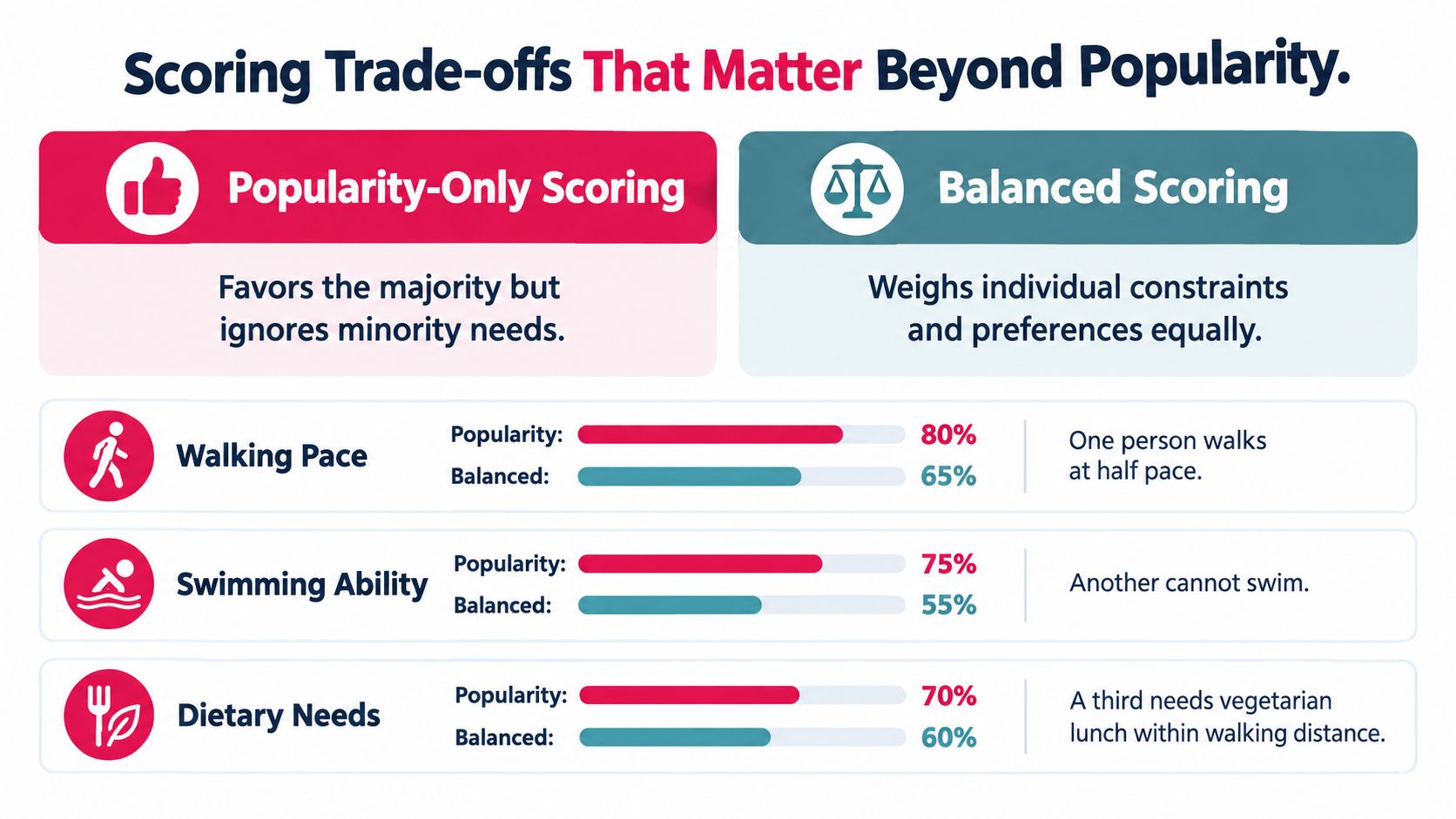
Popularity isn't the same as suitability. A busy walking tour may win a vote while excluding the person who needs a slower pace; a beach activity may be a poor fit for someone who can't swim; and a restaurant choice can fail if a participant needs a vegetarian meal nearby. These aren't minor preferences if they make the plan unworkable for someone.
Treat accessibility as a private feasibility constraint. Ask what the plan needs to accommodate, without requiring anyone to explain personal medical details to the group. Then compare the remaining choices on practical factors such as walking distance, places to rest, meal options, transport, and whether someone can opt out without being stranded.
Sustainability can be handled just as concretely. A global survey of more than 32,000 travelers across 34 countries found that 93% wanted to make more sustainable choices and 73% wanted their spending to benefit local communities, according to the GSTC and Booking.com sustainability report announcement. Instead of asking the group to endorse one “green” plan, show the trade-offs: transport, crowd pressure, local ownership, convenience, and mobility. A concentrated walkable day may reduce transfers; spending with local providers may distribute benefits differently. Neither consideration should be hidden behind one moralized score.
| Approach | Best For | Main Failure Mode |
|---|---|---|
| Weighted approval | Groups that want some preferences to count more | Weights can be unclear or contested |
| Median utility | Finding an option with broad, moderate support | Can overlook strong dislikes |
| Satisfaction threshold | Ensuring a plan is acceptable to most participants | May leave few options if the threshold is too strict |
Agree on tie-breakers before the vote. Remove any option that violates an essential requirement, prefer the choice with fewer severe conflicts, and check whether the same person keeps absorbing inconvenient time slots. A fair score doesn't have to make everyone equally excited. It should prevent the group from repeatedly sacrificing the same person's comfort.
Sample Itineraries for a Lisbon Weekend and a Dubai Retreat
For a four-day Lisbon-to-Douro Valley trip for eight friends, the survey should ask about budget comfort, interest in food and wine, travel pace, and whether everyone wants a full-day excursion. Start with three candidates: a city-focused Lisbon plan, a day trip into the Douro Valley, and a more relaxed itinerary with extra unstructured time. Filter out any option that clashes with a hard date or mobility constraint, then score the survivors on shared interest and pace.

A possible lock is Lisbon as the base, with one day reserved for the Douro Valley and an unplanned block left open for anyone who wants a slower afternoon. That keeps the trip's shared anchor while allowing people to skip an activity without derailing the group. A group tour itinerary guide can help organizers think through the relationship between shared activities and free time.
For a three-day Dubai retreat for a 12-person corporate team, ask which work sessions are essential and whether the group prefers a desert experience, time around Dubai Creek, or a balance of both. Score three candidates against the agenda and attendance constraints, then lock the work blocks before fitting in leisure. Europe and MENA make natural starting points for destination examples: Europe received approximately 747 million international tourist arrivals in 2024, while the Middle East recorded about 95 million, 32% above its 2019 level, according to this 2024 tourism arrivals summary.
A visual overview can help organizers adapt the voting sequence to a specific group:
Locking the Plan and What to Do When Reality Changes
A lock isn't a promise to ignore new information. It's a shared reference point that stops people from reopening settled choices because they've changed their minds. Send the same final itinerary to everyone, state which bookings are confirmed, and explain how participants can raise a genuine change request.
Before locking a schedule across time zones, convert all proposed times into a common reference and show each participant their local time. Scheduling research reports that confirming one cross-time-zone meeting can take an average of 8.5 exchanges and 2.7 days, according to this cross-time-zone scheduling research summary. A private asynchronous poll with an expiry time gives people space to reply without keeping the decision open indefinitely.
Lock-day checklist
- Publish one version: Include dates, start times, locations, transport, and confirmed bookings.
- Name the decision rule: State what counts as a real conflict and who can approve a change.
- Set expectations for deposits: Don't commit shared money until the relevant participants have confirmed.
- Handle partial confirmations: Mark uncertain attendance clearly and avoid treating nonresponse as consent.
- Plan for dropouts: Decide whether a booking can proceed, change, or be cancelled if someone withdraws.
For shared calendars and a common itinerary, organizers can use this guide to share a calendar. If illness, flight disruption, or weather makes the agreed plan impractical, reopen only the affected part and offer a bounded choice. If someone prefers another restaurant after the group has booked, keep the original decision unless the group's agreed change rule says otherwise.
Humane flexibility is part of good planning. The process should protect people from endless re-voting, not force them through an unsafe or unworkable day.
MyPerfectStay helps groups collect private trip preferences, vote on activities, and turn the agreed choices into a shared, organized itinerary. If you're ready to replace another round of chat debate with a clear decision, explore MyPerfectStay.