How to Plan a Family Vacation from Start to Finish
September 30, 2026·MyPerfectStay
You're probably staring at a family group chat that has become a planning disaster. One person wants Paris, another is pushing Lisbon, the grandparents haven't answered, and the children are lobbying for an activity nobody has priced. The longer everyone negotiates in public, the harder it becomes to separate genuine preferences from noise.
The reliable way to plan a family vacation is to treat it as a two-stage decision system. Decide the high-impact variables first, then lock the practical details in a short preparation sprint. That approach gives three generations a voice without making every meal, museum, and transfer a group referendum.
Table of Contents
- The Family Vacation Planning Sprint
- Building a Realistic Family Trip Budget
- Choosing Lodging That Works for Everyone
- Coordinating Preferences With Structured Voting
- A Sample Multi-Generational Day-by-Day Itinerary
- Packing and Safety Checklists Before You Leave
- Locking the Plan and Trip-Week Execution
The Family Vacation Planning Sprint
Start five weeks before departure. That gives the adults enough time to settle the expensive, high-variance choices before availability narrows, while leaving the final preparation period for documents, packing, and confirmations.
Family travel is a serious planning category, not an occasional impulse purchase. The 2025 U.S. Family Travel Survey found that 92% of parents were likely or very likely to travel with their children in the next 12 months, while 81% planned to increase or maintain domestic travel spending. It also reported average family travel spending of about $8,052 in 2024, roughly 20% higher than the previous year, with 73% naming affordability as the biggest barrier. A family trip needs a budget decision before it needs an attraction shortlist.
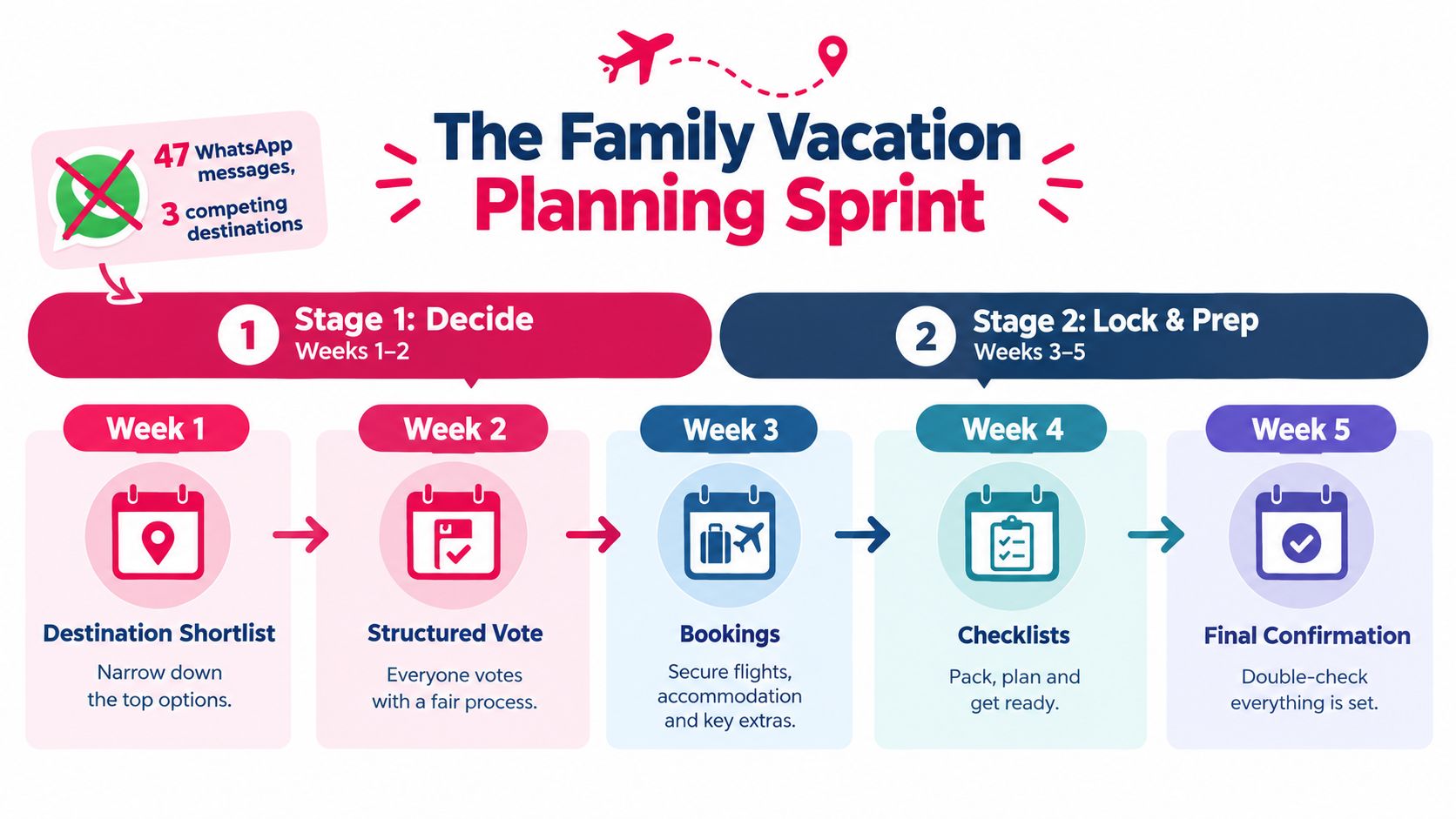
Stage one decides the trip
Use the first part of the sprint to settle:
- Destination: Shortlist destinations that fit the group's mobility, interests, season, and travel time. For European family trips, Lisbon, Barcelona, Paris, Rome, Vienna, and Dubrovnik all offer different balances of culture, walkability, food, and downtime.
- Budget envelope: Set a ceiling before anyone falls in love with a hotel or an expensive day trip.
- Lodging type: Decide whether the group needs a vacation rental, hotel suite, family room, or adjoining rooms.
- Must-have conditions: Record firm requirements such as a lift, kitchen, pool, separate sleeping areas, or proximity to public transport.
A 2024 Skift travel trends report found that 46% of family trips were classified as multi-generational. That matters because a three-generation group isn't choosing for one traveler. It's solving for sleep, stamina, food, privacy, and interest at the same time.
Stage two locks and prepares
During the final part of the sprint, book the lodging and transport, close the activity vote, collect documents, assign packing responsibilities, and publish the daily skeleton. Don't schedule every minute. A good plan protects the anchors and leaves room for naps, weather, slow lunches, and the inevitable delay.
Give every adult one clear job:
- Trip Lead: Owns the master timeline and final decisions.
- Money Lead: Tracks deposits, shared costs, reimbursements, and the buffer.
- Vetter: Checks whether destinations, tours, restaurants, and transport work for the group.
- Document Keeper: Stores passports, insurance details, confirmations, and emergency contacts.
If the family wants an activity outside Europe or MENA, such as a manta ray snorkel for families, assess it using the same process. Check age suitability, travel time, safety equipment, and cost before it reaches the final vote.
One-glance sprint calendar
- Week five: Destination shortlist, budget ceiling, and traveler constraints.
- Week four: Private voting, match score, and backup destination.
- Week three: Lodging and transport decisions.
- Week two: Activity bookings, transfers, and document check.
- Week one: Packing, offline information, final confirmations, and a lean itinerary.
Building a Realistic Family Trip Budget
A family budget fails when it hides the expensive lines inside one reassuring total. Build the trip from separate categories, then decide where comfort matters and where convenience is costing too much.
For a European trip, a published family travel breakdown lists example ranges of $1,800 to $4,200 for accommodation, $1,000 to $2,000 for food, and $400 to $1,000 for trains and local transport. The Europe with kids budget guide also recommends apartments over hotels when appropriate, cooking breakfasts, carrying picnic lunches, and booking fast trains early.
Use those published components as a planning reference, not as a promise of what your own trip will cost. Flights or long-distance rail, attractions, transfers, travel insurance, and pre-trip purchases still need their own lines.
The seven-night budget structure
| Budget Line | Budget | Mid-Range | Premium |
|---|---|---|---|
| Accommodation | $1,800 | Between the published low and high range | $4,200 |
| Food | $1,000 | Between the published low and high range | $2,000 |
| Trains and local transport | $400 | Between the published low and high range | $1,000 |
| Flights or long-distance travel | Price separately | Price separately | Price separately |
| Attractions and tours | Price by chosen activities | Price by chosen activities | Price by chosen activities |
| Buffer | Add to the working total | Add to the working total | Add to the working total |
| Pre-trip spend | Adapters, bags, medicines, and documents | Adapters, bags, medicines, and documents | Adapters, bags, medicines, and documents |
The table separates the known planning ranges from costs that vary too sharply to state without dates, origin airports, group size, and destination. For a family of four staying seven nights, start with accommodation, food, and transport, then add flights, activities, and a buffer rather than pretending the published components represent the full holiday.
Practical rule: Put the buffer in the budget before anyone votes on activities. A buffer that exists only in your head will be spent before departure.
Food is where lodging decisions compound. A kitchen-equipped apartment can support breakfast in, packed lunches, and some dinners at home. That doesn't mean cooking every night. It means reserving restaurant spending for meals the family wants to remember, rather than paying restaurant prices because nobody has the energy to find food.
If you're comparing tactics, use this family vacation budget guide as a planning reference, then record the actual figures in a shared sheet. List who paid, what the payment covered, and whether the cost is shared by every traveler or only by one household.
Add a 10% planning buffer as an editorial safeguard for price changes, extra taxis, replacement items, and an unplanned meal. Keep a separate pre-trip line for adapters, stroller decisions, visa fees, prescriptions, luggage, and airport parking. Those costs arrive before the holiday, so they shouldn't skew the spending money available during it.
Choosing Lodging That Works for Everyone
Lodging is the decision that determines whether a family trip feels restorative or like a sleep-deprived group project. Choose by sleeping arrangements, access, kitchen needs, and support, not by photographs of a beautiful lobby.
For European and North African stays, Accor's family accommodation guidance provides a useful baseline. Its family search can cover two adults and at least one child up to age 15, participating properties may allow children to stay free when sharing a parent's room, and the maximum number of children depends on the hotel and room type. Check the exact property rules before paying. “Family room” is not a universal capacity category.
Four options, four trade-offs
| Lodging Type | Best For | Kitchen Access | On-Site Support |
|---|---|---|---|
| Hotel suite | Families wanting privacy and hotel services | Often limited or partial | Strong, with reception and housekeeping |
| Family room | Smaller groups with younger children | Usually limited | Strong, subject to property rules |
| Adjoining rooms | Three generations needing separation and flexibility | Usually limited | Strong, with separate room privacy |
| Vacation rental | Larger groups that value shared space and meals at home | Usually full | Depends on host and property |
A hotel suite is efficient when grandparents need quiet, children need an early bedtime, and the adults still want to sit together. A family room costs less complexity, but it can become cramped once luggage, mobility aids, and different sleep schedules enter the picture. Adjoining rooms often beat a single suite for a multi-generational group because adults can access a kitchen or shared sitting area late at night without waking children.
Vacation rentals make the strongest case when the group wants breakfast flexibility, laundry, a dining table, and a common room. The family travel survey reported that 50% of parents book lodging with a kitchen, and 46% limit paid attractions to control the total cost. Those choices point to a practical preference, families often protect trip quality by managing recurring costs and preserving flexibility.
A spacious vacation rental for groups can be useful as a comparison point when shared space matters, but inspect the details carefully. Rentals usually don't provide daily housekeeping or a 24-hour desk, which can matter when toddlers wake early, grandparents need help, or a late arrival goes wrong.
Use this shortcut:
- Young children and a small group: Family room or suite.
- Different bedtimes and older adults: Adjoining rooms.
- Several households or regular meals at home: Vacation rental.
- Mobility concerns: Lift access, step-free entry, bathroom layout, and distance to transport outrank decorative style.
Coordinating Preferences With Structured Voting
By the fourth week before departure, the group chat has usually produced more opinions than decisions. A loud relative can dominate the destination choice, while quieter travelers and children get treated as afterthoughts. Use a private, structured vote instead.
Give every traveler the same short list, ask each person to rank the options independently, and reveal the result only after voting closes. A match score shows where preferences overlap. The highest-scoring destination becomes the working choice unless the host finds a clear problem with affordability, accessibility, or safety.
Run the vote on a fixed clock
Build this into the first stage of the five-week pre-departure sprint:
- Day three: Close destination nominations. Each adult may nominate one, while children can suggest ideas through the adult responsible for them.
- Day four: Send the final shortlist. Keep it short enough for a meaningful comparison.
- Day five: Close private voting. Use one vote per person, not one vote per household.
- Twenty-four-hour mark: Send one nudge to anyone who has not responded. Do not reopen the discussion.
- Day six: The host breaks a tie and records the backup destination.
- Stage two: Test the winner against the budget. If it fails, move directly to the documented backup.
Once the shortlist goes out, ban campaigning in the group chat. A genuine veto still deserves attention, such as a mobility limitation or an impossible travel connection. A preference for one beach or hotel does not justify restarting the debate.
Planning fatigue grows when every choice stays open. Set the decision window, publish the result, and reserve detailed comparison for the finalists. The Royal Caribbean Group vacation research reported that 67% of parents said their children help plan activities, 62% said children influence whether a vacation is fun, and 61% said involving children positively affects their happiness and engagement during the trip. Let children shape suitable choices without handing them the entire itinerary.
Give children bounded influence. Ask them to rank a short list of destination-compatible activities rather than submit an unlimited wish list. A child can choose between the Oceanário and a beach morning. An adult remains responsible for opening hours, transport, price, and stamina.
The family doesn't need unanimous enthusiasm. It needs a fair process, a workable winner, and a backup nobody feels was hidden.
MyPerfectStay's family group decision-making guide describes a workflow with private preferences, deadlines, nudges, and a shared result. The point is not to automate family relationships. It's to prevent the group chat from becoming the place where every decision gets reopened.
A Sample Multi-Generational Day-by-Day Itinerary
Lisbon works well for a three-generation example because the trip can combine historic neighborhoods, child-focused attractions, food, river views, and a manageable pace. The mistake would be treating every day as a sightseeing test. Each day below has one cultural anchor, one kid-centric activity, and one unstructured block.
| Day | Anchor Activity | Kid-Centric | Downtime Block |
|---|---|---|---|
| Day one | Tram 28 ride | Pastel de nata stop near the hotel | Arrival, unpacking, and an early night |
| Day two | Belém Tower in the morning | Oceanário in the afternoon | Early dinner and hotel rest |
| Day three | Slow Alfama walk | Tuk-tuk ride | Fado nightcap for interested adults and grandparents |
| Day four | Sintra day trip | Castle photos and kid-friendly gardens | Return to Lisbon without a second evening activity |
| Day five | Cascais beach morning | Sand and sea time | Apartment pool and quiet afternoon |
| Day six | Family brunch | A final walk chosen by the children | Departure logistics |
How the rhythm works
Day one is deliberately light. After arrival, take a tram 28 ride only if the group has the energy. A pastel de nata stop near the hotel gives children a simple reward and gives grandparents a chance to sit before the evening ends.
Day two carries the strongest cultural load. Visit Belém Tower in the morning, when the group is fresh. Put the Oceanário in the afternoon, then eat early. Children get a visually rich activity, while adults don't have to force everyone through a late restaurant booking.
Day three belongs to the slower walkers. Explore Alfama at a gentle pace and use a tuk-tuk when the hills start to defeat the group. A short fado nightcap gives grandparents the cultural evening they may have been hoping for, but it stays optional for tired children.
Sintra deserves its own day. Castle photographs and kid-friendly gardens provide a clear purpose without adding several unrelated stops. The following day at Cascais is intentionally less ambitious. A beach morning followed by apartment-pool downtime lets everyone recover from the city and the day trip.
The family vacation Europe planning guide can help generate further destination and activity ideas, but don't let a long list replace the daily rhythm. The strongest itinerary is not the one with the most reservations. It's the one that leaves enough energy for conversation, snacks, and changing plans.
Packing and Safety Checklists Before You Leave
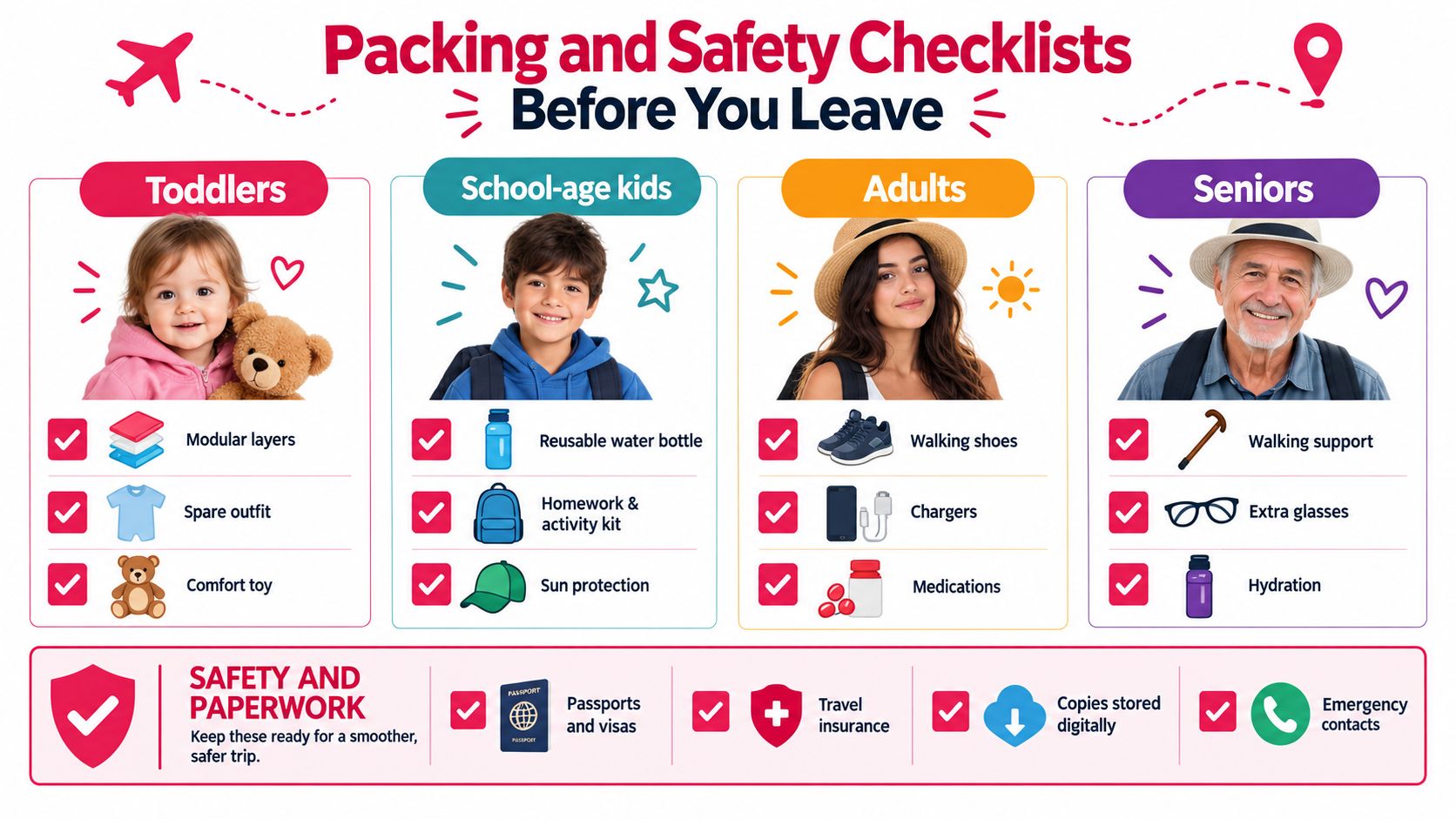
Pack by traveler type, then create one shared safety file. A family packing list fails when one adult assumes another adult has packed the medication, adapters, or documents.
Traveler-specific packing
Toddlers
- Clothing: Modular layers, spare outfits, swimwear, and a light rain shell.
- Comfort: A familiar pillow, comfort toy, and a small first-day surprise.
- Transit: Snacks, wipes, and a simple activity that doesn't depend on internet access.
School-age children
- Clothing: Comfortable walking shoes, modular layers, swimwear, and one dressier outfit.
- Entertainment: A tablet pre-loaded with offline content, headphones, and a small activity kit.
- Ownership: A short personal packing list so the child knows what they brought and where it is.
Adults
- Essentials: Comfortable walking shoes, chargers, adapters, medications, and copies of key documents.
- Weather: A light rain shell and layers that can work across changing temperatures.
- Organization: A shared day bag with snacks, water, tissues, and the day's confirmation details.
Seniors
- Medication: Prescriptions in original packaging, with a record of doses and timing.
- Mobility: A compact walking aid if needed, plus comfortable shoes that have already been worn.
- Flight comfort: Compression socks and spare reading glasses.
Safety and paperwork
Check the official travel advisory for every destination. Record the advisory level, the reason for it, and the issue date. A safe family travel checklist also recommends recording the name, address, and phone number of hospitals near the accommodation.
Before leaving, complete these checks:
- Copy passports, visas, insurance cards, prescriptions, and booking confirmations.
- Store digital copies in an encrypted cloud folder.
- Give a printed set to a non-traveling relative.
- Register with consular services for non-EU trips where that service is available.
- Confirm that travel insurance includes medical evacuation.
- Pack a basic first-aid kit.
- Identify the nearest pediatric hospital and an English-speaking clinic.
- Check activity-specific safety equipment. Use helmets for biking or horseback riding and life vests for boating.
- In mosquito-risk areas, confirm the accommodation has air conditioning or screened rooms, and pack suitable protection such as bed nets or repellents containing DEET, picaridin, oil of lemon eucalyptus, or PMD.
At 72 hours before departure, perform one final check of chargers, adapters, documents, prescriptions, and pet or house-sitter confirmations. Don't wait until the airport to discover that the only adapter is in the suitcase nobody brought.
Locking the Plan and Trip-Week Execution
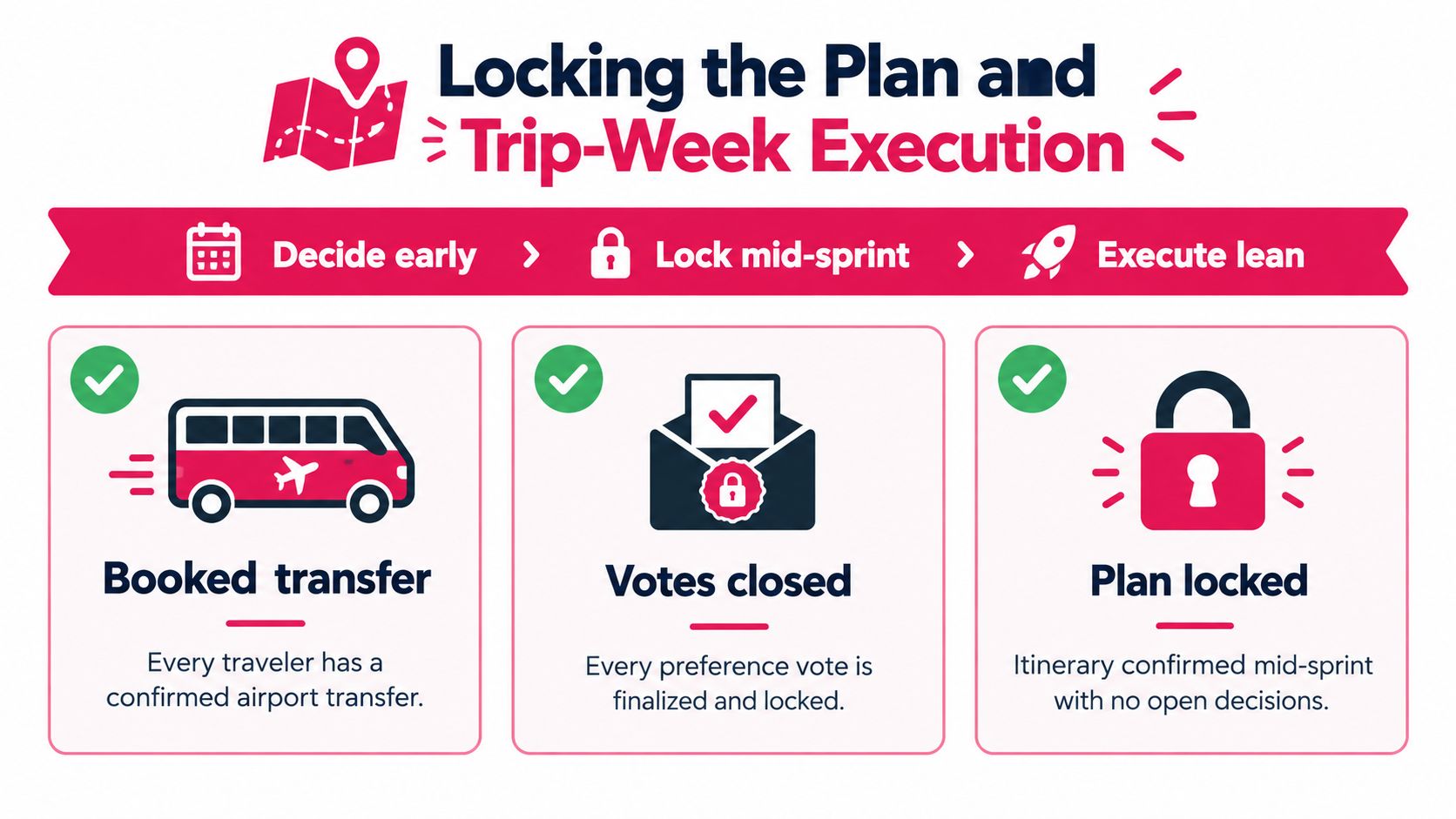
The final principle is simple: decide early, lock mid-sprint, execute lean. A family vacation doesn't need a rigid schedule. It needs enough decisions settled that nobody is negotiating transfers, rooms, and dinner while standing beside a tired child.
Three signals tell you the plan is on track:
- Every traveler has a booked transfer. Confirm airport, station, or port arrangements and save the provider's contact details.
- Every preference vote is closed. The destination and core activities have a result, a record, and a backup where necessary.
- Downtime sits between high-energy activities. Don't stack a major museum, a long transfer, and a late dinner without a recovery block.
The print-friendly final check
- Passport expiry and visa requirements checked.
- European Health Insurance Card or travel insurance cards packed.
- Adapter types confirmed for the destination.
- Pharmacy receipts and prescription information stored.
- Offline maps downloaded.
- Shared itinerary link tested.
- Lodging host's contact saved in every relevant adult's phone.
- Daily family check-in time agreed.
- Transfers confirmed.
- Accessibility and sleeping arrangements reconfirmed.
- Weather checked and layers adjusted.
- Backup destination or backup activity recorded where needed.
The trip-week protocol
Hold a short morning huddle. Confirm the day's anchor activity, kid-centric activity, and downtime block, then state the meeting point and the person carrying the documents.
Share one mid-day photo in the family group. It keeps relatives connected without turning the chat into a live operations center. In the evening, ask one practical question: what needs changing tomorrow?
Move the breakfast time, shorten the museum visit, replace a wet-weather plan, or give one household a separate afternoon. A flexible plan isn't a failed plan. It's the reason the plan works for people with different ages and energy levels.
A family trip runs on rhythm, not heroics. The five-week sprint handles the hard decisions before departure, structured voting creates buy-in, and the daily skeleton protects everyone from overload. Once those pieces are in place, three generations can stay present instead of managing logistics from morning until bedtime.
If your family is stuck between destinations or activities, MyPerfectStay lets each traveler submit private preferences, compare match scores, vote, and turn the result into a shared daily itinerary. Start with your destination, rough dates, and travelers, then use the shared plan to lock the trip before the group chat takes over.