Match Scores Today for Group Trip Plans
October 31, 2026·MyPerfectStay

Six friends are in Lisbon for the weekend, and Saturday still isn't decided. Someone wants a food tasting, someone else wants a tram pass and a slow morning, one person keeps sending a late club, and another keeps sending a day trip. Nobody's being difficult. You're all just looking at the same day with different budgets, energy, and ideas about what's worth leaving the hotel for.
That's the moment match scores today are built for. Not a ranking of Lisbon, and not a popularity contest in the chat. It's a quick, freshness stamped snapshot that tells you, with the replies you have right now, which activity everyone can live with today, and whether it's safe to book it.
Table of Contents
- What Match Scores Today Mean on a Group Trip
- How a Same-Day Match Score Is Calculated
- Score Bands and What to Do With Each One
- When Today's Score Is Safe to Trust
- Match Scores on Europe and MENA Group Days
- How to Lift a Weak Score Before You Book
- Lock the Fairest Plan for Today
What Match Scores Today Mean on a Group Trip
Stay with that Lisbon Saturday. The chat has four good ideas and no decision, because each message shows what one person loves. It doesn't show whether the price breaks someone's limit, whether a late finish clashes with an early train, or whether one friend privately marked clubs as a must skip.
A match score fixes that blind spot by checking one bookable activity against every person's private answers.
Match score, in plain terms: a same day overlap figure, out of 100, for one activity. It shows how well that activity fits the group's current budget ceilings, interests, energy for today, and must see or must skip ideas.
Today is the important word. The score uses the replies currently in, not an old wishlist from when you booked the flights. If someone slept badly, lowered their budget, or changed their mind about museums this morning, today's figure should reflect that. It's a snapshot, not a permanent verdict on the city or the activity.
How to Read the Number at a Glance
A figure near the top means almost everyone can join without breaking a hard limit. Price fits, pace fits, and nobody's must skip is in the way. You can treat that activity as the anchor for the day.
A middle figure means the plan fits only some people, or only part of the day. Maybe the food tasting works for five of you but runs too long for the sixth. That isn't a no. It's a signal to shorten it, move it, or make it optional.
A low figure means something real is blocking it. Budget, pace, timing, or a must skip is in the way, and pushing ahead usually means one person pays too much, powers through exhaustion, or drops out.
This deadlock is ordinary on friend trips, which are now a normal way to travel. In Zeta Global's Travel Trends 2025 report, 21% of surveyed travelers in 2025 intended to vacation with friends. With that many group chats trying to lock a Saturday, you need a clearer signal than the most recent link.
Before anyone pays, use the band chart further down. The number tells you the overlap. The band tells you what to do with it.
How a Same-Day Match Score Is Calculated
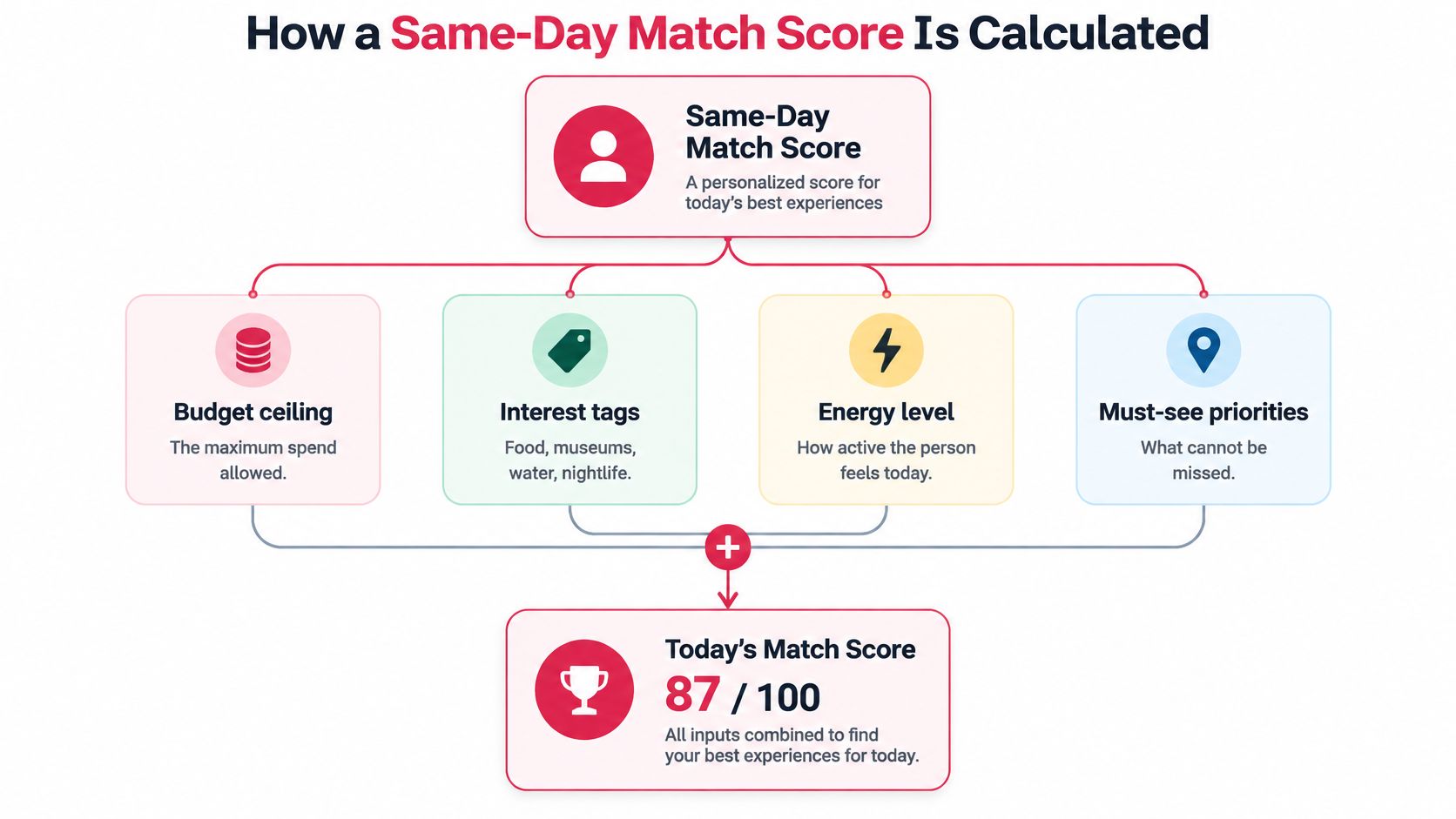
The calculation isn't mysterious. It's overlap, counted person by person, using four private inputs. Nobody has to defend their answers in the chat, and the loudest message doesn't count extra.
The Four Inputs Everyone Gives
- Budget ceiling: the maximum that person can spend on this activity today, not their whole trip budget.
- Interest tags: simple labels such as food, museums, water, history, or nightlife.
- Energy level for today: whether they want an active day, a gentle day, or something in between.
- Must see and must skip ideas: the one or two things they really want, and anything they won't do.
Those four answers get compared with the activity itself. Price, theme, start time, duration, and physical effort all get checked against each person, not against a group average invented by the organizer.
Picture Four Switches
Think of a Barcelona morning at the Sagrada Familia. For each person, imagine four switches. Is the ticket inside their ceiling? Did they tag architecture or museums? Does a timed morning entry match their energy today, rather than demanding a late night after it? And did they mark churches, crowds, or early starts as a must skip?
Count how many switches stay on across the whole group, then show that overlap as a score out of 100. That's the whole idea. A good activity keeps most switches on for most participants. A weak one turns several off, often for the same reason.
Swipes feed the same process in a faster form. Group members swipe on activities, and the itinerary is built from what the group loves, not from a preset list an organizer guessed at. If you're comparing tools for this step, a clear group scheduling tool should show you that overlap, not just collect votes.
Two Numbers From One Rome Day
Say a reunion group in Rome scores a Vatican morning at 71. The interest is there and the price fits, but two people want a slower start after a late arrival, so energy pulls the figure down. An evening pizza walk scores 88 because budget, pace, and the shared must see of eating together all line up.
Neither number says the Vatican is worse than pizza. It says the pizza walk fits this group, today, with less friction.
Two Traps to Watch
First, a must skip outweighs several mild likes. If one person cannot do boats and four people quite like boats, a boat trip shouldn't sail through on enthusiasm alone. The hard limit matters more than the mild preferences around it.
Second, an activity nobody has seen yet can't fairly outrank one the group already marked. It has no real overlap behind it, only a fresh link and a hopeful caption.
A useful score names the constraint that pulled it down, such as budget or energy, so your next edit is obvious.
If the score doesn't tell you why it's low, you can't fix it. You can only argue about it.
Score Bands and What to Do With Each One
A raw number doesn't book anything. You need an action band, a simple rule that turns the figure into lock, shorten, make optional, or drop. Use this chart on today's shortlist before you debate individual activities.
| Score today | What it indicates | Group action |
|---|---|---|
| 90–100 | Almost everyone clears budget, pace, and must-sees | Lock the slot and book |
| 70–89 | Strong overlap with minor friction for one or two people | Default yes, place it on the shared day |
| 50–69 | Fits some people well, or fits everyone for only part of the time | Shorten it, move it to a free hour, or swap one constraint |
| 30–49 | A minority interest or one hard clash | Optional only; do not anchor the day |
| 0–29 | Budget, pace, or a must skip blocks most of the group | Drop it for today |
What Each Band Really Means
90 to 100 is a lock. Budget, pace, and must sees are clear for almost everyone. Don't keep shopping for alternatives. Book that slot while the time you want is still available.
70 to 89 is the default yes. Most good group days land in this range. Put it on the shared day unless another activity in the same band fits the clock noticeably better. Waiting for a perfect 100 usually wastes the morning.
50 to 69 is a split. The idea has real support, but the full version doesn't fit. Keep a shorter version, move it to a free hour, or change one constraint, such as the start time or price tier, instead of forcing everyone through the whole activity.
30 to 49 is optional only. A minority wants it, or one hard clash blocks it as a group plan. Offer it as a side option for whoever's keen. Never build the shared day, transport, or dinner booking around it.
0 to 29 is a drop for today. That wording matters. You're not banning the idea forever. You're saying it doesn't fit this group, on this day, with these replies.
One Lisbon Saturday, Sorted
Take the mixed list from the opening chat. A shared food tasting scores 86, so it's in the default yes band and becomes the anchor. You build lunch around it and stop reopening the question.
A tram pass scores 61. That's a split, not a headline plan. Keep it as a short add on between neighborhoods, useful for tired legs, but don't let a transport pass dictate the whole route.
A late club scores 34. It stays off the family friendly shared evening. Anyone who still wants it can go after dinner as an optional extra, without making everyone else plan around a 1 a.m. finish.
The day trip, if it lands below 30 because it eats the entire Saturday, drops for today. It can return on Sunday if energy and time look different then.
Practical rule: sort today's list into lock, shorten, and drop before you decide anything else.
One caution before you book from this chart. A band is only as firm as the replies behind it. An 86 built on everyone's answers means something very different from an 86 built on three replies out of six, and that difference decides whether you should pay yet.
When Today's Score Is Safe to Trust
A today page is a live planning feed, not a printed list. The number moves when someone joins late, skips an activity, edits a budget ceiling, or adds a must skip. So before you pay, check which state your score is in.
| Reply state | What the score means | Book now? |
|---|---|---|
| Everyone invited has answered | Stable overlap for this shortlist | Yes, take the top band |
| One or two people still out | Provisional and likely to move | No, nudge and recheck |
| A budget or must-skip changed | Previous score is stale | No, refresh first |
| Two activities in the same band | Both are fair on overlap | Use time and energy, then book one |
The Four States, One Action Each
If every invited person has answered, treat the score as stable. Book the top band and move on. More discussion won't add information, it'll only add links.
If one or two people are still out, label the score provisional in your own head, even if the screen just shows a number. Send one nudge, give a clear deadline, and recheck before paying. A provisional 84 can become a 58 the moment the last person reveals a tight budget.
If someone lowered a budget or marked a must skip after the score appeared, the old number is stale. Refresh it before any deposit. Paying on a stale score is how an organizer ends up holding tickets nobody agreed to.
If two activities sit in the same band, don't let the longest argument win. Break the tie with clock and energy. Say a Prague brewery tour scores 74 and a river cruise scores 78. Both sit in the 70 to 89 band, so both are fair. The earlier, lower energy option goes in the slot that fits the group's afternoon, and you book that one.
Two Freshness Habits That Prevent Mistakes
Show the time of the last complete reply next to the score whenever you share it. "Food tasting, 86, updated after Maya answered at 9.40" stops people treating a screenshot from breakfast as the final word at dinner.
Also name which today the score uses when friends are in different time zones. A Lisbon start time may already feel past for someone joining plans from Dubai, and "this evening" means different hours in each chat window. Pin the plan to the destination's local time and say so once, clearly.
This care matters most where group travel is busiest. UN Tourism reported 793 million international tourist arrivals in Europe during 2025, a 4% increase from 2024 and 6% above 2019 levels. In cities like Paris, London, Barcelona, Rome, Amsterdam, Prague, Vienna, and Lisbon, popular slots move fast, which is exactly why you want a score you can trust the first time.
The rule that protects your money is simple. Never pay on a provisional or stale score.
Match Scores on Europe and MENA Group Days
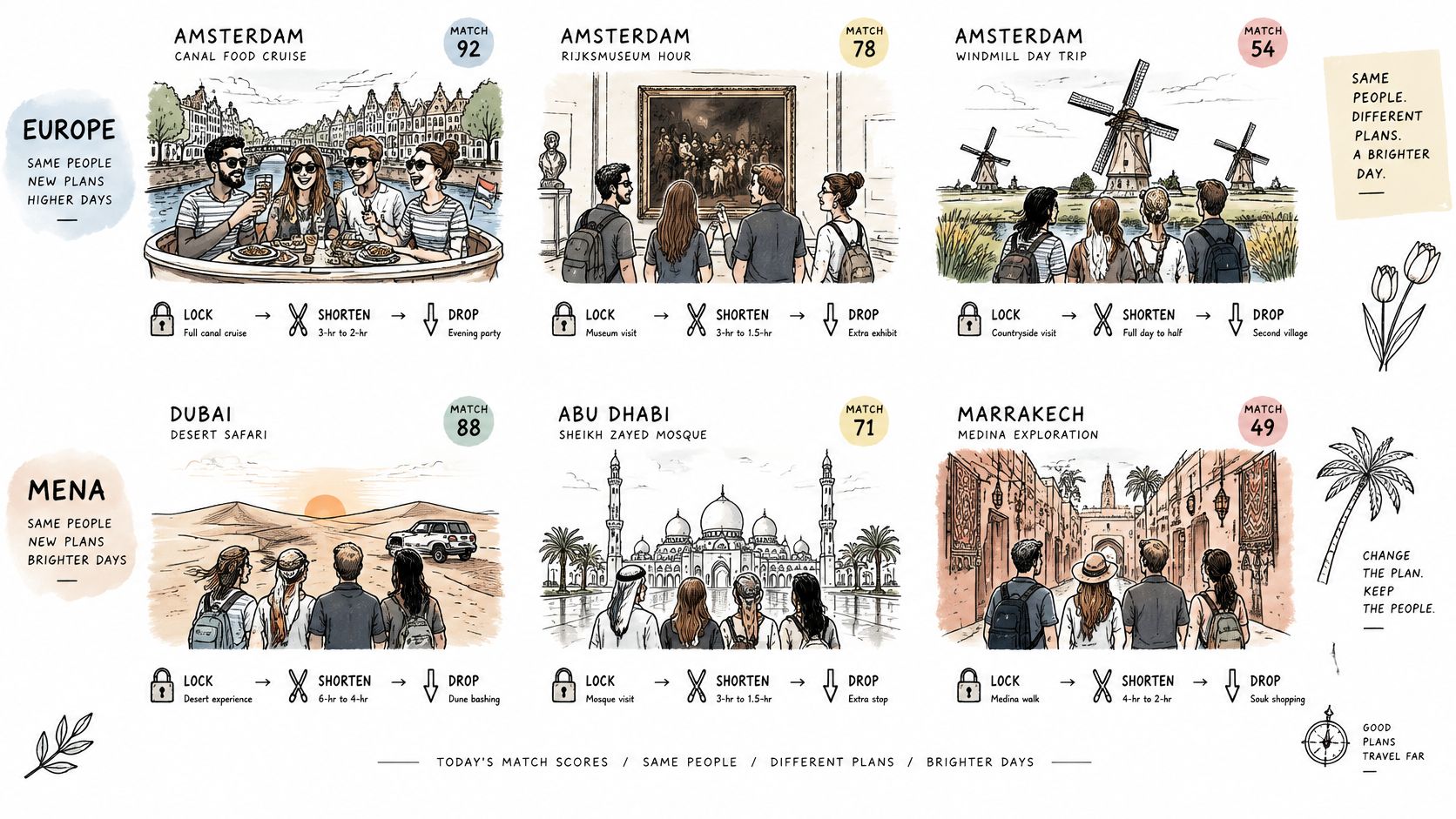
A day in Amsterdam can show how a match score helps a group make different choices for different activities. The score is a snapshot of how well the group's preferences overlap, not a rating of the city or a popularity contest. Use each example as a planning pattern.
Amsterdam With Friends
A canal food cruise scores 84, making it a strong shared afternoon choice. A museum visit scores 63, so the group could make it a focused 90-minute stop rather than an open-ended wander. A six-hour bike loop scores 28. Even if it sounds fun in the chat, a low energy fit makes it a poor choice for the shared plan.
Vienna With Three Generations
A palace morning scores 76 and suits a timed entry better than a late start with queues. A cafe walk scores 88 and works for the evening because everyone can join at their own pace. The late classical concert scores 41, so it can stay optional for those who want to go.
Santorini With Couple Friends
The caldera viewpoint at sunset scores 91, reflecting strong overlap around a shared must-see. The full island boat day scores 52. A two-hour sail keeps the water and views in the plan without taking the whole day or budget.
Marrakech With a Mixed Group
A medina food walk scores 82, making it a strong morning choice. The riad cooking class scores 67, so it could suit a shorter afternoon slot for the keen cooks. A full-day desert trip scores 48 because its return time clashes with the dinner plan the group has agreed on.
Dubai With Hotel Guests of Different Ages
A museum and creek walk scores 80 and fits a mixed-age group with a gentle pace. The yacht afternoon scores 42, so it may not suit the shared day if the group's budget ceiling is tight. Abu Dhabi or Doha plans can be assessed activity by activity in the same way, checking whether each option fits the group's preferences and schedule.
Cities across Europe and MENA offer many kinds of group days, from food tours to cultural visits. A guide to planning travel with a group can help friends make decisions together, while MyPerfectStay's group members swipe on activities and build an itinerary from what they love.
A good group day is a sequence of compatible choices, not one perfect activity that exhausts everyone.
Across these examples, a high score points to a strong shared fit, while a lower score can prompt the group to reconsider the activity's duration, timing, or place in the day. Scores are only useful as a same-day snapshot when the right people have replied. If friends have not answered yet, the result may not reflect the whole group.
How to Lift a Weak Score Before You Book
A Marrakech dinner may suit the group, while a full desert day clashes with someone's schedule or energy. A weak match score helps pinpoint the friction. Adjust the activity to address that constraint, then check whether the group's overlap improves.

Five Edits That Remove the Clash
-
Split a long plan. A full desert day scoring in the 40s might become a short dune stop followed by dinner in Marrakech. If the return time caused the low score, the shorter version may fit more people. The score reflects that new option, not a promise that it will reach a particular band.
-
Swap the price tier. If a Dubai yacht clashes with the group's budget, consider a shared creek dinner instead. The water setting remains, while the cost concern may ease. A planning guide for diving holidays also discusses matching an activity tier to a group before committing.
-
Move the clock. A Barcelona beach club that feels too tiring in the evening may work as a shorter late-afternoon stop. Changing the time can address an energy or schedule clash without replacing the activity.
-
Separate must-sees from nice-to-haves. If one person marks a club as optional and the group favors a Rome food walk, keep those preferences distinct when reconsidering the options. A must-see and a nice-to-have should not carry the same weight in the decision.
-
Offer a parallel hour. In Vienna, some travelers might choose a concert while others take a café walk. The group can agree on the shared plan without requiring everyone to choose the same activity. For more ways to structure group choices, see these group decision-making methods.
What Doesn't Count as Lifting a Score
A score has not improved if a must-skip is averaged away, a price appears only at checkout, or someone is pressed to agree before replying. Those changes hide the disagreement rather than resolve it.
A score should rise because the constraint was removed, not because someone was worn down.
Make one relevant edit, then refresh the score. If the revised activity still has a weak match, keep adjusting the plan rather than treating a prettier number as agreement.
Lock the Fairest Plan for Today
You're the organizer, and the group doesn't need more options. It needs a fair decision it can see. Run this five step close and then stop collecting links.
- Sort the shortlist. Put each activity in its band, lock, shorten, optional, or drop.
- Check the reply state. If every invitee has answered, the score is stable. If not, mark it provisional and send one nudge with a deadline.
- Lift only if needed. If the leader is still a split, apply one edit that removes the named constraint, then refresh once.
- Name the outcome. Put the top fair activity on the shared day, and say out loud which options were dropped and why, so nobody thinks their idea was ignored.
- Book the winner together. Pay in one checkout and send the confirmation to everyone at the same time.
That last step is where the voting format helps. The planner's voting uses swipes, and each person makes about 15 swipes, so the shortlist reflects real choices without a long survey. Friends vote on activities, the group books the winner together, and the group pays in one checkout.
Once a stable score reaches the default yes band or above, you're done deciding. The useful outcome of today's scores isn't a longer shortlist or a flawless number. It's a booked hour, at a price and pace everyone already cleared, that the whole group can enjoy together.
Ready to turn today's shortlist into a booked plan your whole group has cleared? With MyPerfectStay, each friend swipes and votes privately, you see clear match scores for every activity, and you book the winner together in one checkout with the confirmation shared to everyone.