Traveling with a Group: A Practical Europe and MENA Guide
October 18, 2026·MyPerfectStay

You're trying to lock a long weekend in Lisbon with six friends. Someone posts a beautiful apartment, someone else wants nightlife, another asks about the total cost, and the quietest travelers have stopped replying. The chat is busy, but nothing is getting booked. Traveling with a group works when you separate constraints from preferences, assign responsibility, and make decisions people can afford and enjoy.
Table of Contents
- What Makes Group Travel So Hard
- The Four Roles Every Group Trip Needs
- Budgeting That Survives Real People
- Picking Destinations That Work for Groups
- Building the Shared Itinerary Step by Step
- Accessibility and Sustainability as Group Constraints
- Turning Groups Into Revenue for Hotels, Creators, and Organizers
- Your 90-Day Group Trip Plan and Troubleshooting Checklist
What Makes Group Travel So Hard
The Lisbon weekend hasn't collapsed because your friends are incompatible. It's stalled because everyone is answering a different question. The apartment enthusiast is choosing accommodation, the nightlife fan is choosing a neighborhood, and the budget-conscious traveler is deciding whether to come at all.
Treating those questions as interchangeable creates expensive mistakes. An apartment can look affordable until you add transfers, meals, activities, and the cost of reaching it. A popular restaurant can win the chat vote while excluding someone with dietary requirements.
Silence isn't consent. It might mean embarrassment about money, uncertainty about walking distances, or exhaustion with the discussion.
The loudest answer isn't the fairest answer
Group size affects more than reservation logistics. A peer-reviewed tourism study on group size and satisfaction reported higher satisfaction in smaller groups, with mean scores of 5.76 versus 4.48, and linked larger groups with weaker cohesion and lower participation in decisions.
That doesn't mean you should abandon a reunion or corporate retreat. It means you shouldn't expect an open chat to give everyone an equal voice.
Organizer's rule: Collect private constraints before asking people to defend public preferences.
For the hypothetical Lisbon weekend, ask each traveler what they can spend, how much walking they're comfortable with, and which experience matters most. Only then shortlist accommodation and activities.
Separate the decisions
Use distinct decision buckets:
- Eligibility: Dates, entry requirements, accessibility, and spending limits.
- Shared commitments: Accommodation, essential transport, and the experiences everyone accepts.
- Optional choices: Late nights, shopping, extra tours, and premium upgrades.
Don't ask the whole group to debate every detail. Give people equal input, then give named organizers authority to execute the agreed plan.
The emotional stakes are straightforward: nobody wants to pay for someone else's dream weekend. The operational stakes are equally clear: unclear approval leads to delayed reservations, disputed expenses, and activities that people avoid.
The Four Roles Every Group Trip Needs
Assign responsibilities before anyone pays a deposit. The person who starts the chat shouldn't automatically become the travel agent, accountant, researcher, and emergency contact.
Use this role map to make ownership visible.
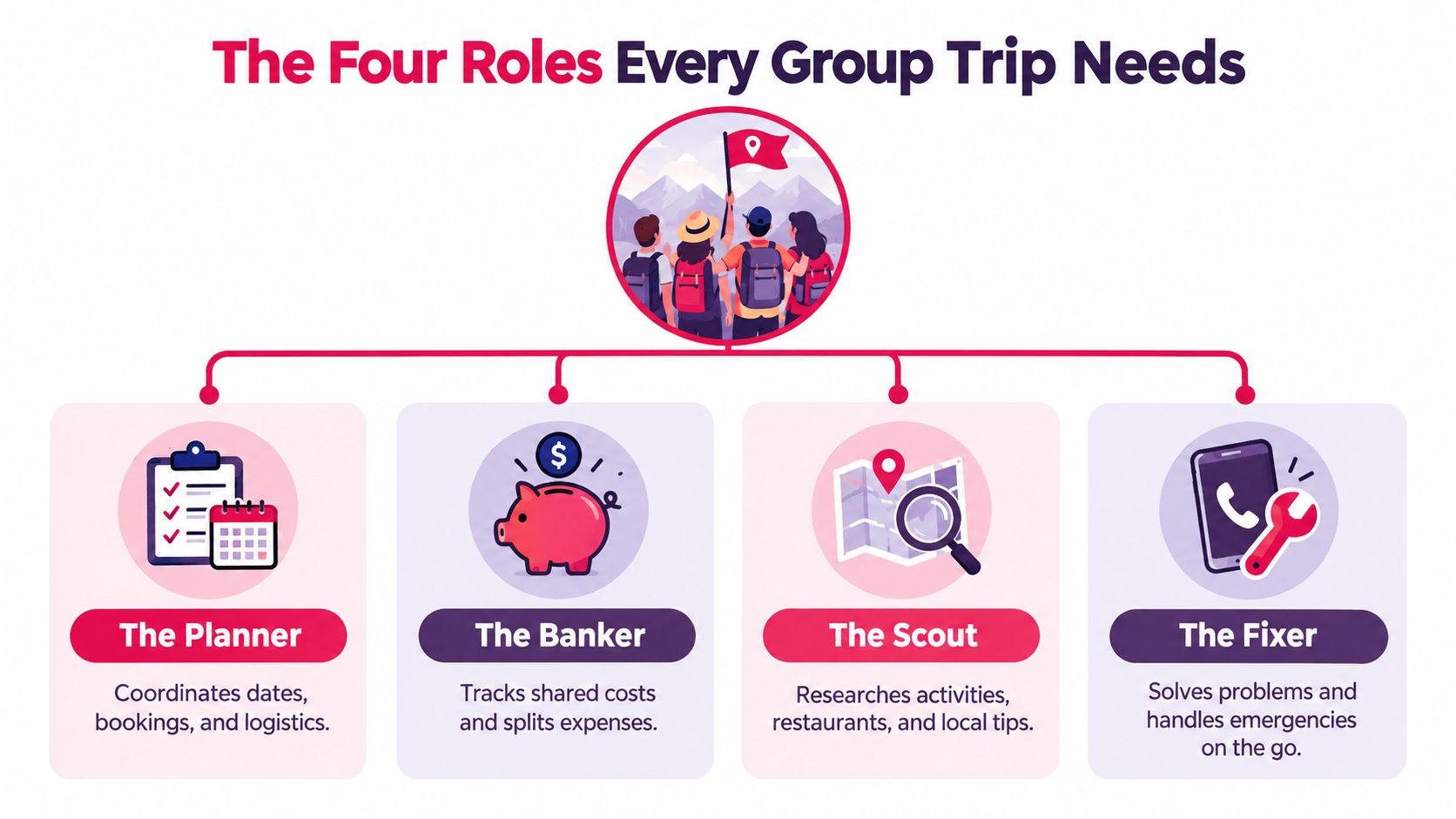
Give each role a concrete remit
- The Planner coordinates dates, bookings, and logistics. For an Amsterdam weekend, this person maintains the approved schedule, tracks reservation deadlines, and checks that arrival times support the first shared activity.
- The Banker records shared costs and collects approved contributions. For a Marrakech riad booking, they confirm who owes what, when payment is due, and what happens if someone withdraws.
- The Scout researches experiences and verifies practical details. For an Istanbul bazaar outing, they check the meeting point, route, operating arrangements, and whether the proposed pace suits the group.
- The Fixer handles changes on the ground. If a Santorini ferry is canceled, they contact the operator and accommodation, present workable alternatives, and communicate the agreed replacement plan.
The Scout can share research with interested travelers. The Planner can delegate individual reservations. But every payment ledger, final itinerary, and emergency decision needs a clearly named owner, not a committee.
Match authority to the trip
For a bachelor or bachelorette weekend, separate the guest of honor's preferences from the Banker's spending controls. For a multigenerational family, choose a Planner who listens to mobility and fatigue requirements rather than just filling the day.
For a corporate offsite, give the Planner explicit purchasing authority and assign someone else to handle confidential dietary or accessibility disclosures. Employees shouldn't have to reveal sensitive information to the entire team.
Use a short delegation agreement: owner, task, approval boundary, deadline, backup contact. The Fixer, for example, may arrange an urgent replacement transfer within an agreed spending limit, but shouldn't buy a premium excursion without permission.
Naming roles isn't bureaucracy. It prevents the familiar argument in which everyone assumed somebody else had checked the cancellation terms.
Budgeting That Survives Real People
Equal spending isn't automatically fair spending. A traveler who skips alcohol, needs a private room, or joins only part of the trip shouldn't discover afterward that they're subsidizing everyone else.
Choose the payment model before choosing the purchases.
| Payment model | Where it works | What to agree beforehand |
|---|---|---|
| Equal split | Shared accommodation or transport used equally | Included costs and approved exceptions |
| Pooled kitty | Routine group meals and small shared purchases | Eligible spending and handling unused funds |
| Tiered contribution | Different room types, optional activities, or partial attendance | Each traveler's share of each purchase |
For corporate offsites, distinguish employer-funded essentials from personal extras. For families, a voluntary subsidy can work, but it must be explicit and private.
Use a fairness-aware shortlist
The research on heterogeneous preferences in tourist trip design frames group itineraries around preferences, economic and time constraints, transport choices, and equity. My recommendation is to translate that into a simple decision method.
Collect private spending ceilings. Reject shared activities above the lowest feasible ceiling unless somebody voluntarily covers the difference or participation becomes optional.
Then rank affordable options by group interest, while lowering the ranking of choices that leave particular travelers consistently dissatisfied. A fairness penalty means that overwhelming enthusiasm from some people doesn't erase serious objections from others.
For a hypothetical Paris museum day, compare a low-cost outdoor alternative that museum lovers dislike with a paid visit that more travelers welcome. The paid visit wins only if it fits the shared budget. A cheap option isn't good value when people don't want to attend.
For Marrakech, compare an independently explored afternoon with a quoted guided outing. In Dubai, apply the same test to desert safari packages: transport, duration, physical demands, and included meals matter alongside price.
Don't solve an affordability problem by asking the least comfortable traveler to explain their finances publicly.
Keep the budget sheet readable
Record item, participants, quoted total, individual shares, payer, payment deadline, cancellation terms, and optional status. Use actual supplier quotes, not optimistic estimates.
Fintrack's guide to the best app for shared expenses is a useful resource when choosing how to record purchases and reimbursements. Before committing, understand how group booking works, including who holds the reservation and accepts liability.
Picking Destinations That Work for Groups
Choose a destination pattern, not the city that received the most enthusiastic reaction. Your group needs a place where its preferred pace, spending range, and activity mix can coexist.
Europe and MENA deserve the first shortlist. UN Tourism's annual tourism barometer recorded approximately 747 million international arrivals in Europe in 2024, while the regional arrivals distribution put the Middle East at approximately 95 million. The Middle East, specifically, finished 32% above its 2019 arrivals level, according to the UN Tourism regional recovery figures.
Don't apply that recovery figure to all of North Africa. MENA is a useful planning geography, but it isn't the same statistical region as the Middle East.
Group Travel Destination Patterns Across Europe and MENA
These are planning judgments, not live price rankings. The cost column identifies what you should quote for the hypothetical group, rather than inventing daily totals.
| Pattern | Example Cities | Cost per Day (Group of 6) | Transit Ease | Cohesion Fit |
|---|---|---|---|---|
| Classic city break | Paris, London, Barcelona | Quote rooms, admissions, meals, and local travel | Check routes from the chosen accommodation | Mixed interests with planned reunion points |
| Coastal and island escape | Santorini, Dubrovnik | Quote transfers, rooms, and optional boat outings | Scrutinize arrival and departure connections | Travelers who agree on relaxation versus sightseeing |
| Imperial and bazaar routes | Istanbul, Marrakech | Compare guided outings with independent exploration | Verify meeting points and walking demands | Curious groups comfortable with a shared pace |
| Gulf city hubs | Dubai, Doha, Abu Dhabi | Check distances and experience-package inclusions | Compare public transport and booked transfers | Groups combining structured outings with downtime |
| Slow travel hubs | Vienna, Prague, Lisbon | Build around the quoted lodging location | Test each proposed daily route | Families and friends wanting flexible days |
Choose the shape before the address
For activity depth, ask whether the shortlist supports different interests without constant cross-city movement. Rome can anchor a food-focused plan; Cairo or Amman/Petra can anchor a history-focused itinerary. Don't turn either into a race through every possible attraction.
For climate risk, check forecasts, seasonal conditions, indoor alternatives, and cancellation policies for the actual dates. For cohesion, decide whether your travelers prefer staying together or separating for part of the day.
Muscat and Tunis also belong on a MENA shortlist when they fit the group's interests. There's no reason to default to a US destination for a generic city break.
Before booking, check phone compatibility and see supported countries for eSIM through RedSim. Make sure the Fixer can contact suppliers even when travelers separate.
Building the Shared Itinerary Step by Step
A hypothetical four-day Marrakech trip needs an approved sequence, not a sprawling collection of saved attractions. Run the same workflow for a three-day Rome food trip, then adjust the amount of detail to the group's needs.
Use this process map as the booking sequence.
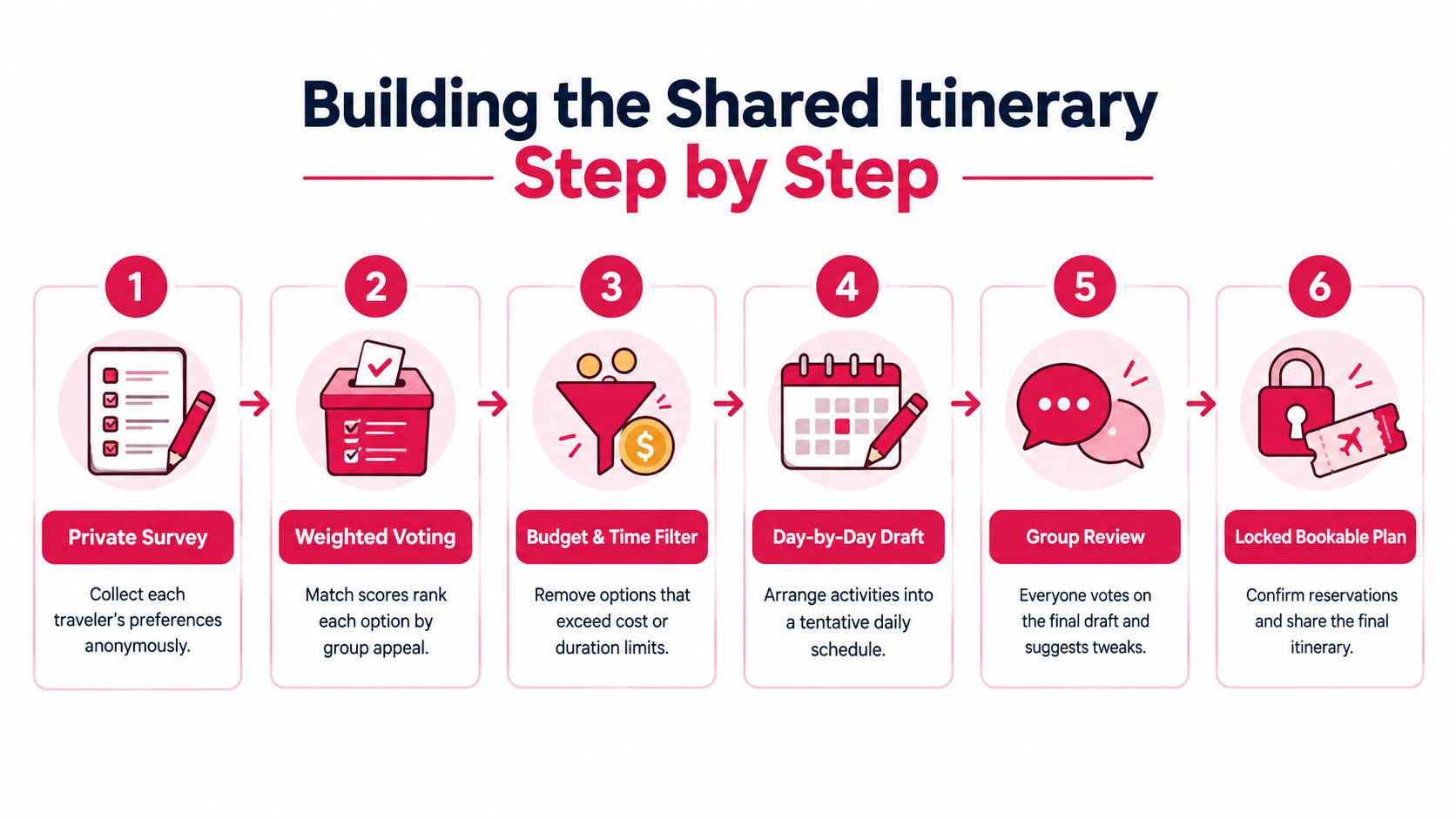
Turn preferences into reservations
-
Private survey. Collect budget, interests, energy level, must-see ideas, and practical constraints. Keep the initial form short enough to target completion in under two minutes per traveler; detailed accessibility follow-up can happen privately afterward.
-
Weighted voting. Use match scores to identify overlap across the submitted preferences. A smart voting algorithm can reveal that travelers disagree about individual attractions but agree on food, a moderate pace, and avoiding expensive extras. Review the result, don't treat it as an unquestionable verdict.
-
Budget and time filtering. Remove options that fail the agreed constraints. If a Marrakech outing occupies the entire available day, it can't coexist with another major reservation because both scored well.
-
Day-by-day sequencing. Arrange geographically compatible activities, meals, and rest periods. For Rome, check the route between a food experience and the next reservation before accepting both. Use a shared group schedule as the operational record.
-
Group review and contingency mapping. Ask travelers to flag unresolved objections, then assign alternatives for weather, fatigue, or cancellation. This is the conflict checkpoint: an accessibility failure or unaffordable cost requires a change, not another popularity vote.
-
Locked bookable plan. Confirm participants, supplier terms, payments, and availability. Where a platform supports one-click group booking, use it after approval, not as a shortcut around approval.
Keep the workflow proportionate
A four-person city break can use a private form, shared document, and expense tracker. A 20-person corporate retreat needs controlled editing, named approvers, invitation tracking, and booking records.
Keep discussions attached to the specific decision. After approval, comments should address changes or errors rather than reopen every preference.
The final itinerary is a commitment record. It should tell each traveler where to be, what they've paid for, what remains optional, and whom to contact when something changes.
Accessibility and Sustainability as Group Constraints
An attraction that some travelers can't comfortably use isn't a suitable shared attraction. Accessibility belongs in the shortlist criteria, not in a message sent after payment.
Demand isn't the issue. European research on travelers with accessibility needs, surveying 3,473 adults across France, Germany, Italy, Spain, and the United Kingdom, found that 46% travel once a year and 61% were likely to participate in a multiday organized tour or package holiday within the next two years.
Score the whole experience
Ask about functional requirements privately. You need to know whether someone requires seating or step-free access, not their diagnosis.
- Step-free access: Verify the complete route, including arrival, entrances, and transfers.
- Seating and toilets: Check availability, not just whether a venue describes itself as accessible.
- Transit and pace: Include walking, standing, waiting, and recovery time.
- Sensory intensity: Discuss crowds, noise, lighting, and opportunities to leave.
- Contingencies: Identify a dignified alternative and a reliable return route.
For an Amman/Petra plan, verify the proposed route and transport with the provider against the traveler's requirements. Don't substitute an attraction's general accessibility label for a discussion of the actual outing.
Dignity test: Would the alternative still feel like a worthwhile experience, or like being left behind?
Compare environmental impact with practical friction
Sustainability requires equally explicit trade-offs. The travel sustainability findings presented by GSTC include a 2025 survey of more than 32,000 travelers across 34 countries, in which 93% wanted to make more sustainable choices. The accompanying European findings identify price, convenience, and time as dominant concerns, with sustainability a priority for 20% of respondents.
Build an impact-versus-friction comparison: environmental considerations, price difference, extra journey time, accessibility, and who bears the inconvenience. Don't claim that a particular route reduces emissions without evidence for that comparison.
Try lower-friction alternatives first: fewer transfers, a locally owned experience after verification, or a quieter booking slot. HYDAWAY's guide on how to travel more sustainably offers practical habits to consider alongside the group's maximum-impact travel choices.
If an alternative costs more, agree who pays before voting. Sustainability shouldn't become a moral test that pressures someone beyond their budget.
Turning Groups Into Revenue for Hotels, Creators, and Organizers
For hospitality businesses, a coordinated group is a distribution opportunity, not merely a room block. The organizer can present relevant experiences to travelers together, collect decisions, and turn approved interest into reservations.
The commercial scale is substantial. US Travel's business and group travel overview estimates approximately $319 billion in annual economic impact and more than 3 million supported jobs from group travel, including business events, leisure tours, sporting events, and entertainment. Those are US figures, not estimates for Europe or MENA, but they demonstrate the breadth of spending connected to organized travel.
Sell a relevant extension, not a generic upsell
Consider these hypothetical applications:
- An Amman boutique hotel offers its 12 participating guests a Petra day package through a shared decision workflow. Staff verify transport, accessibility, inclusions, and cancellation terms before collecting approval.
- A Lisbon food creator proposes a private tasca crawl for a bachelor group, using deep links that connect recommendations to bookable experiences. The creator explains suitability and discloses commercial relationships.
- A Vienna offsite organizer uses invitation links, deadlines, and nudges to collect participation decisions without repeatedly chasing individual replies.
A locked group booking isn't automatically more profitable than the same number of individual bookings. Its advantage is operational: the business can coordinate participation, transport, timing, and related purchases together. Profit still depends on supplier costs, discounts, cancellations, and servicing requirements.
Measure what the coordination changes
Track the path from recommendation to completed experience:
- Participation: Who received the offer, responded, and attended?
- Conversion: Which approved choices became paid reservations?
- Ancillary revenue: What dining, tour, transport, or experience income was collected?
- Servicing effort: How much staff time went into changes, refunds, and questions?
Creators should also review payout terms before recommending a booking channel. Hotels should avoid bundling activities that don't fit the guests to raise transaction value.
Useful coordination creates a commercially valuable service. The guest gets a suitable outing, the organizer gets fewer loose ends, and the provider gets a clearer reservation.
Your 90-Day Group Trip Plan and Troubleshooting Checklist
Use this 90-day countdown as a preparation template, not a claim about the ideal booking window. Supplier availability and cancellation terms should determine when you commit.
Keep the shared planning workspace visible to participants.
Work backward from departure
- 90 days before: Send the private survey, assign roles, and shortlist destinations.
- 60 days before: Collect votes, verify constraints, and approve supplier quotes.
- 30 days before: Lock the itinerary and capture deposits according to booking terms.
- Before departure: Reconfirm meeting points, distribute booking records, and sign off contingencies.
Troubleshoot without blaming people
Late dropouts: Check the actual cancellation and name-change terms. The Banker separates recoverable costs from committed costs, then applies the agreement travelers accepted before payment.
Energy mismatches: Preserve a shared anchor, such as dinner, while allowing optional time apart. For Lisbon, publish clear reunion details rather than forcing exhausted travelers to continue sightseeing.
Mid-trip cancellations: If the Santorini ferry plan fails, the Fixer checks replacement transport and accommodation together. Don't solve the crossing while leaving the group without somewhere to stay.
Use the video below as a companion to your planning conversation.
Questions to settle before inviting everyone
Are preferences private? Choose a workflow that keeps individual disclosures private while presenting usable group results. Never promise anonymity unless the tool supports it.
Does everyone receive confirmation? Use participant-wide confirmations where available, and check that bookings include the correct names, dates, and meeting instructions.
Are accounts or downloads required? Requirements vary by tool. Test the invitation process before sending it, especially for travelers who don't want another app.
MyPerfectStay offers private preference surveys, activity match scores, group booking, and a shared daily itinerary, with no account or app download required to start. Visit MyPerfectStay, invite your travelers through a link, and collect their constraints before you commit to the next reservation.