Planning a Weekend Getaway with Friends Without the Chaos
October 15, 2026·MyPerfectStay

You've got six friends, a free weekend, and a group chat moving faster than anyone can think. One person suggests Barcelona, another votes for Paris, someone asks about the budget, two people disappear, and after hundreds of messages nobody knows whether the trip is happening.
Planning a weekend getaway with friends works better when you treat it as a small, time-boxed decision problem. The destination matters, but the process matters more. Set constraints first, expose costs openly, score the options, and give every decision a deadline.
Table of Contents
- Why Most Group Weekend Plans Stall Before Friday
- Set Non-Negotiables Before Anyone Suggests a City
- Build a Fair Budget That Survives Honest Conversations
- Pick a Destination That Actually Fits a Two-Night Trip
- Assign Roles and Run a Reverse-Choice Timeline
- Use Voting Tools to Lock Plans Without the Endless Debate
- Plan for Fatigue, Crowds, and the Friend Who Needs a Quiet Hour
Why Most Group Weekend Plans Stall Before Friday
Most group trips don't fail because friends lack enthusiasm. They fail because nobody separates hard constraints from personal preferences. A friend who can't take Friday off gets treated like someone who prefers another city, while a hidden budget limit surfaces only after someone proposes an expensive hotel.
Short trips deserve a faster planning system. In 2023, residents of EU countries aged 15 and over took more than 1.1 billion tourism trips with at least one overnight stay, and 56.5% lasted no more than three nights, according to Eurostat's tourism trip data. Short breaks aren't a niche format. They're the dominant travel pattern in the European market.

That changes the planning question. You don't need to discover the world's perfect destination. You need to find a place that works for everyone's dates, money, energy, and transport tolerance, then book it before the chat loses momentum.
Stop brainstorming before you have boundaries
Destination brainstorming feels productive because it creates visible activity. In practice, it encourages premature attachment. Someone falls in love with a hotel in Paris before the group has agreed on a spending ceiling, and every later discussion becomes an argument against that choice.
Start with nearby European cities, compact city breaks, or destinations reachable within a few hours. A two- or three-night structure usually requires less time off, limits transport fatigue, and makes participation easier for friends with work or family obligations. If you need more inspiration for regional options, Global's Texas getaway picks can help illustrate how to compare short-break destinations, even though European and MENA cities should lead most international group planning.
Practical rule: No city suggestions until every traveler has submitted dates, a maximum budget, transport tolerance, and at least one non-negotiable.
The rest of the process should fix one failure point at a time. First remove impossible options, then compare realistic ones, then lock the winner with a deadline. That approach keeps enthusiasm useful instead of letting it turn into another 400-message thread.
Set Non-Negotiables Before Anyone Suggests a City
Send a private questionnaire before opening the destination debate. Each person should answer the same questions individually, not react to whoever speaks first in the group chat.
Ask for the available dates, maximum total budget, longest acceptable journey, accessibility or dietary requirements, and one or two activities that would make the trip worthwhile. Then ask about flexible preferences such as nightlife, museums, food, beaches, outdoor time, and preferred accommodation style.
This order matters because travel planning is temporal, dynamic, successive, multistage, and contingent. Research on trip planning describes logistical constraints and subjective preferences as factors that require active coordination, rather than a single choice made at the beginning. You can read the underlying research on coordinated travel planning for the broader planning model.
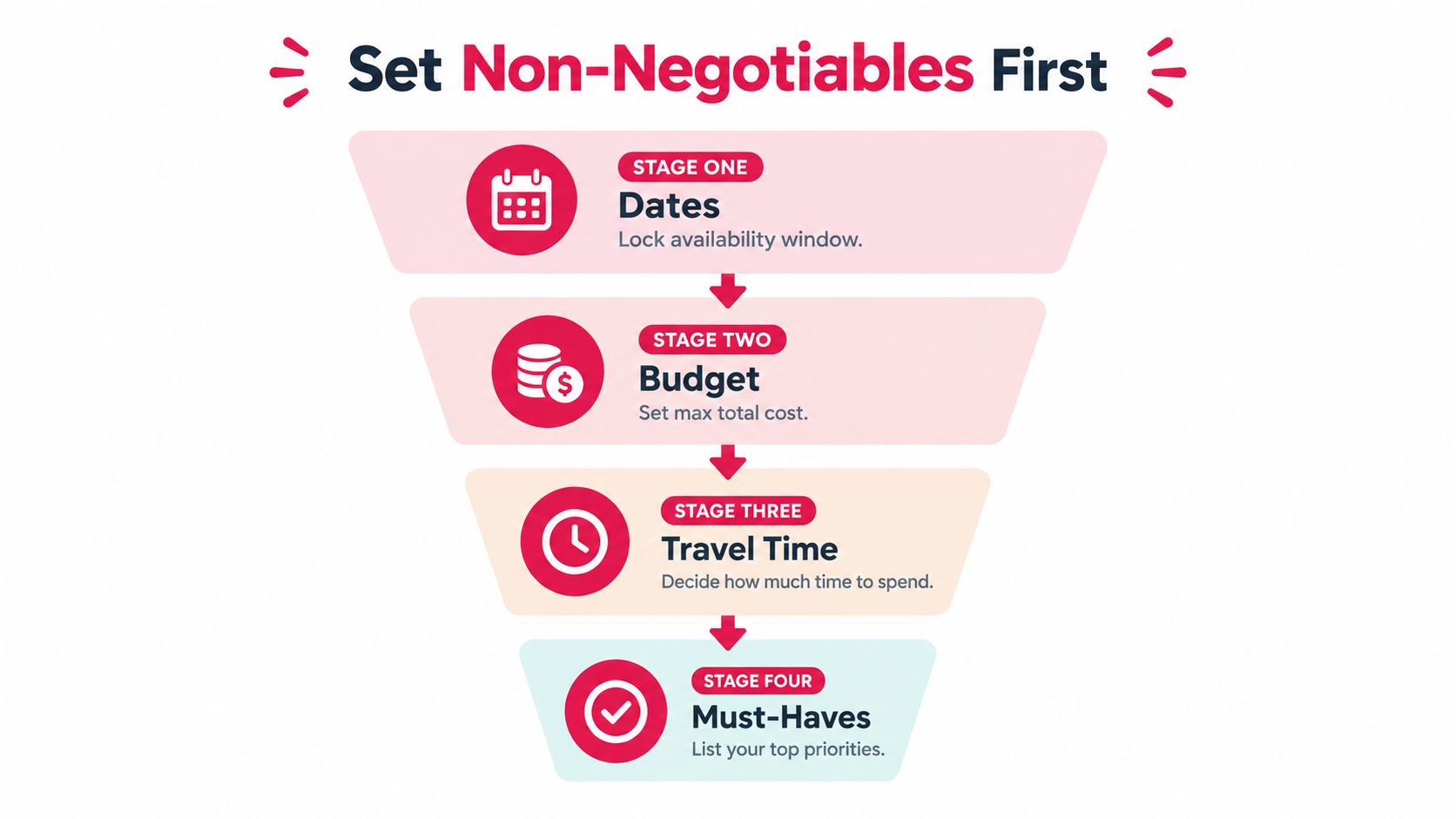
Use a six-stage decision pipeline
- Collect private inputs: Give everyone a deadline and ask them to answer without seeing other responses.
- Filter hard constraints: Remove any destination that breaks one person's date, budget, mobility, dietary, or transport requirement.
- Score weighted preferences: Agree on categories such as food, culture, nightlife, rest, and outdoor activities. Give each category a clear importance level.
- Run a transparent vote: Show the remaining options, the scoring rule, and the result. Don't change the method after seeing the outcome.
- Confirm by deadline: Set a booking date. A decision that remains open indefinitely isn't a decision.
- Keep a fallback: Save a second transport option, a weather alternative, and a cancellation plan before paying deposits.
Copy this into the group chat:
Dates:
Maximum total budget:
Longest acceptable travel time:
Accessibility or dietary needs:
Must-do activity:
Nice-to-have activities:
Energy level: low, moderate, or high
Final response deadline:
Keep early choices reversible until you verify availability and cost. Preferences often change once people see real accommodation prices or transport times, so don't spend emotional energy defending an idea that hasn't passed the basic filters.
Build a Fair Budget That Survives Honest Conversations
Money is where friendly planning becomes vague, then resentful. Don't ask, “What does the trip cost?” Ask, “What will this trip cost each person under realistic choices?”
Cost is a serious barrier for European travel. In early 2025, 46% of people not planning a Europe trip cited cost, while 42% of prospective travelers planned to spend €100 to €200 per day, a band that increased 14% year on year, according to European Travel Commission reporting on cost concerns.
Build the budget in layers:
- Fixed shared costs: Accommodation, essential transport, shared transfers, and deposits.
- Predictable personal costs: Meals, local transport, and everyday spending.
- Optional costs: Spa visits, premium restaurants, nightlife, tours, and paid attractions.
- Risk costs: City taxes, booking fees, tourist surcharges, cancellation penalties, and deposits that may not be refundable.
The group should see a personalized total before anyone agrees. A friend joining for only part of the weekend shouldn't automatically pay the same as someone staying every night. A traveler who skips a premium dinner shouldn't subsidize it, and a person with the lowest budget shouldn't have to reveal private financial details in front of everyone.
Compare scenarios instead of arguing about a single total
Use clear tiers for the same itinerary. The figures below are planning examples, not quoted market prices. Replace them with checked prices before booking.
| Cost line | Budget tier | Mid tier | Higher tier |
|---|---|---|---|
| Accommodation | Shared basic room or apartment | Comfortable central stay | Premium central accommodation |
| Transport | Lowest practical fare | Flexible standard fare | Flexible or premium fare |
| Food | Groceries and casual meals | Mixed casual and restaurant meals | Frequent sit-down dining |
| Activities | Free and low-cost options | Several paid experiences | Premium experiences |
| Optional spend | Opt out by default | Selected add-ons | Multiple upgrades |
Split deposits evenly when the whole group benefits from holding the booking. Let each traveler opt into optional activities individually. Record who paid, who owes what, and what happens if someone cancels before money changes hands. A simple shared spreadsheet is enough, although this guide to planning a trip can help structure the wider booking process.
The fair rule is simple: shared necessities are shared, personal upgrades are personal, and no one commits without seeing their own total.
Pick a Destination That Actually Fits a Two-Night Trip
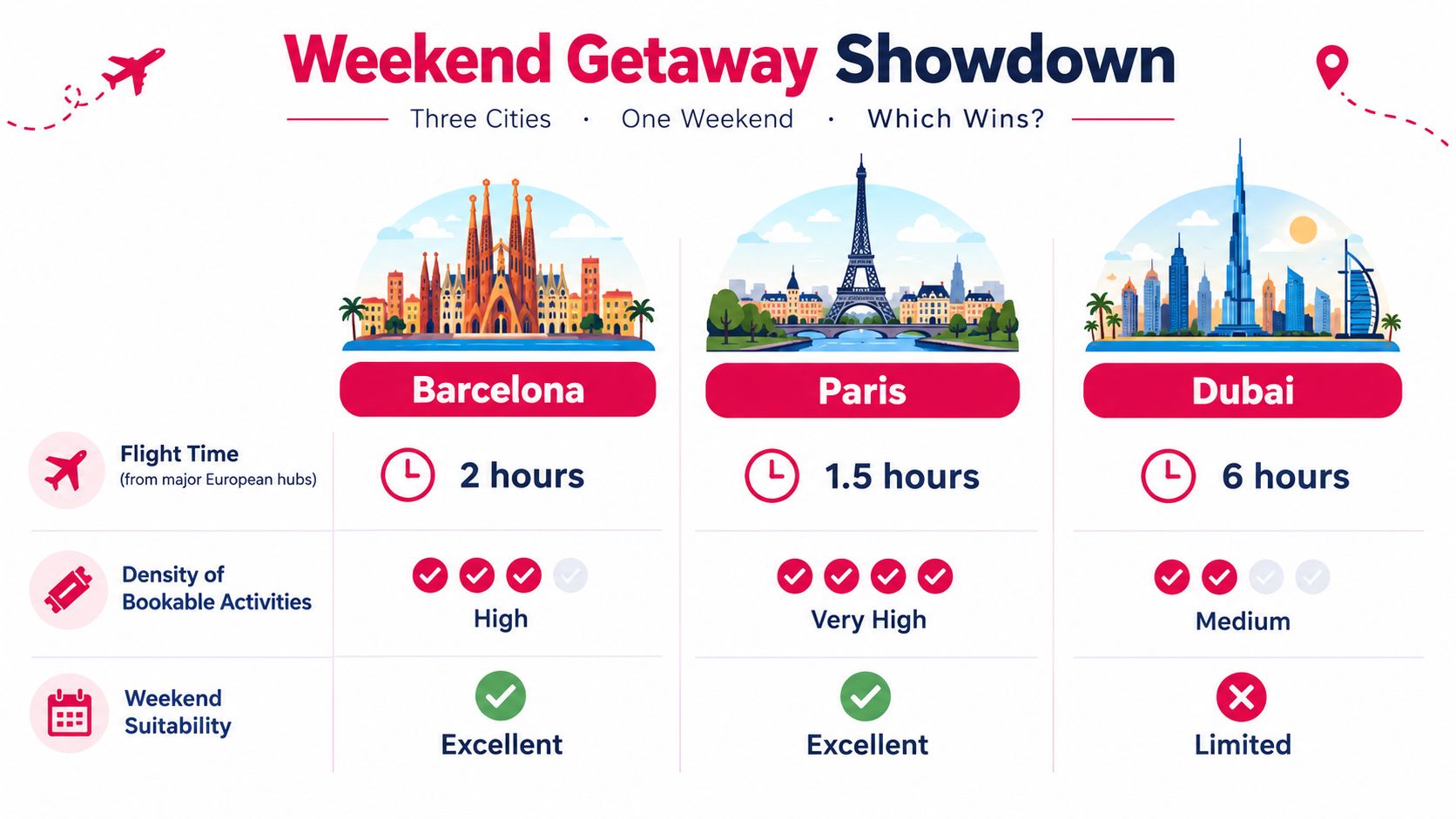
For a short break, density beats novelty. The winning destination isn't the one with the longest list of attractions. It's the one where the group can arrive, settle in, do several worthwhile things, and leave without spending the weekend crossing the city.
Barcelona, Paris, and Dubai make useful comparisons because they offer different versions of a city break. Official Eurostat data recorded more than 40 million tourist-accommodation nights in each of the Rome, Paris, and Barcelona regions in 2024, with Rome reaching 47.2 million and Paris 43.2 million, as shown in Eurostat's regional tourism data.
Barcelona
Barcelona is strong when the group wants food, architecture, beaches, nightlife, and walkable neighborhoods without building every day around long transfers. Its tourism authority reports that 75% of the city's most visited sites in 2024 were located within the city itself, supporting a compact itinerary for a short stay. The city also ranked seventh among European cities for total overnight stays, according to Barcelona's tourism authority.
Paris
Paris suits groups with strong culture, food, shopping, and neighborhood preferences. It and London were identified as standout European city-break destinations in a 2025 overview, while Paris and the surrounding Île-de-France region received more than 20 million inbound visitors in 2024, according to European city tourism data. Choose Paris when the group values variety and doesn't mind a more intense urban rhythm.
Dubai
Dubai works for groups seeking warm weather, restaurants, shopping, beaches, desert experiences, and a highly organized hospitality environment. Dubai recorded 18.72 million international overnight visitors in 2024, including 3.74 million from Western Europe, according to the Dubai Department of Economy and Tourism. Its greater distance from many European hubs makes it less suitable for a very short weekend unless transport connections and budgets align.
Use a simple scorecard for travel time, accommodation location, activity density, crowd tolerance, and total cost. For a broader way to compare destination suitability, this guide to choosing trail destinations offers a useful reminder to match the place to the group's actual priorities. You can also browse weekend getaways in Europe for additional city-break starting points.
Assign Roles and Run a Reverse-Choice Timeline
A group trip needs owners, not just opinions. Assign one lead organizer to maintain the decision log, one treasurer to track payments and cancellation terms, one researcher to compare transport and accommodation, and one communications person to publish deadlines and confirmations.
The lead organizer shouldn't secretly make every decision. Their job is to keep the process moving, show the evidence, and trigger the agreed fallback when the group misses a deadline.
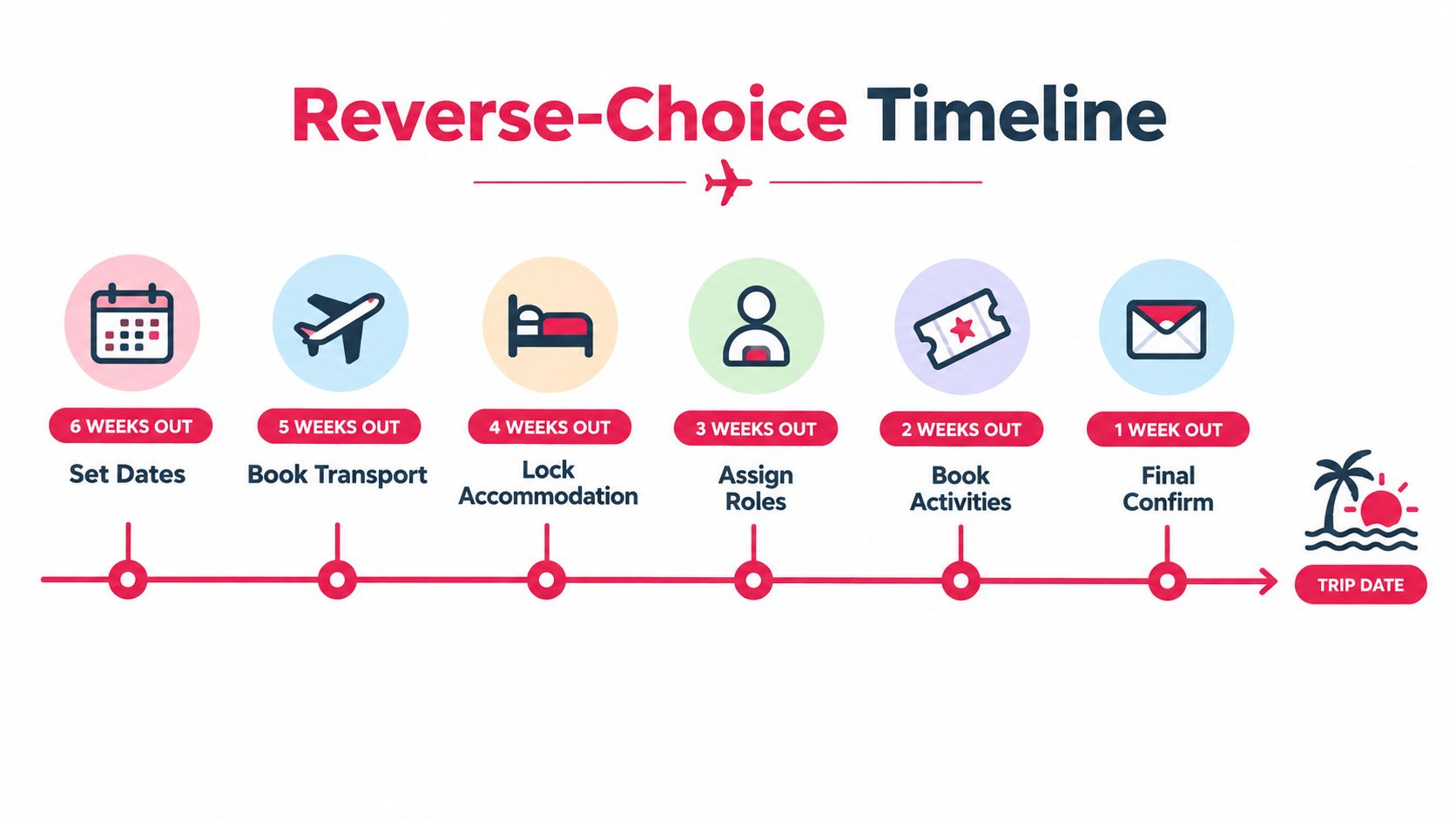
Count backward from departure
- Six weeks out: Set the dates and collect private constraints.
- Five weeks out: Compare and book transport once the destination passes the hard-constraint filter.
- Four weeks out: Lock accommodation, room assignments, deposits, and cancellation terms.
- Three weeks out: Confirm roles, dietary information, accessibility details, and shared transport.
- Two weeks out: Vote on activities and reserve anything with limited availability.
- One week out: Send the final itinerary, payment summary, contact details, packing notes, and fallback options.
Your real deadline should be earlier than the supplier's deadline. Waiting until the last cancellation window creates pressure, while a firm internal date gives the group room to fix a problem.
Turn silence into a trigger
Silence isn't a veto. If someone has submitted their preferences but doesn't respond to the final vote, apply the decision rule you published in advance. If someone hasn't submitted preferences at all, don't infer consent. Contact them directly, give one final deadline, and explain what happens if they miss it.
Keep a short decision log with the winning option, payment status, booking links, and unresolved risks. If the organizer becomes unavailable, another person should be able to take over without reconstructing the entire conversation from a chat history.
Use Voting Tools to Lock Plans Without the Endless Debate
Public group chat rewards speed, confidence, and whoever happens to be online. It doesn't reliably reveal the friend who wants museums but feels awkward rejecting a nightlife-heavy itinerary, or the person whose budget makes a premium dinner impossible.
A private survey creates better inputs. Each traveler can submit a budget ceiling, interests, energy level, accessibility needs, and must-see ideas without performing their preferences for the group. The group then compares overlap instead of debating personalities.
A neutral study involving 217 social cliques found that negotiation affects spatial choices and that fairness becomes especially important when travel costs enter the discussion. The group travel decision-making research supports treating the outcome as a negotiated fit, not a simple popularity contest.
Make the output visible and reversible
Suppose four friends have different priorities: food, museums, beaches, and nightlife. Each completes a short private survey. The group can then compare the strongest shared options, choose a core activity, and add separate modules for people who want more.
A voting tool should show:
- Private inputs: Budget, interests, energy, dietary needs, and must-see ideas.
- Match signals: Which activities fit the group and which appeal to only part of it.
- Decision deadlines: When votes close and what happens after the deadline.
- Shared itinerary: A daily plan that everyone can access and update.
- Opt-in modules: Activities that don't force the entire group to participate.
This group decision-making tool is one example of that workflow. It lets travelers submit private preferences, compare activity matches, organize a shared itinerary, and invite participants through a link without requiring an account or app download to start. Keep the final itinerary flexible, because a match score can't predict fatigue, weather, or a sudden change of heart.
Plan for Fatigue, Crowds, and the Friend Who Needs a Quiet Hour
The best group itinerary isn't the fullest one. It's the one that lets people participate without pretending they have identical energy, mobility, spending habits, sleep schedules, or social preferences.
A 2025 European survey found that 60% of travelers consider environmental risks when choosing destinations, 72% want spending to benefit local communities, and 24% of non-travelers cited overtourism as a reason to avoid travel, according to the Allianz Partners European Vacation Confidence Index. Those concerns belong in the group conversation, alongside price and convenience.
Build a core itinerary with escape routes
Give everyone a shared backbone, then attach optional modules. The core might be arrival, one meal, one central activity, and departure. Optional modules might include a museum visit, a beach afternoon, a late bar, a spa booking, or a long dinner.
Reserve an unscheduled recovery block each afternoon. That empty space protects the friend who needs quiet time, the person managing pain or mobility limits, and anyone who doesn't want to turn friendship into a continuous performance.
Use these rules:
- Check access before booking: Confirm stairs, lifts, walking distances, seating, toilets, and transfer arrangements.
- Offer a lower-pressure alternative: Pair a crowded landmark with a quieter neighborhood, local market, park, or smaller venue.
- Split once, stay together: Let people skip one activity without splitting the entire weekend into separate trips.
- Make spending opt-in: A non-drinker shouldn't fund a bar crawl, and someone skipping an expensive dinner needs a dignified alternative.
- Protect sleep: Put late nights and early starts on different days whenever possible.
- Name the fallback: Decide what happens if rain, transport disruption, illness, or a closed venue changes the plan.
Screenshot this checklist
Weekend getaway checklist
- Dates and attendance confirmed
- Private budget ceilings collected
- Transport tolerance and accessibility needs checked
- Destination scored against hard constraints
- Accommodation cancellation terms recorded
- Shared and optional costs separated
- Deposit deadline published
- Roles assigned
- Core itinerary agreed
- Opt-in activities listed
- Recovery block protected
- Weather and transport fallback saved
- Final payment summary sent
- Everyone knows the meeting point and emergency contact
A friend shouldn't have to choose between struggling in silence and becoming the person who ruins the trip. Design the weekend so participation has more than one shape.
MyPerfectStay lets groups collect private preferences, vote on activities, compare match scores, book experiences, and keep a shared daily itinerary in one place. Visit MyPerfectStay to turn your next friends' getaway from an endless chat into a decision with a deadline.