What Is Corporate Planning? a Plain Guide for Leaders
November 8, 2026·MyPerfectStay
Why does a clear strategy still produce a budget that looks like a photocopy of last year's? Corporate planning is the structured process that turns an organization's strategy into measurable targets, budgets, owners and review points. Only 45 percent of executives in a 2006 McKinsey survey of 796 executives said they were satisfied with that process, which is why a tidy strategy deck is not the same thing as a working plan.
Teams stall when they treat planning as a document that comes out once a year. The useful version is a loop: priorities get owners, money moves, results come back, and funding changes when an assumption breaks. Offsites and retreats are often where that loop closes, because that is the room where leaders decide what gets funded before anyone goes home.
Table of Contents
- What Corporate Planning Means in Plain Terms
- How Corporate Planning Differs From Strategy and Budgets
- The Five Stages From Direction to Results
- Who Owns the Plan and Why Plans Stall
- How Budgets, Targets and KPIs Connect
- Planning Offsites, Retreats and Events
- Confirm the Decision Before You Book
What Corporate Planning Means in Plain Terms
What is corporate planning in day-to-day language? It is the structured management process that turns an organization's purpose and strategic choices into measurable objectives, resource allocations, budgets, action programs and review milestones. A historical review of planning practice shows why that package is wider than a finance close.
A sat-nav is a useful comparison. The destination is the strategy. The route is the plan. Recalculation is what you do when traffic, a closed road or a new competitor changes the picture. You do not throw the destination away every time the route updates, and you do not keep driving a route that no longer reaches it.
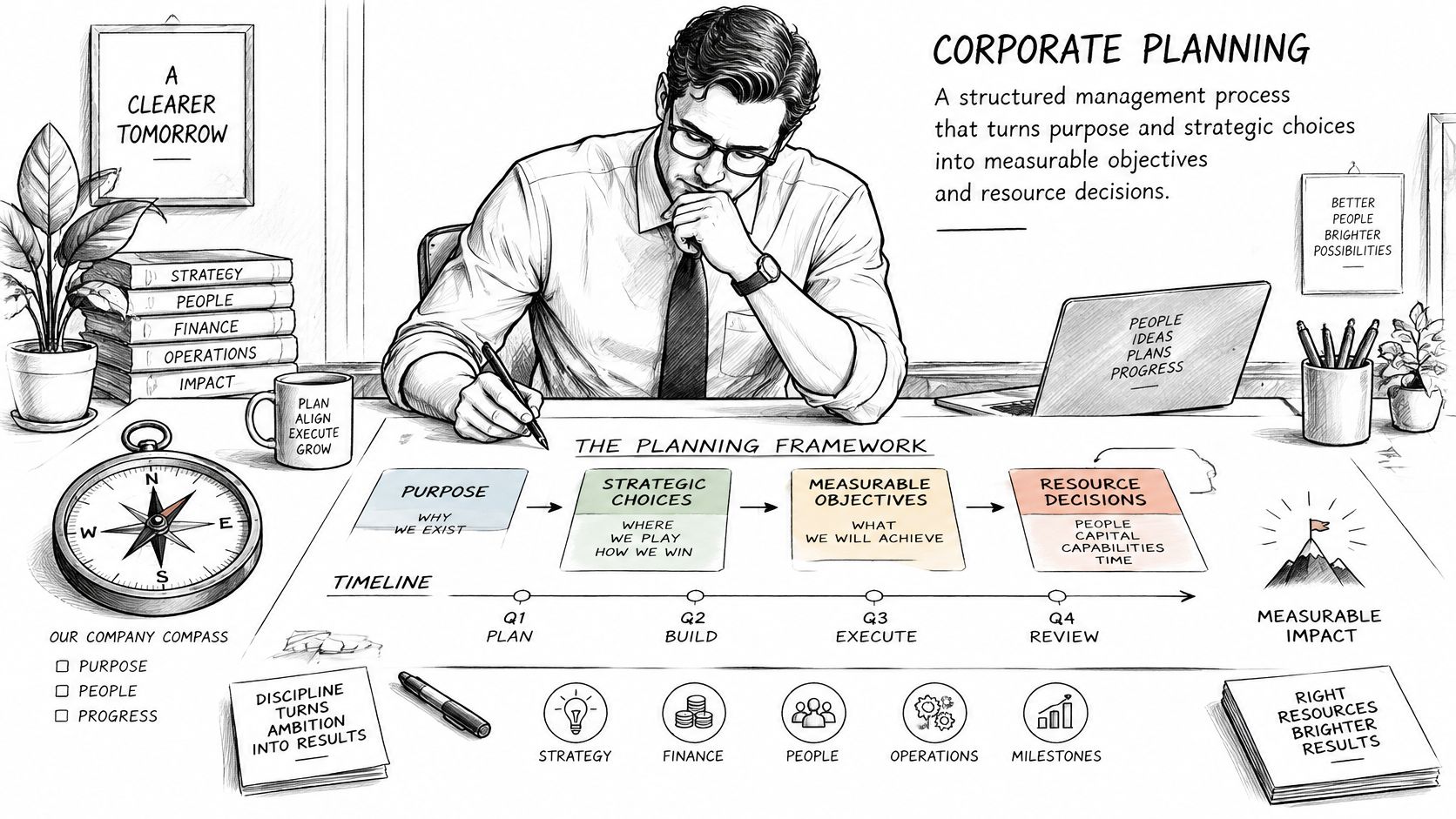
An annual budget is one slice of that route, not the whole journey. Corporate planning links long-term choices to daily operating decisions and tests whether the organization has the capabilities and the money to arrive. Its modern form grew out of long-range planning and became a formal management function in large companies during the 1960s and 1970s, as scale, competition, technological change and uncertainty made informal coordination too slow.
How the idea grew up
The same review names four broad stages: implementation, control, extrapolative planning and entrepreneurial planning. Extrapolative planning made forecasting, budgeting, feasibility checks, action schedules and profit goals a distinct function. Entrepreneurial planning added external scanning, a strengths-and-weaknesses check, threat and opportunity assessment, gap analysis and explicit strategic commitments.
That is why planning is better understood as a routine than as a document. Priorities are set, owners are named, money is committed, results come back, and the next version adjusts. A plan that sits untouched for twelve months has skipped the steps where it does its work.
Every serious plan still answers five questions.
- Where are we going: the direction the company will not abandon.
- What is changing around us: markets, rivals, technology and rules.
- What matters most: the few priorities that get time and money.
- Where does the money go: the budget and the people tied to those priorities.
- How will we measure progress: the dates, owners and numbers that make a miss visible.
Answer all five and the loop can run. Skip one and it stalls before it starts.
How Corporate Planning Differs From Strategy and Budgets
Managers mix up five documents that sit on the same shelf. They answer different questions, cover different horizons and produce different outputs. If you can't name which one you're holding, you'll argue about the wrong thing in the meeting.
| Term | Question It Answers | Typical Horizon | Main Output |
|---|---|---|---|
| Strategy | Where we will compete and how we will win | 3 to 5 years | Strategy statement with priorities |
| Corporate planning | How priorities become targets, budgets and owners | 1 to 3 years, rolling | Plan with targets, initiatives and review dates |
| Annual budget | How much each unit may spend this year | 12 months | Approved spending limits |
| Forecast | What revenue, costs and cash look like under current assumptions | 1 to 18 months | Rolling forecast model |
| Operational plan | What each team delivers this quarter | Weeks to one quarter | Task lists, rosters and schedules |
Where they overlap
Strategy chooses the field and the way you intend to win. Corporate planning is the bridge that turns those priorities into targets, budgets and named owners on a rolling one-to-three-year view. The annual budget is one output of that work, the spending limits for the next 12 months, not the plan itself. The forecast is an input. It says what revenue, costs and cash look like if today's assumptions hold, and it should be refreshed, not framed.
The operational plan is shorter still. It is the quarter's task lists, rosters and schedules. A team can hit every task on that list and still miss the strategy if the tasks were never tied to a priority that has money behind it.
Leaders who want to connect strategy and finance with Nexist are really asking for that bridge, not for a thicker budget pack. Finance owns the model. The business owns the choices. Neither document works alone.
If a document sets targets, owners and a review date, it is planning. If it only states ambitions, it is strategy. If it only fixes spending, it is a budget.
Run that test on the pack in front of you before the next leadership meeting. Most "strategy offsites" produce the middle item and call it the first.
The Five Stages From Direction to Results
The stages below are a loop, not a binder. Each one has an output. If the output is missing, the next stage is guesswork.
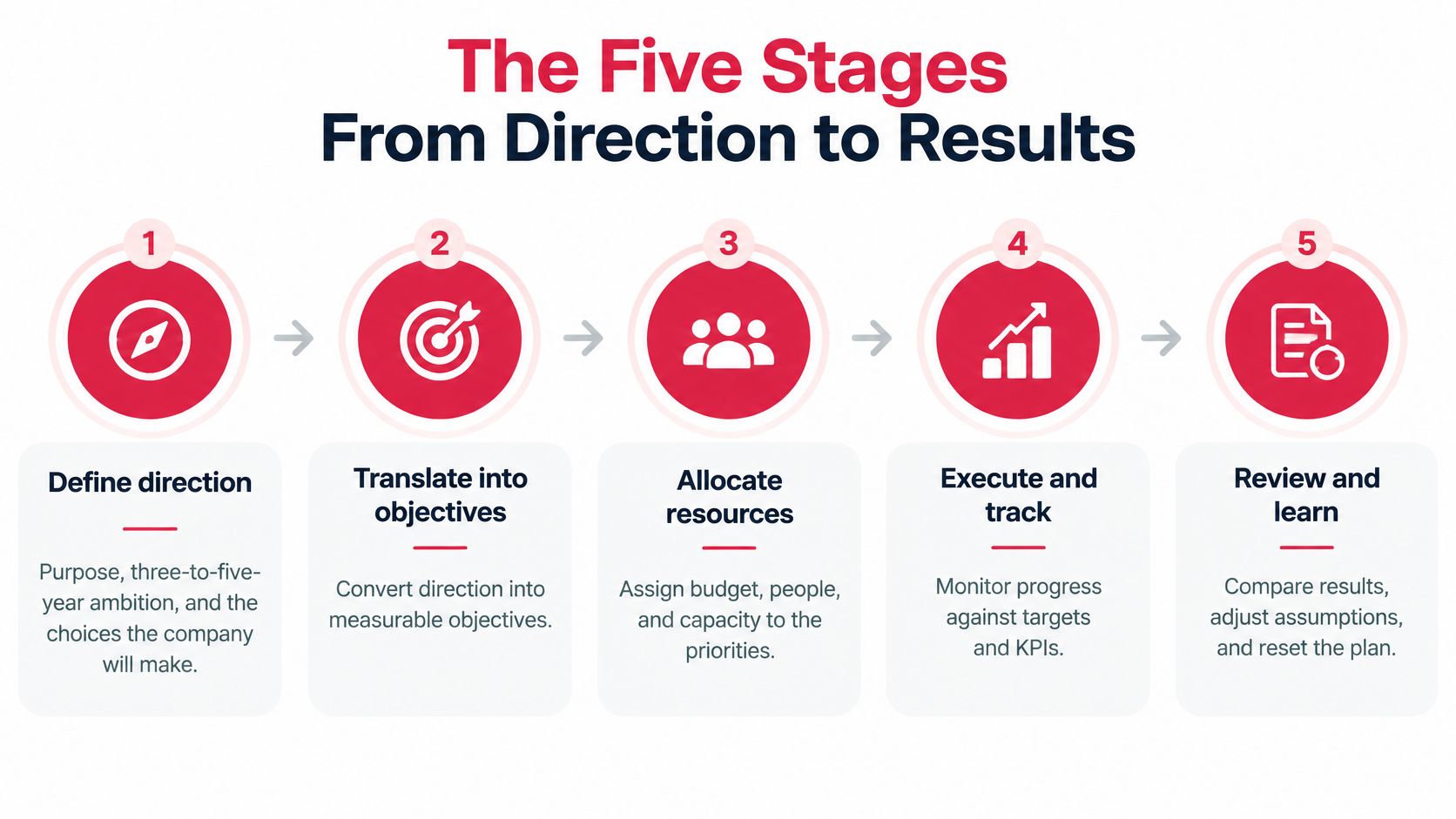
- Define direction. State the purpose, the three-to-five-year ambition and the choices the company will not make. The output is a short direction statement.
- Analyze the environment. Scan markets, competitors, technology and regulation, then run a strengths-and-weaknesses check and a gap analysis. The output is a short list of threats and opportunities.
- Choose priorities. Select three to five initiatives and stop the rest. Each one has a named owner. The output is a priority list people can memorize.
- Allocate resources. Map money, people, capital spending and management time onto those initiatives. The output is a resource map, not a speech.
- Execute. Owners run the work against dated milestones. The output is progress you can see between reviews.
- Measure and revise. Compare results with targets and change funding when assumptions break. The output is a decision, including the decision to stop.
Results feed the next environment scan, so the stages repeat. A plan that never changes funding is a diary.
Why the stages fall apart
Only 11 percent of organizations in the 2025 FP&A Trends Survey said planning was integrated across strategic, financial and operational perspectives. The weakness is usually that split, not a lack of strategy. About 51 percent of organizations in that survey completed scenarios in less than one week, and 61 percent of those faster organizations said they use data in most or all decisions. Nearly four in ten named a lack of dynamic tools as the leading barrier to scenario planning.
A light cadence keeps the loop alive between annual cycles. Hold a short monthly check on the few numbers that would force a choice. Hold a quarterly review that can reopen priorities. Keep one full annual cycle for direction and the budget. Write decision triggers in advance, such as a partner-supply drop or a conversion miss past an agreed range, so a broken assumption reopens the priority list instead of waiting for year end.
Teams that want to sustain business transformation results treat that quarterly review as the moment funding moves, not as a status theatre. Many leadership groups do this work away from the office. A practical corporate retreat planning guide is useful once you know the retreat has to produce owners and a resource shift, not only alignment slides.
A short walk-through of how the stages fit together is easier to see than to memorize from a list.
Who Owns the Plan and Why Plans Stall
A plan with no names is a wish. Split the work so trade-offs have a home.
Ownership works like a relay team: every leg has one runner, and races are lost in the handoffs. The CEO sets direction and settles trade-offs when two good priorities cannot both be fully funded. The CFO or finance lead owns the model, the assumptions and the budget calendar. Business unit heads own initiatives and the numbers attached to them. HR owns workforce and skills plans. Operations and technology own capacity and reliability. The board approves targets and checks progress. If two seats believe they own the same decision, the plan stalls in the gap between them.
Where satisfaction actually comes from
A central job of this system is connecting strategy with decisions about money, people and investment. Many companies miss that link. In a McKinsey survey of 796 executives conducted in 2006, only 45 percent said they were satisfied with their strategic-planning process, while satisfaction reached 79 percent where the formal process played a significant role in developing strategy and just 21 percent where it did not. Respondents at companies without a formal process were more than twice as likely to be dissatisfied: 51 percent, versus 20 percent where a formal process existed.
The money gap did not close with time. Many organizations still struggle to align budgets with strategy, and fewer than two in three fully fund the priorities they have identified.
The mechanism is dull and stubborn. Budgets stay tied to last year's allocations, and nobody is accountable for moving money between priorities. Plans stall in predictable places: when an owner leaves and the seat stays empty, when a review meeting reports numbers it cannot change, and when two functions claim the same decision so neither one makes it. A shared calendar and a nicer dashboard fix none of these. Named owners, active senior-management participation and a reallocation cadence do. Clear OKR rhythms for better leadership decisions help only when a missed objective can change next quarter's spend.
Who can move money from one priority to another this quarter? If the honest answer is "nobody until the annual budget," the plan has already stalled.
How Budgets, Targets and KPIs Connect
Priorities become numbers through value drivers. Volume, price, conversion, utilization, headcount, customer acquisition cost and return on invested capital are the usual bridges. Those drivers set forecast revenue, costs, cash flow and capacity. Common objectives, such as revenue growth, margin, market share, cash generation and the capacity to deliver, each need at least one driver or they stay as slogans.
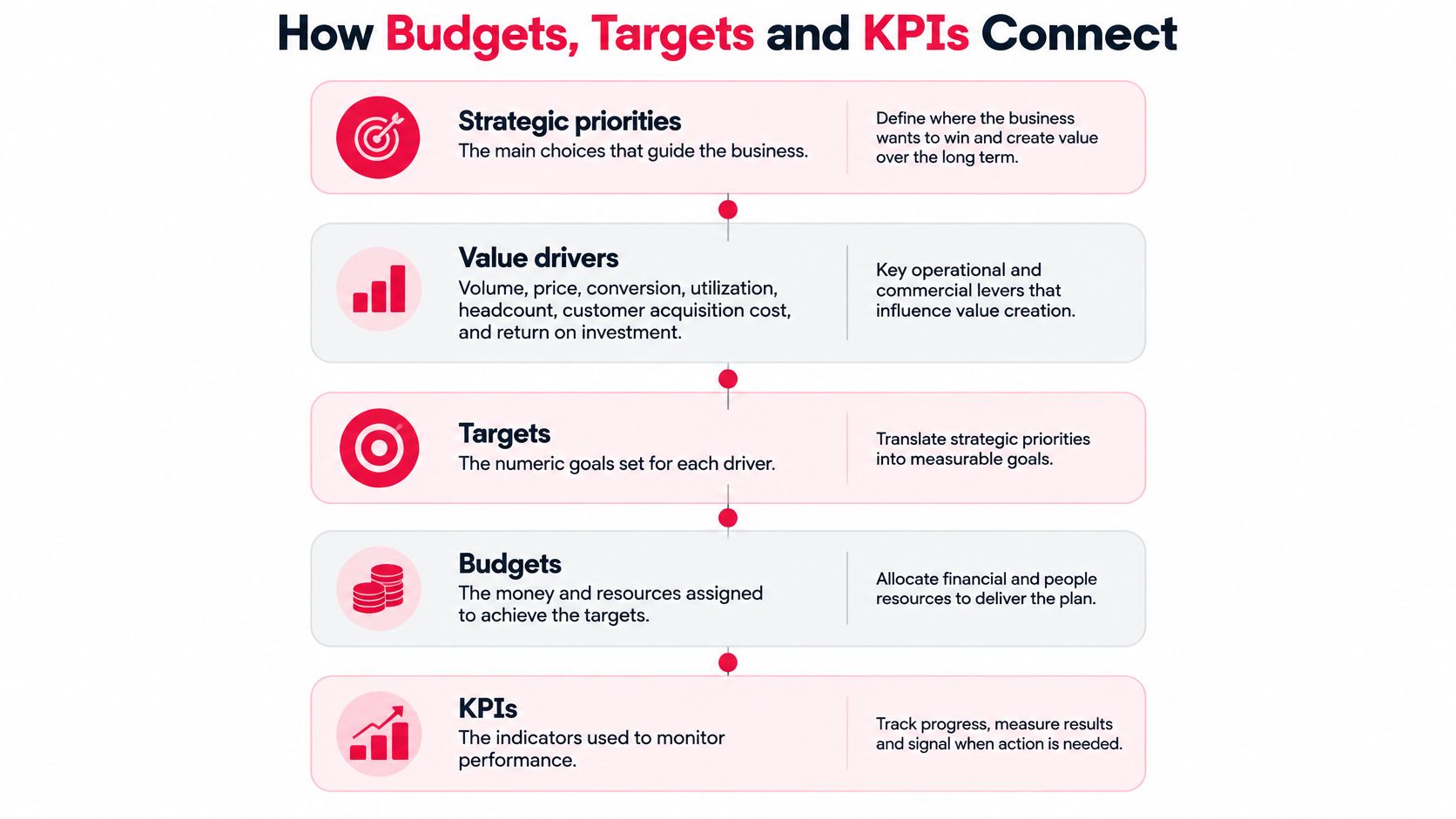
Corporate planning, in the sense McKinsey describes for strategic planning, links a long-range plan to a driver-based model, an annual operating budget, an initiative portfolio, workforce and capital plans, and a performance loop. The annual budget operationalizes the first planning period. Rolling forecasts and scenario analysis test whether the assumptions still hold. The budget that comes out of this is the resource map for roughly the next 12 to 18 months, and it sets the targets that guide behavior and incentives.
A travel business on one page
Say a travel-booking business wants more partner hotels and more repeat guests. Those growth assumptions have to feed supply, payment costs, support capacity and marketing spend. Each assumption needs an owner, a baseline, a sensitivity range and one observable KPI. Then a miss can be traced. Did conversion fall because the product team shipped a broken checkout, or because partner supply in a city dried up? Those are different fixes. Cutting every cost line treats them as the same problem.
| Value Driver | Example KPI | Typical Owner | Review Cadence |
|---|---|---|---|
| Volume | Bookings or units sold per month | Commercial lead | Monthly |
| Conversion | Share of visitors who complete a booking | Product lead | Monthly |
| Customer acquisition cost | Marketing spend divided by new customers | Marketing lead | Monthly |
| Utilization | Share of available capacity that is sold | Operations lead | Monthly |
| Headcount | Staff in post against plan | HR lead | Quarterly |
| Return on invested capital | Operating profit after tax divided by capital employed | CFO | Quarterly |
The review design that separates causes
Use monthly forecasting, a quarterly strategic review, and three cases: downside, base and upside. The monthly pass updates drivers. The quarterly pass decides whether a variance is execution or the market, and whether funding should move. Three cases stop the room from treating the base case as a promise. If the downside still funds the must-do priorities, you have a real plan. If it only works in the upside case, you have a hope.
Planning Offsites, Retreats and Events
An offsite is where planning decisions get made and funded. It is not a social event with a strategy slide at the front. If the group leaves without a budget decision, you paid for a conversation.
| Format | Typical Length | Best Use | Main Budget Driver |
|---|---|---|---|
| Half-day leadership session in the office | 3 to 4 hours | Quarterly reviews and reprioritizing | Room hire and catering |
| One-day offsite near the office | 1 day | Annual targets for one department | Venue and local transport |
| Two-day retreat in another city | 2 days, one night | Company-wide strategy and budget decisions | Flights, hotel rooms, venue and meals |
| Multi-city leadership summit | 3 to 4 days | Global teams aligning across regions | Cross-border travel, visas and several venues |
A two-day sequence that ends in funding
For a company-wide choice, use the two-day shape. Day one reviews last cycle's results, then scans what changed in the market. Day two votes on priorities, then allocates budget to those priorities before anyone leaves. Voting without an allocation is theatre. Allocation without a vote just freezes last year's winners.
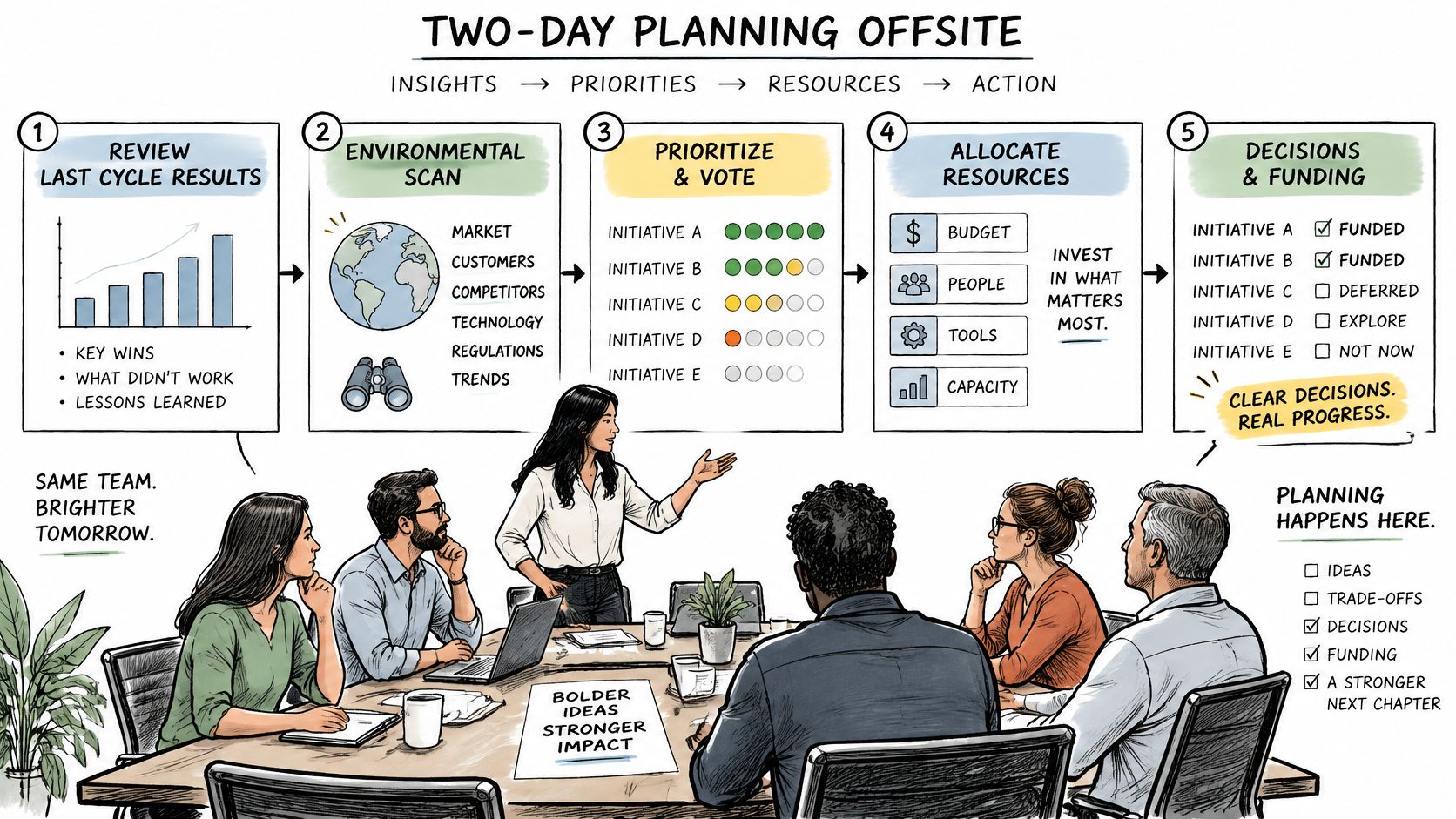
Settle logistics early, or they will eat the agenda.
- Dates: lock them at least three months ahead.
- Rooms: hold a venue and a room block before you debate content.
- Travel policy: write the rules for flights and hotels so people aren't negotiating in the chat.
- Access and food: collect accessibility and dietary needs with the invite.
- Agenda: every session has an owner, a decision and a stop time.
The budget case, and where to hold it
Deloitte's 2025 corporate travel study found that 74 percent of surveyed corporate travel managers reported expanding their travel budgets in 2025, while 10 percent expected cuts. In the same year, 94 percent of business travelers surveyed by SAP Concur and Wakefield Research said business travel was helpful or essential to succeeding in their roles. The survey covered 3,750 travelers across 24 markets. Those figures don't justify a trip by themselves. The case for the event has to be written in decisions made, not days spent. If you can't name the decision, don't book the flights.
Lead with European hubs when the group can meet in one city. Paris and the Île-de-France region received more than 20 million inbound visitors in 2024 and ranked ahead of London, Istanbul and Barcelona on international arrivals, while London recorded the highest number of overnight stays among European cities, according to Statista's city-tourism figures. Barcelona and Lisbon suit shorter formats. Dubai or Doha works when the team is already split across the Middle East and you want one neutral hub. The point of leaving the office is the decision, which is also the plain corporate retreat meaning worth agreeing before anyone picks a hotel.
Confirm the Decision Before You Book
Name the one decision the offsite must make before you talk about cities. It is the budget ceiling, the ranked priorities, or the year's targets. If you can't say which, you aren't ready to book.
- Name the decision and its budget ceiling. Write both in one line. A ceiling stops the room from adding a sixth priority "just for this year."
- Assign an owner to every priority and budget line. A priority without a name will not survive the first month back.
- Pick the format. Match length and location to the decision. A quarterly reprioritization rarely needs a second city. A company-wide funding choice often does.
- Collect participant input before the event. Planning a group trip has three steps: someone picks a city, the group is invited, and everyone votes so a plan appears. Setting up a first trip takes about ninety seconds, and building the plan takes a little longer. A group-planning platform such as MyPerfectStay fits here. One organizer proposes a city, invites the group, and members vote, so travel choices are settled before the sessions begin. The platform handles travel and booking. Planning decisions stay with leadership.
- Confirm dates, budget and attendees in writing. A verbal "we're on" is how room blocks get released.
Walk into the venue with a corporate event planning checklist that already holds five items: the decision list, the budget ceiling, the owner names, the dates and the format. If one of those is blank, you are still planning the meeting, not the company.
MyPerfectStay helps a leadership group pick a city, collect private preferences and vote on the trip before the strategy sessions start, so the offsite time goes to priorities and funding rather than to chat threads. We built it for teams who need the travel settled and the decisions left with the people who own the plan. When you're ready to set the next retreat up that way, visit MyPerfectStay.