Croatia in May: What to Expect Before You Go
November 20, 2026·MyPerfectStay

The usual advice about Croatia in May makes it sound like summer without the crowds. That's the wrong expectation to book around. May works best when you want several kinds of holiday in the same trip, coastal walks, historic cities, food, national parks and, when conditions suit, swimming.
The practical question isn't whether May is a good time to visit. It's whether your chosen base, travel dates and group preferences leave you with a satisfying day when the beach or boat trip doesn't work out.
Table of Contents
- May Weather by Region at a Glance
- Choosing a May Plan That Fits Every Traveler
- Public Holidays That Shift Your May Itinerary
- Crowds and Prices Across the Month
- Island Hopping and Ferries in Early and Late May
- Seasonal Activities and Events Worth Booking
- Plan Your Group's May Trip Before You Book
May Weather by Region at a Glance
| Region | Typical daytime high | Rainy days | Sea temperature |
|---|---|---|---|
| Zagreb (inland) | About 21°C | About 15 | Not applicable |
| Split | About 22°C | About 12 | 18-19°C |
| Dubrovnik | About 22°C | About 10 | 18-19°C |
| Adriatic national average | About 21°C | 12 days with some precipitation | About 18°C |
These are long-term planning averages, not a forecast. Weather2Travel's Croatia climate guide gives national May averages of about 21°C for daytime highs, 8 hours of daily sunshine, 69 mm of rain and 12 days with some precipitation, with Adriatic seawater around 18°C; the regional breakdown distinguishes the coastal bases from inland Zagreb.
Read the table as a way to choose the shape of your holiday. Split and Dubrovnik offer warmer coastal afternoons, but breezes can make a waterfront lunch or boat deck feel cooler than a sheltered street. Zagreb's continental setting makes an evening layer more important, even when daytime sightseeing feels comfortable.
Choose your base for the day you actually want
Split makes sense if you want to combine city walking with coastal excursions. Keep your accommodation convenient for both the old town and your departure point, rather than choosing solely for beach access.
Dubrovnik suits travelers who want historic sightseeing and sea views within the same stay. Don't interpret its comparatively drier profile as permission to fill every day with exposed outdoor activities.
Zagreb is the better fit when museums, cafés and urban exploration matter more than swimming. Its inland weather profile calls for a more deliberate mix of indoor and outdoor stops.
Practical rule: Air temperature tells you what to wear while sightseeing. Sea temperature tells you whether swimming belongs in the shared itinerary at all.
Rain needn't mean a lost day. May showers can be intermittent, so a dry morning may give way to a wet afternoon rather than continuous rain throughout your stay. Put walks and weather-sensitive excursions earlier in the day where practical, but let the short-range forecast override that default.
The sea remains cool early in the month and generally becomes more inviting toward late May. Pack a light waterproof layer, comfortable shoes with grip and something warm for evenings. Choose May for sightseeing and active travel first, with beach time as an opportunity rather than a promise.
Choosing a May Plan That Fits Every Traveler
May isn't one consistent Croatian season. Croatia Atlas's guide to when to visit puts Zagreb around 21°C with roughly 15 rainy days, Split and Dubrovnik around 22°C with approximately 12 and 10 rainy days, respectively, and coastal water around 18-19°C. Those differences matter most when travelers disagree about what counts as a good holiday.
Start by making those preferences visible before anyone books.

A hybrid itinerary usually works better than a beach-only plan. Late May may suit confident swimmers, while families, older travelers and anyone expecting warm-water lounging need activities that don't depend on entering the sea. Age alone doesn't determine suitability, so ask about cold tolerance, mobility and enthusiasm rather than making assumptions.
| Group type | Best-fit activities | Swimming suitability | Backup option |
|---|---|---|---|
| Confident swimmers | Coastal swims, boat days | Good in late May if comfortable with the cool water described above | Shore walks and suitable cliff paths |
| Families with children | Boat trips, national park visits | Short, supervised sessions in sheltered shallow bays if conditions suit | Museum and food tours |
| Older or less mobile travelers | Accessible walking tours, wine and olive-oil visits | Low priority unless specifically requested | Café-based sightseeing |
| Mixed friend groups | Split day with optional swimming, then culture | Optional | Indoor cultural programme |
Find the overlap without forcing unanimity
Ask each traveler to rank swimming, sunshine certainty, walking, nightlife and flexibility using the same simple scale. Build the shared day around overlapping preferences. Where priorities diverge, arrange separate options with an agreed meeting place rather than making everyone negotiate again that morning.
For a hypothetical six-person friend group, two might want swimming, two wine and walking, and two a national park day. A morning coastal swim with an alternative shore walk, an afternoon olive-oil visit and a shared dinner can satisfy much of that mix. Give the park enthusiasts a dedicated outing elsewhere in the itinerary rather than pretending a tasting replaces their priority.
Use this video as a visual prompt while discussing what appeals to the group.
If the base city is still undecided, compare Dubrovnik versus Split against those preferences before choosing accommodation. May's advantage is activity diversity, not guaranteed summer conditions, so protect everyone's enjoyment with options rather than a single anchor activity.
Public Holidays That Shift Your May Itinerary
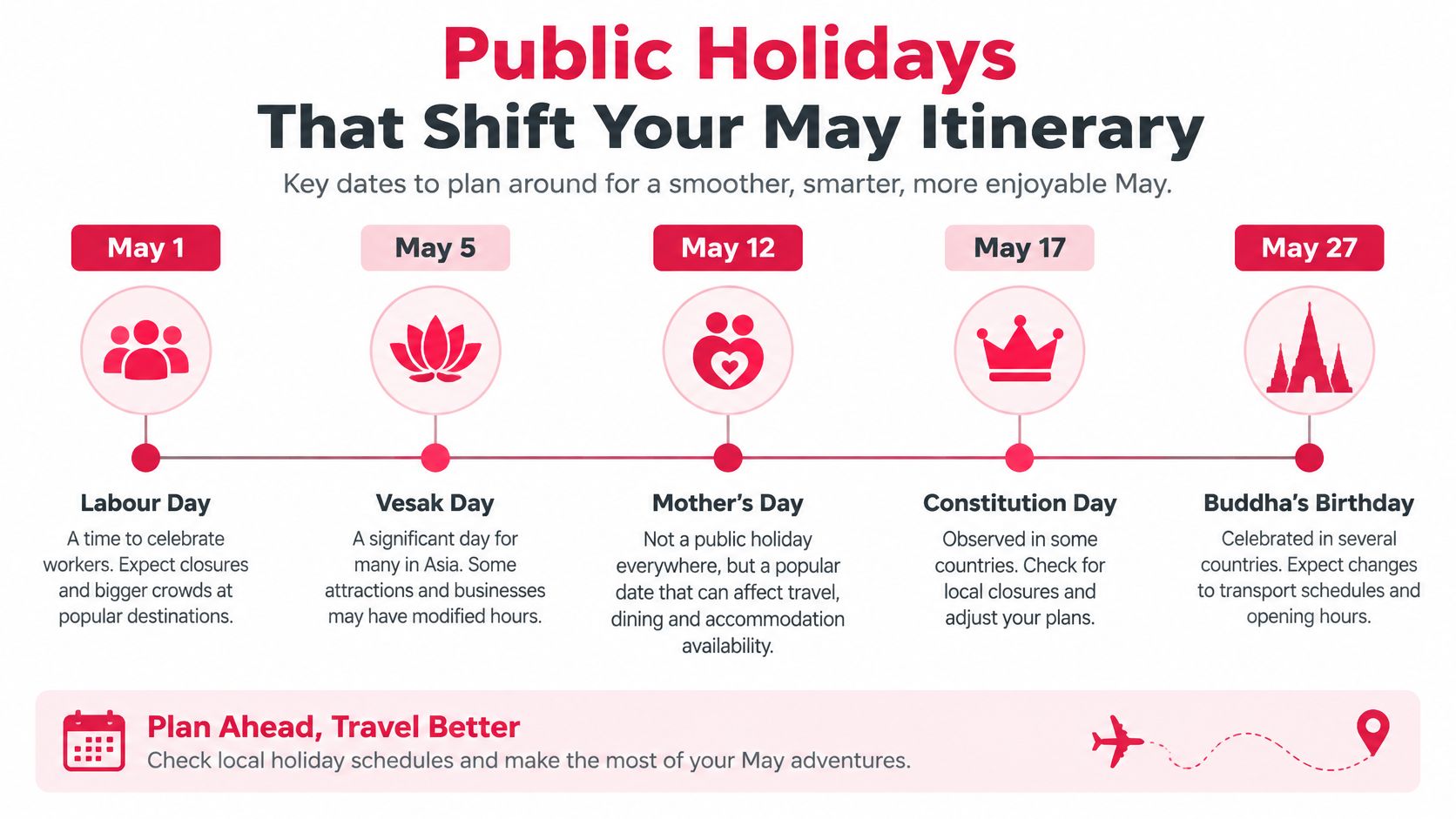
1 May is International Workers' Day and 30 May is Statehood Day, both listed among Croatia's statutory holidays by the Croatian National Tourist Board. International Workers' Day, locally called Praznik rada, is an official non-working day across Croatia, as confirmed by the Croatian Ministry of Foreign Affairs holiday calendar.
Public institutions, banks and some businesses may follow holiday schedules. Opening hours can differ particularly in places where tourism isn't the main source of income, so a normal weekday listing isn't enough to confirm access.
Check the whole day, not just the attraction
- Mark arrival and departure days. Check whether transfers, luggage storage or essential errands fall on or beside a holiday.
- Reserve the activities you care about. Book museum slots, restaurant tables and excursions in advance where reservations are available. Confirm that the booking applies to holiday opening hours.
- Verify the connection. Check the transport service and ticket office separately. A running service doesn't necessarily mean every sales counter operates normally.
- Move errands earlier. Handle shopping, banking needs and other practical tasks the day before rather than between tightly timed activities.
A restaurant reservation doesn't confirm that a nearby museum will open. Verify each venue independently through its current calendar or direct confirmation, and save the answer with the booking details so the organizer isn't searching through messages outside a locked door.
Keep a substitute activity on the same day's list, not buried in a general collection of ideas.
For each holiday, aim to finish with one checked calendar and two backup bookings or reservation-ready alternatives. Prefer cancellable alternatives, and don't hold duplicate non-refundable reservations. If a booked venue closes, replace that stop without rebuilding the entire day.
Crowds and Prices Across the Month
May is a meaningful tourism month, not an empty interval before summer. Croatia's official statistical release for May 2024 recorded 1.9 million arrivals and 6.9 million overnight stays in commercial accommodation, up 19.6% and 23.9% respectively from May 2023; international arrivals rose 20.8%, international nights rose 25.6%, Germany supplied more than a third of foreign nights, and domestic visitors contributed 283,000 arrivals and 619,000 nights.
That is substantial demand before peak summer. These figures cover commercial accommodation only, not every visitor, excursion passenger or person walking through a historic centre. They show a busy shoulder season; they cannot tell you how crowded a particular street will feel.
Year-to-year changes also argue against assuming a fixed pattern. The Croatian Bureau of Statistics' May 2023 release recorded arrivals 31.9% above May 2022, which shows how sharply demand can move between comparable months.
Book scarcity, not the whole itinerary
Treat weekends and public holidays as the dates most likely to put pressure on your preferred restaurant, museum slot or boat departure. Reserve the experiences the group would be disappointed to miss, and leave ordinary sightseeing flexible.
- Compare departure times. Check early-morning and late-afternoon availability rather than accepting the most obvious midday slot.
- Protect shared meals. A group needs a suitable table, not merely a restaurant with space for an individual walk-in.
- Compare total costs. Include transfers, luggage, cancellation terms and extra accommodation nights when judging an apparent bargain.
Prices vary by date and location, so a blanket claim that May is cheap is hard to rely on. Compare live quotes for your exact dates, and do not assume a quieter early-month island stay offsets awkward transport.
May is generally less crowded than July and August, but it isn't empty. Booking the busiest experiences early protects the plan without turning every hour into a commitment, and it leaves room to choose activities based on the conditions you get.
Island Hopping and Ferries in Early and Late May
Island hopping isn't automatically easy just because it's May. Packzup's Croatia in May guide notes that summer timetables may not begin until the final week of May, with thinner earlier services and late-month changes affecting routes such as Hvar and Vis.
The trade-off is practical. Early May can offer quieter island stays but fewer departures to recover from a missed connection. Late May may offer fuller schedules, although you shouldn't assume every route has reached peak-season frequency.
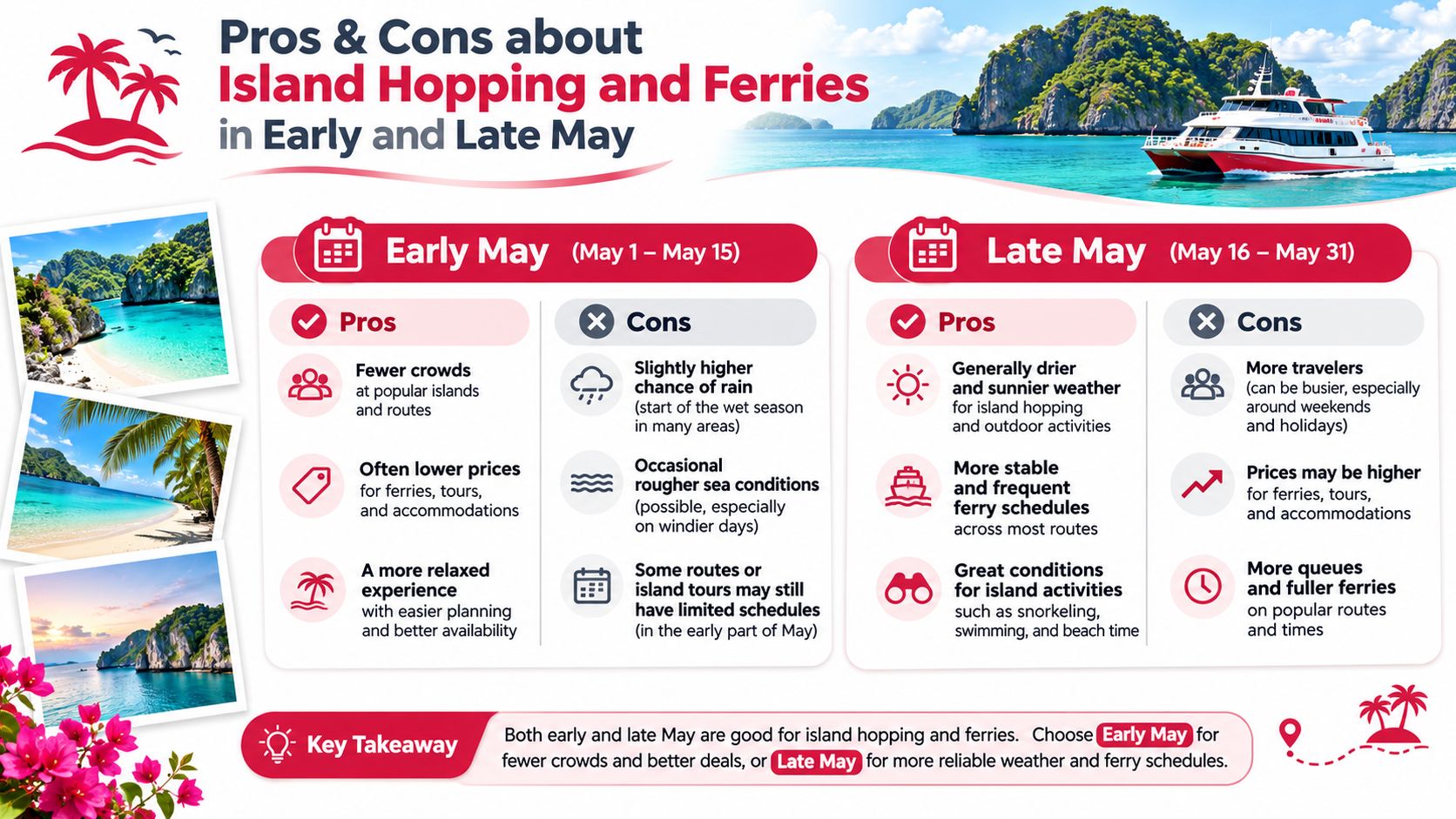
Fast passenger catamarans can be more exposed to weather-related cancellations than car ferries. That doesn't make a car ferry cancellation-proof, or interchangeable with a catamaran: check the actual arrival port, onward transfer and whether the sailing accepts vehicles.
Build a route that can survive a missed crossing
- Use the published timetable for your exact dates. Check direction, operating days and arrival port. A route appearing on a map doesn't establish a usable connection.
- Limit the island sequence. I'd avoid chaining more than two islands into a week-long trip. Each additional move creates another dependency between accommodation and transport.
- Keep a mainland buffer. Stay on the mainland before your outward crossing, and return there before a fixed flight rather than relying on a same-day island connection.
- Choose flexible tickets where available. Read the change conditions before paying. Flexibility helps with rebooking, but it doesn't create seats on a full alternative service.
- Prefer crossings before midday when the timetable allows. This leaves more recovery time if plans change. It's a scheduling buffer, not a guarantee of calmer weather.
For families comparing Mediterranean itineraries, the family vacation in Greece guide can help frame the broader choice between a settled base and repeated island transfers. Don't carry assumptions about another country's ferry network into Croatia.
For fixed-flight trips: Make the mainland your secure base and treat island days as optional excursions, not essential links in the journey home.
A missed boat can affect everyone's rooms, meals and excursions. Choose fewer well-supported crossings over an ambitious route that works only if every departure runs exactly as planned.
Seasonal Activities and Events Worth Booking
A useful May day starts with a clear outdoor purpose and ends without anyone feeling they've spent it chasing the weather. Say your group is staying in Split: begin with a historic old-town walking tour, leave room for lunch, then choose an afternoon activity that still works if showers arrive.
In Dubrovnik, use the same logic without copying the same itinerary. Match the walking route to the group's stamina, and keep a museum or church visit available for a wet morning. For less mobile travelers, confirm steps, seating and walking surfaces before booking a tour described merely as easy.
Match the outing to a workable substitute
| Main activity | What to check before booking | Indoor or lower-effort substitute |
|---|---|---|
| Plitvice Lakes or Krka visit | Transport, walking route, current access and footwear needs | Museum visit or a cooking class near your base |
| Cycling on flat coastal roads or inland valleys | Traffic exposure, gradients and the return route | Tasting room or indoor cultural visit |
| Dalmatian seafood, local cheese and cured-meat tasting | Dietary needs and whether seating is sheltered | Covered market lunch where available |
| Wine and olive-oil visits in Istria or Dalmatia | Appointment, transport and non-drinking options | Hosted tasting in town |
| Coastal boat excursion | Cancellation terms, boarding arrangements and exposure | Cooking class or shore-based food tour |
A national park visit deserves its own day rather than being squeezed between a morning city tour and dinner across the region. Choose Plitvice Lakes or Krka according to your route, not because both names appear on a wish list.
For cycling, don't confuse a coastal route with a flat route. Inspect the elevation profile and ask how the group returns if someone becomes tired. For food visits, a sheltered tasting can be the main event rather than a consolation prize.
Book events only after the calendar is confirmed
Festivals and local celebrations change by town and year. Only build a day around an event once the local tourist calendar confirms it for your travel year, and check whether it overlaps a public holiday before arranging transport.
Use two daily anchors, one outdoor and one flexible. Reserve weather-sensitive activities first with clear cancellation terms, then fit flexible experiences around them.
Plan Your Group's May Trip Before You Book
Turn the shortlist into decisions before making non-refundable payments. Keep the booking sequence visible to everyone so accommodation, activities and transport aren't chosen independently.
- Choose the base. Match the regional weather profile to the group's preferred kind of day.
- Validate the dates. Confirm holiday opening arrangements and exact ferry schedules before approving the route.
- Assign each day a direction. Decide whether it's beach-first or culture-first rather than leaving that debate until breakfast.
- Build a compact shortlist. Keep two outdoor and two indoor options for each day, with location and cancellation terms attached.
- Release bookings in order. Lock the weather-sensitive and holiday-sensitive experiences first, then fill the remaining gaps.
Use a shared planning session to resolve genuine disagreements, not just collect more suggestions.

Agree before anyone pays
Each traveler should answer a short survey about budget, interests, energy level and must-see ideas. MyPerfectStay gathers those preferences so the group can compare options and identify overlap without relying on whoever writes most often in the chat.
Use this guide to organize a trip to give the organizer a clear process. Once activities are agreed, HYDAWAY's packing tips for Europe trip offers a useful packing reference alongside your Croatia-specific layers and walking gear.
Share the survey with the group this week, and set a voting deadline before booking ferries or the first day's excursions.
MyPerfectStay helps groups collect private travel preferences, compare activities and agree on a shared itinerary. Use it to find the overlap between Croatia's coastal outings, cultural visits and flexible May alternatives, then set a decision deadline before committing to bookings.