Offsite Agenda Template for Hybrid Teams
November 13, 2026·MyPerfectStay
42% of meeting planners surveyed by the Global Business Travel Association in 2024 reported that internal meetings and client or customer advisory boards would experience higher volumes (Business Travel News Europe). More internal gatherings are coming. Most of them will arrive with an agenda that lists topics and hands out times.
A list of topics produces a day that feels busy and a follow-up email that says "great discussion, next steps to follow." A workable offsite agenda template is a different object altogether: a sequence of decision questions, each with a named owner, a method, a timebox, and an artifact that exists on paper before the room moves on.
I would rather run a five-hour day that ends with four written decisions than a two-day retreat that ends with a good mood and no record of what changed. What follows is the timed spine, the build sequence, the roles, the hybrid and multi-day shapes, and the way a European or MENA destination reshapes the clock without turning the offsite into a tour.
Table of Contents
- One-Day Offsite Agenda Template With Timed Blocks
- How to Build the Agenda Before the Offsite
- Roles and Preparation for Every Session
- Hybrid and Multi-Day Formats That Protect Decisions
- Sample Offsite Clocks in Europe and MENA
- Send the Agenda and Book the Optional Block
One-Day Offsite Agenda Template With Timed Blocks
Meeting time is often poorly used, and remote meetings can be less effective still, according to MIT Sloan Management Review's analysis of remote meeting effectiveness. A practical response is to frame each agenda item as a question the group must answer. The question clarifies why people are in the room and what the session must produce.
The one-day spine
Copy the table, add the date, and assign an owner to each question. The timings suit a twelve-person leadership team meeting in Paris, Lisbon or Dubai.
| Block | Minutes | Question to resolve | Recorded output |
|---|---|---|---|
| Objectives and working agreements | 15 | What will we decide today, and how? | Working agreements |
| Shared facts | 45 | What evidence does everyone accept before we debate? | One-page fact sheet |
| Diagnosis | 60 | What is causing the gap? | Problem statement |
| Break | 15 | What should we reset before continuing? | Rest and reset |
| Option generation | 75 | Which options are worth comparing? | Option list with owners |
| Prioritization | 60 | What ranks first, and what is deferred? | Ranked list |
| Implementation planning | 45 | Who does what by when, and what depends on it? | Owner-date pairs and dependencies |
| Commitments | 30 | What will we tell the rest of the company? | Decision log |
The blocks total 345 minutes, including the 15-minute break, or 330 working minutes. That is five and a half hours of work, leaving room for lunch, two additional breaks and some overrun when a disagreement needs resolution.
Use the opening 15 minutes to agree how the group will work. Write the rules on a flipchart: phones away, one conversation at a time, and dissent is useful evidence. Keep the shared-facts block out of presentation mode. Give everyone the same one-page data sheet and time to read it before discussion starts.
Where equal time goes wrong
Equal time for every topic gives low-stakes updates the same weight as a consequential budget decision. Give the largest blocks to decisions with the greatest financial impact or disagreement. Send routine updates as a pre-read, no more than three pages, and use the meeting to address what changed or remains unresolved.
Practical rule: If a topic needs no discussion, it does not need a meeting slot.
The facilitator audit
Before sending the agenda, check that each line names an action: decide, rank, test, assign or resolve. Replace vague items such as “discuss,” “brainstorm” or “align” with a question and a concrete output. If the group cannot say what it will record before leaving the block, revise the block.
The schedule only works if someone owns the clock and the outputs. Start on time, protect the decision blocks, and record changes when a discussion runs long. The commitments block then gives the team a decision log to share with colleagues who were not in the room, including those who need to plan a town hall across shifts.
How to Build the Agenda Before the Offsite
The order of work matters more than the format. Teams that start with the venue end up decorating a schedule. Teams that start with the decision end up with a day.
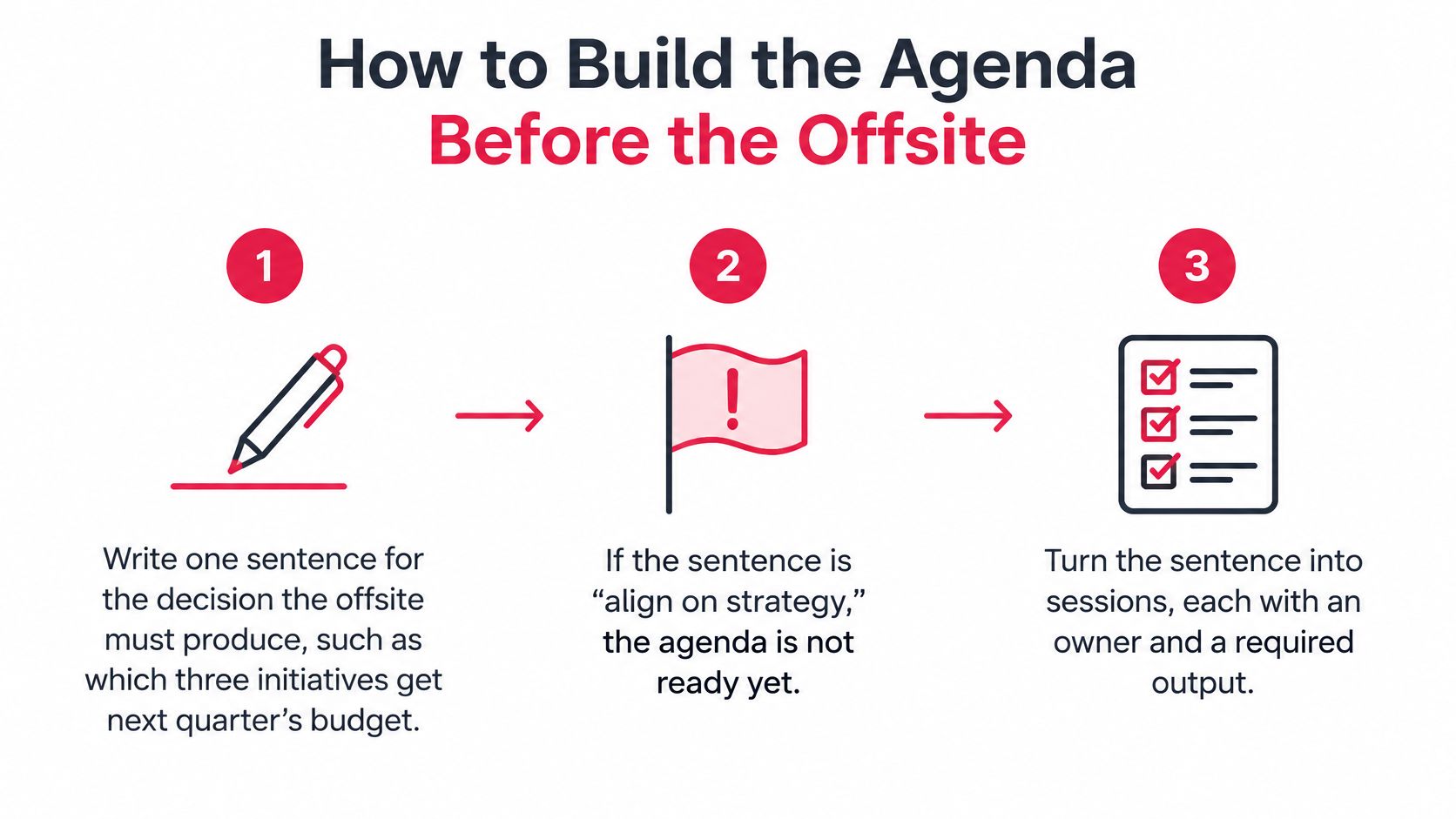
Seven steps from a sentence to a timetable
- Write one sentence naming the decision the offsite must produce. Not "align on strategy." Something closer to "choose the three initiatives that get next quarter's budget." If the sentence won't come, the offsite isn't ready to be scheduled.
- Collect anonymous input two weeks out. Ask for priorities, risks, the dissent nobody says aloud, and the outcome each person wants. Then publish a single page showing which session each input maps to. People who see their concern on the page prepare. People who don't, disengage.
- Split decisions from updates. Decisions stay in the room. Status becomes a pre-read of no more than three pages. The usual slip is a 25-minute "where we are" session that eats the first hour and the group's patience.
- Draft each block as a question with a verb. For every block, specify the decision owner, the pre-read, the method (silent writing, then pairs, then plenary), the timebox, the decision rule (consent, ranked vote, or the owner decides after hearing input), and the artifact.
- Place the spine in the calendar and protect it. A break roughly every 90 minutes, and a lunch that is a break rather than a working session with food.
- Run the verb audit and cut. Anything that only says discuss, brainstorm or align is rewritten or removed.
- Send it five to seven days ahead with the pre-read and one sentence defining "prepared." I ask for two numbers they'd defend and one thing they're worried about.
If you'd rather watch the build than read it, this walkthrough runs the same sequence from purpose sentence to timed blocks.
The evidence for sending it early holds up. In a 2009 study of 292 employees, both working through an agenda and receiving a written agenda in advance predicted higher perceived meeting effectiveness, with standardized coefficients of β = 0.31 and β = 0.28 respectively, as summarised in this review of the meeting-agenda research. Harvard Business School's preliminary experiment with 200 full-time employees found that participants who imagined preparing an agenda felt 21% more prepared and expected their meetings to be 11 to 12% more efficient and productive than those who imagined the same preparation without one.
The same body of work is honest about limits. Agenda effects turn inconsistent when meetings start late, run over, or ignore the document once it's sent. The template structures the discussion. It doesn't guarantee a punctual start.
If the offsite sits inside an annual cycle, what corporate planning covers is worth reading before you argue about which decisions belong in the room. For a second opinion on sequencing, browse offsite agenda planning steps that other facilitators have used.
Roles and Preparation for Every Session
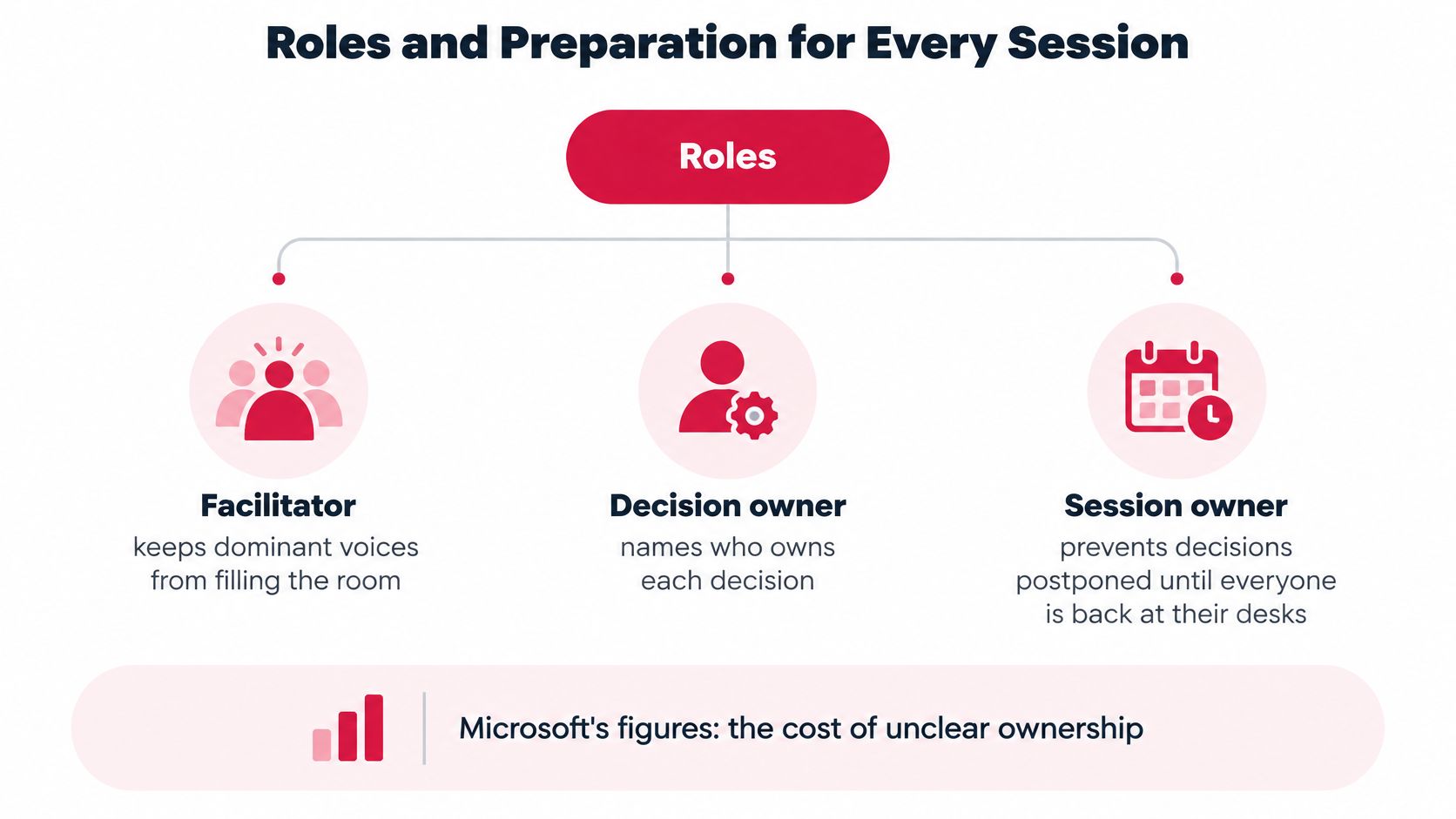
Microsoft reports that 55% of people find next steps unclear at meeting endings and 56% find it difficult to summarize what happened, which is exactly the gap the team-effectiveness guidance from Google's re:Work addresses when it ranks structure and clarity directly behind psychological safety. Those two numbers describe what happens when nobody owns the close of a block.
Roles exist to prevent three specific failures: dominant voices filling the room, unclear ownership of a decision, and decisions postponed until everyone is back at their desks. None of them get fixed by a team-building hour on day two.
Six roles for a group of eight to twenty people
| Role | Before | During | After |
|---|---|---|---|
| Facilitator | Verb audit and agenda sent 5 to 7 days out | Holds timeboxes and invites quieter voices | Confirms every block has an artifact |
| Decision owner | Options and the decision rule | States the call and the dissent | Owns the outcome past the retreat |
| Scribe | Blank decision-log template | Records decision, owner, deadline, dependency, channel | Circulates the log within 24 hours |
| Timekeeper | Flags blocks longer than 75 minutes | Five-minute warnings | Parks overruns for async work |
| Remote buddy | Access test and caption check | Reads chat into the room | Confirms remote people heard the decision |
| Experience lead | Dietary, prayer, access, and a quiet room | Keeps social time optional | Does not let an activity replace a decision |
The remote buddy and the experience lead are the two roles people forget, and they're the two that decide whether the day works for everyone who isn't standing at the whiteboard. One speaks for the people on laptops so the room can't outvote them by volume.
Participation rules, not an icebreaker hour
Google's study of more than 180 teams identified psychological safety as the most important team-effectiveness dynamic, followed by structure and clarity, and teams with strong psychological safety were rated effective twice as often by executives. Google also reported that adopting a new group norm raised psychological-safety ratings by 6% and structure-and-clarity ratings by 10%.
Build that into the operating rules rather than a separate session. Silent writing before any open discussion. A round-robin on the first pass so the fastest talker isn't automatically the framing. Breakouts of three or four for the messy middle. And at least one recorded alternative or dissenting view attached to every major decision.
The order is the safety: write first, pair second, argue third. By the time the plenary starts, the quietest person in the room has already contributed in writing.
Three checkpoints to hold the day together
- Full input: 100% of invitees answer the pre-offsite input. Chase the last two personally.
- Recorded dissent: every major decision carries at least one alternative view in the log.
- Names and dates: every commitment leaves with an owner and a deadline, no exceptions on the way to dinner.
If you want the collaboration habits to survive past the retreat, a reference on cross-team rituals, roles and metrics helps the facilitator hand the practice back to the teams rather than keeping it in the room.
Hybrid and Multi-Day Formats That Protect Decisions
A polished schedule can still fail if nobody names the decision each block must produce. For hybrid teams, decide who participates, how they contribute, and where the outcome is recorded before the offsite begins.
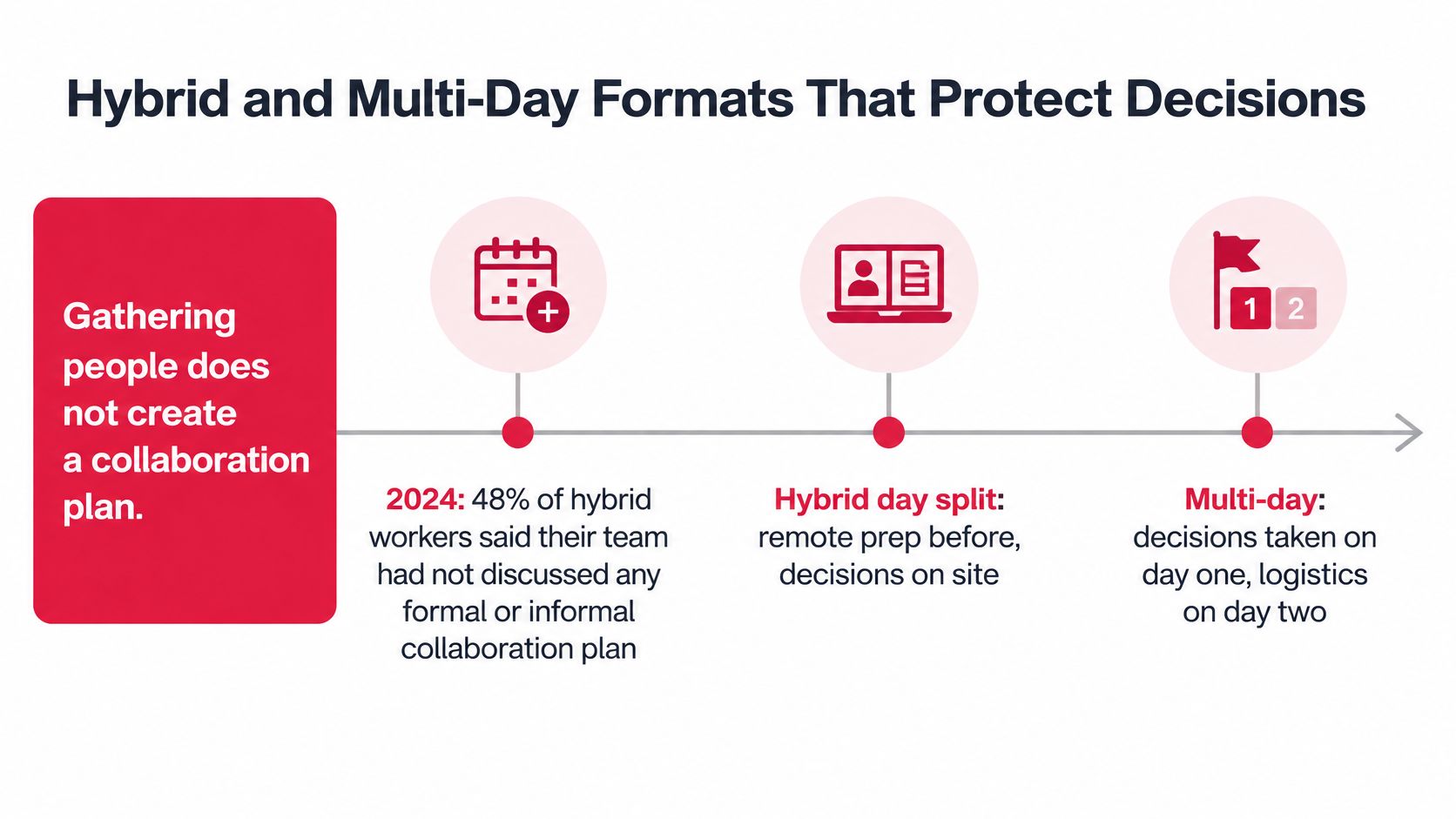
Many remote companies organize whole-company offsites. Connect the event to Monday's work by giving each decision a named owner, a participation method, and a written output.
Label every decision before you book anything
Mark each draft-agenda decision as in-room, hybrid, or async. Give in-room decisions the largest blocks and strongest morning energy. Async decisions need no live session: assign an owner and deadline for the written work.
For hybrid decisions, name a remote buddy before invitations go out. Turn captions on by default, and use camera-on only during decision moments. Send pre-reads so remote participants can review the facts before the session. The day before, run a 20-minute access test with the actual room, screen, and account.
The two-day shape
Give the two-day format a distinct purpose: Day 1 settles strategic choices; Day 2 turns them into implementation steps, risk responses, and owners.
| When | Block | Minutes or rule | Output |
|---|---|---|---|
| Arrival evening | Optional welcome, alcohol-free default | No decisions | None |
| Day 1 morning | Hard strategic decisions from the one-day spine | Largest blocks on money or disagreement | Ranked list or decision |
| Day 1 afternoon | One shared experience | Optional, and only after the ranked list | Not a substitute for the log |
| Day 2 morning | Implementation, risks, and owners | Break about every 90 minutes | Owner-date pairs and dependencies |
| Day 2 close | Commitments and the message to the company | 30 | Decision log |
| Each full day | Unscheduled time | At least 90 minutes | Recovery, not a hidden workshop |
| Before booking | Label each decision | In-room only, hybrid, or async | Named participation method |
| Day before | Remote access test | 20 | Captions, remote buddy, camera-on only for decisions |
Keep the strategic blocks on Day 1, when the group has energy for disagreement and hard calls. Day 2 is for turning decisions into accountable work. Protect the unscheduled time; otherwise, a multi-day agenda can become a longer workshop.
The inclusion checkpoint that comes before the deposit
The University of Glasgow neurodiversity resource hub recommends sharing agendas and materials in advance, allowing breaks, asking about communication preferences, and permitting sensory or fidget tools. Put those needs into the venue checklist: a quiet room, timed breaks, early circulation of materials, prayer windows where needed, and dietary and mobility notes collected before booking.
Participation does not require identical behaviour. Use silent idea generation and structured turn-taking alongside open discussion. Make social activities optional, and keep breaks free of networking expectations so people can recover.
Agree the decision rule in writing before the session. A short guide to what consensus decision making involves can help the group choose how it will resolve disagreement. Send a confidential preferences note with the agenda, before anyone has to raise an access need in the room.
Sample Offsite Clocks in Europe and MENA
The spine survives the flight. What changes is where the hard block sits, when the group eats, and how far the optional social block is allowed to travel from the venue. Keep the decisions fixed and move the logistics around them.
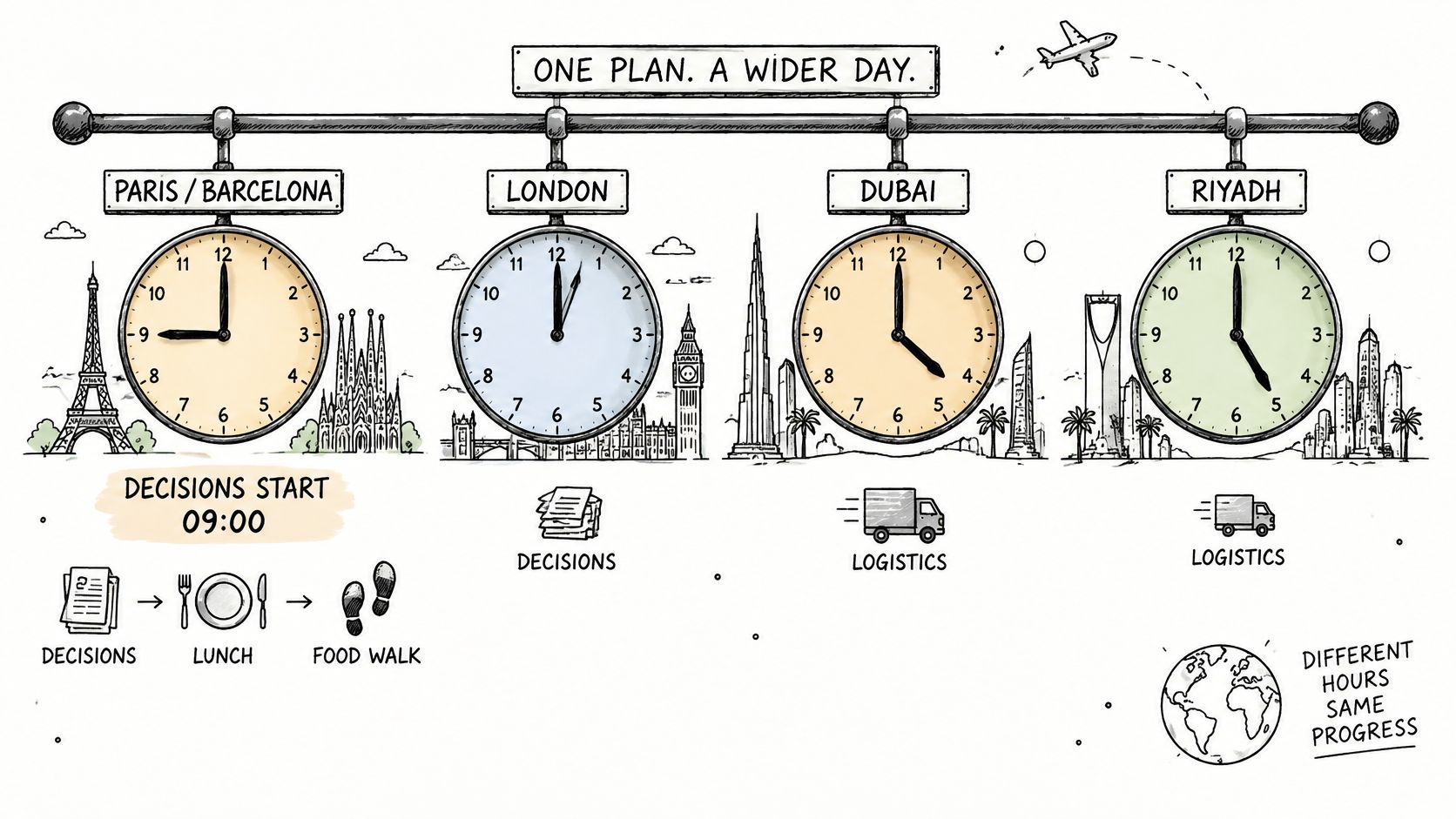
- Paris or Barcelona. Decisions start at 09:00 sharp. Lunch is a real break away from the table. The neighbourhood food walk happens only after the ranked list exists, so nobody is choosing between a decision and a tasting.
- Rome or Lisbon. If the group flew overnight, shorten the morning and run diagnosis before a long lunch. Close commitments before anyone leaves for the evening, because half the room will be gone by then.
- Vienna or Amsterdam. Use the one-day spine for a leadership team that can't stay over, and cut the shared experience entirely if the decision log is still unfinished at 16:00.
- Dubai or Abu Dhabi. Put the hardest block in late morning, keep early afternoon indoors, and print prayer times on the agenda instead of hoping a break lands on them.
- Marrakech. Hold facts and diagnosis in a courtyard workshop, and allow an optional afternoon outside the medina only after owners and dates are named.
The scale behind those choices is measurable rather than atmospheric. Eurostat reported that in 2024 Mallorca recorded 55.3 million nights in tourist accommodation, while Rome, Paris and Barcelona each passed 40.0 million nights (Eurostat regional tourism statistics). Those figures measure nights in tourist accommodation, so treat them as a proxy for bed capacity and venue pressure, not offsite demand. They still tell you something practical: in a high-volume city, book the room early and don't plan a 20-person rooftop dinner on three weeks' notice.
Business travel into the region is moving in the same direction. International business trips from Europe to Germany rose 7.7% year over year in 2024, from 11.1 million to 11.9 million trips, according to IPK International for the German National Tourist Board and German Convention Bureau (GCB).
That's the argument for leading with European and MENA cities rather than defaulting elsewhere: the logistics are dense, the venues are reachable, and a shared experience can be a 90-minute decision instead of a full-day excursion. The experience stays one optional block. It never replaces the decision log.
Send the Agenda and Book the Optional Block
Send three files together once every block has an owner and an artifact: the one-page agenda of questions and timeboxes, the pre-read of no more than three pages, and the six-role list with names in it. One email, one version, no attachments named "final_v3".
Ask each person to reply with the one decision they must leave with, plus any access, dietary, prayer or sensory note. Treat silence as not ready to travel and chase it individually. A missing reply isn't shyness; it's one more person who will arrive unprepared and vote late.
After the offsite, the success measure is the scribe's decision log circulated within 24 hours with the decision, owner, deadline, dependency and channel. Not the group photos. If the log is late, the retreat didn't finish.
Book the optional shared experience only after the owners are named. Pick one city already on the agenda, one window that doesn't collide with the commitment block, and one activity the group chose: a Lisbon food tasting, a Paris museum slot, a Dubai desert outing. Keep alcohol-free as the default and mark the block optional in writing.
The same three questions decide the social block as decide the trip: where, roughly when, and who's coming. Our planner starts a trip that way, then the group votes on activities and a plan appears, which takes about ninety seconds to set up and a little longer to build. If the retreat is still at concept stage, business retreats planning guidance covers the venue and budget layer before you commit to anything.
The last action is concrete. Copy the one-day table, name the six roles, and send the pack five to seven days before anyone boards a flight to Barcelona, Rome or Marrakech.
MyPerfectStay turns the social half of an offsite into a decision the group makes quickly: private preference surveys, activity voting with match scores, and one checkout for the whole team. Once the decisions are logged and the owners are named, invite the group, let them vote on the shared experience, and lock it. Visit MyPerfectStay to build the itinerary that sits around your agenda.